
Pulp Fiction, 1886 · page 7 of 32
Beadle's Dime Library No. 384 — page 7: what you’re looking at
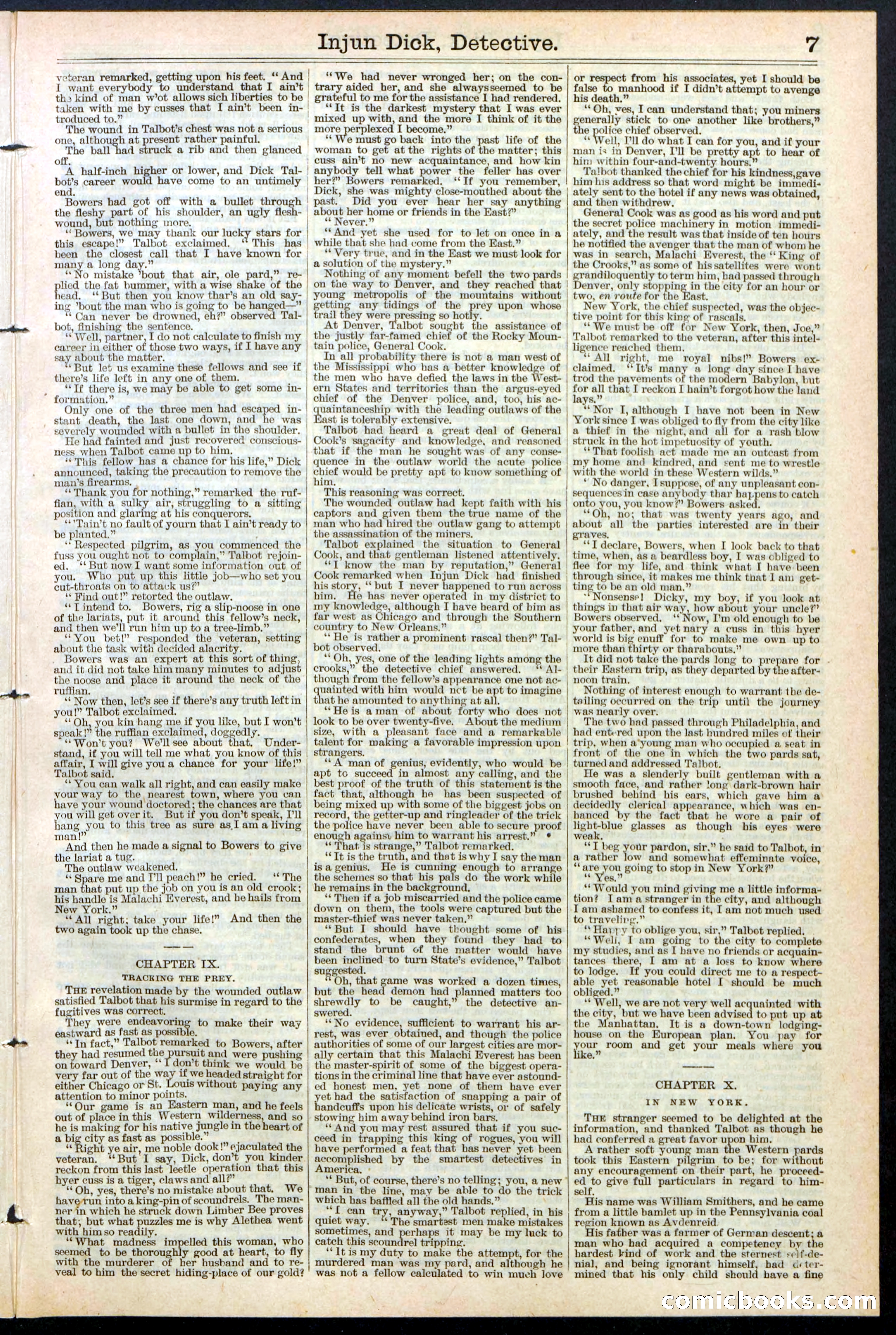
A restored page from Pulp Fiction, 1886. Page through the whole issue in the reader above.
📄 Transcribed text from this page (OCR, searchable)
Machine-transcribed from the original scan — historical spelling and the odd misread are preserved.
veteran remarked, getting upon his feet. ‘‘ And | I want everybody to understand that I ain’t thea kind of man w’ot allows sich liberties to be taken with me by cusses that I ain’t been in- troduced to.” The wound in Talbot’s chest was not a serious one, although at present rather painful. The ball chad struck a rib and then glanced off, A half-inch higher or lower, and Dick Tal- bot’s career would have come to an untimely end. Bowers had got off with a bullet through the fleshy part of his shoulder, an ugly flesh- wound, but nothing more. ‘‘ Bowers, we may thank our lucky stars for this escape!” Talbot exclaimed. ‘* This has been the closest call that I have known for many a long day.” ‘No mistake ‘bout that air, ole pard,” re- lied the fat bummer, with a wise shake of the head. ‘‘ But then you know thar’s an old say- ing "bout the man who is going to be hanged—” ‘Can never be drowned, eh?” observed Tal- | bot, finishing the sentence. ‘ ‘Well, partner, I do not calculate to finish my career in either of those two ways, if I have any say about the matter. : ‘But let us examine these fellows and see if there’s life left in any one of them. “Tf there is, we may be able to get some in- ' formation.” Only one of the three men had escaped in- | stant death, the last one down, and he was | severely wounded with a bullet in the shoulder. He had fainted and just recovered conscious- ness when Talbot came up to him. “This fellow has a chance for his life,” Dick announced, taking the precaution to remove the man’s firearms, “Thank you for nothing,” remarked the ruf- fian, with a sulky air, struggling to a sitting position and glaring at his conquerors. ***Tain’t no fault of yourn that I ain’t ready to be planted.” | ‘*‘ Respected pilgrim, as you commenced the fuss you ought not to complain,” Talbot rejoin- ed. ‘* But now I want some information out of you. Who put up this little job—who set you cut-throats on to attack us?” “Wind out!” retorted the outlaw. ‘‘T intend to. Bowers, rig a slip-noose in one of the lariats, put it around this fellow’s neck, and then we'll run him up toa tree-limb.” “You bet!” responded the veteran, setting about the task with decided alacrity. Bowers was an expert at this sort of thing, and it did not take him many minutes to adjust the noose and place it around the neck of the ruffian. ‘‘ Now then, let’s see if there’s any truth left in you!” Talbot exclaimed, _ “Oh, you kin hang me if you like, but I won’t speak!” the ruffian exclaimed, doggedly. “Won't you? We'll see about that. Under- stand, if you will tell me what you know of this affair, I will give youa chance for your life!” Talbot said. ‘You can walk all right, and can easily make your way to the nearest town, where you can ave your wound doctored; the chances are that you will get overit. But if you don’t speak, I'll hang you to this tree as sure as.I am a living man!” And then he made a signal to Bowers to give the lariat a tug. The outlaw weakened, ; “Spare me and T'll peach!” he cried. ‘* The man that put up the job on you is an old crook; his handle is Malachi Everest, and be hails from New York.” “All right; take your life!” And then the two again took up the chase. CHAPTER IX. TRACKING THE PREY. THE revelation made by the wounded outlaw satisfied Talbot that his surmise in regard to the fugitives was correct. They were serial Fo to make their way eastward as fast as possible. “In fact,” Talbot remarked to Bowers, after they had resumed the pursuit and were pushing on toward Denver, “‘ I don’t think we would be very far out of the WAY eee headed straight for either Chicago or St. Louis without paying any attention to minor points. “Our game is an Eastern man, and he feels out of place in this Western wilderness, and so he is making for his Faas! jungle in the heart of ig city as fast as possible. ‘ a Right ye air, me noble dook ! ejaculated the veteran. “But I say, Dick, don’t you kinder reckon from this last leetle operation that this hyer cuss is a tiger, claws and all? ‘““Oh, yes, there’s no mistake about that. We have-run into a king-pin of scoundrels. The man- ner in which he struck down Limber Bee proves that, but what res me is why Alethea went with himso readily. : ~ t madness impelled this woman, who seemed to be ore, y good at heart, to fly with the murderer of her hushand and to re- veal to him the secret hiding-place of our gold? Et ee EN ES OEE — eee eee LL Injun Dick, Detective. “We had never wronged her; on the con- trary aided her, and she alwaysseemed to be grateful to me for the assistance I had rendered. “It is the darkest mystery that I was ever mixed up with, and the more I think of it the more perplexed I become.” ‘** We must go back into the past life of the woman to get at the rights of the matter; this cuss ain’t no new acquaintance, and how kin anybody tell what power the feller has over her?’ Bowers remarked. ‘‘If you remember, Dick, she was mighty close-mouthed about the past. Did you ever hear her say anything about her home or friends in the East?” ** Never.” **And yet she used for to let on once in a while that she had come from the East.” ** Very true, and in the East we must look for a solution of the mystery.” Nothing of any moment befell the two pards on the way to Denver, and they reached that young metropolis of the mountains without getting any tidings of the prey upon whose trail they were pressing so hotly. At Denver, Talbot sought the assistance of the justly far-famed chief of the Rocky Moun- tain police, General Cook. In all probability there is not a man west of the Mississippi who has a better knowledge of the men who have defied the laws in the West- ern States and territories than the argus-eyed chief of the Denver police, and, too, his ac- quaintanceship with the leading outlaws of the fast is tolerably extensive. Talbot had heard a greut deal of General Cook’s sagacity and knowledge, and reasoned that if the man he sought was of any conse- quence in the outlaw world the acute police chief would be pretty apt to know something of him. This reasoning was correct. The wounded outlaw had kept faith with his captors and given them the true name of the man who had hired the outlaw gang to attempt the assassination of the miners, Talbot explained the situation to General Cook, and that gentleman listened attentively. ‘*T know the man by reputation,” General Cook remarked when Injun Dick had finished his story, ‘‘ but I never happened to run across him. e has never operated in my district to my knowledge, although I have heard of bim as far west as Chicago and through the Southern country to New Orleans.” ‘**He is rather a prominent rascal then?” Tal- bot observed. ‘**Oh, yes, one of the leading lights among the crooks,” the detective chief answered. ‘ Al- though from the fellow’s appearance one not ac- uainted with him would nct be JM to imagine that he amounted to anything at all. “Heis aman of about forty who does not look to be over twenty-five. About the medium size, with a pleasant face and a remarkable talent for making a favorable impression upon strangers. **A man of genius, evidently, who would be apt to succeed in almost any calling, and the best proof of the truth of this statement is the fact that, although he has been suspected of being mixed up with some of the biggest jobs on record, the getter-up and ringleader of the trick the police have never been able to secure proof enough againsy him to warrant his arrest,” ¢ “That is strange,” Talbot remarked. ‘Tt is the truth, and that iswhy I say the man isa genius. He is cunning enough to arrange the schemes so that his pals do the work while he remains in the background. “Then if a job miscarried and the police came down on them, the tools were captured but the master-thief was never taken.” **But I should have thought some of his confederates, when they found they had to stand the brunt of the matter would have been inclined to turn State’s evidence,” Talbot su . R'Oh, that game was worked a dozen times, but the head demon had planned matters too shrewdly to be caught,” the detective an- swered. ‘“No evidence, sufficient to warrant his ar- rest, was ever obtained, and though the police authorities of some of our largest cities are mor- ally certain that this Malachi Everest has been the master-spirit of some of the biggest opera- tions in the criminal line that have ever astound- ed honest men, yet none of them have ever et had the satisfaction of snapping a pair of banaendts upon his delicate wrists, or of safely stowing him away behind iron bars. ‘** And you may rest assured that if you suc- ceed in trapping this king of rogues, you will have performed a feat that has never yet been accomplished by the smartest detectives in America. ° ‘“* But, of course, there’s no telling; you, a new man in the line, may be able to do the trick which has baffled all the old hands.” | “f can try, anyway,” Talbot replied, in his quiet way. ‘* The smartest men make mistakes sometimes, and perhaps it may be my luck to catch this scoundrel tripping. ‘‘ It is my duty to make the attempt, for the murdered man was my pard, and although he was not a fellow calculated to win much love 7 or respect from his associates, yet I should be false to manhood if I didn’t attempt to avenge his death.” ‘Oh, ves, I can understand that; you miners enerally stick to one another like brothers,” the police chief observed. ** Well, Pll do what I can for you, and if your man is in Denver, I'll be pretty apt to hear of him within four-and-twenty hours.” Talbot thanked the chief for his kindness,gave him his address so that word might be immedi- ately sent to the hotel if any news was obtained, and then withdrew, General Cook was as good as his word and put the secret police machinery in motion immedi- ately, and the result was that inside of ten hours he notified the avenger that the man of whom he was in search, Malachi Everest, the “ King of the Crooks,” as some of his satellites were wont grandiloquently to term him, bad passed through Denver, only stopping in the city for an hour or two, en route for the east, New York, the chief suspected, was the objec- tive point for this king of rascals. ** We must be off for New York, then, Joe,” Talbot remarked to the veteran, after this intel- ligence reached them. ‘‘ All right, me royal nibs!” Bowers ex- claimed. ‘It’s many a long day since I have trod the pavements of the modern Babylon, but a all that I reckon [ hain’t forgot how the land ays. ‘*“Nor I, although I have not been in New York since I was obliged to fly from the city like a thief in the night,and all for a rash blow struck in the hot impetuosity of youth. “That foolish act made me an outcast from my home and kindred, and sent me to wrestle with the world in these Western wilds.” * No danger, I suppose, of any unpleasant con- sequences in case anybody thar happens to catch onto you, you know?’ Bowers asked. “Oh, no; that was twenty years ago, and about all the parties interested are in their graves, ‘**T declare, Bowers, when I look back to that time, when, as a beardless boy, I was cbliged to flee for my life, and think what I have been through since, it makes me think that 1 am get- ting to be an old man.” “Nonsense! Dicky, my boy, if you look at things iv that air way, how about your uncle?” Bowers observed, ‘ Now, I'm old enough to be your father, and yet nary a cuss in this hyer world is big enuff for to make me own up to more than thirty or tharabouts,” It did not take the pards long to prepare for .- their Eastern trip, as they departed by the after- noon train, Nothing of interest enough to warrant the de- tailing occurred on the trip until the journey was nearly over. The two had passed through Philadelphia, and had entered upon the last hundred miles of their trip, when a*young man who occupied a seat in front of the one in which the two pards sat, turned and addressed Talbot. He was a slenderly built gentleman with a smooth face, and rather long dark-brown hair brushed behind his ears, which gave him a’ decidedly clerical appearance, which was en- hanced by the fact that he wore a pair of light-blue glasses as though his eyes were weak. : “T beg pour pardon, sir,” he said to Talbot, in a rather low and somewhat effeminate voice, 4 ri you going to stop in New York?” es,” ** Would you mind giving me a little informa- tion? Lam a stranger in the city, and although I am ashamed to confess it, Iam not much used to traveling.” ** Happy to oblige you, sir,” Talbot replied. “Well, I am going to the city to complete my studies, and as I have no friends or acquain- tances there, I am at a loss to know where to lodge. If you could direct me to a respect- able yet reasonable hotel I should be much obliged.” ‘* Well, we are not very well acquainted with the city, but we have been advised to put up at the Manhattan. It is a down-town lodging- house on the European plan. You pay for four room and get your meals where you e. CHAPTER X. IN NEW YORK. THE stranger seemed to be delighted at the information, and thanked Talbot as though he had conferred a great favor upon him. A rather soft young man the Western pards took this Eastern pilgrim to be; for without any encouragement on their part, he proceed- ed to give full particulars in regard to him- self. His name was William Smithers, and he came from a little bamlet up in the Pennsylvania coal region known as Avdenreid. His father was a farmer of German descent; a man who had acquired a competency by the hardest kind of work and the sternest self-de- nial, and being ignorant himself, bad cr ter- mined that his only child should have a fine Eomicbooks (E(@)