
Pulp Fiction, 1886 · page 11 of 32
Beadle's Dime Library No. 384 — page 11: what you’re looking at
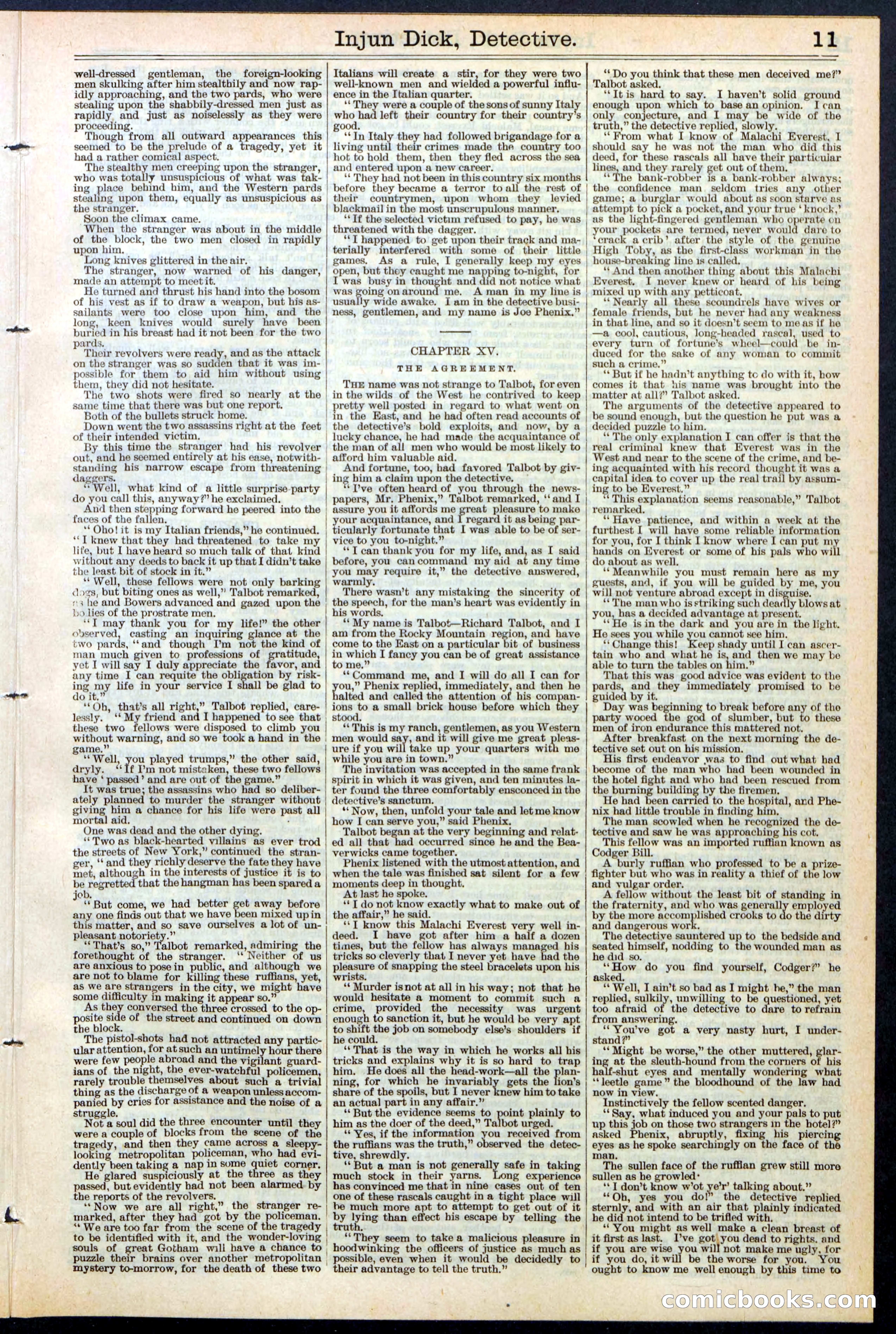
A restored page from Pulp Fiction, 1886. Page through the whole issue in the reader above.
📄 Transcribed text from this page (OCR, searchable)
Machine-transcribed from the original scan — historical spelling and the odd misread are preserved.
well-dressed gentleman, the foreign-looking men skulking after him stealthily and now rap- idly Eptinoanbiig, and the two pards, who were stealing upon the shabbily-dressed men just as rapidly and just as noiselessly as they were proceeding. Though from all outward appearances this seemed to be the prelude of a tragedy, yet it had a rather comical aspect. The stealthy men creeping upon the stranger, who was totally unsuspicious of what was tak- ing place behind him, and the Western pards stealing upon them, equally as unsuspicious as the stranger. Soon the climax came. When the stranger was about in the middle of the block, the two men closed in rapidly upon him. Long knives glittered in the air. The stranger, now warned of his danger, made an attempt to meet it. He turned and thrust his hand into the bosom of his vest as if to draw a weapon, but his as- sailants were too close upon him, and the long, keen knives would surely have been buried in his breast had it not been for the two sards. Their revolvers were ready, and as the attack on the stranger was so sudden that it was im- possible for them to aid him without using them, they did not hesitate. -—_——_——— ee __-_- -- err ———— —— ee The two shots were fired so nearly at the | same time that there was but one report. Both of the bullets struck home. Down went the two assassins right at the feet of their intended victim, By this time the stranger had his revolver out, and he seemed entirely at his ease, notwith- Injun Dick, Detective. Italians will create a stir, for they were two well-known men and wielded a powerful influ- ence in the Italian quarter. ‘*They were a couple of the sons of sunny Italy who had left their country for their country’s good. ‘*In Italy they had followed brigandage for a living until their crimes made the country too hot to hold them, then they fled across the sea and entered upon a new career. ‘* They had not been in this country six months before they became a terror toall the rest of their countrymen, upon whom they levied blackmail in the most unscrupulous manner, ‘* Tf the selected victim refused to pay, he was threatened with the dagger. ‘*T happened to get upon their track and ma- terially interfered with some of their little games. As a rule, I generally keep my eyes open, but they caught me napping to-night, for Iwas busy in thought and did not notice what was going onaround me. A man in my line is usually wide awake. I am in the detective busi- ness, gentlemen, and my name is Joe Phenix,” CHAPTER XV. THE AGREEMENT. THE name was not strange to Talbot, for even in the wilds of the West he contrived to keep | pretty well posted in regard to what went on in the East, and he had often read accounts of the detective’s bold exploits, and now, by a _ lucky chance, he had made the acquaintance of standing his narrow escape from threatening | daggers. * Well, what kind of a little surprise-party do you call this, anyway?” he exclaimed. And then stepping forward he peered into the faces of the fallen. ‘* Oho! it is my Italian friends,” he continued. ‘‘T knew that they had threatened to take my life, but I have heard so much talk of that kind without any deeds to back it up that I didn’t take the least bit of stock in it.” ‘* Well, these fellows were not only barking dogs, but biting ones as well,” Talbot remarked, «3 he and Bowers advanced and gazed upon the bo lies of the prostrate men. ‘“T may thank you for my life!” the other observed, casting an inquiring glance at the two pards, ‘and though I’m not the kind of man much given to professions of gratitude, yet I will say I duly appreciate the favor, and any time I can requite the obligation by risk- ing my life in your service I shall be glad to do it.” “Oh, that’s all right,” Talbot replied, care- | lessly. these two fellows were disposed to climb you ‘* My friend and I happened to see that , without warning, and so we took a hand in the | ame.” ‘* Well, you played trumps,” the other said, dryly. “If ’'m not mistaken, these two fellows have ‘ > and are out of the game.” It was true; the assassins who had so deliber- ately planned to murder the stranger without giving him a chance for his life were past all mortal aid. . One was dead and the other dying. ‘*Two as black-hearted villains as ever trod the streets of New York,” continued the stran- ger, ‘‘and they richly deserve the fate they have met, although in the interests of justice it is to be regretted that the hangman has been spared a job. ue But come, we had better get away before any one finds out that we have been mixed up in this matter, and so save ourselves a lot of un- pleasant notoriety.” ‘ ‘“That’s so,” Talbot remarked, admiring the forethought of the stranger. ‘‘ Neither of us are anxious to posein public, and although we are not to blame for killing these ruffians, yet, as we are strangers in the city, we might have some difficulty in making it appear so.” As they conversed the three crossed to the op- posite side of the street and continued on down the block. The pistol-shots had not attracted any ue ular attention, for atsuch an untimely hour there were few people abroad and the Viotlant guard- ians of the night, the ever-watchful policemen, rarely trouble themselves about such a trivial thing as the discharge of a weapon unless accom- panied by cries for assistance and the noise of a struggle. Not a soul did the three encounter until they were a couple of blocks from the scene of the tragedy, and then they came across a sleepy- looking metropolitan policeman, who had evi- dently been taking a nap In sume uiet corner. He glared suspiciously at the three as they passed, but evidently had not been alarmed. by the reports of the revolvers. ‘‘Now we are all right,” the stranger re- marked, after they had got by the ee ‘* We are too far from the scene of the tragedy to be identified with it, and the wonder-loving souls of great Gotham will have a chance to puzzle their brains over another metropolitan cen | the man of all men who would be most likely to afford him valuable aid. And fortune, too, had favored Talbot by giv- ing bim a claim upon the detective. — ‘* I’ve often heard of you through the news- papers, Mr, Phenix,” Talbot remarked, ‘‘ and I assure you it affords me yas pleasure to make your acquaintance, and | regard it as being par- ticularly fortunate that I was able to be of ser- vice to you to-night.” ‘*T can thank you for my life, and, as I said before, you cancommand my aid at any time you may require it,” the detective answered, warmly, There wasn’t any mistaking the sincerity of the speech, for the man’s heart was evidently in his words. **My name is Talbot—Richard Talbot, and I am from the Rocky Mountain region, and have come to the East on a particular bit of business in which I fancy you can be of great assistance to me.” ‘*Command me, and I will do all I can for ou,” Phenix replied, immediately, and then he alted and called the attention of his compan- a to a small brick house before which they stood. ‘* This is my ranch, gentlemen, as you Western men would say, and it will give me great pleas- ure if you will take up your quarters with me while you are in town.” The invitation was accepted in the same frank spirit in which it was given, and ten minutes la- ter found the three comfortably ensconced in the detective’s sanctum. ‘* Now, then, unfold your tale and let me know how I can serve you,” said Phenix. Talbot began at the very beginning and relat- ed all that had occurred since he and the Bea- verwicks came together. Phenix listened with the utmost attention, and when the tale was finished sat silent for a few moments deep in thought. At last he spoke. ‘*T do not know exactly what to make out of the affair,” he said. ‘*T know this Malachi Everest very well in- deed. I have got after him a half a dozen times, but the fellow has always managed his tricks so cleverly that I never yet have had the pene of snapping the steel bracelets upon his wrists. ‘* Murder isnot at all in his way; not that he would hesitate a moment to commit such a crime, provided the necessity was urgent enough to sanction it, but he would be very apt to shift the job on somebody else’s shoulders if he could. ‘* That is the way in which he works all his tricks and explains why it is so hard to trap him. He does all the head-work—all the plan- ning, for which he invariably gets the lion's share of the spoils, but I never knew him to take an actual part in any affair.” ‘But the evidence seems to point plainly to him as the doer of the deed,” Talbot urged. ‘‘ Yes, if the information you received from the ruffians was the truth,” o ed the detec- tive, shrewdly. ‘But a man is not generally safe in taking much stock in their yarns. ng experience has convinced me that in nine cases out of ten one of these rascals caught in a tight place will be much more apt to attempt to get out of it yt tying than effect his escape by telling the ‘They seem to take a malicious pleasure in hoodwinking the officers of justice as much as possible, even when it would be decidedly to mystery to-morrow, for the death of these two their advantage to tell the truth.” ' On eee 1 **Do you think that these men deceived me?” Talbot asked, ‘‘Itis hard to say. I haven’t solid ground enough upon which to base an opinion. I can only conjecture, and I may be wide of the truth,” the detective replied, slowly. ‘*From what I know of Malachi Everest, I should say he was not the man who did this deed, for these rascals all have their particular lines, and they rarely get out of them, “The bank-robber is a bank-robber always; the confidence man seldom tries any other game; a burglar would about as soon starve as attempt to pick a pocket, and your true ‘ knock,’ as the light-fingered gentleman who operate on your pockets are termed, never would dare to ‘crack acrib’ after the style of the genuine High Toby, as the first-class workman in the house-breaking line is called, ‘** And then another thing about this Malachi Everest. I never knew or heard of his being mixed up with any petticoat. ‘* Nearly all these scoundrels have wives or female friends, but he never had any weakness in that line, and so it doesn’t seem to meas if he —a cool, cautious, long-headed rascal, used to every turn of fortune’s wheel—could be in- duced for the sake of any woman to commit such a crime.” ** But if he hadn’t anything tc do with it, how comes it that his name was brought into the matter at all?’ Talbot asked. The arguments of the detective appeared to be sound enough, but the question he put was a decided puzzle to him. ‘** The only explanation I can offer is that the real criminal knew that Everest was in the West and near to the scene of the crime, and be- ing peruanee with his record thought it was a capital idea to cover up the real trail by assum- ing to be Everest.” ‘This explanation seems reasonable,” Talbot remarked, ‘‘ Have patience, and within a week at the furthest I will have some reliable information for you, for I think I know where I can put my hands on Everest or some of his pals who wi do about as well. ‘* Meanwhile you must remain here as my guests, and, if you will be guided by me, you will not venture abroad except in disguise. ‘**The man who is striking such deadly blows at | you, has a decided advantage at present. ‘‘He isin the dark and you are in the light. He sees you while you cannot see him. ‘‘ Change this! Keep shady until I can ascer- tain who and what he is, and then we may be able to turn the tables on him.” That this was good advice was evident to the pards, and they immediately promised to be guided by it. Day was 5 pe to break before any of the party wooed the god of slumber, but to these men of iron endurance this mattered not, After breakfast on the next morning the de- tective set out on his mission. His first endeavor was to find out what had become of the man who had been wounded in the hotel fight and who had been rescued from the burning building by the firemen, He had been carried to the hospital, and Phe- nix had little trouble in finding him, The man scowled when he recognized the de- tective and saw he was approaching his cot, This fellow was an imported ruffian known as Codger Bill. A burly ruffian who professed to be a prize- fighter but who was in reality a thief of the low and yulgar order. A fellow without the least bit of standing in the fraternity, and who was generally employed by the more Recor per crooks to do the dirty and dangerous work. The detective sauntered up to the bedside and seated himself, nodding to the wounded man as he did so. + ew" do you find yourself, Codger?” he ** Well, I ain’t so bad as I might he,” the man replied, sulkily, unwilling to be P deers yet too afraid of the detective to dare to refrain from answering. ‘“You’ve got a very nasty hurt, I under- stand?” ‘*Might be worse,” the other muttered, glar- ing at the sleuth-hound from the corners of his half-shut eyes and mentally wondering what ‘‘leetle game” the bloodhound of the law had now in view. * Instinctively the fellow scented danger. ‘*Say, what induced you and your pals to put up this job on those two strangers 1n the hotel?” asked Phenix, abruptly, fixing his piercin eyes as he spoke searchingly on the face of th man. The sullen face of the ruffian grew still more sullen as he growled: 4 ‘*T don’t know w’ot yer’ talking about.” ‘“Oh, yes you do!” the detective replied sternly, and with an air that plainly indicated he did not intend to be trifled with, ‘You might as well make a clean breast of it first as last. I’ve gothyou dead to rights. and if you are wise you will not make me ugly, for if you do, it be the worse for you. You ought to know me well enough by this time to : f Gomilchboo <KSEGEOr