
Pulp Fiction, 1886 · page 10 of 32
Beadle's Dime Library No. 384 — page 10: what you’re looking at
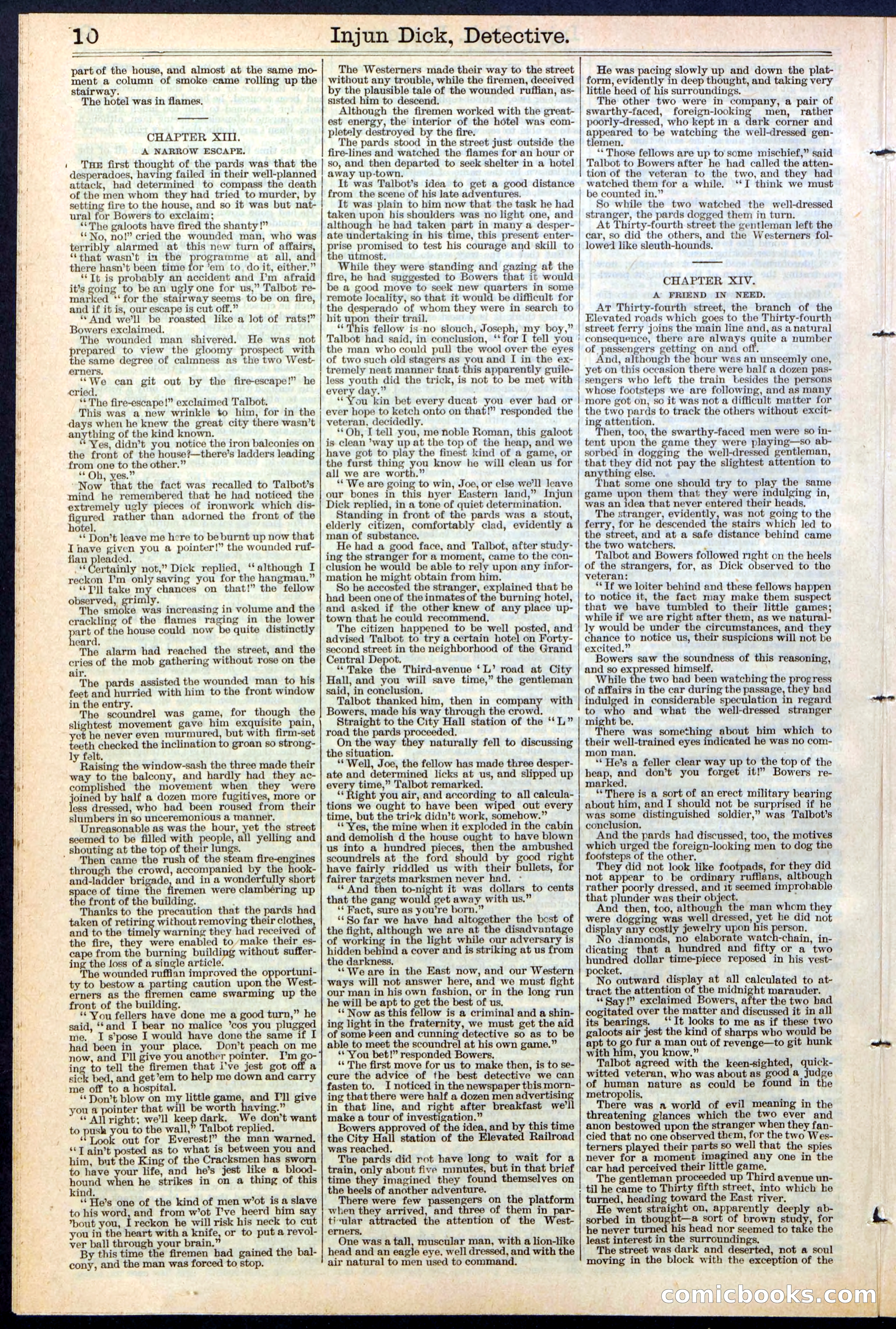
A restored page from Pulp Fiction, 1886. Page through the whole issue in the reader above.
📄 Transcribed text from this page (OCR, searchable)
Machine-transcribed from the original scan — historical spelling and the odd misread are preserved.
10 ss — part of the house, and almost at the same mo- ment a column of smoke came rolling up the stairway. The hotel was in flames. CHAPTER XITI. A NARROW ESCAPE. | Tu first thought of the pards was that the desperadoes, having failed in their well-planned attack, had determined to compass the death of the men whom they had tried to murder, by setting fire to the house, and so it was but nat- ural for Bowers to exclaim; ‘‘The galoots have fired the shanty!” ‘No, no!” cried the wounded man, who was terribly alarmed at this new turn of affairs “that wasn’t in the programme at all, anc there hasn’t been time for ’em to. do it, either.” ‘Tt is probably an accident and I’m afraid it’s going to be an ugly one for us,” Talbot re- marked ‘‘ for the stairway seems to be on fire, and if it is, our escape is cut off.” “ And we'll be roasted like a lot of rats!” Bowers exclaimed. The wounded man shivered. He was not prepared to view the gloomy prospect with the same degree of calmness as the two West- erners. ‘““We can git out by the fire-escape!” he cried, «The fire-escape!” exclaimed Talbot. This was a new wrinkle to him, for in the days when he knew the great city there wasn’t anything of the kind known. “ Yes, didn’t you notice the iron balconies on the front of the house?—there’s ladders leading from one to the other.” ** Oh, yes.” “Now that the fact was recalled to Talbot’s mind he remembered that he had noticed the extremely ugly pieces of ironwork which dis- figured rather than adorned the front of the hotel. ‘¢ Don’t leave me here to be burnt up now that Thave given you a pointer!” the wounded ruf- fian pleaded. “Certainly not,” Dick replied, ‘‘although I reckon I’m only saving you for the hangman.” ‘‘T)]] take my chances on that!” the fellow observed, grimly. The smoke was increasing in volume and the crackling of the flames raging in the lower ae of the house could now be quite distinctly eard., The alarm had reached the street, and the cries of the mob gathering without rose on the air. The pards assisted the wounded man to his feet aia hurried with him to the front window in the entry. The sponmadeet was game, for though the slightest movement gave him exquisite pain, yet he never even murmured, but with firm-set teeth checked the inclination to groan so strong- ly felt. ” Rileing the window-sash the three made their way to the balcony, and hardly had they ac- complished the movement when they were joined by half a dozen more fugitives, more or less dressed, who had been roused from their slumbers in so unceremonious a manner. Unreasonable as was the hour, yet the street seemed to be filled with people, all yelling and shouting at the top of their lungs. ' Then came the rush of the steam fire-engines through the crowd, accompanied by the hook- and-ladder brigade, and in a wonderfully short space of time the firemen were clambéring up the front of the building. Thanks to the precaution that the pards had taken of retiring without removing their clothes and to the timely warning they had received o the fire, they were enabled to make their es- cape from the burning building without suffer- ing the loss of a single article. The wounded ruffian improved the opportuni- ty to bestow a parting caution upon the West- erners as the firemen came swarming up the front of the building. ‘* You fellers have done me a good turn,” he said, ‘‘and I bear no malice ’cos you plugged me. I s’pose I would have done the same if I had been in your place. Don’t peach on me now, and [ll give you another pointer. I’m go- ing to tell the firemen that I’ve jest got off a sick bed, and get’em to help me down and carry me off to a hospital. — ‘‘ Don’t blow on my little game, and Pll give you a pointer that will be worth having.” “ Allright; we'll kee dark. We don’t want to pusk ou to the wall,” Talbot replied. ‘Look out for Everest!” the man warned. ‘*T ain’t posted as to what is between you and him, but the King of the Cracksmen has sworn to have your life, and he’s jest like a blood- hound ehiant he strikes in on a thing of this ‘‘ He’s one of the kind of men w’ot is a slave to his word, and from w’ot I’ve heerd bim say *bout you, I reckon he will risk his neck to cut you in the heart with a knife, or to puta revol- ver ball through your brain.” By this time the firemen bad gained the bal- cony, and the man was forced to stop. Injun Dick, Detective. The Westerners made their way to the street without any trouble, while the firemen, deceived by the plausible tale of the wounded ruffian, as- sisted him to descend. Although the firemen worked with the great- est energy, the interior of the hotel was com- pletely destroyed by the fire. The pards stood in the street just outside the fire-lines and watched the flames for an hour or | so, and then departed to seek shelter in a hotel | away up-town. It was Talbot’s idea to get a good distance | from the scene of his late adventures. It was plain to him now that the task he had taken upon his shoulders was no light one, and although he had taken part in many a desper- ate undertaking in his time, this present enter- prise promised to test his courage and skill to the utmost. While they were standing and gazing at the fire, he had suggested to Bowers that it would be a good move to seek new quarters in some remote locality, so that it would be difficult for the desperado of whom they were in search to hit upon their trail. ‘This fellow is no slouch, Joseph, my boy,” Talbot had said, in conclusion, ‘for I tell you the man who could pull the wool over the eyes of two such old stagers as you and I in the ex- tremely neat manner that this apparently guile- less youth did the trick, is not to be met with every day.” ‘*You kin bet every ducat you ever bad or ever hope to ketch onto on that!” responded the veteran, decidedly. **Oh, I tell you, me noble Roman, this galoot is clean ’way up at the top of the heap, and we have got to play the finest kind of a game, or the furst thing you know he will clean us for all we are worth.” ‘We are going to win, Joe, or else we'll leave our bones in this byer Eastern land,” Injun Dick replied, in a tone of quiet determination. Standing in front of the pards was a stout, elderly citizen, comfortably clad, evidently a man of substance. He had a good face, and Talbot, after study- ing the stranger for a moment, came to the con- clusion he would be able to rely upon any infor- mation he might obtain from him. So he accosted the stranger, explained that he had been one of the inmates of the burning hotel, and asked if the other knew of any place up- town that he could recommend. The citizen happened to be well posted, and advised Talbot to try a certain hotel on Forty- second street in the neighborhood of the Grand Central Depot. ‘“‘Take the Third-avenue ‘L’ road at City Hall, and you will save time,” the gentleman said, in conclusion. Talbot thanked him, then in company with Bowers, made his way through the crowd. Straight to the City Hall station of the ‘‘L” road the pards proceeded. On the way they naturally fell to discussing the situation. ** Well, Joe, the fellow has made three ex ate and determined licks at us, and slipped up every time,” Talbot remarked. ‘Right you air, and according to all calcula- tions we ought to have been wiped out every time, but the trick didn’t work, somehow.” Xs Yes, the mine when it exploded in the cabin and demolish d the house ought to have blown us into a hundred pieces, then the ambushed scoundrels at the ford should by good right have fairly riddled us with their bullets, for fairer targets marksmen never had. - ** And then to-night it was dollars to cents that the gang would get away with us.” ‘* Fact, sure as you’re born.” ‘‘So far we have had altogether the bost of the fight, although we are at the disadvantage of working in the light while our adversary is hidden behind a cover and is striking at us from the darkness. ‘‘“Weare in the East now, and our Western ways will not answer here, and we must fight our man in his own fashion, or in the long run he will be apt to get the best of us. ‘** Now as this fellow is a criminal and a shin- ing light in the fraternity, we must get the aid of some keen and cunning detective so as to be able to meet the scoundrel at his own game.” ** You bet!” responded Bowers. ‘‘ The first move for us to make then, is to se- cure the advice of the best detective we can fasten to. I noticed in the newspaper this morn- ing that there were half a dozen men advertising in that line, and right after breakfast we'll make a tour of investigation.” : Bowers approved of the idea, and by this time the City Hall station of the Elevated Railroad was reached. : The pards did rot have long to wait for a train, only about five minutes, but in that brief time they imagined they found themselves on the heels of another adventure. There were few ngers on the platform when they arrived, and three of them in par- tieular attracted the attention of the West- erners, One was a tall, muscular man, with a lion-like head and an eagle eye. well dressed, and with the air natural to men used to command. He was pacing slowly up and down the plat- form, evidently in deep thought, and taking very little heed of his surroundings. The other two were in company, a pair of swarthy-faced, are a men, rather poorly-dressed, who kept in a dark corner and appeared to be watching the well-dressed gen- tlemen. ‘‘ Those fellows are up to some mischief,” said Talbot to Bowers after he had called the atten- tion of the veteran to the two, and they had watched them for a while. ‘‘I think we must be counted in.” So while the two watched the well-dressed stranger, the pards dogged them in turn. At Thirty-fourth street the gentleman left the car, so did the others, and the Westerners fol- lowe like sleuth-hounds. CHAPTER XIV. A FRIEND IN NEED. At Thirty-fourth street, the branch of the Elevated roads which goes to the Thirty-fourth street ferry joins the main line and, as anatural ' consequence, there are always quite a number of passengers getting on and off. And, although the hour wes an unseemly one, yet on this occasion there were balf a dozen pas- sengers who left the train besides the persons whose footsteps we are following, and as many | more got on, so it was not a difficult matter for | the two pards to track the others without excit- | ig he ea j hen, too, the swarthy-faced men were 80 In- tent upon the game they were playing—so ab- sorbed in dogging the well-dressed gentleman, that they did not pay the slightest attention to gre else. ‘hat some one should try to play the same game upon them that they were indulging in, was an idea that never entered their heads, The stranger, evidently, was not going to the ferry, for he descended the stairs which led to the street, and at a safe distance behind came the two watchers. , Talbot and Bowers followed right on the heels of the strangers, for, as Dick observed to the veteran: . ‘*Tf we loiter behind and these fellows happen to notice it, the fact may make them suspect that we bave tumbled to their little games; while if we are right after them, as we natural- ly would be under the circumstances, and they chance to notice us, their suspicions will not be excited.” Bowers saw the soundness of this reasoning, and so expressed himself. While the two had been watching the progress of affairs in the car during the passage, they bad indulged in considerable speculation in regard to who and what the well-dressed stranger might be, There was something about him which to their well-trained eyes indicated he was no com- mon man, ‘* He’s a feller clear way up to the top of the heap, and don’t you forget it!” Bowers re- marked, ‘There is a sort of an erect military bearing about him, and I should not be surprised if he was some distinguished soldier,” was Talbot’s conclusion. And the pards had discussed, too, the motives which urged the foreign-looking men to dog the footsteps of the other. : : They did not look like footpads, for they did not appear to be ordinary ruffians, although rather poorly dressed, and it seemed improbable that plunder was their object. And then, too, although the man whom they were dogging was well dressed, yet he did not display any costly jewelry upon his Pago No diamonds, no elaborate watch-chain, in- dicating that a hundred and fifty or a two hundred dollar time-piece reposed in his vest- pocket. No outward display at all calculated to at- tract the attention of the midnight marauder. “Say!” exclaimed Bowers, after the two bad cogitated over the matter and discussed it in all its bearings. ‘‘It looks to me as if these two galoots air jest the kind of sharps who would be apt to go fur a man out of revenge—to git hunk with him, you know.” Talbot agreed with the keen-sighted, quick- witted veteran, who was about as good a judge of human nature as could be found in the metropolis. ae There was a world of evil meaning in the threatening glances which the two ever and anon bestowed upon the stranger when they fan- cied that no one observed them, for the two Wes- terners played their parts so well that the spies never for a moment imagined any one in the car had perceived their little game, The gentleman proceeded up Third avenue un- til he came to Thirty fifth street, into which he turned, heading toward the East river. He went straight on, apparently deeply ab- sorbed in thous t—a sort of brown study, for he never turned his head nor seemed to take the least interest in the surroundings. The street was dark and deserted, not a soul moving in the block with the exception of the —— ES LL re Gom (E S) 200) | (eo) m i ; wait