
Pulp Fiction, 1885 · page 26 of 32
Beadle's Dime Library No. 366 — page 26: what you’re looking at
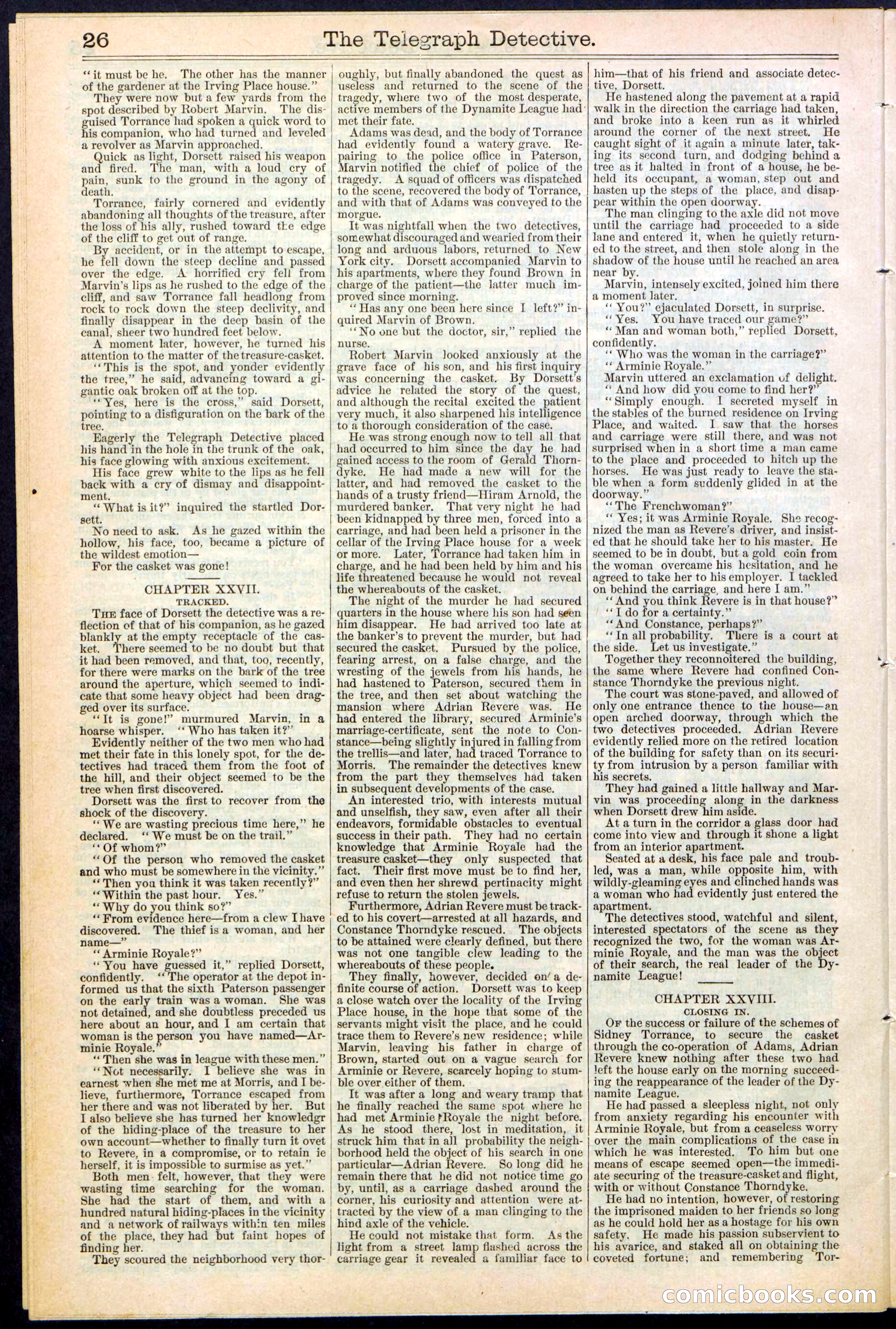
A restored page from Pulp Fiction, 1885. Page through the whole issue in the reader above.
📄 Transcribed text from this page (OCR, searchable)
Machine-transcribed from the original scan — historical spelling and the odd misread are preserved.
if oa - Ul oe 7 , ' ' : ¢ ~ ‘ os. ee on am : Sn eT en ee —_ 26 ‘‘it must be he. The other has the manner of the gardener at the Irving Place house.” They were now but a few yards from the spot described by Robert Marvin. The dis- guised Torrance had spoken a quick word to his companion, who had turned and leveled a revolver as Marvin approached. Quick as light, Dorsett raised his weapon and fired. The man, with a loud cry of pain, sunk to the ground in the agony of death. Torrance, fairly cornered and evidently abandoning all thoughts of the treasure, after the loss of his ally, rushed toward tke edge | of the cliff to get out of range. By accident, or in the attempt to escape, he fell down the steep decline and passed over the edge. A horrified cry fell from Marvin’s lips as he rushed to the edge of the cliff, and saw Torrance fall headlong from rock to rock down the steep declivity, and finally disappear in the deep basin of the canal, sheer two hundred feet below. A moment later, however, he turned his attention to the matter of the treasure-casket. ‘‘This is the spot, and yonder evidently the tree,” he said, advancing toward a gi- gantic oak broken off at the top. ‘*Yes, here is the cross,” said Dorsett, pointing to a disfiguration on the bark of the tree. Eagerly the Telegraph Detective placed his hand in the hole in the trunk of the oak, his face glowing with anxious excitement. His face grew white to the lips as he fell back with a cry of dismay and disappoint- ment. “< What is it?’ inquired the startled Dor- sett. No need to ask. As he gazed within the hollow, his face, too, became a picture of the wildest emotion— For the casket was gone! CHAPTER XXYVII. TRACKED. Tne face of Dorsett the detective was a re- flection of that of his companion, as he gazed blankly at the empty receptacle of the cas- ket. There seemed to be no doubt but that it had been removed, and that, too, recently, for there were marks on the bark of the tree around the aperture, which seemed to indi- cate that some heavy object had been drag- ged over its surface. ‘‘Tt is gone!” murmured Marvin, in a hoarse whisper. ‘‘ Who has taken it?” Evidently neither of the two men who had met their fate in this lonely spot, for the de- tectives had traced them from the foot of the hill, and their object seemed to be the tree when first discovered. Dorsett was the first to recover from the shock of the discovery. ‘We are wasting precious time here,’ he declared. ‘‘ We must be on the trail.” ‘*Of whom?” ‘Of the person who removed the casket and who must be somewhere in the vicinity.”’ ‘‘Then you think it was taken recently?” ‘Within the past hour. Yes.” “Why do you think so?” ‘‘From evidence here—from a clew Ihave discovered. The thief isa woman, and her name—” ‘‘ Arminie Royale?” ‘You have guessed it,” replied Dorsett, confidently. ‘‘ The operator at the depot in- formed us that the sixth Paterson passenger on the early train was a woman. She was not detained, and she doubtless preceded us here about an hour, and I am certain that woman is the person you have named—Ar- minie Royale.” ‘‘Then she was in league with these men.” ‘‘Not necessarily. I believe she was in earnest when she met me at Morris, and I be- lieve, furthermore, Torrance escaped from her there and was not liberated by her. The Telegraph Detective. oughly, but finally abandoned the quest as | him—that of his friend and associate detec- useless and returned to the scene of the tragedy, where two of the most desperate, active members of the Dynamite League had met their fate. Adams was dead, and the body of Torrance had evidently found a watery grave. Re- pairing to the police office in Paterson, Marvin notified the chief of police of the tragedy. <A squad of officers was dispatched to the scene, recovered the body of Torrance, and with that of Adams was conveyed to the morgue. It was nightfall when the two detectives, somewhat discouraged and wearied from their long and arduous labors, returned to New York city. Dorsett accompanied Marvin to his apartments, where they found Brown in charge of the patient—the latter much im- proved since morning. ‘Has any one been here since [ left?” in- quired Marvin of Brown. ‘“No one but the doctor, sir,” replied the nurse. Robert Marvin Jooked anxiously at the grave face of his son, and his first inquiry was concerning the casket. By Dorsett’s advice he related the story of the quest, and although the recital excited the patient very much, it also sharpened his intelligence to a thorough consideration of the case. He was strong enough now to tell all that had occurred to him since the day he had gained access to the room of Gerald Thorn- dyke. He had made a new will for the latter, and had removed the casket to the hands of a trusty friend—Hiram Arnold, the murdered banker. That very night he had been kidnapped by three men, forced into a carriage, and had been held a prisoner in the cellar of the Irving Place house for a week or more. Later, Torrance had taken him in charge, and he had been held by him and his life threatened because he would not reveal the whereabouts of the casket. The night of the murder he had secured quarters in the house where his son had seen him disappear. He had arrived too late at the banker’s to prevent the murder, but had secured the casket. Pursued by the police, fearing arrest, on a false charge, and the wresting of the jewels from his hands, he had hastened to Paterson, secured them in the tree, and then set about watching the mansion where Adrian Revere was, He had entered the library, secured Arminie’s marriage-certificate, sent the note to Con- stance—being slightly injured in falling from the trellis—and later, had traced Torrance to Morris. The remainder the detectives knew from the part they themselves had taken in subsequent developments of the case. An interested trio, with interests mutual and unselfish, they saw, even after all their endeavors, formidable obstacles to eventual success in their path. They had no certain knowledge that Arminie Royale had the treasure casket—they only suspected that fact. Their first move must be to find her, and even then her shrewd pertinacity might refuse to return the stolen jewels. Furthermore, Adrian Revere must be track- ed to his covert—arrested at all hazards, and Constance Thorndyke rescued. The objects to be attained were clearly defined, but there was not one tangible clew leading to the whereabouts of these people. They finally, however, decided on/a de- finite course of action. Dorsett was to keep a close watch over the locality of the Irving Place house, in the hope that some of the servants might visit the place, and he could trace them to Revere’s new residence; while Marvin, leaving his father in charge of Brown, started out on a vague search for Arminie or Revere, scarcely hoping to stum- ble over either of them. It was after a long and weary tramp that But | he finally reached the same spot where he I also believe she has turned her knowledgr | had met Arminie FRoyale the night before. of the hiding-place of the treasure to her| As he stood there, lost in meditation, it own account—whether to finally turn it ovet | struck him that in all probability the neigh- to Revere, in a compromise, or to retain ie | borhood held the object of his search in one herself, it is impossible to surmise as yet.” Both men- felt, however, that they were wasting time searching for the woman. | particular—Adrian Revere. So long did he remain there that he did not notice time go by, until, as a carriage dashed around the She had the start of them, and with a/| corner, his curiosity and attention were at- hundred natural hiding-places in the vicinity | tracted by the view of a man clinging to the and a network of railways within ten miles | hind axle of the vehicle. of the place, they had but faint hopes of finding her. They scoured the neighborhood very thor- carriage gear it reveale He could not mistake that form. As the light from a street lamp flashed across the a familiar face to tive, Dorsett. He hastened along the pavement at a rapid walk in the direction the carriage had taken, and broke into a keen run as it whirled around the corner of the next street. He caught sight of it again a minute later, tak- ing its second turn, and dodging behind a tree as it halted in front of a house, he be- held its occupant, a woman, step out and hasten up the steps of the place, and disap- pear within the open doorway. The man clinging to the axle did not move until the carriage had proceeded to a side lane and entered it, when he quietly return- ed to the street, and then stole along in the shadow of the house until he reached an area near by. Marvin, intensely excited, joined him there a moment later. ‘‘ You?” ejaculated Dorsett, in surprise. “Yes. You have traced our game?” ‘Man and woman both,” replied Dorsett, confidently. ‘* Who was the woman in the carriage?” ‘* Arminie Royale.” Marvin uttered an exclamation uf delight. ‘* And how did you come to find her?” “Simply enough. I secreted myself in the stables of the burned residence on Irving Place, and waited. I saw that the horses and carriage were still there, and was not surprised when in a short time a man came to the place and proceeded to hitch up the horses. He was just ready to leave the sta- ble when a form suddenly glided in at the doorway.” “The Frenchwoman?” ‘“‘ Yes; it was Arminie Royale. She recog- nized the man as Revere’s driver, and insist- ed that he should take her to his master. He seemed to be in doubt, but a gold coin from the woman overcame his hesitation, and he agreed to take her to hisemployer. I tackled on behind the carriage, and here | am.” ‘‘And you think Revere is in that house?” ‘‘1 do for a certainty.” ‘‘And Constance, perhaps?” ‘‘In all probability. There is a court at the side. Let us investigate.” Together they reconnoitered the building, the same where Revere had confined Con- stance Thorndyke the previous night. The court was stone-paved, and allowed of only one entrance thence to the house—an open arched doorway, through which the two detectives proceeded. Adrian Revere evidently relied more on the retired location of the building for safety than on its securi- ty from intrusion by a person familiar with his secrets. They had gained a little hallway and Mar- vin was proceeding along in the darkness when Dorsett drew him aside. At a turn in the corridor a glass door had come into view and through it shone a light from an interior apartment. Seated at a desk, his face pale and troub- led, was a man, while opposite him, with wildly-gleaming eyes and clinched hands was a woman who had evidently just entered the apartment. The detectives stood, watchful and silent, interested spectators of the scene as they recognized the two, for the woman was Ar- minie Royale, and the man was the object of their search, the real leader of the Dy- namite League! CHAPTER XXVIII. CLOSING IN. Or the success or failure of the schemes of Sidney Torrance, to secure the casket through the co-operation of Adams, Adrian Revere knew nothing after these two had left the house early on the morning succeed- ing the reappearance of the leader of the Dy- namite League. He had passed a sleepless night, not only from anxiety regarding his encounter with Arminie Royale, but from a ceaseless worry over the main complications of the case in which he was interested. To him but one means of escape seemed open—the immedi- ate securing of the treasure-casket and flight, with or without Constance Thorndyke. He had no intention, however, of restoring the imprisoned maiden to her friends so long as he could hold her as a hostage for his own safety. He made his passion subservient to his avarice, and staked all on obtaining the coveted fortune; and remembering Tor- EOMmIE 9@0Ks aa :