
Pulp Fiction, 1885 · page 25 of 32
Beadle's Dime Library No. 366 — page 25: what you’re looking at
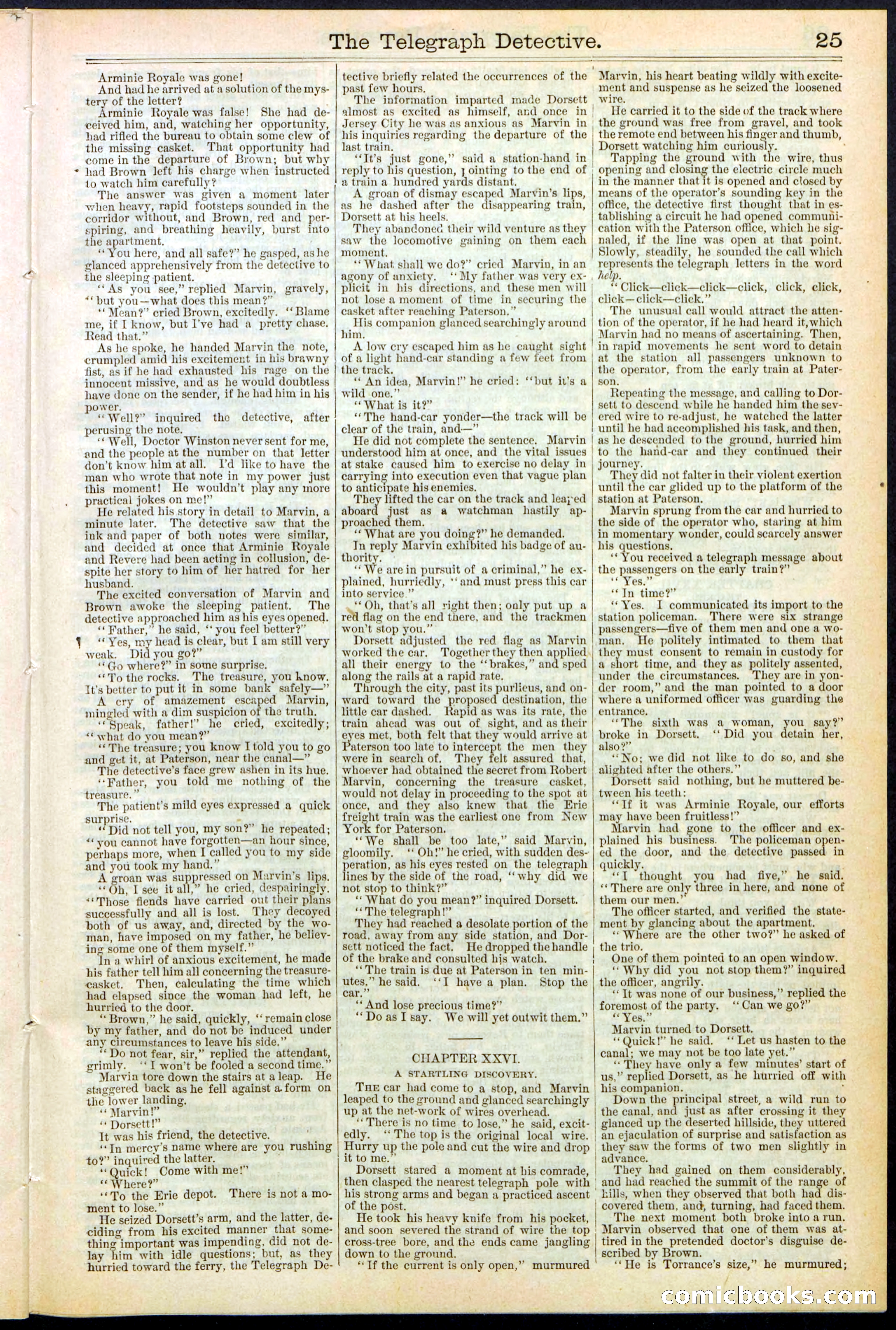
A restored page from Pulp Fiction, 1885. Page through the whole issue in the reader above.
📄 Transcribed text from this page (OCR, searchable)
Machine-transcribed from the original scan — historical spelling and the odd misread are preserved.
— —— = é j T . ——EE Arminie Royale was gone! And had he arrived at a solution of the mys- tery of the letter? Arminie Royale was false! She had de- ecived him, and, watching her opportunity, had rifled the bureau to obtain some clew of the missing casket. That opportunity had come in the departure of Brown; but why had Brown left his charge when instructed to watch him carefully? The answer was given a moment later when heavy, rapid footsteps sounded in the corridor without, and Brown, red and per- spiring, and breathing heavily, burst into the apartment. “You here, and all safe?” he gasped, as he glanced apprehensively from the detective to the sleeping patient. ‘““As you see,” replied Marvin, gravely, **but you—what does this mean?” ‘*Mean?” cried Brown, excitedly. ‘‘ Blame me, if I know, but I’ve had a pretty chase. Read that.” As he spoke, he handed Marvin the note, crumpled amid his excitement in his brawny fist, as if he had exhausted his rage on the innocent missive, and as he would doubtless have done on the sender, if he had him in his power. “Well?” inquired the perusing the note. ‘‘ Well, Doctor Winston never sent for me, and the people at the number on that letter don’t know him atall. I'd like to have the man who wrote that note in my power just this moment! He wouldn’t play any more practical jokes on me!” He related his story in detail to Marvin, a minute later. The detective saw that the ink and paper of both notes were similar, and decided at once that Arminie Royale and Revere had been acting in collusion, de- spite her story to him of her hatred for her husband. The excited conversation of Marvin and Brown awoke the sleeping patient. The detective approached him as his eyes opened. ‘‘ Father,” he said, ‘* you feel better?” ‘“ Yes, my head is clear, but I am still very weak, Did you go?” ‘*(}o where?” in some surprise. ‘To the rocks. The treasure, you hnow. It's better to put it in some bank safely—” A cry of amazement escaped Marvin, mingled with a dim suspicion of the truth. ‘‘Speak, father!” he cried, excitedly; ‘‘what do you mean?” ‘‘The treasure; you know [told you to go and get it, at Paterson, near the canal—” The detective’s face grew ashen in its hue. ‘Father, you told me nothing of the treasure.” The patient’s mild eyes expressed a quick surprise. “ ‘Did not tell you, my son?” he repeated; “you cannot have forgotten—an hour since, perhaps more, when I called you to my side and you took my hand. sa a A groan was su pressed on Marvin’s lips. ‘‘Oh, I see it all,” he cried, despairingly. ‘‘Those fiends have carried out their plans successfully and all is lost. They decoyed both of us away, and, directed by the wo- man, have imposed on my father, he believ- ing some one of them myself.” In a whirl of anxious excitement, he made his father tell him all concerning the treasure- casket. Then, calculating the time which had elapsed since the woman had left, he hurried to the door. “ Brown,” he said, quickly, ‘‘ remain close by my father, and do not be induced under any circumstances to leave his side,” ‘Do not fear, sir,” replied the attendant, grimly. ‘I won’t be fooled a second time,” Marvin tore down the stairs at aleap. He staggered back as he fell against a form on the lower landing, ‘* Marvin!” ‘* Dorsett!” It was his friend, the detective. ; ‘In mercy’s name where are you rushing to?” inquired the latter. ‘Quick! Come with me!” “Where?” ‘*To the Erie depot. ment to lose.” He seized Dorsett’s arm, and the latter, de- ciding from his excited manner that some- thing important was impending, did not de- lay iin with idle questions; but, as they hurried toward the ferry, the Telegraph De- detective, after There is not a mo- eee eee ee CDC Om . - ee tective briefly related the occurrences of the past few hours. The information imparted made Dorsett almost as excited as himself, and once in Jersey City he was as anxious as Marvin in his inquiries regarding the departure of the last train. “‘Tt’s just gone,” said a station-hand in reply to his question, } ointing to the end of a train a hundred yards distant. A groan of dismay escaped Marvin's lips, as he dashed after the disappearing train, Dorsett at his heels. They abandonec their wild venture as they | saw the locomotive gaining on them each moment, ‘* What shall we do?” cried Marvin, in an agony of anxiety. ‘‘ My father was very ex- plicit in his directions, and these men will not losea moment of time in securing the casket after reaching Paterson,” His companion glanced searchingly around him. A low ery escaped him as he caught sight of a light hand-car standing a few feet from the track. ** An idea, Marvin!” he cried: ‘‘but iv’s a wild one.” “What is it?” ‘‘The hand-car yonder—the track will be clear of the train, and—”’ He did not complete the sentence. Marvin understood him at once, and the vital issues at stake caused him to exercise no delay in carrying into execution even that vague plan to anticipate his enemies. They lifted the car on the track and leajed | aboard just as a watchman hastily ap- proached them. ‘What are you doing?” he demanded. Tn reply Marvin exhibited his badge of au- thority. ‘“We are in pursuit of a criminal,” he ex- plained, hurriedly, ‘*‘and must press this car into service.” **Oh, that’s all right then; only put up a red flag on the end there, and the trackmen | won't stop you.” | Dorsett adjusted the red flag as Marvin worked the car. Together they then Appi all their energy to the ‘‘ brakes,” and sped along the rails at a rapid rate. Through the city, past its purlieus, and on- | ward toward the proposed destination, the little car dashed. Rapid as was its rate, the train ahead was out of sight, and as their ores met, both felt that they would arrive at aterson too late to intercept the men they were in search of. They felt assured that, whoever had obtained the secret from Robert Marvin, concerning the treasure casket, would not delay in proceeding to the spot at once, and they also knew that the Erie freight train was the earliest one from New York for Paterson. ‘‘We shall be too late,” said Marvin, gloomily. ‘‘ Oh!’ he cried, with sudden des- peration, as his eyes rested on the telegraph lines by the side of the road, ‘‘why did we not stop to think?” ‘“ What do you mean?” inquired Dorsett. **'The telegraph!” They had reached a desolate portion of the road, away from any side station, and Dor- sett noticed the fact. He dropped the handle of the brake and consulted his watch. ‘The train is due at Paterson in ten min- utes,” he said. ‘‘I have a plan. Stop the car,”’ : ‘** And lose precious time?” CHAPTER XXVI. A STARTLING DISCOVERY. THE car had come to a stop, and Marvin leaped to the ground and glanced searchingly up at the net-work of wires overhead. ‘‘ There is no time to lose,” he said, excit- edly. ‘‘ The top is the original local wire. Hurry up the pole and cut the wire and drop it to me.”’ Dorsett stared a moment at his comrade, then clasped the nearest telegraph pole with ' kills, when they observed that both ha _ covered them, and, turning, had faced them. his strong arms and began a practiced ascent of the post. He took his heavy knife from his pocket, and soon severed the strand of wire the top cross-tree bore, and the ends came jangling down to the ground. “Tf the current is only open,” murmured ' / + $$ ee | “DoasIsay. We will yet outwit them.” 25 Marvin, his heart beating wildly with excite- ment and suspense as he seized the loosened wire. He carried it to the side of the track where the ground was free from gravel, and took _ the remote end between his finger and thumb f= , | Dorsett watching him curiously. Tapping the ground with the wire, thus opening and closing the electric circle much in the manner that it is opened and closed by means of the operator’s sounding key in the office, the detective first thought that in es- tablishing a circuit he had opened communi- cation with the Paterson office, which he sig- naled, if the line was open at that point. Slowly, steadily, he sounded the call which yea mek the telegraph letters in the word ielp. ** Click—click—click—click, click, click, click—click—click.”’ The unusual call would attract the atten- tion of the operator, if he had heard it, which Marvin had no means of ascertaining. Then, in rapid movements he sent word to detain at the station all passengers unknown to the operator, from the early train at Pater- s0n. tepeating the message, and calling to Dor- sett to descend while he handed him the sev- ered wire to re-adjust, he watched the latter until he had accomplished his task, and then, as he descended to the ground, hurried him to the hand-car and they continued their journey. They did not falter in their violent exertion until the car glided up to the platform of the station at Paterson. Marvin sprung from the car and hurried to the side of the operator who, staring at him in momentary wonder, could scarcely answer his questions, ‘* You received a telegraph message about the passengers on the early train?” ‘eeVes.” ‘*In time?” ‘Yes. I communicated its import to the station policeman. There were six strange Seayage Ra of them men and one a wo- man. He politely intimated to them that they must consent to remain in custody for a short time, and they as politely assented, under the circumstances. They are in yon- der room,” and the man pointed to a door where a uniformed officer was guarding the entrance, ‘The sixth was a woman, broke in Dorsett. ‘* Did you also?” ‘‘No; we did not like to do so, and she alighted after the others.”’ Dorsett said nothing, but he muttered be- tween his teeth: “Tf it was Arminie Royale, our efforts may have been fruitless!” Marvin had gone to the officer and ex- plained his business. The policeman open- ed the door, and the detective passed in quickly. ‘‘T thought you had five,” he said. ‘There are only three in here, and none of them our men.’ The officer started, and verified the state- ment by glancing about the apartment, ‘Where are the other two?” he asked of the trio. One of them pointed to an open window. ‘Why did you not stop them?” inquired the officer, angrily. ‘‘Tt was none of our business,” replied the foremost of the party. ‘‘Can we go?” ‘* Yes,” Marvin turned to Dorsett. ‘‘Quick!” he said. ‘‘ Let us hasten to the canal; we may not be too late yet.” ‘They have only a few minutes’ start of us,” replied Dorsett, as he hurried off witl his companion. : Down the Bees street, a wild run to the canal, and just as after crossing it they r Abe say?” etain her, | glanced up the deserted hillside, they uttered an ejaculation of surprise and satisfaction as they saw the forms of two men slightly in advance. They had gained on them considerably, and had reached the summit of the ran aa is- The next moment both broke into a run, ' Marvin observed that one of them was at- tired in the pretended doctor's disguise de- scribed by Brown. ‘He is Torrance’s size,” he murmured; “ecomicbooks com = ——— — — OO