
Pulp Fiction, 1878 · page 13 of 24
Beadle's New York Dime Library, Vol. III, No. 34 — page 13: what you’re looking at
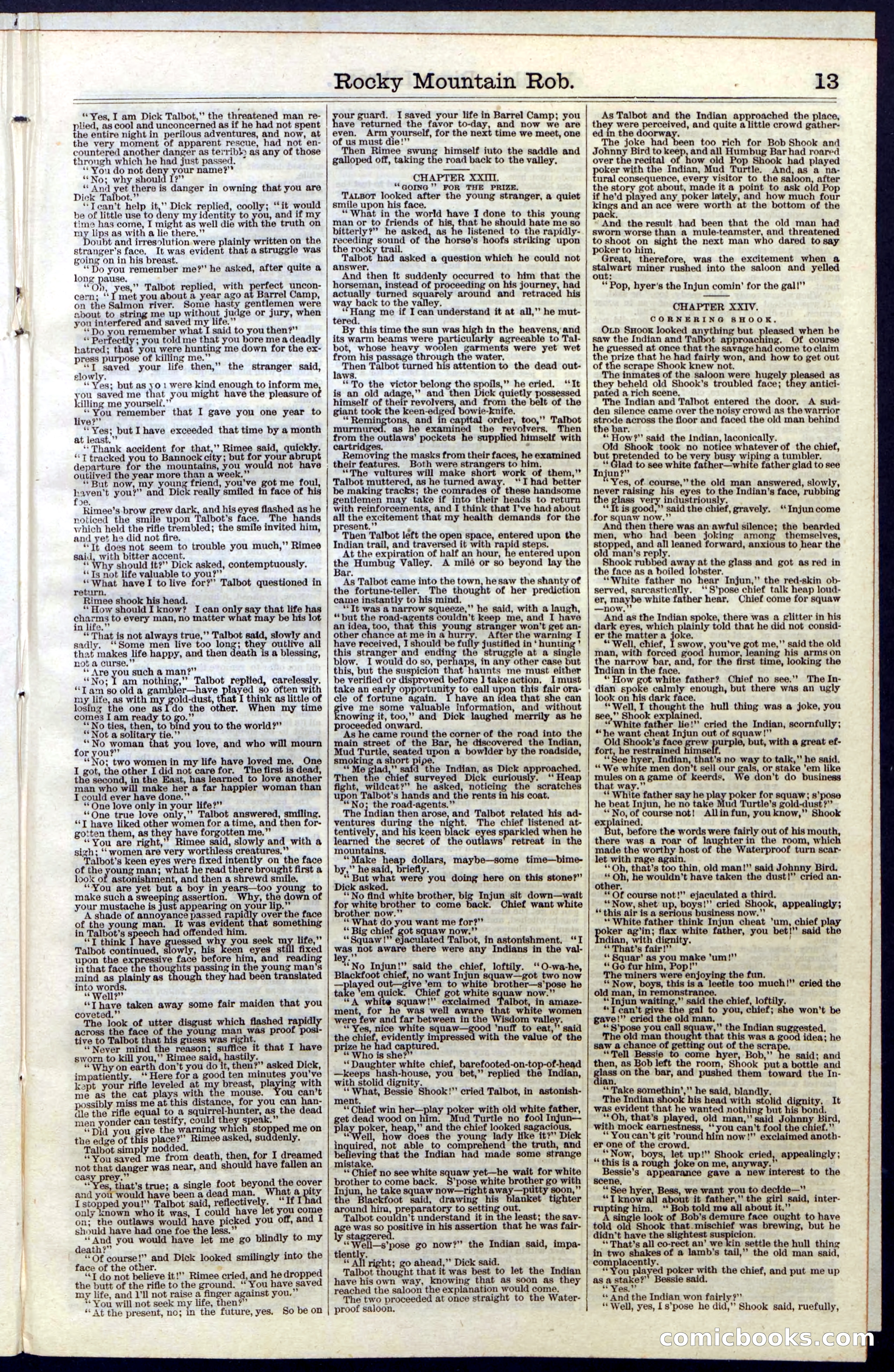
A restored page from Pulp Fiction, 1878. Page through the whole issue in the reader above.
📄 Transcribed text from this page (OCR, searchable)
Machine-transcribed from the original scan — historical spelling and the odd misread are preserved.
a yy. “Yes, I am Dick Talbot,"’ the threatened man re- plied, as cool and unconcerned as if he had not spent Rocky Mountain Rob. your guard. I saved your life in Barrel Camp; you ave returned the favor to-day, and now we are the entire night in perilous adventures, and now, at | even. Arm yourself, for the next time we meet, one the very moment of apparent rescue, had not en- countered another danger as terrib} as any of those throngh which he had just passed. ‘* You do not deny your name?” ‘*No; why should 1?” ** And yet there is danger in owning that you are Dick Talbot.” “Tcan't help it,’ Dick replied, coolly; “it would be of little use to deny my identity to you, and if my time has come, I might as well die with the truth on my lips as with a lie there,” Doubt and irresolution were plainly written on the stranger’s face. It was evident that a struggle was going on in his breast. “Do you remember me?" he asked, after quite a long pause. “Oh, yes,” Talbot replied, with perfect uncon- cern; ‘‘ Pi you about a year ago a Barrel Camp, on the Salmon river. Some hasty gentlemen were about to string me up without judge or jury, when you interfered and saved my life.” ‘‘Do you remember what I said to you then?" “ Perfectly; you told me that you bore me a deadly hatred; that you were hunting me down for the ex- press purpose of killing me.”” “T saved your life then,” the stranger said, slowly. ‘Ves; but as yo1 were kind enough to inform me you saved me that you might have the pleasure o killing me yourself.” ‘You remember that I gave you one year to ve?” 4 bee but I have exceeded that time by a month at least,”’ ‘Thank accident for that,’’ Rimee said, quickly. ‘“‘T tracked you to Bannock city; but for your abrupt departure for the mountains, you would not have outlived the year more than a week.” ‘But now, my young friend, you've got me foul, haven't you?” and Dick really smiled in face of his fe, Rimee’s brow grew dark, and his eyes flashed as he noticed the smile upon Talbot's face. The hands which held the rifle trembled; the smile invited him, and yet he did not fire. ‘It does not seem to trouble you much," Rimee said, with bitter accent. ‘Why should it?’ Dick asked, contemptuously. ‘* Ts not life valuable to you?” ‘“What havelI to live for?” Talbot questioned in return. Rimee shook his head. ‘‘How should I know? I can Coly gay that life has rg to every man, no matter what may be his lot in life." “That is not always true,’ Talbot said, slowly and sadly. ‘*Some men live too long; they outlive all that makes life happy, and then death is a blessing, not a curse,” ‘** Are you such a man?” “No; I am nothing,” Talbot replied, carelessly. “Tam so old a gambler—have played so often with my lite, as with my gold-dust, that I think as little of losing the one asI do the other. When my time comes I am ready to gO.” ‘‘ No ties, then, to bind you to the world?” Nota sigan tie.”’ ‘No woman that you love, and who will mourn for you?” ‘No; two women in my life have loved me. One I got, the other I did not care for. The first is dead, the second, in the East, has learned to love another man who will make her a far happier woman than I could ever have done.”’ **One love only in your life?” ‘‘One true love only,’ Talbot answered, smiling, ‘‘T have liked other women for a time, and then for- gotten them, as they have forgotten me,” “You are right,’ Rimee said, slowly and with a sizh; ‘women are very worthless creatures,” Talbot’s keen eyes were fixed intently on the face of the young man; what he read there brought first a look of astonishment, and then a shrewd smile, ‘“You are yet but a boy in years—too young to make such a swee ing assertion, Why, the down of your mustache is if appearing on your lip,” A shade of annoyance passed raplly over the face of the young man. It was evident that something in Talbot’s speech had offended him. ‘‘T think I have guessed why you seek wy life,”’ Talbot continued, slowly, his keen eyes still fixed upon the expressive face before him, and reading in that face the thoughts passing in the young man’s mind as plainly as though they had been translated into words. as Well ade “T have taken away some fair maiden that you coveted.”’ The look of utter disgust which flashed rapi across the face of the young man was proof - tive to Talbot that his guess was right. ‘“* Never Sr aes sg ge that I have sworn to ou," Rimee , “Why on earth don’t you aot then?” asked Dick, impatiently, ‘* Here for a good ten minutes you've kept your rifle leveled at m breast, playing with me as the cat plays with the mouse. You can’t possibly miss me at this distance, for you can han- dle the rifle equal to a squirrel-hunter, as the dead men yonder can testify, could they speak. a ou give the warning which sto me on the Mao this place?” Rimee asked, pes Talbot simply nodded. “You saved me from death, then, for I dreamed not that danger was near, and should have fallen an cas rey.”’ “Yes, that’s true; a single foot beyond the cover and you would have been a dead man. What a. ity I stopped you!” Talbot said, reflectively. “If hac only known who it was, I could have let you come on; the outlaws would have picked you off, and I should have had one foe the less.” ‘And you would have let me go blindly to my death?” “Of Cl paar and Dick looked smilingly into the face of the other. ” “T do not believe it!” Rimee cried, and he dropped the butt of the rifle to the ground. ‘ You have saved my life, and 1'll not raise a ra against you. ‘You will not seek my life, then?” “At the present, no; in the future, yes. So be on eee eee Ss he of us must die!"’ Then Rimee begs himself iuto the saddle and galloped off, taking the road back to the valley. CHAPTER XXIII. ““Gornc’’ FOR THE PRIZE. TALBOT looked after the young stranger, a quiet smile upon his face. “What in the world have I done to this young man or to friends of his, that he should hate me so bitterly?” he asked, as he listened to the rapidly- receding sound of the horse’s hoofs striking upon the rocky trail. Talbot had asked a question which he could not answer, And then {t suddenly occurred to him that the horseman, instead of proceeding on his journey, had actually turned amy around and retraced his way back to the valley. “Hang me if I can understand it at all,” he mut- tered. By this time the sun was high in the heavens, and its warm beams were particularly agreeable to Tal- bot, whose heavy woolen garments were yet wet from his passage through the water. Then Talbot turned his attention to the dead out- laws. “To the victor belong the spoils,” he cried. ‘It is an old ,”’ and then Dick quietly possessed himself of their revolv and from the belt of the t took the keen-ed bowie-knife. “ Remi ns, and in capital order, too,’’ Talbot murmured. as he examined the revolvers. Then from the outlaws’ pockets he supplied himself with cartridges. Removing the masks from their faces, he examined their features. Both were strangers to him. “The vultures will make short work of them,” Talbot muttered, as he turned away. “I had better be making tracks; the comrades of these handsome gentlemen may take if into their heads to return with reinforcements, and I think that I’ve had about all the Rane i that my health demands for the present.” - Then Talbot left the open space, entered upon the Indian trail, and traversed it with ee steps. At the expiration of half an hour, he entered upon the Humbug Valley. A milé or so beyond lay the Bar. As Talbot came into the town, he saw the shanty of the fortune-teller. The thought of her prediction came instantly to his mind. ‘Tt was a narrow squeeze,” he said, with a laugh, “but the road-agents couldn't keep me, and I have an idea, too, that this young stranger won't get an- other chance at me in a igh 6 After the warning I have received, I should be fully justified in * hunting’ this stranger and ending the struggle at a single blow. I would do so, perhaps, in any other case but this, but the suspicion that haunts me must either be verified or disproved before 1 take action. Imust take an early cpp to call upon this fair ora- cle of fortune again. have an idea that she can ve me some valuable Information, and without nowing it, too,’’ and Dick laughed merrily as he pr ed onward. As he came round the corner of the road into the main street of the Bar, he discovered the Indian, Mud Turtle, seated upon a bowlder by the roadside, smoking a short pipe. “Me glad," the Indian, as Dick approached. Then the chief surveyed Dick curiously. * Heap fight, wildcat?” he asked, noticing the scratches upon Talbot's hands and the rents in his coat. “No; the road-agents.” The Indian then arose, and Talbot related his ad- ventures during the night. The chief listened at- tentively, and his keen black vos sparkled when he learned the secret of the outlaws’ retreat in the moun “Make heap dollars, maybe—some time—bime- by," he said, briefly. ‘““But what were you doing here on this stone?”’ Dick asked. ‘No find white brother, a Ti Sha sit down—wait for white brother to come Chief want white brother now.” ** What do you want me for?” * Big chief got w now.” “Squaw!” e ted Talbot, in astonishment. ‘“T was not aware there were any Indians in the val- ley."” ‘No Injun!” said the chief, loftily. ‘‘O-wa-h Blackfoot chief, no want Injun pier oct two ow pplayen out—give ‘em to white brother—s'pose he take ‘em quick. Chief got white squaw now.” “A white squaw!"’ exclaimed Talbot, in amaze- ment, for he was well aware that white women were few and far between in the Wisdom v eat ** Yes, nice white Sach, ae ‘nuff to eat,’’ said the chief, evidently imp with the value of the prize he had captured, Dugdale chit, barefooted ontof-hed “Da rw chief, efooted-on- - —kee a Hast Nous: you bet,’’ replied the Indian, with stolid dignity. ‘* What, Bessie Shook!” cried Talbot, in astonish- ment. “Chief win Br ee po with old white father, get dead wood on him. Mud Turtle no fool Injun— pla ker, heap,’’ and the chief looked sagacious. “Well, how does the young lady like it?’ Dick inquired, not able to comprehend the truth, and a og that the Indian had made some strange mistake. ** Chief no see white — yet—he wait for white pocenet ° Some back. Rene ales vemautiee,” j e squaw now— away—p n, the: Biackfoot’ akt. drawing his Dlauket tighter around him, preparatory to setting out, Talbot couldn’t understand it in the least; the sav- age was so tive in his assertion that he was fair- Mewes pose go now?” the Indian said, impa- Gene * All right; go ahead,” Dick said. Talbot thought that it was best to let the Indian have his own way, knowing that as soon as they reached the saloon the explanation would come, The two proceeded at once straight to the Water- proof saloon, . 13 As Talbot and the Indian approached the place, yr apo perceived, and quite a little crowd gather- ed in the doorway. The joke had n too rich for Bob Shook and Johnny Bird to keep, and all Humbug Bar had roared over the recital of how old Pop Shook had played ker with the Indian, Mud Turtle. And, as a na- ural consequence, every visitor to the saloon, after the story got about, made it a point to ask old Pop if he’d played any poker lately, and how much four a and an ace were worth at the bottom of the pac * And the result had been that the old man had sworn worse than a mule-teamster, and threatened to shoot on sight the next man who dared to say poker to him, Great, therefore, was the excitement when a stalwart miner rushed into the saloon and yelled out: **Pop, hyer’s the Injun comin’ for the gal!" CHAPTER XXIV. CORNERING SHOOK, OLD SHooK looked anything but pleased when be saw the Indian and Talbot app ; course he guessed at once that the savage had come to claim the — that he had fairly won, and how to get out of the scrape Shook knew not. The inmates of the saloon were hugely pleased as they beheld old Shook’s troubled face; they antici- pated a rich scene. The Indian and Talbot entered the door, A sud- den silence came over the noisy crowd as the warrior yoo across the floor and faced the old man behind @ bar. *“ How?" said the indian, laconically. Old Shook took no notice whatever of the chief, but pretended to be very busy wiping a tumbler. ie omy to see white father—white father glad to see un?” i Yes, of. course,"’*the old man answered, slowly, never raising his eyes to the Indian's face, rubbing the = very industriously, ‘**Tt is good,’’ said the chief, gravely. ‘ Injun come for squaw now.”’ And then there was an awful silence; the bearded men, who had been joking among themselves, stopped, and all leaned forward, anxious to hear the old man’s reply. Shook rubbed away at the glass and got as red in the face as a boiled lobster. ‘““White father no hear Injun,"’ the red-skin ob- served, sarcastically. ‘S*pose chief talk heap loud- er, maybe white father hear, Chief come for squaw —now.” And as the Indian spoke, there was a glitter in his dark eyes, which plainly told that he did not consid- er the matter a joke. x , chief, I swow, you've me,"’ said the old man, with forced good humor, leaning his arms on the narrow bar, and, for the first time, looking the Indian in the face. “ How white father? Chief no see."’ The In- dian spoke calmly enough, but there was an ugly look on his dark face. **Well, I thought the hull thing was a joke, you see,” Shook e ed, “White father lie!’’ cried the Indian, scornfully; “he want cheat Injun out of squaw!” Old Shook’s face grew purple, but, with a great ef- fo he restrained wie p ihe paid. : er, Indian, ‘sno w talk," he “We white men don’t sell our gals, or stake ‘em like mules ona game of keerds, e don’t do business t way.” na wits father say he play poker for squaw; s’ he beat Injun, he no take Mud Turtle’s gold-dust?” # re course not! Allin fun, you know,"’ Shook a . ut, before the words were fairly out of his mouth, there was a roar of laughterin the room, which made the worthy host of the Waterproof turn scar- let with rage again. ‘Oh, that’s too thin, old man!” said Johnny Bird. ** Oh, he wouldn’t have taken the dust!" cried an- other. ** Now, shet up, s!"’ a $ ‘this airisa petione witinaas now.”’ ten. , ‘White father think Injun cheat ‘um, chief play ole Fn flax white father, you bet!" said the , With dignity. / “That's fair!” ** Squar’ as you make ‘um!"’ “Go fur him, Pop!" The miners were enjo the fun, ** Now, boys, this is a leetle too much!" cried the old man, in remonstrance. “Tnjun a said the chief, loftily. “IT can't give the gal to you, chief; she won't be ear Broce hous the Indian ted ou iw,” the ested, The old a t that idea; he man saw a chance of ge “Tell Bessie to come hyer, Bob,” = said; and then, as zo left the room, Shook puta bottle and lass on the bar, and pushed them toward the In- ‘** Take somethin’,”’ he blandly. The Indian shook his head with stolid dignity, It was evident that he wanted nothing but his bond. ‘**Oh, that’s played, old man," said J Bird, with mock earn “you can't fool the chief.” You can't git ’round him now!"’ exclaimed anoth- snr of the — + Bs ‘Now, t up!" Shook cried, appealingly; “ this is a roug joke on me, — | Bessie’s appearance gave a new interest to the “See hyer, Bess, we want you to decide—” OP nce ch ceeutit father" the said, inter- ipting him. “ Bob told me all a it.”’ le look of Bob’s demure face ought to have ld old Shook that.mischief was brewing, but he to didn’t have the slightest * 'That’s all co-rect an’ we settle the hull thing in two shakes of a lamb's tail,’ the old man said, on eth poker with the chief, and put “You ef, and put meu as a stake BY Sencle said. P P ** and the Indian won fairly?” ** Well, yes, I s’pose he did," Shook said, ruefully, EOmicboo s) (Ly (E(o)