
Pulp Fiction, 1884 · page 20 of 32
Beadle's New York Dime Library No. 308 — page 20: what you’re looking at
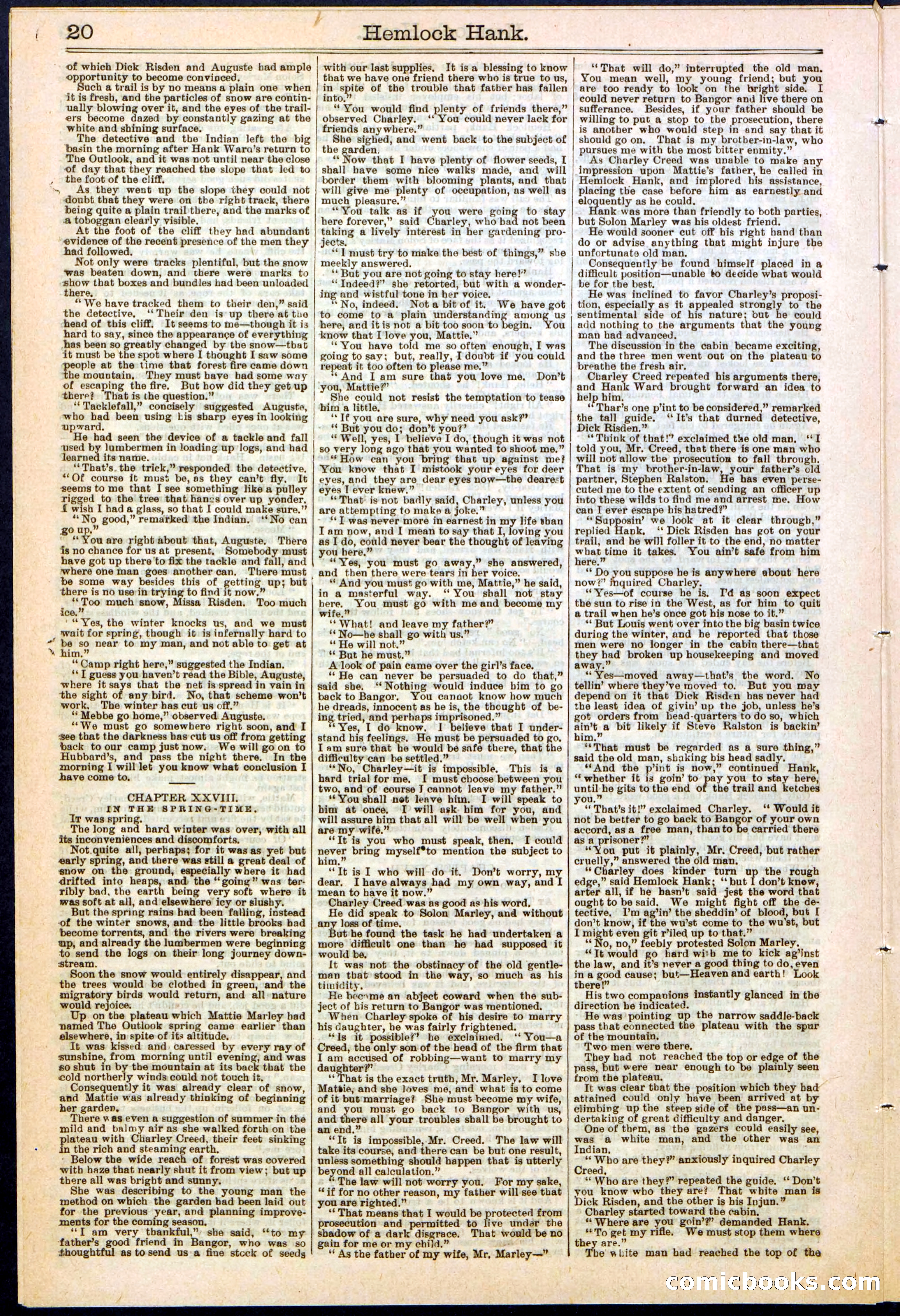
A restored page from Pulp Fiction, 1884. Page through the whole issue in the reader above.
📄 Transcribed text from this page (OCR, searchable)
Machine-transcribed from the original scan — historical spelling and the odd misread are preserved.
t! i eZ SS oS = or ™ 20 of which Dick Risden and Auguste had ample opportunity to become convinced. uch a trail is by no means a plain one when it is fresh, and the particles of snow are contin- ually blowing over it, and the eyes of the trail- ers become dazed by constantly gazing at the white and shining surface. The detective and tbe Indian left the big basin the morning after Hank Wara’s return to The Outlook, and it was not until near the close of day that they reached the slope that led to the foot of the cliff. As they went up the slope they could not doubt that they were on the right track, there being quite a plain trail there, and the marks of a toboggan clearly visible. At the foot of the cliff they had abundant evidence of the recent presence of the men they had followed. Not only were tracks plentiful, but the snow ‘was beaten down, and there were marks to a that boxes and bundles bad been unloaded there, “We have tracked them to their den,” said the detective. ‘‘ Their den is up there at the head of this cliff. It seems to me—though it is hard to say, since the appearance of everything has been so nwa 4 changed by the snow—tbat it must be the spot where I thought I saw some eople at the time that forest fire came down he mountain, They must bave had some way of escaping the fire. But how did they get up there? That is the question.” ‘“*Tacklefall,” concisely suggested Auguste, who had been using bis sharp eyes in looking upward. He had seen the device of a tackle and fall sed by lumbermen in loading up logs, and had earned its name. ‘*That’s. the trick,” responded the detective. “Of course it must be, as they can’t fly. It seems to me that I see something like a pulley aL Wi to the tree that hanes over up yonder, 4 wish I had a glass, so that I could make sure.” ““No good,” remarked the Indian, ‘‘No can go up,” ory A Yon are right about that, Auguste, There ‘is no chance for us at present, Somebody must have got up there to fix the tackle and fall, and where one man goes another can, There must be some way besides this of getting up; but | there is no use:in trying to find it now.” ; ‘Too much snow, Missa Risden. Too much ce, '“ Yes, the winter knocks us, and we must wait for spring, though it is infernally hard to ~" be so near to my man, and not able to get at % him,” “Camp right here,” suggested the Indian. ‘*T guess you haven’t read the Bible, Auguste, where it says that the net is spread in vain in the sight of any bird. No, that scheme won't work, The winter has cut us off.” ‘** Mebbe go home,” observed Auguste. *““We must go somewhere right soon, and I see that the darkness bas cut us off from getting back to our camp just now. We will goon to Hubbard’s, and pass the night there. In the morning I will let you know what conclusion I have come to, CHAPTER XXVIII. IN THE SPRING-TIME, Iv was pertad. ‘ The long and hard wiuter was over, with all its inconveniences and discomforts, Not.quite all, perhaps; for it wasas yet but early spring, and there was still a great deal of snow on the ground, especially where it had drifted into heaps, and the “going” was ter- ribly bad, the earth being very soft where it was soft at all, and elsewhere icy or slushy. But the spring rains had been falling, instead of the winter snows, and the little brooks bad become torrents, and the rivers were breaking up, and already the lumbermen were beginning to send the logs on their long journey down- stream. Soon the snow would entirely disappear, and the trees would be clothed in green, and the migratory birds would return, and all nature would rejoice. it Up on the plateau which Mattie Marley had named The Outlook spring came earlier than elsewhere, in spite of its altitude. It was kissed and. caressed by every ray of sunshine, from ore med evening, and was so shut in by the mountain at its back that the cold northerly winds could not touch it, Consequently it was already clear of snow, and Mattie was already thinking of beginning her garden, There v as even a suggestion of summer in the mild and balmy air as she walked forth on the lateau with Charley Creed, their feet sinking fh the rich and steaming earth. ' Below the wide reach of forest was covered with baze that nearly shut it from view; but up there all was bright and sunny. She was describing to the young man the method on which the garden bad been laid out for the previous year, and planning improve- ments for the coming season, ‘“T am very than " she said, ‘“‘*to my ‘father’s good friend in Bangor, who was so thoughtful as tosend us a fine stcck of seeds Hemlock Hank. with our last supplies. It isa blessing to know that we have one friend there who is true to us, in spite of the trouble that fatber has fallen into.” “You would find plenty of friends there,” observed Charley. ‘‘ You could never lack for friends any where.” She sighed, and went back to the subject of the garden. “Now that I have plenty of flower seeds, [ shall bave some nice walks made, and will border them with blooming plants, and that will give me plenty of occupation, as well as much pleasure.” “You talk as if you were going to stay here forever,” said Charley, who bad not been taking a lively interest in her gardening pro- jects, “I must try to make the best of things,” sbe meekly answered. ‘* But you are not going to stay here!’ *“ Indeed?” she retorted, but with a wonder- ing and wistful tone in her voice, ‘** No, indeed. Nota bitof it. We have got to come to a plain understanding among us here, ard itis not a bit too soon to begin. ou know that I love you, Mattie.” “You have told me so often enough, I was going to say; but, really, I doubt if you could repeat it too often to please me.” ‘And I am sure that you love me. Don’t you, Mattie?” She could not resist the temptation to tease him a little, ‘“If you are sure, why need you ask?” ** But you do; don’t you?’ “Well, yes, I believe I do, though it was not so very long ago that you wanted to shoot me.” “How can you bring that up against me? You kynow that I mistook your eyes for deer eyes, and they are dear eyes now—the dearest eyes I ever knew.” ‘That is not badly said, Charley, unless you are attempting to make a joke.” - **T was never more in earnest in my life than I am now, and I mean to say that I, loving you as I do, could never bear the thought of leaving you here,” “Yes, you must go away,” she answered, and then there were tears in her voice. “* And you must go with me, Mattie,” he said, in a masterful way. ‘“ You shall not stay pat You must go with me and become my wife. ‘* What! and leave my father?’ ** No—he shall go with us.” “* He will not.” ** But he must.” A look of pain came over the girl’s face. ‘He can never be persuaded to do that,” said she. ‘“ Nothing would induce bim to go back to Bangor. You canaot know how much he dreads, innocent as he is, the thought of be- ing tried, and perhaps imprisoned.” ‘Yes, I do know, I believe that I under- stand his feelings. He must be persuaded to go, I am sure that he would be safe there, that the difficulty can be settled.” “No, Charley—it is impossible. This is a hard trial for me, I must choose between you two, and of course J cannot leave my father.” “You shall net leave him. I will speak to him at once, I will ask. him for you, and will assure bim that all will be well when you are my wife.” “It is you who must speak, then, I could eens bring myself*to mention the subject to im “It is I who will do it. Don’t worry, my dear, [have always had my own way, and I mean to have it now.” ogee Creed was as good as his word, He did speak to Solon Marley, and without any loss of time. But he found the task he had undertaken a more difficult one than he had supposed it would be, It was not the obstinacy of the old gentle- man tbat stood in the way, so much as his timidity. He beexme an abject coward when the sub- ject of bis return to Bangor was mentioned. When Charley spoke of his desire to marry his daughter, he was fairly frightened. “Is it possible?’ be exclaimed. ‘‘ You—a Creed, the only son of the head of the firm that I am accused of robbing—want to marry my daughter?” ‘* That is the exact truth, Mr. Marley. I love Mattie; and she loves me, and what is to come of it but' marriage? She must become my wife, and ae must go back to Bangor with us, aud there all your troubles shall be brought to an end.” “It is impossible, Mr. Creed. The law will take its course, and there can be but one result, unless something should happen that is utterly beyond all calculation.” The law will not worry you. For my sake, “if for no other reason, my father will see that you are righted.” ‘* That means that I would be protected from prosecution and permitted to live under the shadow of a dark disgrace. That would be no gain for me or my child.” Te ‘* As the father of my wife, Mr, Marley—” ae ily “That will do,” interrupted the old man. ou mean well, my young friend; but you are too ready to look on the bright side. I could never return to Bangor and live there on sufferance. Besides, if your father should be willing to put a stop to the prosecution, there is another who would step in and say that it should goon, That is my brotber-in-law, who pursues me with the most bitter enmity.” As Charley Creed was unable to make any impression upon Mattie’s father, he called in Hemlock Hank, and implored his assistance, placing tbe case before him as earnestly and eloquently as he could, ank was more than friendly to both parties, . but Solon Marley was his oldest friend. He would sooner cut off his right band than do or advise anything that might injure the unfortunate old man. Consequently be found himself placed in a difficult position—unable to decide what would be for the best. He was inclined to favor Charley’s proposi- tion, especially as it appealed seronaty to the sentimental side of his nature; but he could add nothing to the arguments that the young man had advanced. The discussion in the cabin became exciting, and the three men went out on the plateau to breathe the fresh air. Charley Creed repeated his arguments there, and Hank Ward brought forward an idea to help him. ‘*Thar’s one p’int to be considered,” remarked the tall guide. “It’s that durned detective, Dick Risden.” “Think of that!” exclaimed the old man, ‘I told you, Mr, Creed, that there is one man who will not allow the prosecution to fall through. That is my brother-in-law, your father’s old partner, Stephen Ralston. He has even perse- cuted me to the extent of sending an officer up into these wilds to find me and arrest me. How can I ever escape his hatred?” “Supposin’ we Jook at it clear througb,” replied Hank, ‘‘ Dick Risden has got on your trail, and be will foller it to the end, no matter what time it takes. You ain’t safe from him here.” ‘** Do you suppose he is anywhere about here now?” inquired Charley. ‘*Yes—of course he is, I'd as soon expect the sun to rise in the West, as for him to quit a trail when he’s once got his nose to it.” ** But Louis went over into the big basin twice during the winter, and he reported that those men were no longer in the cabin there—that they had broken up housekeeping and moved away. “Yes—moved away—that’s the word. No tellin’ where they’ve moved to. But you may depend on it that Dick Risden bas never had the least idea of givin’ up the job, unless he’s got orders from bead-quarters to do so, which ain’t a bit likely if Steve Ralston is backin’ him,” ‘*That must be regarded as a sure thing,” said the old man, shaking bis head sadly. *‘And the p’int is now,” continued Hank, “‘ whether it is goin’ to pay you to a here, until he gits tothe end of the trail and ketches ou. “That's it!” exclaimed Charley. ‘t Would it not be better to go back to ora ea of your own accord, asa free man, thanto be carried there as a prisoner?” ‘You put it plainly, Mr. Creed, but rather cruelly,” answered the old man. ‘*Charley does kinder turn up the rough edge,” said Hemlock Hank; ‘‘ but I don’t knew, arter all, if he basn’t said jest the word that ought to be said. We might fight off the de- tective. I’m ag’in’ the sheddin’ of blood, but [ don’t know, if the wu’st come to the wu'st, but I might even git r’iled up to that.” ‘* No, no,” feebly protested Solon Marley. “Tt would go bard with me to kick ag’inst the law, and it’s never a good thing to do, even in a good cause; but—Heaven and earth! Look there!” His two compavions instantly glanced in the direction he indicated. He was pointing up the narrow saddle-back pass that connected the plateau with the spur of the mountain. Two men were there, They had not reached the top or edge of the pass, but were near enough to be plainly seen from the plateau. It was clear that the position which they bad attained could only have been arrived at by climbing up the steep side of the pass—an un- dertaking of great difficulty and danger. One of them, as the gazers could easily see, was a white man, and the other was an Indian. 4 , G oe are they?” anxiously inquired Charley reed, | ** Who are they?” repeated the guide. ‘‘ Don’t you know who they are? That white man is Dick Risden, and the other is his Injun.” Charley started toward the cabin. “Where are you goin’?”? demanded Hank. “To get my rifle. We must stop them where they are.” The wlite man bad reached the top of the Gomichboo S