
Pulp Fiction, 1884 · page 19 of 32
Beadle's New York Dime Library No. 308 — page 19: what you’re looking at
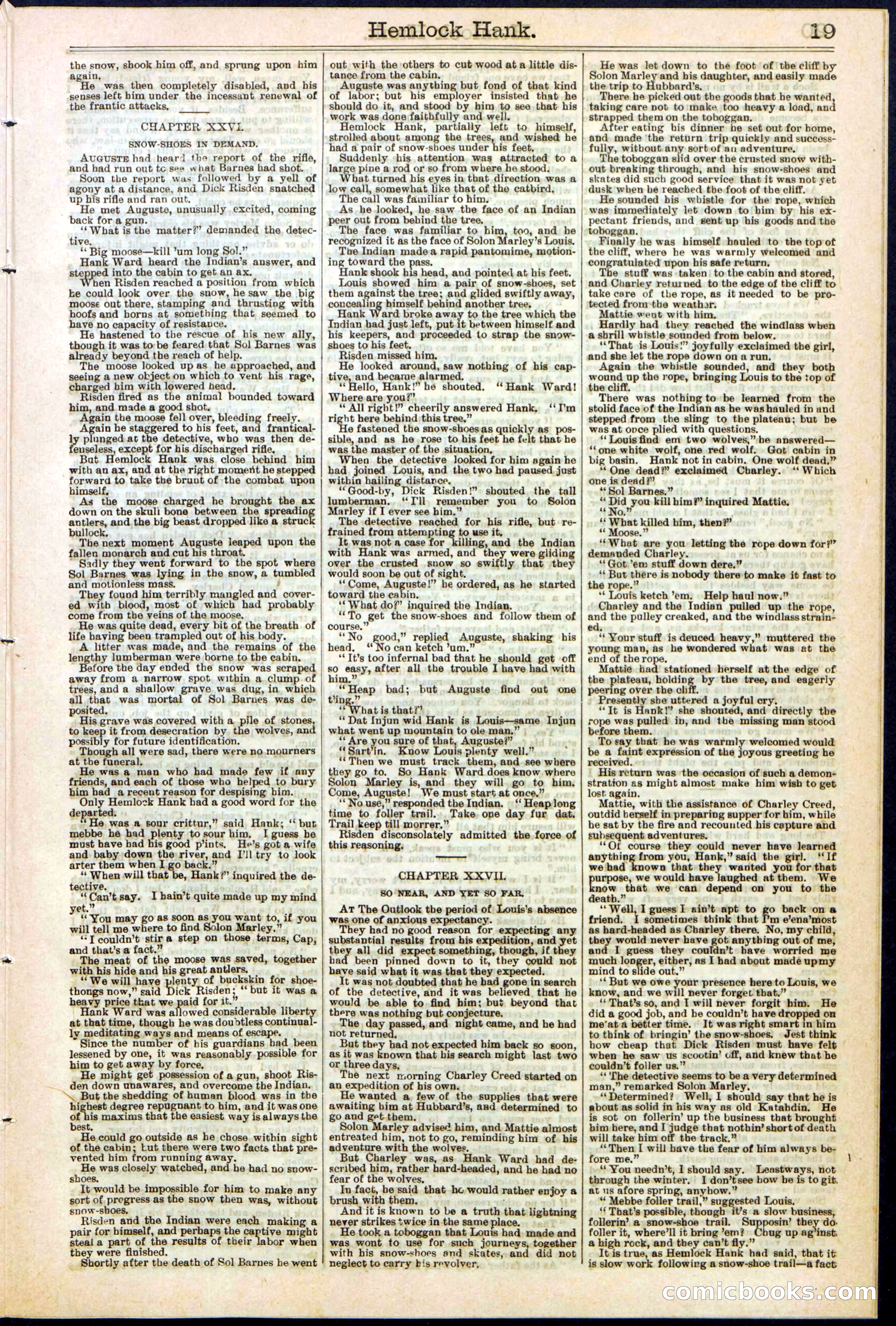
A restored page from Pulp Fiction, 1884. Page through the whole issue in the reader above.
📄 Transcribed text from this page (OCR, searchable)
Machine-transcribed from the original scan — historical spelling and the odd misread are preserved.
the snow, shook him off, and sprung upon him again, ; He was then completely disabled, and _ his senses left bim under the incessant renewal of the frantic attacks, CHAPTER XXXVI SNOW-SHOES IN DEMAND. AUGUSTE had heard the report of the rifle, and had run out te see what Barnes bad shot. Soon the report was followed by a yell of agony at a distance, and Dick Risden snatched up his rifle and ran out. He met Auguste, unusually excited, coming back for a gun. ‘‘ What is the matter?’ demanded the. detec- tive. ‘* Big moose—kill ’um long Sol.” Hank Ward heard the Indian’s answer, and stepped into the cabin to get an ax. ben Risden reached a position from which ke could look over the snow, he saw the big moose out there, stamping and thrusting with hoofs and borns at something that seemed to have no capacity of resistance. He hastened to the rescue of his new ally, though it was to be feared that Sol Barnes was already beyond the reach of help. The moose looked up as he approached, and seeing a new okject on which to vent his rage, charged bim with lowered head, Risden fired as the animal bounded toward him, and made a good shot. Again the moose fell over, bleeding freely. Again he eens to his feet, and frantical- ly plunged at the detective, who was then de- fenseless, except for his discharged rifle, But Hemlock Hank was close behind him with an ax, and at the right momett he stepped forward to take the brunt of the combat upon himself, As the moose charged he brought the ax down on the skuli bone between the spear ing ne ay and the big beast dropped like a struck bullock, The next moment Auguste leaped upon the fallen monarch and cut his throat. ' Sadly they went forward to the spot where Sol Barnes was lying in the snow, a tumbled and motionless mass. t They found him terribly mangled and cover- ed with blood, most of which had probably come from the veins of the moose, He was quite dead, every bit of the breath of life having been trampled out of his body. A litter was made, and the remains of the lengthy lumberman were borne to the cabin, Before the day ended the snow was scraped away from a narrow spot. within a clump of trees, anda shallow grave was dug, in. which all that was mortal of Sol Barnes was de- posited. His grave was covered with a to a it from desecration by possibly for future identification. Though all were sad, there were no mourners at the funeral. He was a man who had made few if any friends, and each of those who helped to bury him had a recent reason for despising bim. Rg a Hank had a good word for the departed. R He was a sour crittur,” said Hank; ‘ but mebbe he had plenty tosour him, I guess he must have had his good p’ints. He’s gota wife and baby down the river, and I'll try to look arter them when I go back.” ‘‘ When will that Hank?” inquired the de- tective. “Can’t say. I bain’t quite made up my mind et.” ‘You may go as soon as you want to, if you will tell me & ere to find Solon Marley.” si ‘*T couldn’t stira step on those terms, Cap, and that’s a fact.” meat of the moose was saved, together with his hide and his great antlers, _ “We will have plenty of buckskin for shoe- thongs now,” said Dick Risden; “‘ but it was a heavy price that we paid for it.” Hank Ward was allowed considerable libert at that time, though he was doubtless continual- ly meditating ways and means of escape. Since the number of his guardians had been lessened by one, it was reasonably possible for him to get away by force, He might get possession of a gun, shoot Ris- den down unawares, and overcome the Indian. ile of stones 6 wolves, an . ‘\. But the shedding of human blood was in the highest degree repugnant to him, and it was one on is maxims that the easiest way is always the t. He could go outside as he chose within sight of the cabin; Lut there were two facts that pre- vented him from runnin away. He was closely watched, and he had no snow- shoes. It would be. ipcastble for him to make any sort of progress as the snow then was, without snow-shoes, Risden and the Indian were each making a pair for bimself, and perhaps the pentive might steal a part of the results of their labor when they were finished. _ Shortly after the death of Sol Barnes he went _ Hemlock Hank. out with the others to cut wood ata little dis- tance from the cabin. Auguste was anything but fond of that kind of labor; but his employer insisted that he should do it, and stood by him to see that his work was done faithfully and well. Hemlock Hank, partially left to himself, strolled about among the trees, and wished he had a pair of snow-shoes under his feet, Suddenly his attention was attracted to a large pine a rod or so from where he stood. What turned his eyes in that direction was a low call, somewhat like that of the catbird, The call was fainiliar to him. As he looked, he saw the face of an Indian peer out from behind the tree, The face was familiar to him, too, and he recognized it as the face of Solon Marley’s Louis. Tbe Indian madea rapid pantomime, motion- ing toward the pass. Hank shook his head, and pointed at his feet. Louis showed him a pair of snow-shoes, set them against the tree; aud glided swiftly away, concealing himself behind another tree, Hank Ward broke away to the tree which the Indian had just left, put it between himself and his keepers, and proceeded to strap the snow- shoes to his feet. Risden missed him, He looked around, saw nothing of his cap- tive, and became alarmed. ‘* Hello, Hank!” he shouted. ‘“‘ Hank Ward! Where are you?” ‘** All right!” cheerily answered Hank, right here behind this tree,” e fastened the snow-shoes as quickly as pos- sible, and as he rose to his feet he felt that he was the master of the situation, When the detective looked for him again he had joined Louis, and the two had paused just within hailing distance, ““Good-by, Dick Risden!” shouted the tall lumberman. ‘I'll remember you to Solon Marley if I ever see him.” The detective reached for his rifle, but re- frained from attempting to use it, It was not a case for killing, and the Indian with Hank was armed, and they were gliding over the crusted snow so swiftly that they would soon be out of sight, “Come, Auguste!” he ordered, as he started toward the cabin, ‘* What do?” inquired the Indian. “To get the snow-shoes and follow them of course.” ‘No good,” replied Auguste, shaking his head. “No can ketch ’um.” ‘* It’s too infernal bad that he should get off -e easy, after all the trouble I have had with im. my Heap bad; but Auguste find out one ting. ** What is that?” ‘“* Dat Injun wid Hank is Louis—same Injun what went up mountain to ole man.” | “Are you sure of that, Auguste?’ “Sart'in. Know Louis plenty well.” ‘Then we must track them, and see where they go to. So Hank Ward does know where Solon Marley is, and they will go to him. Come, Auguste! We must start at once,” _‘‘ No use,” responded the Indian. ‘‘ Heap long time to foller trail. Take one day fur dat, Trail keep till morrer,” Risden disconsolately admitted the force of this reasoning. ‘ee I'm ———— CHAPTER XXVIL SO NEAR, AND YET SO FAR, AT The Outlook the period of Louis’s absence was one of anxious expectancy. They had no good reason for expecting any substantial results from bis expedition, and yet they all did expect something, though, if they had been pinned down to it, they could not have said what it was that they expected. It was not doubted that he bad gone in search of the detective, and it was believed that he would be able to find him; but beyond that there was noleleg but conjecture, The day passed, and night came, and he had not returned, But they had not expected him back so soon, as it was known that his search might last two or three days, The next morning Charley Creed started on an expedition of his own. He wanted a few of the supplies that were awaiting bim at Hubbard’s, and determined to go and get. them. Solon Marley advised him, and Mattie almost entreated him, not to go, reminding him of his adventure with the wolves. But Charley was, as Hank Ward had de- scribed him, rather hard-headed, and he had no fear of the wolves, In fact, be said that hc would rather enjoy a brush with them, dive © And it is known to be a truth that lightning never strikestwice inthe sameplace. | He took a toboggan that Louis had made and was wont to use for such journeys, together with his snow-shoes and skates, and did not neglect to carry bis revolver, 19 ooo He was let down to the foot of the cliff by Solon Marley and bis daughter, and easily made the trip to Hubbard’s, There he picked out the goods that he wanted, taking care not to make too heavy a load, and strapped them on the toboggan. After eating bis dinner he set out for home, and made the return trip quickly and success- — witbout. any sortof an adventure. The toboggan slid over the crusted snow with- out breaking through, and his snow-shoes and skates did such good service that it was not yet dusk when be reached the foot of the cliff. He sounded bis whistle for the rope, which was immediately let down to bim by his ex- pectant friends, and sent up his goods and the toboggan. Finally he was himself hauled to the topot the cliff, where he was warmly welcomed and congratulated upon his safe return, The stuff was taken to the cabin and stored, and Charley returned to the edge of the cliff to take care of the rope, as it needed to be pro- tected fromthe weathar. Mattie went with him. Hardly had they reached the windlass when a shrill whistle sounded from below. “That is Louis!” joyfully exclaimed the girl, and she let the rope down on a run. Again the whistle sounded, and they both wound up the rope, bringing Louis to the top of the cliff. There was nothing to be learned from the stolid face of the Indian as he was hauled in and stepped from the sling to the plateau; but be was at once plied with questions. ‘‘ Louis find em two wolves,” he answered— ‘‘one white wolf, one red wolf. Got cabin in big basin. Hank not in cabin. One wolf dead,” “One dead?” exclaimed Charley. ‘‘ Which one is dead?” ** Sol Barnes.” i Did you kill him?” inquired Mattie. oO. ‘* What killed him, then?’ ** Moose.” ‘*What are you letting the rope down for?” demanded Charley. . ‘*Got’em stuff down dere.” ‘** But there is nobody there to make it fast to the rope.” ‘** Louis ketch ’em. Help haul now.” dt Charley and the Indian pulled up the rope, and the pulley creaked, and the windlass stHeine ‘* Your stuff is deuced heavy,” muttered the young man, as he wondered what was at the end of the rope, Mattie had stationed herself at the edge of the plateau, ea | by the tree, and eagerly peering over the cliff. ” Presently she uttered a joyful cry. “It is Hank!” she shouted, and directly the rope was pulled in, and the missing man stood before them. . To say that he was warmly welcomed would be a faint expression of the joyous greeting he received. His return was the occasion of such a demon- stration as might almost make him wish to get lost: again. Mattie, with the assistance of Charley Creed, outdid berself in preparing supper for him, while he sat by the fire and recounted his capture and subsequent adventures. ‘“Of course they could never have learned anything from you, Hank,” said the girl. “If we bad known that wn wanted you for that —— we would have laughed at them. We on bhat we can depend on you to the ° it ‘* Well, I guess I ain’t apt to back on a friend. I sometimes think that I’m e’ena’most as hard-headed as Charley there. No, my chili tbey would never have got anything out of me, aud I guess they couldn’t have worried me much longer, eitber, as Il had about made upmy mind to slide out,” ‘* But we owe your presence here to Louis, we know, and we will never forget that.” ; ‘* That’s so, and I will never forgit him. He did a good job, and he couldn’t have ne oe on me‘ata better time. It was right smart in him to think of bringin’ the snow-shoes, Jest think how cheap tha when he saw us scootin’ off, and knew that he couldn’t foller us.” ‘“*'The detective seems to be a very determined man,” remarked Solon Marley, ““ Determined? Well, I should say that he is about as solid in his way as old Katahdin. He is sot on follerin’ up the business that brought him here, and I judge that nothin’ short of death will take him off the track.” ‘ “Then I will bave the fear of him always be- fore me,” “You needn’t, I should say. Leastways, not through the winter. I don’tsee how be is to git, at us afore spring, anyhow.” “ Mebbe foller trail,” sug d Louis. ‘‘ That’s possible, though it’s a slow business, follerin’ a snow-shoe trail. tay on they do. foller it, where’ll it bring ’em? ug up ag’inst, a high rock, and they can’t fly.” ’ It is true, as Hemlock Hank had said, that it: is slow work followirg a snow-shoe trail—a fact Dick Risden must have felt — MICOOKS (E(0) (EO) See