
Pulp Fiction, 1884 · page 25 of 32
Beadle's Dime Library No. 307 — page 25: what you’re looking at
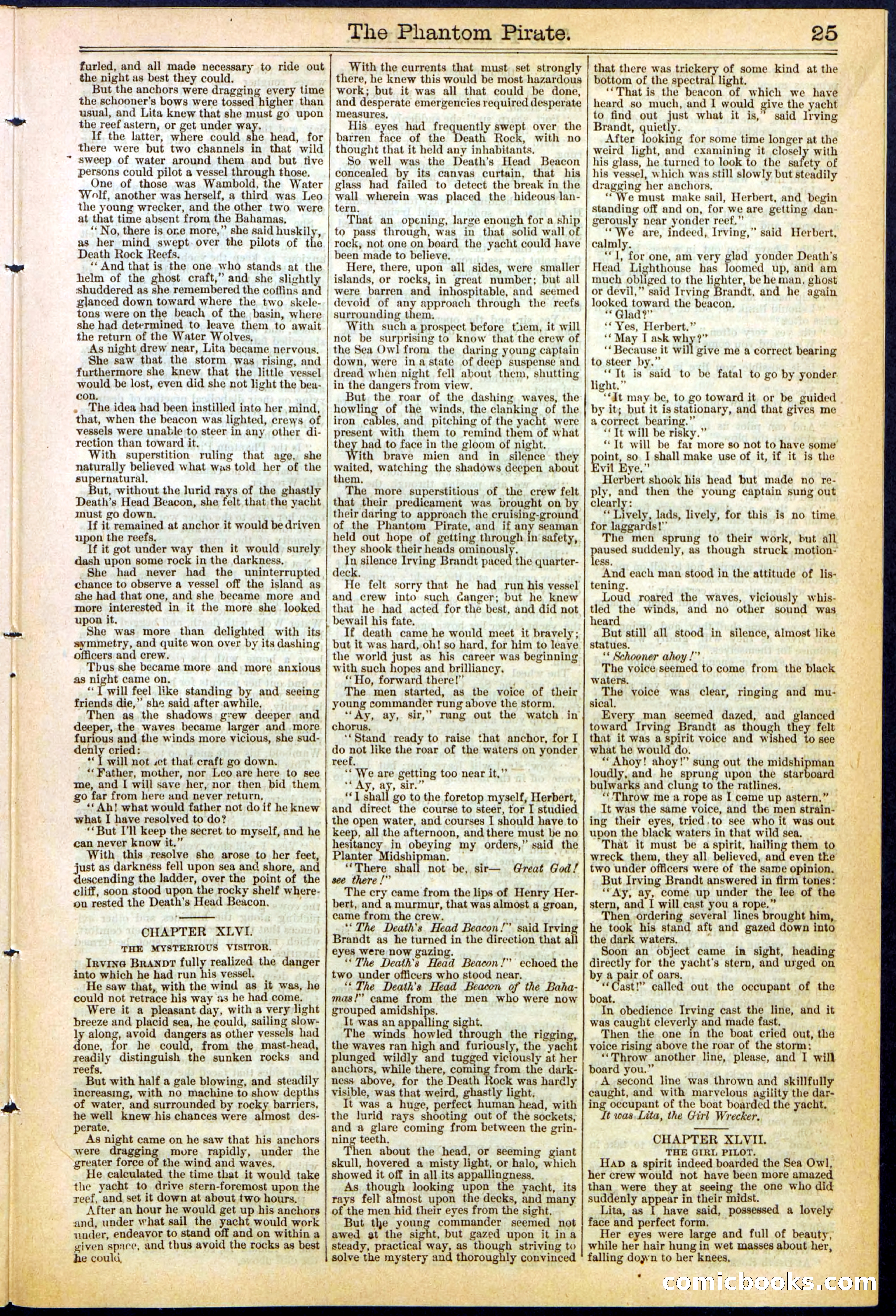
A restored page from Pulp Fiction, 1884. Page through the whole issue in the reader above.
📄 Transcribed text from this page (OCR, searchable)
Machine-transcribed from the original scan — historical spelling and the odd misread are preserved.
The Phantom Pirate. 25 furled, and all made necessary to ride out the night as best they could. But the anchors were dragging every time the schooner’s bows were tossed higher than usual, and Lita knew that she must go upon the reef astern, or get under way. If the latter, where could Ae head, for there were but two channels in that wild sweep of water around them and but tive persons could pilot a vessel through those. One of those was Wambold, the Water Wolf, another was herself, a third was Leo the young wrecker, and the other two were at that time absent from the Bahamas, ‘‘ No, there is one more,” she said huskily, as her mind swept. over the pilots of the Death Rock Reefs. ‘* And that is the one who stands at the helm of the ghost craft,” and she slightly shuddered as she remembered the coftins and glanced down toward where the two skele- tons were on the beach of the basin, where she had determined to leave them to await the return of the Water Wolves, As night drew near, Lita became nervous. She saw that the storm was rising, and furthermore she knew that the little vessel would be lost, even did she not light the bea- con, . The idea had been instilled into her mind, that, when the beacon was lighted, crews of vessels were unable to steer in any other di- rection than toward it. With superstition ruling that age, she naturally believed what was told her of the supernatural, ut, without the lurid rays of the ghastly Death’s Head Beacon, she felt that the yacht must go down. If it remained at anchor it would be driven upon the reefs. If it got under way then it would surely dash upon some rock in the darkness, She had never had the uninterrupted chance to observe a vessel off the island as she had that one, and she became more and more interested in it the more she looked upon it. She was more than delighted with its symmetry, and quite won over by its dashing officers and crew. : Thus she became more and more anxious as night came on. “] will feel like standing by and seeing friends die,” she said after awhile, Then as the shadows grew deeper and deeper, the waves became larger and more furious and the winds more vicious, she sud- denly cried: **T will not uct that craft go down. ‘‘ Father, mother, nor Leo are here to see me, and [ will save her, nor then bid them go far from here and never return, ‘‘ Ah! what would father not do if he knew what I have resolved to do? ‘‘But I'll keep the secret to myself, and he can never know it.” With this resolve she arose to her feet, just as darkness fell upon sea and shore, and descending the ladder, over the point of the cliff, soon stood upon the rocky shelf where- on rested the Death’s Head Beacon, , CHAPTER XLVI. THE MYSTERIOUS VISITOR. Irvine Branot fully realized the danger into which he had run his vessel. | He saw that, with the wind as it was, he could not retrace his way 2s he had come. Were it a pleasant day, with a very light breeze and placid sea, he could, sailing slow- ly along, avoid dangers as other vessels had | is for he cane from the mast-head, readily distinguish the sunken rocks and reefs, But with half a gale blowing, and steadily increasing, with no machine to show depths of water, and surrounded by rocky barriers, he well knew his chances were almost des- perate, As night came on he saw that his anchors were dra mure rapidly, under the - greater force of the wind and waves, He calculated the time that it would take the yacht to drive stern-foremost upon the reef, and set it down at about two hours. After an hour he would get up his anchors and, under what sail the yacht would work under, endeavor to stand off and on within a given space, and thus avoid the rocks as best he could, > - ee + e* a “2 ' Se Pee With the currents that must set strongly there, he knew this would be most hazardous work; but it was all that could be done, and desperate emergencies required desperate measures, His eyes had frequently swept over the barren face of the Death Rock, with no thought that it held any inhabitants. So well was the Death’s Head Beacon concealed by its canvas curtain, that his glass had failed to detect the break in the wall wherein was placed the hideous lan- tern. That an opening, large enough for a ship to pass through, was in that solid wall of rock, not one on board the yacht could have been made to believe. Here, there, upon all sides, were smaller islands, or rocks, in great number; but all were barren and inhospitable, and seemed devoid of any approach through the reefs surrounding them, With such a prospect before tiem, it will not be surprising to know that the crew of the Sea Owl from the daring young captain down, were ina state of deep suspense and dread when night fell about them, shutting in the dangers from view. But the roar of the dashing waves, the howling of the winds, the clanking of the iron cables, and pitching of the yacht were present with them to remind them of what ney had to face in the gloom of night. ith brave mien and in silence they waited, watching the shadows deepen about them. The more superstitious of the crew felt that their predicament was brought on by their daring to approach the cruising-ground of the Phantom Pirate, and if any seaman held out hope of getting through in safety, they shook their heads ominously. F ry silence Irving Brandt pitied: the quarter- eck, He felt sorry that he had run his vessel and crew into such Canger; but he knew that he had acted for the best, and did not bewail his fate. If death came he would meet it bravely; but it was hard, oh! so hard, for him to leave the world just as his career was beginning with such hopes and brilliancy, **Ho, forward there!” , The men started, as the voice of their young commander rung above the storm, ‘‘Ay, ay, sir,” rang out the watch in chorus. ‘* Stand ready to raise that anchor, for I do he like the roar of the waters on yonder reet, ‘* We are getting too near it,” ‘Ay, ay sir.” ‘*] shall go to the foretop myself, Herbert, and direct the course to steer, tor I studied the open water, and courses I should have to keep, all the afternoon, and there must be no hesitancy in obeying my orders,” said the Planter Midshipman. — : “There shall not be, sir— Great God! see there /” The cry came from the lips of Henry Her- bert, and a murmur, that was almost a groan, came from the crew. “The Death's Head Beacon!” said Irvin Brandt as he turned in the direction that eyes were now gazing. “The Death's Head Beacon!” echoed the two under officers who stood near. ‘*The Death's Head Beacon of the Baha- mas!” came from the men who were now grouped seginale It was an appalling sight. The winds howled through the rigging, the waves ran high and furiously, the yacht plunged wildly and tugged viciously at her anchors, while there, coming from the dark- ness above, for the Death Rock was hardly visible, was that weird, ghastly light, It was a huge, perfect human head, with the lurid rays shooting out of the sockets, and a glare coming from between the grin- ning teeth, Then about the head, or seeming giant skull, hovered a misty light, or halo, which showed it off in all its appallingness. As eae looking upon the yacht, its rays fell almost upon the decks, and many of the men hid their eyes from the sight. But the young commander seemed not awed at the sight, but gazed upon it ina steady, practical way, as though striving to solve the mystery and thoroughly convinced that there was trickery of some kind at the bottom of the spectral light. ‘“That is the beacon of which we have heard so much, and | would give the yacht to find out just what it is,” said Irving Brandt, quietly. After Tookiiie for some time longer at the weird light, and examining it closely with his glass, he turned to look to the safety of his vessel, which was still slowly but steadily dragging her anchors, “We must make sail, Herbert, and begin standing off and on, for we are getting dan- gerously near yonder reef,” ‘We are, indeed, Irving,” said Herbert, calmly. “1, for one, am very glad yonder Death's Head Lighthouse has loomed up, and am much obliged to the lighter, be he man, ghost or devil,” said Irving Brandt, and he again looked toward the beacon, ** Glad?” ‘“ Yes, Herbert.” ‘* May I ask why?” ‘* Because it will give me a correct bearing to steer by.” ‘It is said to be fatal to go by yonder. light.” ‘‘Jt may be, to go toward it or be guided | by it; but it is stationary, and that gives me a correct bearing.” ‘Tt will be risky.” ‘“It will be far more so not to have some oint, so I shall make use of it, if it is the vil Eye.” Herbert shook his head but made no re- ply, and then the young captain sung out clearly: ; * Lively, lads, lively, for this is no time. for laggards!"’ The men sprung to their work, but all pence suddenly, as though struck motion- $8. And each man stood in the attitude of lis- tening. Loud roared the waves, viciously whis- tled the winds, and no other sound was heard But still all stood in silence, almost like statues. ** Schooner ahoy !” The voice seemed to come from the black waters, The voice was clear, ringing and mu- sical. Every man seemed dazed, and glanced toward Irving Brandt as though they felt that it was a spirit voice and Wished to see what he would do. “ Ahoy! ahoy!” sung out the midshi) loudly, and he sprung upon the starboard bulwarks and clung to the ratlines. ' “Throw me a rope as I ceme up astern.” | It was the same voice, and the men strain- ing their eyes, tried.to see who it was out — upon the black waters in that wild sea. . That it must be a spirit, hailing them to wreck them, they all believed, and even the two under officers were of the same opinion. But Irving Brandt answered in firm tones: ‘*Ay, ay, come up under the lee of the stern, and I will cast you a rope.” ; Then ordering several lines brought hin, . 3 into he took his stand aft and gazed down the dark waters. Soon an object came in sight, heading directly for the yacht's stern, and urged on by a pair of oars. “Cast!” called out the occupant of the boat. ty In obedience Irving cast the line, and it was caught cleverly and made fast. my Then the one in the boat cried out, the voice rising above the roar of the storm: _ “Throw another line, please, and I will board you.” a A second line was thrown and skillfully caught, and with marvelous agility the dar- ing occupant of the boat boarded the yacht, é t was Lita, the Girl Wrecker. CHAPTER XLVII. THE GIRL PILOT. : Hap a spirit indeed boarded the Sea Owl, her crew would not have been more than were they at seeing the one who di suddenly appear in their midst. | Lita, as I have said, possessed a lovely face and perfect form. — . Her eyes were large and full of beauty, while her hair hung in wet masses about her, _ falling down to her knees, COMMING <S) JOO ‘ . - com . 2: YY ar : -_ =