
Pulp Fiction, 1884 · page 24 of 32
Beadle's Dime Library No. 307 — page 24: what you’re looking at
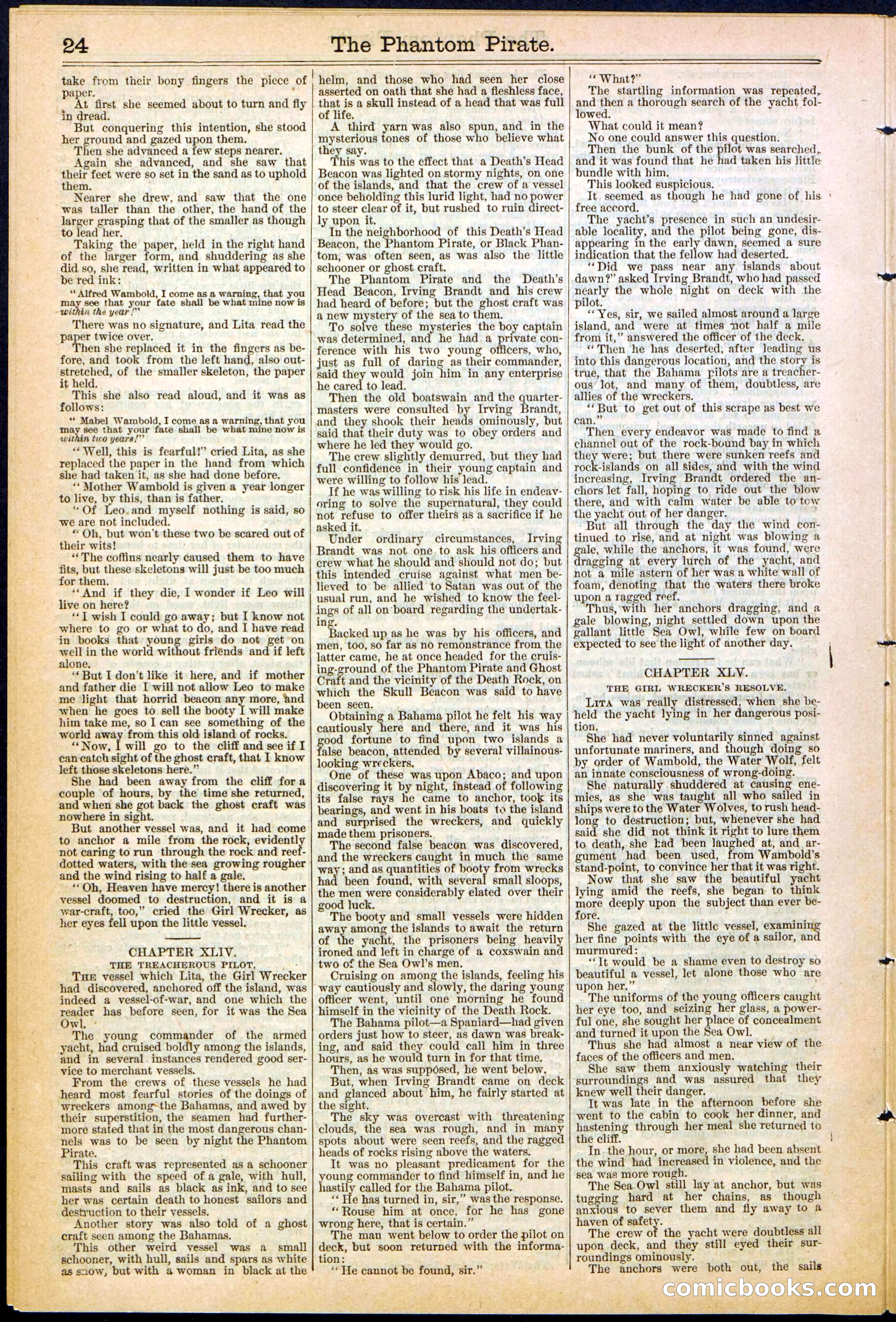
A restored page from Pulp Fiction, 1884. Page through the whole issue in the reader above.
📄 Transcribed text from this page (OCR, searchable)
Machine-transcribed from the original scan — historical spelling and the odd misread are preserved.
4% 7* ms - Pn es — Se er ee take from their bony fingers the piece of Paper. ’ t first she seemed about to turn and fly in dread. But conquering this intention, she stood her ground and gazed upon them. Then she advanced a few steps nearer. Again she advanced, and she saw that their feet were so set in the sand as to uphold them. Nearer she drew, and saw that the one was taller than the other, the hand of the larger grasping that of the smaller as though to lead her. Taking the paper, held in the right hand of the larger form, and shuddering as she did so, she read, written in what appeared to be red ink: “Alfred Wambold, I come as a warning, that you may see that your fate shall be what mine now is within the year!” There was no signature, and Lita read the paper twice over. Then she replaced it in the fingers as be- fore, and took from the left hand, also out- stretched, of the smaller skeleton, the paper it held, This she also read aloud, and it was as follows: “* Mabel Wambold, I come as a warning, that you may see that your fate shall be what mine now is within taco years!” ** Well, this is fearful!” cried Lita, as she replaced the paper in the hand from which she had taken it, as she had done before. ** Mother Wambold is given a year longer to live, by this, than is father. “Of Leo.and myself nothing is said, so we are not included. “Oh, but won’t these two be scared out of their wits! ‘*The coffins nearly caused them to have fits, but these skeletons will just be too much for them. ‘‘And if they die, I wonder if Leo will live on here? ‘*T wish I could go away; but I know not where to go or what to do, and I have read in books that young girls do not get on well in the world without friends and if left alone. ‘But I don’t like it here, and if mother and father die I will not allow Leo to make me light that horrid beacon any more, and when he goes to sell the booty I will make him take me, so I can see something of the world away from this old island of rocks. “Now, | will go to the cliff and see if I can catch sight of the ghost craft, that I know left those skeletons here.” She had been away from the cliff fora couple of hours, by the time she returned, and when she got back the ghost craft was nowhere in sight. But another vessel was, and it had come to anchor a mile from the rock, evident] not caring to run through the rock and reef- dotted waters, with the sea growing rougher and the wind rising to half a gale. **Oh, Heaven have mercy! there is another vessel doomed to destruction, and it is a war-craft, too,” cried the Girl Wrecker, as her eyes fell upon the little vessel. CHAPTER XLIV. THE TREACHEROUS PILOT, Tue vessel which Lita, the Girl Wrecker had discovered, anchored off the island, was indeed a vessel-of-war, and one which the reader has before seen, for it was the Sea Owl, ° The young commander of the armed yacht, had cruised boldly among the islands, and in several instances rendered good ser- vice to merchant vessels. From the crews of these vessels he had heard most fearful stories of the doings of --wreckers among-the Bahamas, and awed by their superstition, the seamen had further- ‘more stated that in the most dangerous chan- nels was to be seen by night the Phantom Pirate. This craft was represented as a schooner sailing with the speed ofa gale, with hull, masts and sails as black as ink, and to see her was certain death to honest sailors and +s nae " Se # 4a ai . ~~ - at Ls destruction to their vessels. Another story was also told of a ghost -eraft seen among the Bahamas. - This other weird vessel was a_ small schooner, with hull, sails and spars as white as snow, but with a woman in black at the _ ion ah * pupae. F es ! helm, and those who had seen her close | ——2 ————— ~- oe The Phantom Pirate. asserted on oath that she had a fleshless face, that is a skull instead of a head that was full of life. A third yarn was also spun, and in the mysterious tones of those who believe what they say. This was to the effect that a Death’s Head Beacon was lighted on stormy nights, on one of the islands, and that the crew of a vessel once beholding this lurid light, had no power to steer clear of it, but rushed to ruin direct- ly upon it, In the neighborhood of this Death’s Head Beacon, the Phantom Pirate, or Black Phan- tom, was often seen, as was also the little schooner or ghost craft. The Phantom Pirate and the Death’s Head Beacon, Irving Brandt and his crew had heard of before; but the ghost craft was a new mystery of the sea to them. To solve these mysteries the boy captain was determined, and he had a private con- ference with his two young officers, who, just as full of daring as their commander, said they would join him in any enterprise he cared to lead. Then the old boatswain and the quarter- masters were consulted by Irving Brandt, and they shook their heads ominously, but said that their duty was to obey orders and where he led they would go. The crew slightly demurred, but they had full confidence in their young captain and were willing to follow his lead. If he was willing to risk his life in endeav- oring to solve the supernatural, they could not refuse to offer theirs as a sacrifice if he asked it. Under ordinary circumstances, Irvin Brandt was not one to ask his officers an crew what he should and should not do; but this intended cruise against what men be- lieved to be allied to Satan was out of the usual run, and he wished to know the feel- ings of all on board regarding the undertak- ing. acted up as he was by his officers, and men, too, so far as no remonstrance from the latter came, he at once headed for the cruis- ing-ground of the Phantom Pirate and Ghost Craft and the vicinity of the Death Rock, on which the Skull Beacon was said to have been seen. Obtaining a Bahama pilot he felt his way cautiously here and there, and it was his ood fortune to find upon two islands a alse beacon, attended by several villainous- looking wreckers, One of these was upon Abaco; and upon discovering it by night, instead of following its false rays he came to anchor, took its bearings, and went in his boats to the island and surprised the wreckers, and quickly made them prisoners. The second false beacon was discovered, and the wreckers caught in much the same way; and as quantities of booty from wrecks hod been found, with several small sloops, the men were considerably elated over their good luck. The booty and small vessels were hidden away among the islands to await the return of the yacht, the prisoners being heavily ironed and left in charge of a coxswain and two of the Sea Owl’s men. Cruising on among the islands, feeling his way cautiously and slowly, the daring young officer went, until one morning he found himself in the vicinity of the Death Rock. The Bahama pilot—a Spaniard—had given orders just how to steer, as dawn was break- ing, and said they could call him in three hours, as he would turn in for that time. Then, as was supposed, he went below. But, when Irving Brandt came on deck and glanced about him, he fairly started at the sight. The sky was overcast with threatening clouds, the sea was rough, and in many spots about were seen reefs, and the ragged heads of rocks rising above the waters. It was no pleasant predicament for the young commander to find himself in, and he hastily called for the Bahama pilot. ‘* He has turned in, sir,” was the response. ‘Rouse him at once, for he has gone wrong here, that is certain.” The man went below to order the pilot on deck, but soon returned with the informa- tion: ‘*He cannot be found, sir.” eS ee EE eee eeeeeeeEeEeeeeeeeeeeee———e——e————ee—————e—— AL SS TBA, Be POL IEE UN LA ED GOCE BEE LE BE \ “© What?” The startling information was repeated, and then a thorough search of the yacht fol- lowed. What could it mean? No one could answer this question. Then the bunk of the pilot was searched,, and it was found that he had taken his little bundle with him. This looked suspicious. It seemed as though he had gone of his free accord. The yacht’s presence in such an undesir- able locality, and the pilot being gone, dis- appearing in the early dawn, seemed a sure indication that the fellow had deserted. “Did we pass near any islands about dawn?” asked Irving Brandt, who had passed nearly the whole night on deck with the pilot. ‘* Yes, sir, we sailed almost around a large island, and were at times not half a mile from it,” answered the officer of the deck. “‘Then he has deserted, after Jeading us into this dangerous location, and the story is true, that the Bahama pilots are a treacher- ous’ lot, and many of them, doubtless, are allies of the wreckers. ‘‘But to get out of this scrape as best we can.” Then every endeavor was made to find a channel out of the rock-bound bay in which they were; but there were sunken reefs and rock-islands on all sides, and with the wind increasing, Irving Brandt ordered the an- chors let fall, hoping to ride out the blow there, and with calm water be able to tow the yacht out of her danger. ; But all through the day the wind con- tinued to rise, and at night was blowing a ale, while the anchors, it was found, were ragging at every lurch of the yacht, and not a mile astern of her was a white wall of foam, denoting that the waters there broke upon a ragged reef. Thus, with her anchors dragging, and a gale blowing, night settled down upon the gallant little Sea Owl, while few on board expected to see the light of another day. CHAPTER XLY. THE GIRL WRECKER’S RESOLVE. Lira was really distressed, when she be- held the yacht lying in her dangerous posi- tion, She had never voluntarily sinned against unfortunate mariners, and though doing so by order of Wambold, the Water Wolf, felt an innate consciousness of wrong-doing. She naturally shuddered at causing ene- mies, as she was taught all who sailed in ships were to the Water Wolves, to rush head- long to destruction; but, whenever she had said she did not think it right to lure them to death, she kad been laughed at, and _ar- gument had been used, from Wambold’s stand-point, to convince her that it was right. Now that she saw the beautiful yacht lying amid the reefs, she began to think more deeply upon the subject than ever be- fore. She gazed at the little vessel, seers | her fine points with the eye of a sailor, an murmured: — ‘Tt would be a shame even to destroy so beautiful a vessel, let alone those who are upon her.” . The uniforms of the young officers caught her eye too, and seizing her glass, a power- ful one, she sought her place of concealment and turned it upon the Sea Owl. Thus she had almost a near view of the faces of the officers and men. , She saw them anxiously watching their surroundings and was assured that they knew well their danger. It was late in the afternoon before she went to the cabin to cook her dinner, and hastening through her meal she returned to the cliff. In. the hour, or more, she had been absent the wind had increased in violence, and the sea was more rough. The Sea. Owl still lay at anchor, but was tugging © hard at her chains, as though ~ anxious to sever them and fly away to 4 haven of pest: The crew of the yacht were doubtless all upon deck, and they still eyed their sur- roundings ominously. The anchors were both out, the Eomicbooks ’ -" ot