
Pulp Fiction, 1884 · page 14 of 24
Beadle's New York Dime Library, No. 306 — page 14: what you’re looking at
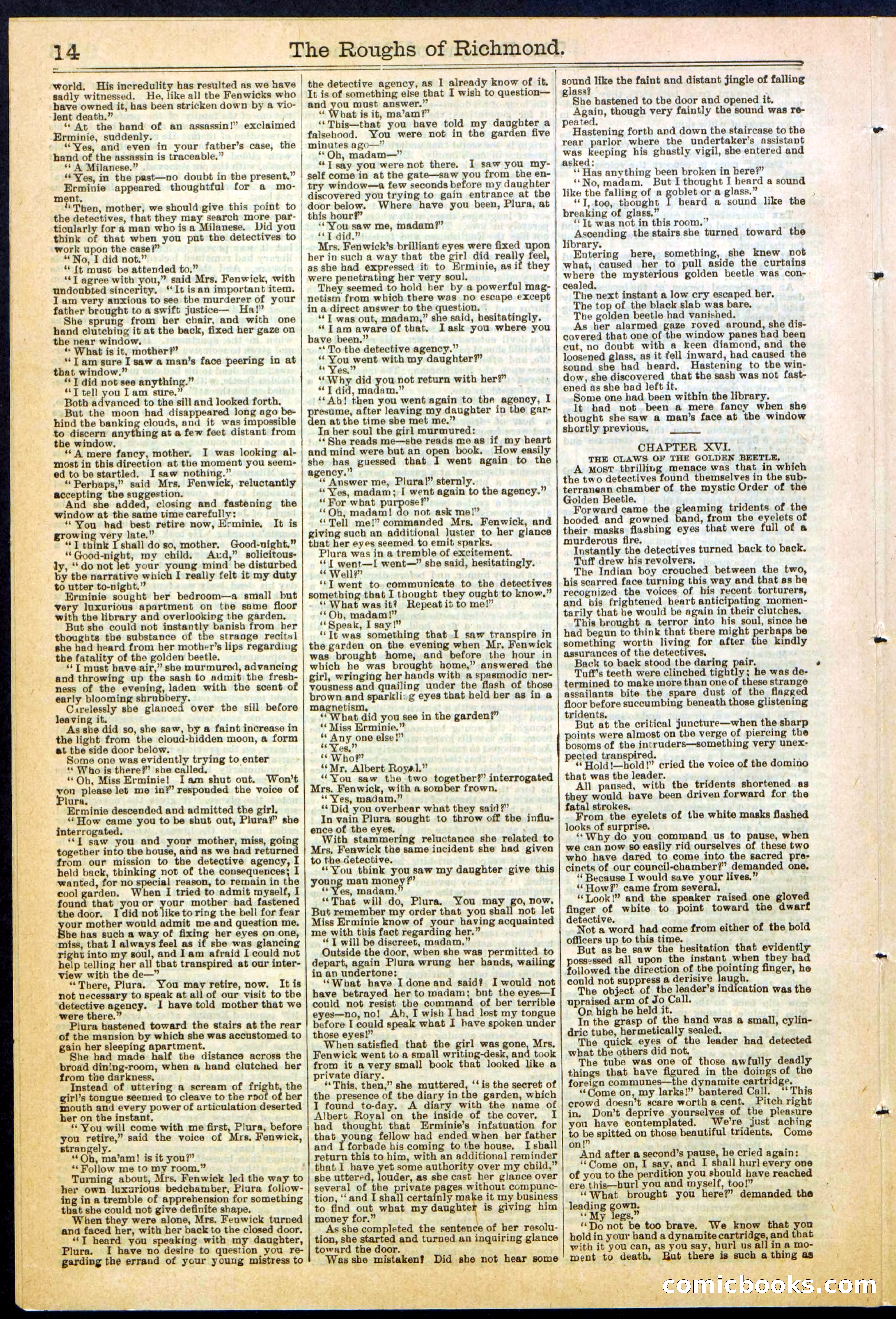
A restored page from Pulp Fiction, 1884. Page through the whole issue in the reader above.
📄 Transcribed text from this page (OCR, searchable)
Machine-transcribed from the original scan — historical spelling and the odd misread are preserved.
* i* — ’ 4 « ' rire > Sy ser? ' v 4 view with the de—” “detective agency. were there.” _of the mansion by which she was accustomed to broad dining-room, when a hand clutched her nin that she could not give definite shape. 11h _ and faced her, with her back to the closed door. : world. His incredulity has resulted as we have | the detective agency, as I already know of it. sadly witnessed. He, like all the Fenwicks who bave owned it, has been stricken down by a vio- | lent death.” | ‘“‘ At the hand of an assassin!” Erminie, suddenly. “Yes, and even in your father’s case, hand of the assassin is traceable.” ‘* A Milanese.” ‘Yes, in the past—no doubt in the present.” Erminie appeared thoughtful for a mo- exclaimed | the | ment, i Then, mother, we should give this point to the detectives, that they may search more par- ticularly for a man who is a Milanese. Did you think of that wben you put the detectives to work upon the case?” “No, I did not.” “ {t must be attended to.” ‘“‘T agree with you,” said Mrs. Fenwick, with undoubted sincerity. ‘It isan important item. I am very anxious to see the murderer of your father brought to a swift justice— Ha!” She sprung from her chair, and with one hand clutching it at the back, fixed her gaze on the near window. ‘* What is it, mother?” ‘‘T am sure I saw a man’s face peering in at that window.” ‘*T did not see anything.” “T tell you [am sure.” Both advanced to the sill and looked forth, But the moon had disappeared long ago be- hind the banking clouds, and it was impossible to discern anything at a few feet distant from the window. ‘A mere fancy, mother. I was looking al- most in this direction at the moment you seem- ed to be startled. I saw nothing.” “Perhaps,” said Mrs. Fenwick, reluctantly accepting the suggestion. And she added, closing and fastening the window at the same time carefully: ‘“ You had best retire now, Erminie, It is Good-night.” growing very late.” **T think I shall do so, mother. ~ re ea, 5 my child. Aud,” solicitous- ly, “do not let your young mind be disturbed by the narrative which I really felt it my duty to utter to-night.” Erminie sought her bedroom—a small but very luxurious apartment on the same floor with the library and overlooking the garden, But she could not instantly banish from her thoughts the substance of the strange recitsl she had heard from her mother’s lips regarding the fatality of the golden beetle. ‘‘T must bave air,” she murmured, advancing and throwing up the sash to admit the fresh- ness of the evening, laden with the scent of early blooming shrubbery. Carelessly she glanced over tbe sill before leaving it. As she did so, she saw, by a faint increase in the light from the cloud-bidden moon, a form at the side door below. Some one was evidently trying to enter ** Who is there?” she called, : ‘*Oh, Miss Erminie! Iam shut out. Won't a please let me in?’ responded the voice of ura. Erminie descended and admitted the girl. ‘How came you to be shut out, Pluraf” she interrogated. ‘*] saw you and your mother, miss, goin together into the house, and as we had returne from our mission to the detective agency, I held back, thinking not of the consequences; I wanted, for no special reason, to remain in the cool garden. When I tried to admit myself, I found that youor your mother bad fastened the door. I did not like toring the bell for fear ag mother would admit me and question me. he has such a way of oaeng her eyes On one, ‘miss, that 1 always feel as if she was glancing i omg into my soul, and I am afraid I could not help telling her all that transpired at our inter- “There, Plura. You may retire, now. It is not necessary to speak at all of our visit to the I have told mother that we Piura hastened toward the stairs at the rear gain her sleeping apartment. - She had made half the distance across the from tine darkness. - Instead of uttering a scream of fright, the girl’s tongue seemed to cleave to the roof of ber mouth and every power of articulation deserted her on the instant. _ * You will come with me first, Plura, before you retire,” said the voice of s. Fenwick, strangely. “Oh, ma’am! is it you?” ‘‘ Follow me to my room,” Turning about, Mrs, Fenwick led the way to her own luxurious bedchamber, Plura follow- ing in a tremble of apprehension for something - When they were alone, Mrs. Fenwick turned “JT heard you speaking with my daughter, I have no desire to question you re- spprding the errand of your young mistress to f, we , * e ‘ = * , ait Tot, — a ' » st . : Lhe OM oie « ‘ - “% » \>, es ie 8 i * Tan. os r PX. te a 7 Df . Le . Pa It is of something else that I wish to question— and Song must answer.” “ What is it, ma’am?” ‘‘This—that you have told my daughter a falsehood. You were not in the garden five minutes ago—” **Oh, madam—” “IT say you were not there. I saw you my- self come in at the gate—saw you from the en- try window—na few seconds before my daughter discovered you trying to gain entrance at the door below. Where have you been, Plura, at this hour?” ‘‘You saw me, madam?” ‘*T did.” Mrs. Fenwick’s brilliant eyes were fixed upon her in such a way that the girl did really feel, as she had expressed it to Erminie, as if they were penetrating her very soul. They seemed to hold her by a powerful mag- netism from which there was no escape except in a direct answer to the question. . ‘*} was out, madam,” she said, besitatingly. ‘+l am aware Of that. lask you where you have been.” **To the detective agency.” ‘‘ You went with my daughter?” iT) Yes.” ‘Why did you not return with her?” “T did, madam,” ‘‘Ab! then you went again to the agency, I resume, after leaving my daughter in the gar- en at the time sbe met me.” In her soul the girl murmured: ‘She reads me—she reads me as if my heart and mind were but an open book. How easily she bas guessed that I went again to the agency.” ‘‘ Answer me, Plura!” sternly. “Yes, madam; I went again to the agency.” ‘For what purpose?” ‘‘Oh, madam! do not ask me!” ‘(Tell me!” commanded Mrs. Fenwick, and giving such an additional luster to her glance that her eyes seemed to emit sparks. Plura was in a tremble of excitement. ‘I went—I went—” she said, hesitatingly. “ Well?” ‘‘T went to communicate to the detectives something that I thought they ought to know,” ‘‘ What was it? Repeatit to me!” ‘‘Ob, madam!” ‘“Speak, I say!” ‘‘It was something that 1 saw transpire in the garden on the evening when Mr, Fenwick was brought home, and before the hour in which he was brought home,” answered the girl, wringing her hands with a spasmodic ner- vousness and quailing under the flash of those brown and sparkli:g eyes that held ber as in a magnetism, ‘What did you see in the garden?” ** Miss Erminie.” ** Any one else!” “cc es,” e Who?’ ‘Mr, Albert Royal.” ‘You saw the two together?” interrogated Mrs. Fenwick, with a somber frown. ‘Yes, madam.” ‘* Did you overhear what they said?” In vain Plura sought to throw off the infiu- ence of the eyes. With stammering reluctance she related to Mrs. Fenwick the same incident she had given to the detective. “You think you saw my daughter give this ye ‘Yes, madam. ‘That will do, Plura, You may go, now. But remember my order that you shall not let Miss Erminie know of your having acquainted me with this fact regarding her.” ‘1 will be discreet, madam,” Outside the door, when she was permitted to depart, again Plura wrung her hands, wailing in an undertone: ‘‘What have Idoneand said? I would not have betrayed her to madam; but the eyes—I could not resist the command of ber terrible eyes—no, no! Ah, I wish Lhad lest my tongue before I could speak what I have spoken under those eyes!” When satisfied that the girl was gone, Mrs. Fenwick went to a small writing-desk, and took from it a very small book that looked like a private diary. ‘*This, then,” she muttered, ‘‘ is the secret of the presence of the diary in the garden, which I found to-day. A diary with the name of Albert Royal on the inside of thecover, I had thought that Erminie’s infatuation for that young fellow had ended when her father and I forbade his coming to the house. I shall return this to him, with an additional reminder that 1 have yet some authority over my child,” sbe uttered, louder, as she cast her glance over several of the private pages without compunc- tion, ‘‘and I shall certainly make it my business to find out what my daughter is giving him money for.” As she completed the sentence of ber resolu- tion, she started and turned an inquiring glance toward the door. : 4 | ‘Was sho: mistaken? Did :ahe not hear some . ‘ « - . », a 4 ‘ f _ <A i - ‘ eS mre y z ak? cn j i “ : Pe The Roughs of Richmond. ——$—$<— ———————————————————S==eVC=alhl_—="~= aaeee=', like the faint and distant jingle of falling glass She hastened to the door and opened it. Again, though very faintly the sound was re- peated. Hastening forth and down the staircase to the rear parlor where the undertaker’s assistant was keeping his ghastly vigil, she entered and asked: ‘Has anything been broken in here?” ‘‘No, madam, But I thought I heard a sound like the falling of a grvies or a glass.” “*T, too, thought breaking of glass,” ‘Tt was not in this room,” Ascending the stairs sbe turned toward the library. Entering here, something, she knew not what, caused her to pull aside the curtains where the mysterious golden beetle was con- cealed., The next instant a low cry escaped her. The top of the black slab was bare. The golden beetle had vanished. As her alarmed gaze roved around, she dis- covered that one of the window panes bad been cut, no doubt with a keen diamond, and the loosened glass, as it fell inward, had caused the sound she had beard. Hastening to the win- dow, she discovered that the sash was not fast- ened as she bad left it. Some one had been within the library. It had not been a mere fancy when she thought she saw a man’s face at the window shortly previous, CHAPTER XVI. THE CLAWS OF THE GOLDEN BEETLE, A most thrilling menace was that in which the two detectives found themselves in the sub- terranean chamber of the mystic Order of the Golden Beetle. Forward came the gies puns tridents of the hooded and gowned nd, from the eyelets of their masks flashing eyes that were full of a murderous fire. Instantly the detectives turned back to back. Tuff drew his revolvers, The Indian boy crouched between the two, his scarred face turning this way and that as he recognized the voices of bis recent torturers, and his frightened heart anticipating momen- tarily that he would be again in their clutches, This brought a terror into his soul, since he had begun to think that there might perbaps be something worth living for after the kindly assurances of the detectives, Back to back stood the daring pair. Tuff’s teeth were clinched tightly; he was de- termined to make more than one of these strange assailants bite the spare dust of the flagged floor before succumbing beneath those glistening tridents. But at the critical juncture—when the sharp points were almost on the verge of piercing the bosoms of the intruders—something very unex- pected transpired. : ‘*‘ Hold!—hold!” cried the voice of the domino that was the leader. All paused, with the tridents shortened as they would have been driven forward for the fatal strokes. ; From the eyelets of the white masks flashed looks of surprise. ‘*Why do you command us to pause, when we can now so easily rid ourselves of these two who have dared to come into the sacred pre- cincts of our council-chamber?”’ demanded one, ‘“ Because I would save your lives,” ‘How?’ came from several, “Look!” and the speaker raised one gloved finger of white to point toward the dwarf detective. Not a word had come from either of the bold officers up to this time. But as he saw the hesitation that evidently oss«ssed all upon the instant when they had ollowed the direction of the Foiniog finger, he could not suppress @ derisive laugh. — The object of the leader’s indication was the upraised arm of Jo Call. Op high he held it. In the grasp of the hand was a small, cylin- dric tube, hermetically sealed. The quick eyes of the leader had detected what the otbers did not, The tube was one of those awfully deadly things that have figured in the doings of the foreign communes—the dynamite cartridge. ‘‘Gome on, my larks!” bantered Call. ‘‘ This crowd doesn’t scare worth acent. Pitch right in. Don’t deprive yourselves of the pleasure you have contemplated. We're just aching to be spitted on those beautiful tridents, Come on! And after a second’s pause, he cried again: ‘‘Come on, I say, and I shall hurl every one of you to the perdition you should have reached ere this—burl you and myself, too!” ‘‘What brought you here?’ demanded the leading gown. ss egs.” : *“Do not be too brave. holdin your band a dynamite cartrid witb it you can, as you say, burl us al ment to death, Rut there is such a wl om te? ar ‘ > ang * é aes a -, Sie ee 2a 24 Sf beard a sound like the —