
Pulp Fiction, 1884 · page 13 of 24
Beadle's New York Dime Library, No. 306 — page 13: what you’re looking at
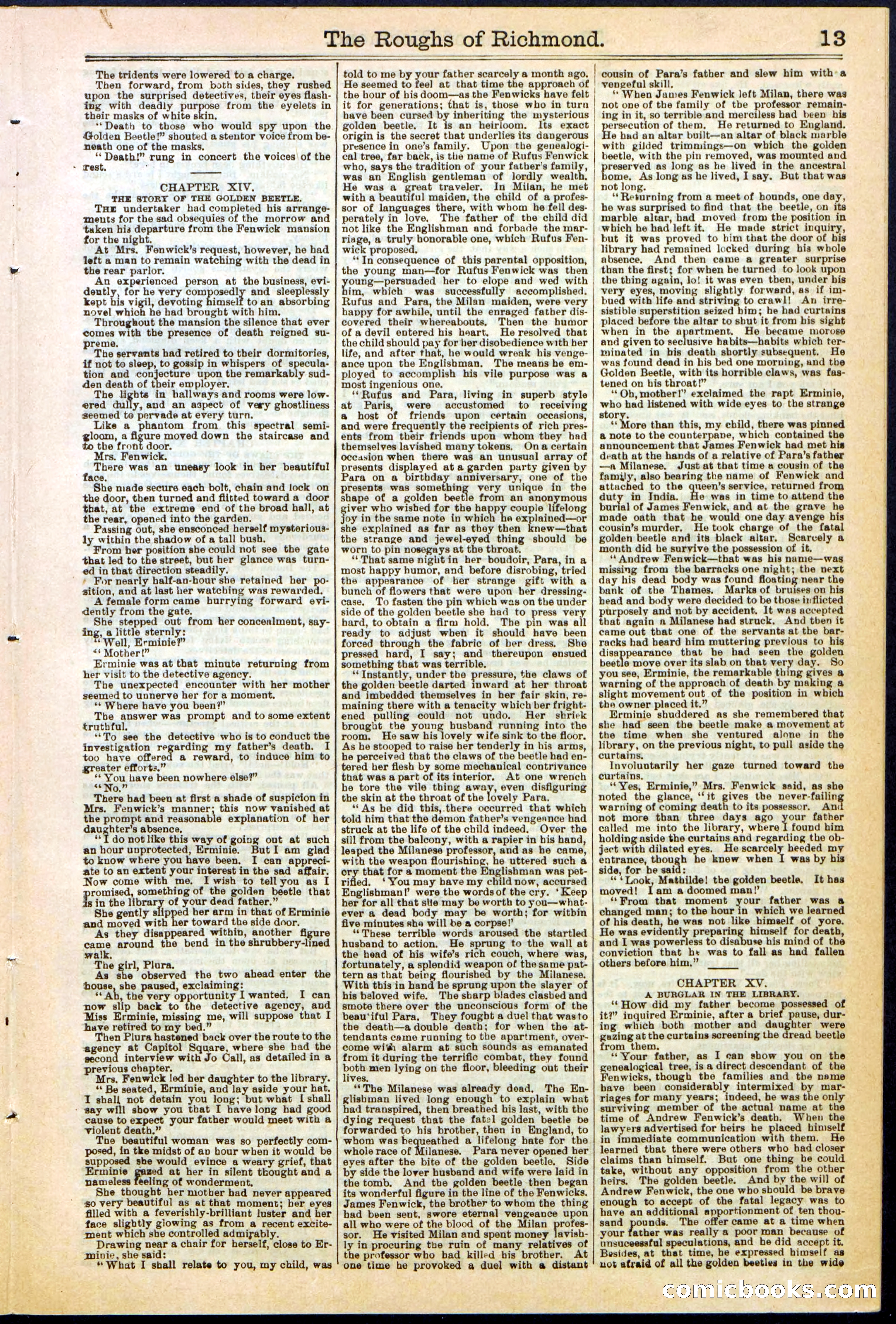
A restored page from Pulp Fiction, 1884. Page through the whole issue in the reader above.
📄 Transcribed text from this page (OCR, searchable)
Machine-transcribed from the original scan — historical spelling and the odd misread are preserved.
The Roughs of Richmond. 13 The tridents were lowered to a charge. Then forward, from both sides, they rushed upon the surprised detectives, their eyes flash- ing with deadly purpose from the eyelets in their masks of white skin, ‘*Death to those who would spy upon the Golden Beetle!” shouted a stentor voice from be- neath one of the masks. ‘** Death!” rung in concert the voices of the ~ west. CHAPTER XTV. THE STORY OF THE GOLDEN BEETLE. THe undertaker had completed his arrange- ments for the sad obsequies of the morrow and taken his departure from the Fenwick mansion for the night. At Mrs. Fenwick’s request, however, he had left a man to remain watching with the dead in the rear parlor. An experienced person at the business, evi- dently, for he very composedly and sleeplessly kept is vi il, devoting himself to an absorbing novel which he had brougbt with him. Throughout the mansion the silence that ever comes with the presence of death reigned su- preme. The servants had retired to their dormitories, if not to sleep, to gossip in whispers of specula- tion and conjecture upon the remarkably sud- den death of their employer. The lights in hallways and rooms were low- ered dully, and an aspect of very ghostliness seemed to pervade at every turn. Like a phantom from this spectral semi- gloom, a figure moved down the staircase and to the front door. Mrs. Fenwick. ‘ There was an uneasy look in her begutiful ace. She made secure each bolt, chain and lock on the door, then turned and flitted toward a door that, at the extreme end of the broad hall, at the rear, opened into the garden. Passing out, she ensconced herself mysterious- ly within the shadow of a tall bush. From her position she could not see the gate that led to the street, but her glance was turn- ed in that direction steadily. » For nearly balf-an-hour she retained her po- sition, and at last her watching was rewarded. A female form came burrying forward evi- dently from the gate. She stepped out from her concealment, say- ing, a little sternly: ‘Well, Erminie?” “* Mother!” Erminie was at that minute returning from her visit to the detective agency. The unexpected encounter with her mother seemed to unnerve her for a moment, ‘* Where bave you been?” The answer was prompt and to some extent truthful. ‘To see the detective who is to conduct the investigation regarding my father’s death, I too have offered a reward, to induce him to greater efforts.” ** You have been nowhere else?” “sé No. ” There had been at first a shade of suspicion in Mrs. Fenwick’s manner; this now vanished at the prompt and reasonable explanation of her daughter’s absence, ‘TI do not like this way of going out at such an hour unprotected, Erminie. ButI am glad to know where you have been. I can appreci- ate to an extent your interest in the sad affair. Now come with me. I wish to tell you as I romised, something of the golden beetle that i, in the lib of your dead father.” She gently slipped her arm in that of Erminie and moved with her toward the side door. As they disappeared within, another figure came around the bend in the shrubbery-lined walk, The girl, Plura. As she observed the two ahead enter the house, she paused, exclaiming: “Ah, the very opportunity I wanted, I can now slip back to the detective agency, and Miss Erminie, missing me, will suppose that I have retired to my bed.” Then Plura hastened back over the route to the agency at Capitol Square, where she had the gecond interview with Jo Call, as detailedin a previous chapter. Mrs, Fenwick led her daughter to the library. ‘« Be seated, Erminie, and lay aside your hat. I shall not detain you long; but what [ shall ' gay will show you that I have long had good cause to expect your father would meet with a violent death.” The beautiful woman was so perfectly com- posed, in tke midst of av hour when it would be supposed she would evince a weary grief, that Erminie ed at her in silent thought and a naweless feeling of wonderment, She thought ber mother bad never appeared so very beautiful as at that moment; ber eyes filled with a feverishly-brilliant luster and her face slightly giowing as from a recent excite- ment which she controlled admirably. Drawing near a chair for herself, close to Er- qinie, she said: * What I shall relate to you, my child, was told to me by your father scarcely a month ago. cousin of Para’s father and slew him with’a He seemed to fee] at that time the approach of the hour of his doom—as the Fenwicks have felt it for generations; that is, those who in turn have been cursed by inheriting the mysterious golden beetle. It is an heirloom. Its exact origin is the secret that underlies its dangerous presence in one’s family. Upon the genealogi- cal tree, far back, is the name of Rufus Fenwick who, says the tradition of your father’s family, was an English gentleman of lordly wealth, He was a great traveler. In Milan, he met with a beautiful maiden, the child of a profes- sor of languages there, with whom he fell des- perately in love, The father of the child did not like the Englishman and forbade the mar- riage, a truly bonorable one, which Rufus Fen- wick proposed, **In consequence of this parental opposition, the young man—for Rufus Fenwick was then oung—persuaded her to elope and wed with im, which was successfully accomplished. Rufus and Para, the Milan maiden, were very happy for awhile, until the enraged father dis- covered their whereabouts. Then the humor of a devil entered his heart, He resolved that the child should pay for her disobedience with ber life, and after that, he would wreak his venge- ance upon the Englishman. The means be em- ployed to accomplish his vile purpose was a most ingenious one. ‘Rufus and Para, living in superb style at Paris, were accustomed to receiving a host of friends upon certain occasions, and were frequently the recipients of rich pres- ents from their friends upon whom they had themselves lavished many tokens. Ona certain occasion when there was an unusual array of presents displayed at a garden party given by Para on a birthday anniversary, one of the presents was something very unique in the shape of a golden beetle from an anonymous iver who wished for the hts couple lifelong Soy in the same note in which he explained—or she explained as far as they then knew—that the strange and jewel-eyed thing should be worn to pin nosegays at the throat. ‘That same night in her boudoir, Para, in a most happy humor, and before disrobing, tried the appearance of her strange gift with a bunch of flowers that were upon ber dressing- case. To fasten the pin which was on the under side of the golden beetle she had to press very hard, to obtain a firm hold. The pin was all ready to adjust when it should have been forced through the fabric of ber dress, She pressed hard, I say; and thereupon ensued something that was terrible. ‘Instantly, under the pressure, the claws of the golden beetle darted inward at her throat and imbedded themselves in her fair skin, re- maining there with a tenacity which ber fright- ened pulling could not undo. Her shriek brought the sh busband running into the room. He saw his lovely wife sink to the floor. As he stooped to raise her tenderly in his arms, he perceived that the claws of the beetle had en- tered her flesh by some mechanical contrivance that was a part of its interior, At one wrench he tore the vile thing ritig # even disfiguring the skin at the throat of the lovely Para. ‘* As he did this, there occurred that which told him that the demon father’s vengeance had struck at the life of the child indeed. Over the sill from the balcony, with a rapier in bis hand, leaped the Milanese professor, and as he came, with the weapon flourishing, he uttered such a ory that for a moment the Englishman was pet- rifled. ‘You may have my child now, accursed Englishman!’ were the wordsof the cry. ‘Keep her for all that ste may be worth to you—what- ever a dead body may be worth; for witbin five minutes she will be a corpse!’ ‘*These terrible words aroused the startled husband to action. He sprung to the wall at the head of his wife’s rich couch, where was, fortunately, a splendid weapon of the same pat- tern as that being flourished by the Milanese. With this in hand he sprung upon the slayer of his beloved wife. The sharp blades clasbed and smote there over the unconscious form of the beau‘iful Para. They fought a duel that wasto the death—a double death; for when the at- tendants came running to the apartment, over- come wit alarm at such sounds as emanated from it during the terrific combat, they found men lying on the floor, bleeding out their ives. **The Milanese was already dead. The En- glisbman lived long enough to explain what had transpired, then breathed his last, with the dying request that the fatel golden beetle be forwarded to his brother, then in England, to whom was bequeathed a lifelong bate for the whole race of Milanese. Para never opened her eyes after the bite of the golden beetle. Side by side the lover husband and wife were laid in the tomb. And the golden beetle then began its wonderful figure in the line of the Fenwicks. James Fenwick, the brother to whom the thing had been sent, swore eternal vengeance upon all who were of the blood of the Milan profes- sor. He visited Milan and spent money lavisb- ly in procuring tbe ruin of many relatives of the professor who bad killed his brother. At one time be provoked a duel with a distant | vengeful skill, * When James Fenwick left Milan, there was not one of the family of tbe professor remain- ing in it, so terrible and merciless had been his ersecution of them, He returned to England. e had an altar built—an altar of black marble with gilded trimmings—on which the golden beetle, with the pin removed, was mounted and ——" as long as he lived in the ancestral ome, As long as he lived, I say. But that was not long. ‘Resurning from a meet of hounds, one day, he was surprised to find that the beetle, on its marble altar, bad moved from the position in which he bad left it. He made strict inquiry, but it was proved to bim that the door of bis library had remained locked during bia whole absence. And then came a greater surprise than the first; for when he turned to look upon the thing again, lo! it was even then, under bis very eyes, moving slightly forward, as if im- bued with life and striving to crawl! An irre- sistible superstition seized bim; he had curtains placed before the altar to shut it from his sight when in the apartment. He became morose and given to seclusive habits—habits which ter- minated in bis death sbortly subsequent. He was found dead in his bed one morning, and the Golden Beetle, with its horrible claws, was fas- tened on his throat!” ‘‘Oh, mother!” exclaimed the rapt Erminie, who had listened with wide eyes to the strange ae ‘* More than this, my child, there was pinned a note to the counterpane, which contained the announcement that James Fenwick bad met his death at the hands of a relative of Para’s father —a Milanese. Just at that time a cousin of the family, also bearing the name of Fenwick and attached to the queen’s service, returned from et in India. e was in time to attend the burial of James Fenwick, and at the grave he made oath that he would one day avenge bis cousin’s murder, He took charge of the fatal golden beetle and its black altar. Scarcely a month did he survive the possession of it, ‘* Andrew Fenwick—that was his name—was missing from tbe barracks one night; the next day his dead body was found floating near the bank of the Thames. Marks of bruises on his bead and body were decided to be those inflicted purposely and not by accident. It was accepted that again a Milanese had struck, And then it came out that one of the servants at the bar- racks had beard him muttering previous to his disappearance that be had seen the golden beetle move over its slab on that very day. you see, Erminie, the remarkable thing gives a warning of the approach of death by making a slight movement out of the position in which the owner placed it,” Erminie shuddered as she remembered that she had seen the beetle make a movement at the time when she ventured alone in the library, on the previous night, to pull aside the curtains, Involuutarily her gaze turned toward the curtains, ‘Yes, Erminie,” Mrs. Fenwick said, as she noted the glance, ‘‘it gives the never-failin warning of coming death to its possessor. An not more than three days ago your father called me into the library, where I found him poling aside the curtains and regarding the ob- ject with dilated wags He anne heeded my entrance, though he knew when I was by his side, for he said: “* Took, Mathilde! the goiden beetle. It has moved! Iam a doomed man!’ ‘From that moment your father was 4 changed man; to the hour in which we learned of his death, he was not like himself of yore. He was evidently preparing himself for death, and I was powerless to disabuse his mind of the conviction that h* was to fall as had fallen others before him,” CHAPTER XV. A BURGLAR IN THE LIBRARY. ‘‘ How did my father become it?’ inquired Erminie, after a brief pause, ing which both mother and daughter were gazing at the curtains screening the dread beetle from them, ‘* Your father, as I can show you on the genealogical tree, is a direct descendant of - Fenwicks, though the families and the name have been considerably intermixed me mar- riages for many years; indeed, he was the only surviving member of the actual name at the time of Andrew Fenwick’s death. When the lawyers advertised for heirs he in immediate communication with them. He learned that there were others who had closer claims than himself. But one thing be could take, without any opposition from the other heirs, The golden beetle. Andrew Fenwick, the one who should be brave enough to accept of the fatal legacy was to have an additional apportionment of ten thou- sand pounds. The offer came at a time when your father was really a poor man because of unsuceessful speculations, and he did accept it. Besides, at that time, he expressed himself as beetles in the wide uot afraid of all the golden laced himself | And by the will of kx ‘ (E(oAniiite SS (elo) ~ _* pe > ae es JOO UG / 1