
Pulp Fiction, 1884 · page 10 of 32
Beadle's New York Dime Library No. 277 — page 10: what you’re looking at
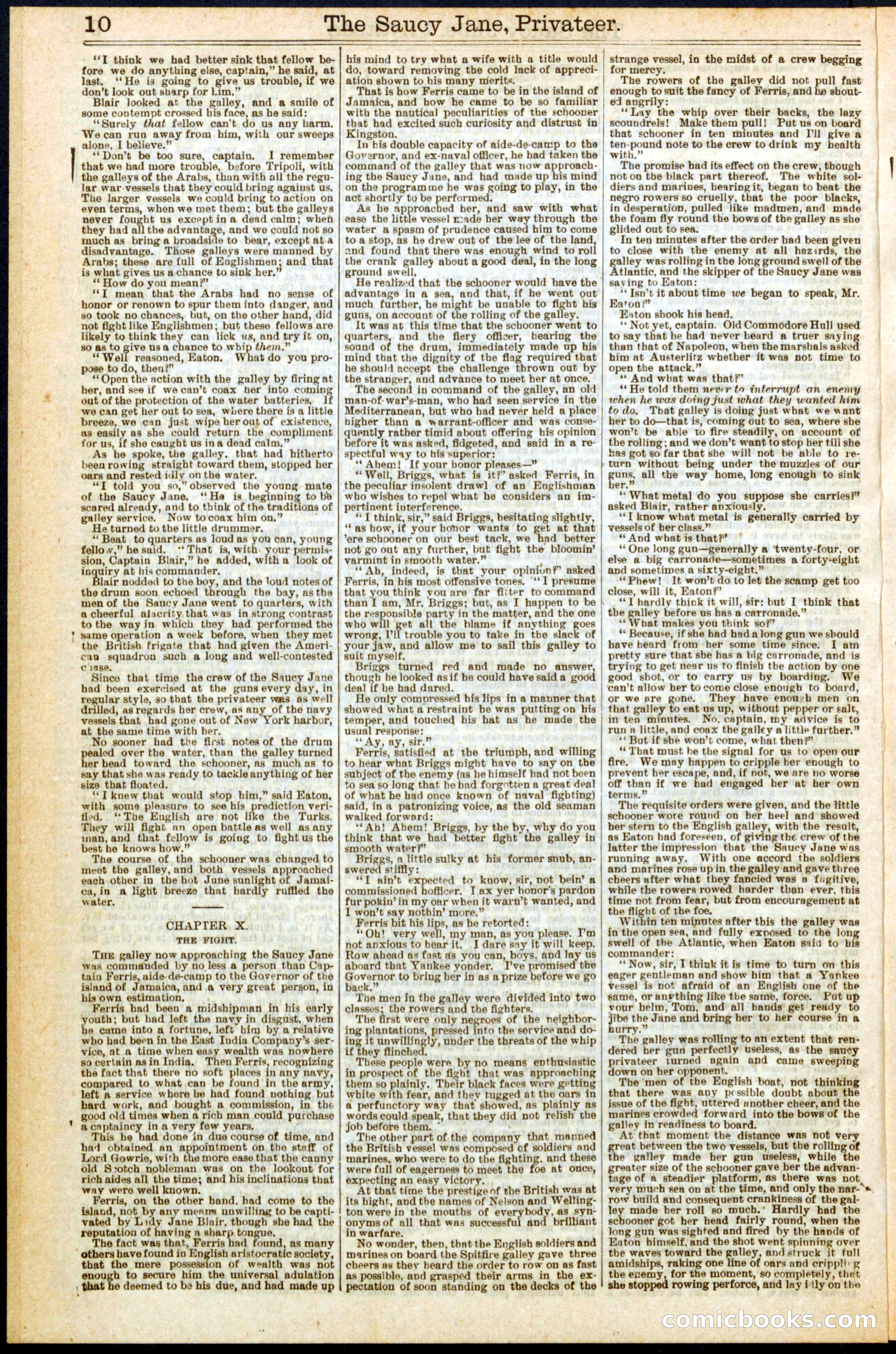
A restored page from Pulp Fiction, 1884. Page through the whole issue in the reader above.
📄 Transcribed text from this page (OCR, searchable)
Machine-transcribed from the original scan — historical spelling and the odd misread are preserved.
—-?: with some pleasure to see his | that 10 | **T think we had better sink that fellow be- fore we do anything else, captain,” he said, at last, ‘‘He is going to give us trouble, if we don’t look out sharp for Lim.” Blair looked at the galley, and a smile of some contempt crossed bis face, as he said: ‘Surely that fellow can’t do us any barm. Wecan run away from him, with our sweeps alone, I believe.” ‘Don’t be too sure, captain. I remember that we had more trouble, before Tripoli, with the galleys of the Arabs, than with all the regu- lar war-vessels that they could bring agaiust us. The larger vessels we could bring to action on even terms, when we met them; but the galleys never fought us exceptina dead calm; when they had all the advantage, and we could not so much as bring a broadside to bear, except ata disadvantage. Those galleys were manned by Arabs; these are full of Englishmen, and that is what gives us a chance to sink her.’ ** How do you mean?’ ‘*— mean that the Arabs had no sense of honor or renown to spur them into danger, and s0 took no chances, but, on the other hand, did not fight like Englishmen; but these fellows are likely to think they can lick us, and try it on, so as to give usa chance to whip them.” ** Well reasoned, Eaton. What do you pro- pose to do, then?” **Open the action with the galley by firing at her, and see if wecan’t coax her into coming out of the protection of the water batteries, If we can get her out to sea, wiere there is a little breeze, we can just wipe her out of existence, as easily as she could return the compliment for us, if she caught us ina dead calm,” As he spoke, the galley, that had hitherto been rowing straight toward them, stopped her oars and rested idly on the water. “T told you so,” observed the young mate of the Saucy Jane, ‘He is beginning to be scared already, and to think of the traditions of galley service. Now tocoax him on,” . He turned to the little drummer. ‘‘ Beat to quarters as loud as you can, young fellow,” hesaid. *‘ That is, with: your permis- sion, Captain Blair,” he added, with a look of inquiry at his commander. lair nodded to the boy, and the loud notes of the drum soon echoed through the bay, asthe men of the Saucy Jane went to quarters, with a cheerful alacrity that was in strong contrast to the wayin which they had performed the same operation a week before, when they met the British frigate that had given the Ameri- can squadron such a long and well-contested c )ase. Since that time the crew of the Saucy Jane had been exercised at the guns every day, in regular style, 30 that the privateer was as well drilled, as regards her crew, as any of the navy vessels that had gone out of New York harbor, at the same time with her. No sooner had the first notes of the drum peerca over the water, than the galley turned er head toward the schooner, as muchas to say that she was ready to tackle anything of her size that floated. **T knew that would stop him,” said Eaton, rediction veri- fied. ‘Tbe English are not like the Turks. They will fight an open battle as well as any inan, and that fellow is going to fight us the best he knows how.” The course of the schooner was changed to meet the galley,and both vessels approached each other in the hot June sunlight of Jamai- ca,in a light breeze that hardly ruffled the water. CHAPTER X. THE FIGHT. THE galley now approaching the Saucy Jane was commanded by no less a person than Cap- tain Ferris, aide-de-camp to the Governor of the island of Jamaica, and a very great person, in his own estimation, ) Ferris had been a midshipman in his early have but had left the navy in disgust, when e came into a fortune, left him by a relative who had been in the East India Company’s ser- vice, at a time when easy wealth was nowhere so certain asin India, Then Ferris, recognizing the fact that there no soft places in any navy, compared to what can be found in the army, left a service where be had found nothing but work, and bought a commission, in the good old times when a rich man could purchase a captaincy in a very few years, This he had done in due course of time, and had obtained an appointment on the staff of Lord Gowrie, with the more ease that the canny old S:otch nobleman was on the lookout for rich aides all the time; and his inclinations that way were well known. Ferris, on the other hand, had come to the island, not by any means unwilling to be capti- vated by Lidy Jane Blair, though she had the reputation of having a sharp tongue, he fact was that, Ferris bad found, as many have found in English aristocratic society, that the mere possession of wealth was not enough to secure him the universal adulation deemed to be his due, and had made up —— ee his mind to try what a wife with a title would do, toward removing the cold lack of appreci- ation shown to his many merits. That is how Ferris came to be in the island of Jamaica, and how he came to be so familiar with the nautical peculiarities of the schooner that had excited such curiosity and distrust in Kingston. In bis double capacity of aide-de-camp to the Governor, and ex-naval officer, he bad taken the command of the galley that was now met io ing the Saucy Jane, and had made up bis mind on the programme he was going to play, in the act shortly tu be performed. As he approached her, and saw with what ease the little vessel made her way through the water a spasm of prudence caused him to come to a stop, as he drew out of the lee of the land and found that there was enough wind to rol the crank galley about a good deal, in the long ground swell, He realized that the schooner would have the advantage in a sea, and that, if he went out much further, he might be unable to fight his guns, on account of the rolling of the galley. It was at this time that the schooner went to quarters, and the fiery officer, bearing the sound of the drum, immediately made up his mind that the dignity of the flag required that he should accept the challenge thrown out by the stranger, and advance to meet her at once, The second in command of the galley, an old man-of- war’s-man, who had seen service in the Mediterranean, but who bad never held a place higher than a warrant-officer and was conse- quently rather timid about offering his opinion before it was asked, fidgeted, and said in a re- spectful way to his superior: ‘* Ahem! If your bonor pleases—” ** Well, Briggs, what is it?” asked Ferris, in the peculiar insolent drawl of an Englishman who wishes to repel what he considers an im- pertinent interference. ** I think, sir,” said Briggs, hesitating slightly, ‘fas how, if your bonor wants to get at that ’ere schooner on our best tack, we had better not go out any further, but fight the bloomin’ varmint in smooth water.” . ‘* Ab, indeed, is that your opinion?’ asked Ferris, in bis most offensive tones. ‘1 presume that you think vou are far fiiter to command than I am, Mr, Briggs; but, as I happen to be the responsible party in the matter, and the one who will get all the blame if anything goes wrong, l’ll trouble you to take in the slack of your jaw, and allow me to sail this galley to suit myself. Briggs turned red and made no answer, though he looked asif he could have said a good deal if he had dared. He only comoressed his lips in a manner that | or we are gone. showed what a restraint he was putting on his j i | | temper, and touched his hat as he made the | usual response: ‘+ Ay, ay, sir.” Ferris, satisfied at the triumph, and willing to hear what Briggs might have to say on the subject of the enemy (as he himself had not been to sea so long that he had forgotten a great deal of what he had once known of naval fighting) said, ina patronizing voice, as the old seaman Ab! Abem! B i by the b hy d ** Ab! em! Briggs, the by, why do you think that we had better fight’ the galley in smooth water?” Briggs, a little sulky at his former snub, an- swered stiffly: “T ain’t expected to know, sir, not bein’ a commissioned hofficer. I ax yer honor’s pardon fur pokin’in my oar when it warn’t wanted, and I won’t say nothin’ more.” Ferris bit his lips, as he retorted: “Ob! very well, my man, as you please. I’m not anxious to hearit. I dare say it will keep. Row ahead as fast ds you can, boys, and lay us aboard that Yankee yonder. I’ve promised the Ones to bring her in as a prize before we go ack, The men in the galley were divided into two classes; the rowers and the fighters. The first were only negroes of the neighbor- ing plantations, pressed into the service and do- ing t bythe pe: fe under the threats of the whip if they flinched. These people were by no means enthusiastic in prospect of the fight that was approaching them so prey: Their black faces were getting white with fear, and they tugged at the oars in a perfunctory way that showed, as plainly as words could speak, that they did not relish the job before them. ~ . The other part of the company that_manned the British vessel was composed of soldiers and marines, who were to do the fighting, and these were full of eagerness to meet the foe at once, expecting an easy victory. At that time the prestige of the British was at its hight, and the names of Nelson and Welling- ton were in the mouths of ere as , as syn- onyms of all that was successful and brilliant in warfare. No wonder, then, that the English soldiers and marines on board the Spitfire galley gave three cheers as they heard the order to row on as fast as possible, and grasped their arms in the ex- pectation of soon standing on the decks of the | Sooo ‘The Saucy Jane, Privateer. PORE re te ee ee le strange vessel, in the midst of a crew begging for mercy. The rowers of the galley did not enough to suit the fancy of Ferris, and ed angrily: ‘‘Lay the whip over their backs, the lazy scoundrels! Make them pull! Put us on board that schooner in ten minutes and I'll give a wae kta note to the crew to drink my health with,” The promise bad its effect on the crew, though not on the black part thereof. The white sol- diers and marines, hearingit, began to beat the negro rowers so cruelly, that the poor blacks, in desperation, pulled like madmen, and made the foam fly round the bows of the galley as she glided out to sea. In ten minutes after the order had been given to close with the enemy at all hazirds, the lley was rolling in the long ground swell of the tlantic, and the skipper of the Saucy Jane was saving to Eaton: ‘‘ Isn't it about time we began to speak, Mr. Eaton?” Eaton shook his head. ‘* Not yet, captain. Old Commodore Hull used to say that he had never beard a truer saying than that of Napoleon, when the marshals aske him at Austerlitz whether it was not time to open the attack.” ** And what was that?” ** He told them newrr to interrupt an enemy when he was doing just what they wanted him todo, That galley is doing just what we want her to do—that is, coming out to sea, where she won’t be able to fire steadily, on account of the rolling; and we don’t want to stop her till she has got so far that she will not be able to re- ull fast shout- turn without being under the muzzles of our guns, all the way home, long enough to sink er. “What metal do you suppose she carries?” asked Blair, rather avxtonde. ‘““I know what metal is generally carried by vessels of ber class.” “And what is that?” ‘*One long gun—generally a ‘twenty-four, or else a big carronade—sometimes a forty-eight and sometimes a sixty-eight.” “Phew! It won’t do to let the scamp get too close, will it, Eaton?” “‘] bardly think it will, sir: but I think that the galley before us bas a carronade.” ‘What makes you think so?” ** Because, if she had hada long gun we should have heard from her some time since. I am pretty sure that she has a big carronade, and is trying to get near us fo finish the action by one good shot, or to carry us by boarding. We can’t allow her to come close enough to board, They have enouvh men on that galley to eat us up, without pepper or salt, in ten minutes. No, captain, my advice is to run a little, and coax the galley a little further.” ‘* But if she won’t come, what then?” ** That must be the signal for us to open our fire. Wemay happen to cripple her enough to prevent her escape, and, if not, we are no worse off than if we bad engaged her at her own terms.” The requisite orders were given, and the little schooner wore round on her heel and showed her stern to the English galley, with the result, as Eaton bad foreseen, of giving the crew of the latter the impression that the Saucy Jane was running away. With one accord the soldiers and marines rose up in the galley and gave three cheers after what they fancied was a fugitive, while the rowers rowed harder than ever, this time not from fear, but from encouragement at the flight of the foe. Within ten minutes after this the galley was in the open sea, and fully exposed to the long swell of the Atlantic, when Eaton said to bis commander: ‘‘ Now, sir, I think itis time to turn on this eager gentleman and show bim that a Yankee vessel is not afraid of an English one of the same, or anvthing like the same, force. Put up vour helm, Tom, and all hands get ready to jibe the Jane and bring her to her course in a burry.” The galley was rolling to an extent that ren- dered her gun perfectly useless, as the saucy privateer turned again and came sweeping down on her opponent. — ' . The men of the English boat, not thinking that there was avy pcssible doubt about the issue of the fight, uttered another cheer, and the marines crowded forward into the bows of the galley in readiness to board. — At that moment the distance was not very great between the two vessels, but the rolling of the galley made her gun useless, while the greater size of the schooner gave her the advan- tage of a steadier platform, as there was not very much sea on at the time, and only the nar- row build and consequent crankiness of the gal- ley made her roll so much.’ Hardly had the schooner got her head fairly round, when the long gun was sighted and fired by the hands of Eaton himself, and the shot went spinning over the waves toward the galley and struck it full amidships, raking one line of oars and crippli: g the exemy, for the moment, so completely, thet she s rowing perforce, and ley iily on the (E(@) me S) JOO ecom