
Pulp Fiction, 1884 · page 5 of 32
Beadle's New York Dime Library No. 271 — page 5: what you’re looking at
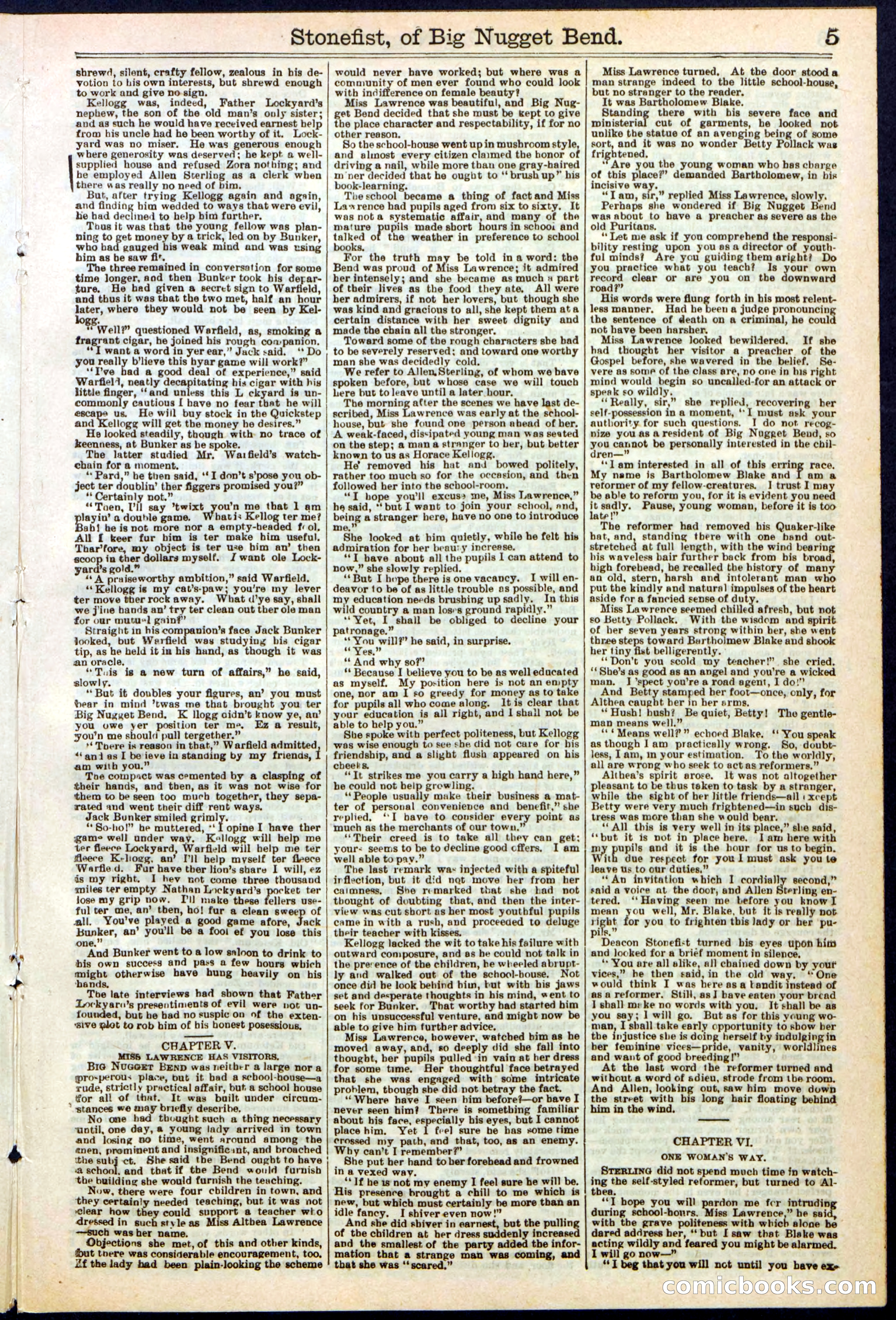
A restored page from Pulp Fiction, 1884. Page through the whole issue in the reader above.
📄 Transcribed text from this page (OCR, searchable)
Machine-transcribed from the original scan — historical spelling and the odd misread are preserved.
> a > | shrewd, silent, crafty fellow, zealous in his de- votion to his own interests, but shrewd enough to work and give no sign. Kellogg was, indeed, Father Lockyard’s nephew, the son of the old man’s only sister; and as such he would have received earnest help from his uncle had he been worthy of it. Lock- yard was no miser. He was generous enough where generosity was deserved; he kept a well- supplied house and refused Zora nothing; and be employed Allen Sterling as a clerk when there was really no need of bim, But, after trying Kellogg again and again, and finding him wedded to ways that were evil, he bad declined to help bim further, Tous it was that the young fellow was plan- ning oo oat money by a trick, led on by Bunker, who bad gauged his weak mind and was using him as be saw fit, The three remained in conversation for some time longer, aod then Bunker took his derpar- ture. He had given a secret sign to Warfield, and thus it was that the two met, half an hour wail where they would not be seen by Kel- ee. * Well?” questioned Warfield, as, smoking a oe sg cigar, he joined his rough coa:panion, **T want a word in yerear,” Jack said. ‘* Do you really b’lieve this byar game will work?” ‘ve bad a good deal of experience,” said Warfiell, neatly decapitating his cigar with his little finger, ‘‘and unless this L ckyard is un- commonly cautious [ have no fear that he will peri us. He wiil buy stock in the Quickstep and Kellogg will get the money he desires.” He looked steadily, though with no trace of keenness, at Bunker as be spoke. The latter studied Mr, Wasfield’s watch- ebain for a moment, * Pard,” he then said, ‘‘ I don’t s’pose you ob- ject ter doublin’ ther figgers promised you?” “Certainly not.” “Toen, Vil say ’twixt you’n me that 1 am layin’ a double game. hatis Kellog ter me? ab! he is not more nor a empty-beaded f: ol, All { keer fur him is ter make him useful. Thar’fore, my object is ter use him an’ then scoop in ther dollars myself. J want ole Lock- yard’s gold.” ““A praiseworthy ambition,” said Warfield. ‘* Kellogg is my cat’s-paw; you’re my lever ter move dber rock away. hat d’ye say, shall we jine bands an’ try ter clean out ther ole man for our mutuel gain?’ Straight in his companion’s face Jack Bunker Jooked, but Werfield was studying bis cigar tip, as he beld it in his hand, as though it was an oracle, “Tuis is a new turn of affairs,” he said, slowly. ‘But it doubles your figures, an’ you must bear in mind ’twas me that brought you ter Big Nugget Bend, K llogg aidn’t know ye, au’ you owe yer position ter me, Ez a result, *you’n me should pull tergether.” ‘*Tnere is reason in that,” Warfield admitted “(ani as I be ieve in standing by my friends, I am with you.” Tne compact was cemented by a clasping of their hands, and then, as it was not wise for them to be seen too much together, they sepa- rated and went their diff rent ways. Jack Bunker smiled grimly. “So-ho!” be muttered, *‘ I opine I have ther game well under way, Kellogg will help me ter fleece Lockyard, Warfield will help me ter fleece K-liogg, an’ I'll belp myself ter fleece Warfie d. Fur have ther lion’s share I will, ez is my right. I hev not come three thousand smiles ter empty Nathan Lockyard’s ket ter jose my grip now. [1] make these fellers use- ful ter me, an’ then, ho! fur a clean sweep of all. You've played a good game afore, Jack Bunker, an’ you'll be a fooi ef you lose this one.” And Bunker went to a low saloon to drink to his own success and pass a few hours which might otherwise bave bung heavily on his ‘bands, The late interviews had shown that Father ‘kyaro’s presentiments of evil were not un- founded, but be bad no suspic on of the exten- sive plot to rob bim of bis honest posessious, CHAPTER V. MISS LAWRENCE HAS VISITORS, Bie NuGGer Benp was neitber a large nora prosperous place, but it bad a sehool-house—a rude, strictly practical affair, but a school house for all of that. It was built under circum- ’ stances we may briefly describe, No one bad thought such a thing necessary ‘until, one day, @ young lady arrived in town and losing no time, went around among the anen, prominent and insignificant, and broached ‘tthe subj ct. She said the Bend ougbt to have school, and thatif the Bend would furnish ‘the building she would furnish the teaching. Now, there were four cbildren in town, and ‘they certainly needed teaching, but it was not clear how they could support a teacher who dressed in such style as Miss Altbea Lawrence was her name. : Objections she met, of this and other kinds, fbut toere was considerable encouragement, too, if the lady had been plain-looking the scheme er ‘Stonefist, of Big Nugget Bend. 5 would never have worked; but where was a community of men ever found who could look with ind ifeninoe on female beauty? Miss Lawrence was beautiful, and Big Nug- get Bend decided that she must be kept to give the place character and respectability, if for no other reason. So the school-house went up in mushroom style, and almost every citizen claamed the bonor of driving a nail, while more than one gray-haired m ner decided that he ought to *‘ brush up” bis book-learning. The school became a thing of fact and Miss Lawrence had pupils aged from six to sixty. It was nota systematic affair, and many of the mature parts made sbort hours in schooi and talked of the weather in preference to school books. For the truth may be told in a word: the Bend was proud of Miss Lawrence; it admired her intensely; and she became as much « part of their lives as the food they ate, All were her admirers, if not her lovers, but though she was kind and gracious to all, she a them ata certain distance with her sweet dignity and made the chain all the stronger. Toward some of the rough characters she bad to be severely reserved; and toward one worthy man she was decidedly cold. We refer to Allen, Sterling, of whom we bave spoken before, but whose case we will touch here but to leave until a later hour. The morning after the scenes we have last de- scribed, Miss Lawrence was early at the school- house, but she found one person abead of her. A weak-faced, dissipated young man was seated on the step; a mana stranger to ber, but better known to us as Horace Kellogg. He’ removed his hat and bowed politely, rather too much so for the occasion, and then followed ber into the scbool-room, “T hope you'll excus» me, Miss Lawrence,” he said, ** but I want to join your school, and, being a stranger here, have no one to introduce me ” She looked at bim quietly, while he felt his admiration for her beauy incresse. ‘*I bave about all the pupils 1 can attend to now,” she slowly replied. ‘But I hope there is one vacancy. I will en- deavor to be of as little trouble as possible, and my education needs brushing up sadly. In this wild country a man loses ground rapidly.” ‘Yet, I shall be obliged to decline your patronage.” ‘You will?’ he said, in surprise. “i Yes,” ** And why so?” ** Because I believe you to be as well educated as myself. My position here is not an empty one, nor am I so greedy for money as to take for pupils all who come along. It is clear that your education is all right, and 1 shail not be able to help you.” Sbe spoke with perfect politeness, but Kellogg was wise enough to see she did not care for bis friendship, and a slight flush appeared on his cheeks. ‘It strikes me you carry a high hand here,” he could not _ growling. ‘People usually make their business a mat- ter of personal convenience and benefit,” she replied, “I bave to consider every point as much as the merchants of our town,’ ‘‘Their creed is to take all they can get: your: seems to be to decline good coffers, I am well able to pay.” The last remark was injected with a spiteful inflection, but it did nqt move her from her caimness, She remarked that she had not thought of doubting that, and then the inter- view was cut sbort as her most youthful pupils came in with a rush, and proceeded to deluge their teacher with kisses. Kellogg lacked the wit to take his failure with outward composure, and as he could not talk in the prerence of the children, be wheeled abrupt- ly and walked out of the school-bouse. Not once did he look behind bim, but with bis jaws set and desperate thoughts in his mind, #ent to seek for Bunker. That worthy bad started him on his unsuccessful venture, and might now be able to give him further advice. E Miss Lawrence, however, watched bim as he moved away, and, so deeply did she fall into thought, ber pupils pulled in vain at ber dress for some time. Her thoughtful face betrayed that she was engaged with some intricate problem, though she did not betray the fact. ‘“Where have I seen bim before?—or bave I never seen him? There is sometbing familiar about his face, especially bis eyes, but I cannot place him. Yet 1 feel sure be bas some time crossed my path, and that, too, as an enemy. Why can’t I remember?” She put ber hand to ber forehead and frowned in a vexed way. ¢ ‘* If he is not my enemy I feel sure he will be. is presence brought a chill to me which is new, but which must certainly be more than an idle fancy. I shiver even now!” And she did shiver in ear but the pullin of the children at her dress nly inc and the smallest of the party the infor- mation that a strange man was coming, and that-chatas “scared.” ‘ Miss Lawrence turned, At the door stooda man strange indeed to the little school-house, but no stranger to the reader. It was Bartholomew Blake. Standing there with bis severe face and winisterial cut of garments, he looked not unlike the statue of an avenging being of some sort, and it was no wonder Betty Pollack was frightened. “Are you the young woman who has cbarge of this place?’ demanded Bartholomew, in bis incisive way. “Tam, sir,” replied Miss Lawrence, slowly, Perhaps she wondered if Big Nugget Bend was about to bave a preacher as severe as the old Puritans, ‘Let me ask if you comprehend the responsi- bility resting upon you as a director of youth- ful minds? Are you guiding them aright? Do you practice what you teach? Is your own record clear or are you on the downward road?” His words were vy: forth in bis most relent- less manner, Had he been a judge pronouncin the sentence of death on a criminal, he coul not have been harsher. Miss Lawrence looked bewildered. If she had thought her visitor a preacher of the Gospel before, she wavered in the belief. Se- vere as some of the class are, no one in his right mind would begin so uncalled-for an attack or speak so wildly. ‘Really, sir,” she replied, recovering her self- sion in a moment, * I must ask your authority for such questions. I do not recog- nize you as aresident of Big Nugget Bend, so ree cannot be personally interested in the chil- ren— ‘‘l am interested in all of this errin My name is Bartholomew Blake and I am a reformer of my fellow-creatures. I trust I may be able to reform you, for it is evident you need i re Pause, young woman, before it is too te , The reformer had removed his Quaker-like hat, and, standing there with one hand out- stretched at full length, with the wind bearing his waveless bair further back from bis broad, bigh forebead, be recalled the bistory of many an old, stern, harsh and intolerant man who put the kindly and natural impulses of the heart aside for a fancied sense of duty. Miss Lawrence seemed chilled afresh, but not s0 Betty Pollack. With the wisdom and spirit of her seven years strong within ber, she went three steps toward Bartholmew Blake and shook her tiny fist belligerently. ‘*Don't you scold my teacher!” she cried. ‘*She’s as good as an angel and you're a wicked man. J ’spect you’re a road agent, I do!” And Betty stamped her foot—once, only, for Althea caught ber in her srms, ‘Hush! bush? Be quiet, Betty! The gentle- map means well.” ‘** Means well?” echoed Blake, ‘‘ You speak as though lam practically wrong. So, doubt- less, lam, in your estimation. To the worldly, all are wrong who seek to act as reformers.” Althea’s spirit arose. It was not altogether pleasant to be thus teken to task by a stranger, While the sight of ber Jittle friends—all | xcept Betty were very much frightened—in such dis- tress was more than she vould bear. ‘‘ All this is very well in its place,” she said, ‘*but it is not in place bere. Iam here with my poails and it is the hour for us to begin. ith due respect for youl must ask you te leave Us to our duties,” ‘An invitation which I er second,” said a voice at the door, and Allen Sterling en- tered. ‘‘ Having seen me before you know] mean you well, Mr. Blake, but it is really not right for you to frighten this lady or her ‘pu- pils. Deacon Stonefist turned bis eyes upon him and Jooked for a brief moment in silence, ‘You are all alike, all chained down by your vices,” he then said, in the old way. “One vould think I was here asa bandit Instead of asa reformer. Still, as] bave eaten your bread I shall mrke no words with you. It shall be as you say; 1 will go. But as for this young wo- man, I shall take early opportunity to show ber the injustice she is pes herself by ee in ber feminine vices—pride, vanity, worldlines and want of good breeding!” At the last word the reformer turned and without a word of adieu, strode from the And Allen, looking out, saw him move dow the street with bis long hair floating behind him in the wind. CHAPTER VI. ONE WOMAN'S WAY. STERLING did not spend much time fn watch- ing the self-styled reformer, but turned to Al- thea. ‘*T hope you will pardon me fer intrudi during school-hours. Miss Lawrence,” he se with the grave politeness with whieh dared address her, *‘ but I saw that Blake was acting wildly and feared you might be alarmed. I will go now—” “I beg that you will not until you have ex- race, alone be MICLOOOLKS (E(0) (E(0)