
Pulp Fiction, 1884 · page 4 of 32
Beadle's New York Dime Library No. 271 — page 4: what you’re looking at
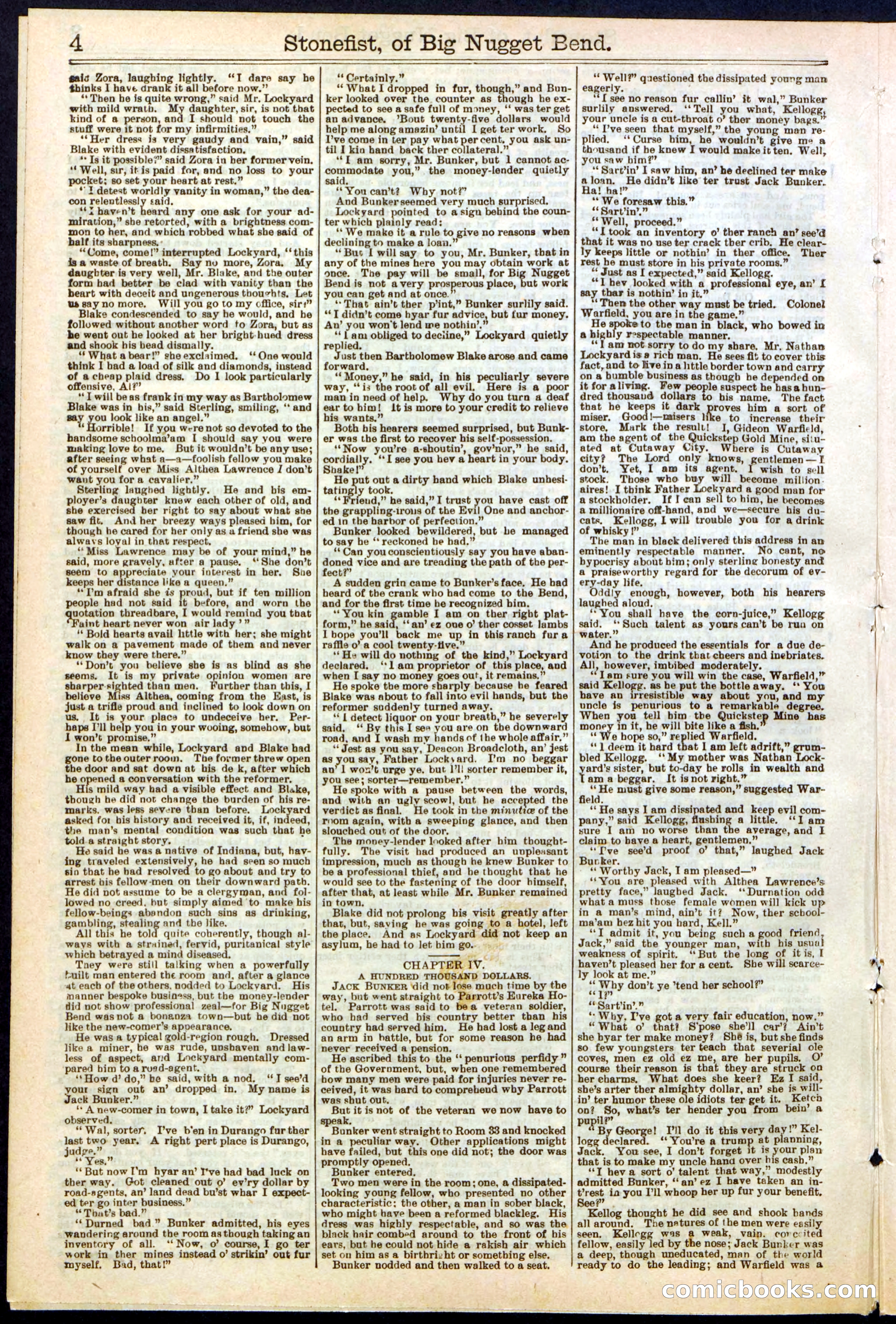
A restored page from Pulp Fiction, 1884. Page through the whole issue in the reader above.
📄 Transcribed text from this page (OCR, searchable)
Machine-transcribed from the original scan — historical spelling and the odd misread are preserved.
a - Se Stonefist, of Bic Nugget Bend. gais Zora, laughing lightly. ‘‘I dare say he thinks I have drank it all before now.” ‘*Then be is quite wrong,” said Mr, Lockyard with mild wrath. My daughter, sir, is not that kind of a person, and I should not touch the stuff were it not for my infirmities,” ‘*Her dress is very gaudy and vain,” said Blake with evident dissatisfaction, ** Is it possible” said Zora in ber former vein. “* Well, sir, itis paid for, and no loss to your pocket; so set your heart at rest.” * I detest worldly vanity in woman,” the dea- con relentlessly said. ‘*) baven’t heard any one ask for your ad- miration,” she retorted, with a brightness com- mon to her, and which robbed what she said of half its sharpness. : “Come, come!” interrupted Lockyard, ‘‘ this is a waste of breath. Say nv more, Zora. My daughter is very well, Mr. Blake, and the outer form had better be clad with vanity than the heart with deceit and ungenerous thouchts, Let us sayno more. Will you go to my office, sir?” Blake condescended to say he would, and he followed without another word to Zora, but as he went out be looked at her bright-hued dress and shook his bead dismally. ‘What a bear!” sheexclaimed. ‘One would think I bad a load of silk and diamonds, instead of a cheap plaid dress. Do I look particularly offensive, Al?’ ** IT will beas frank in my way as Bartholomew Blake was in bis,” said Sterling, smiling, ‘* and say you look like an angel.” ‘Horrible! If you were not so devoted to the bandsome schoolma’am I should say you were making love to me. But it wouldo’t be any use; after seeing what a—a—foolish fellow you make of yourself over Miss Althea Lawrence J don’t want you for a cavalier.” Sterling laughed lightly. He and bis em- ployer’s daugbter knew each other of old, and she exercised her right to say about what she saw fit. And her breezy ways pleased bim, for though he cared for her only as a friend she was alwavs loyal in that respect, ‘Miss Lawrence may be of your mind,” he said, more gravely, after a pause. ‘She don’t seem to appreciate your interest in ber. She keeps her distance like a queen.” “Tm afraid she is proud, but if ten million people had not said it before, and worn the ——- threadbare, I would remind you that aint heart never won air lady’” '* Bold hearts avail httle with her; she might walk on a pavement made of them and never know they were there.” ‘*Don’t you believe she is as blind as she seems. It is my private opinion women are ety ager than men. Further than this, I believe Miss Althea, coming from the East, is just a trifle proud and inclined to look down on us, It is your place to undeceive her. Per- bape I'll belp you in your wooing, somehow, but I won’t promise,” In the mean while, Lockyard and Blake had gone tothe outerroom. The former threw open the door and sat down at his de k, after which he opened a conversation with the reformer, His mild way had a visible effect and Blake, though he did not change the burden of his re- marks. was less severe than before. Lockyard asked for bis history and received it, if, indeed, the man’s mental condition was such that he told.a straight story. He said he was a native of Indiana, but, hav- ing traveled extensively, he had seen so much sin that he bad resolved to go about and try to arrest bis fellow-men on their downward path. He did not assume to be a clergyman, and fol- lowed no creed. but simply aimed ‘to make his fellow-beings abendon such sins as drinking, gambling, stealing and the like. All this he told quite coherently, though al- ways with a strained, fervid, puritanical style which betrayed a mind diseased, Tney were still talking when a powerfully Luilt man entered the room and, after a glance «at each of the others, nodded to Lockyard. His manner bespoke business, but the money-lender did not show professional zeal—for Big Nugget Bend was not a bonanza town—but he did not like the new-comer’s appearance, He was a typical! gold-region rough. Dressed like a miner, he was rude, upsbaven and law- less of aspect, and Lockyard mentally com- ‘pared bim to a rued-agent. ‘‘How d’ do,” be said, with a nod. ‘I see’d your sign out an’ dropped in. My name is Jack Bunker.” ‘* A new-comer in town, I take it?’ Lockyard observed, ‘Wal, sorter, I’ve b'en in Durango fur ther last two year. A right pert place is Durango, ‘But now I'm hyar an’ I’ve had bad luck on ther way. Got cleaned out 0’ ev’ry dollar by road-sgents, an’ land dead bu’st whar I expect- ed ter go inter business.” “That’s bad.” ‘*Durned bad.” Bunker admitted, his eyes - wandering around the room as though taking an inventory of all. ‘‘ Now, o’ course,I go ter work in ther mines instead o’ strikin’ out fur myself. Bad, that!” ~ ‘* Certainly.” “What I dropped in fur, though,” and Bun- ker looked over the counter as though he ex- pected to see a safe full of money, ‘‘ was ter get an advance, ‘Bout twenty-five dollars would help me along amazin’ until I get ter work, So I’ve come in ter pay what percent, you ask un- til I kin hand back ther collateral.” ‘““T am sorry, Mr. Bunker, but 1 cannot ac- ot walled you,” the money-lender quietly said. **You can’t? Why not?” And Bunkerseemed very much surprised. Lockyard pointed to a sign bebind the coun- ter which plainly read: ‘‘We make it a rule to give no reasons when declining to make a loan.” “Bus I will say to you, Mr. Bunker, tbat in any of the mines here you may obtain work at once. The pay will be small, for Big Nugget Bend is not avery prosperous place, but work you can get and at once.” ‘That ain’t ther p’int,” Bunker surlily said. **T didn’t come hyar fur advice, but fur money. An’ you won't lend me nothin’.’ at * m obliged to deciine,” Lockyard quietly replied. ust then Bartholomew Blake arose and came forward, ‘* Money,” he said, in his peculiarly severe way, “is the rootof all evil. Here is a poor man in need of help. Why do you turn a deaf ear to him! it is more to your credit to relieve his wants.” Both bis hearers seemed surprised, but Bunk- er was the first to recover his se!f-possession. ‘*Now you’re a-shoutin’, gov’nor,” he said, cordially, ‘*I see you bev a heart in your body. Shake!’ He sy out a dirty band which Blake unhesi- tatin took. ‘‘Frieud,” be said,” I trust you have cast off the grappling-irous of the Evil One and anchor- ed in the barbor of perfection.” Bunker looked bewildered, but be managed to say he “ reckoned be had,” **Can youconscientiously say you have aban- pee vice and are treading the path of the per- ect A sudden grin came to Bunker’s face. He had heard of the crank who had come to the Bend, and for the first time be recognized bim. “You kin eons I am on ther rigbt plat- form,” he said, ‘‘an’ ez ove o’ ther cosset lambs I bope you'll back me up in this ranch fura raffle o’ a cool twenty-five.” ‘* He will do nothing of the kind,” Lockyard declared, ‘*l1 am proprietor of this place, and when [ say no money goes out, it remains,” He spoke tbe more sharply because he feared Blake was about to fall into evil hands, but the reformer suddenly turned away. ‘‘ { detect liquor on your breath,” he severely said, ‘ By this I sea you are on the downward road, and I wash my hands of the whole affair,” ‘‘ Jest ag you say, Deacon Broadcloth, an’ jest as you say, Fatber Lockyard. I’m no beggar an’ | won’t urge ye. but 1’ll sorter remember it, you see; sorter—remember.” He spoke with a pause between the words, and with an ugly scowl, but he accepted the verdict as final. He took in the minutie@ of the room again, with a sweeping glance, and then slouched out of the door, The movey-lender looked after him tbhought- fully. The visit had produced an uvpleasant impression, much as though he knew Bunker to be a professional thief, and be thought that he would see to the fastening of the door himself, after that, at least while Mr. Bunker remained in town, Blake did not prolong his visit greatly after that, but, saving he was going to a hotel, left the place. And as Lockyard did not keep an asylum, he had to let bim go... ~ * . 9F J A HUNDRED THOUSAND DOLLARS. Jack BuNKER ‘did not lose much time by the way, but went straight to Parrott’s Eureka Ho- tel. Parrott was said to a veteran soldier, who had served bis country better than his country had served him. He had lost a legand an arm in battle, but for some reason he had never received a pension. He ascribed this to the ‘‘ penurious perfidy ” of the Government, but, when one remembered bow many men were paid for injuries never re- ceived, it was bard to comprebeud why Parrott was shut out. But it is not of the veteran we now have to ak, Bunker went straight to Room 33 and knocked in a peculiar way. Other applications might have failed, but this one did not; the door was promptly opened. Bunker entered, Two men were in the room; one, a dissipated- looking young fellow, who presented no other characteristic; the other, a man in sober black, who might have been a reformed blackleg. His dress was highly respectable, and so was the black hair combed around to the front of bis ears, but he could not hide a rakish air which set on him as a birthrizht or sometbing else. Bunker nodded and then walked to a seat. ** Well?” questioned the dissipated young man eagerly. ‘“*[ see no reason fur callin’ it wal,” Bunker surlily answered. ‘‘Tell you what, Kellogg your uncle is a cut-throat o’ ther money bags.” ‘“Pve seen that myself,” the young man re- plied. ‘‘Curse bim, he wouldn’t give me a thousand if he knew I would make it ten. Well, you saw him?’ ‘“*Sart’in’ I saw him, an’ he declined ter make aloan. He didn’t like ter trust Jack Bunker. Ha! ha!” ‘** We foresaw this.” “Sart’in’,” ** Well, proceed.” “I took an inventory o’ ther ranch an’ see’d that it was no use ter crack ther crib. He clear- ly keeps little or nothin’ in ther office. Ther rest he must store in his private rooms.” “« Just as I expected,” said Kellogg. ““I hev looked with a professional eye, an’ £ say thar is nothin’ init.” - ‘Then the other way must be tried. Colonel Warfield, you are in the game. He to the man in black, who bowed in a highly respectable manner. ‘Il am not.sorry to do my share, Mr, Nathan Lockyard is rich man. He sees fit to cover this fact, and to live in a little border town and carry on a bumble business as though he depended on it for aliving. Few people suspect he hasa hun- dred thousaud dollars to his name, The fact that he keeps it dark proves him a sort of miser, Good!—nnaisers like to increase their store, Mark the result! I, Gideon Warfield, am the agent of the Quickstep Gold Mine, situ- ated at Cutaway City. Where is Cutaway city? The Lord only knows, gentlemen —TI don’t. Yet, I am its agent, wish to sell stock. Those who buy will become million. aires! I think Father Loeckyard a good man for a stockholder. If I can sell to him, he becomes a millionaire off-hand, and we—secure his du- cats. Kellogg, I will trouble you for a drink of whisky !” The man in black delivered this address in an eminently respectable manner, No cant, no bypocrisy about bim; only sterling bonesty and a praiseworthy regard for the decorum of ev- ery-day life. Oddly enough, however, both his hearers laughed aloud. ‘You shall have the corn-juice,” Kellogg said. “Such talent as yours can’t be rua on water.” And he produced the essentials for a due de- votion to the drink that cheers and inebriates. All, however, imbibed moderately. **T am sure you will win the case, Warfield,” said Kellogg. as he put the bottleaway. ‘‘ You bave an irresistible way about you, and my uncle is penurious to a remarkable degree. When you tell him tbe Quickstep Mine has money in it, he will bite like a fish, ‘We hope so,” replied Warfield. ‘**] deem it hard that | am left adrift,” grum- bled Kellogg. ‘‘My mother was Nathan k- ard’s sister, but to-day he rolls in wealth and am a beggar. It is not right.” ‘ ¥ He must give some reason,” suggested War- eid. ‘‘ He says I am dissipated and keep evil com- pany,” said Kellogg, flushing a little. ‘‘1 am sure I am no worse than the average, and I claim to bave a heart, gentlemen,” ‘Pye see’d proof o’ that,” laughed Jack Bunker. “Worthy Jack, I am pleased—” ‘‘You are pleased with Althea Lawrence’s pretty face,” laugbed Jack. ‘*Durnation odd what a muss those female women will kick uf in a man’s mind, ain’t it? Now, ther school- ma’am bez hit you hard, Kell.” “IT admit it, you being such a good friend Jack,” said the younger man, with his usua weakness of spirit. ‘But the long of itis, I haven’t pleased her for a cent. Sbe will scarce- ly look at me.” rt Nr don’t ye "tend her school?” **Sart’in’.” ‘Why, I’ve got a very fair education, now.” “What o’ that? S'‘pose she'll car’? Ain’t she byar ter make money? Shé is, but she finds so few youngsters ter teach that severial ole coves, men ez old ez me, are her pupils. course their reason is that they are struck on her charms. What does she keer? Ez I said, she’s arter ther almi mg! dollar, an’ she is will- in’ ter humor these ole idiots ter get it. Ketch on? So, what’s ter hender you from bein’ a pupil?” - : my Geo e! Ill do it this very day!” Kel- logg declared. ‘‘ You're a edad at planning, Jack. You see, I don’t forget it is your plan that is to make my uncle hand over his casb,” “YT heva sort o’ talent that way,” modestly admitted Bunker, ‘‘an’ ez I have taken an in- trest ia you I'll whoop her up fur your benefit. ¢ Kellog thought he did see and shook bands all around. The natures of the men were easily seen. Kellegg was i weak, vain. corccited fellow, easily led by the nose; Jack Bunker was a deep, though uneducated, man of the world ready to do the leading; and Warfield was a EGOMIIGDoOoks