
Pulp Fiction, 1878 · page 23 of 28
Beadle's Dime Library No. 27 — page 23: what you’re looking at
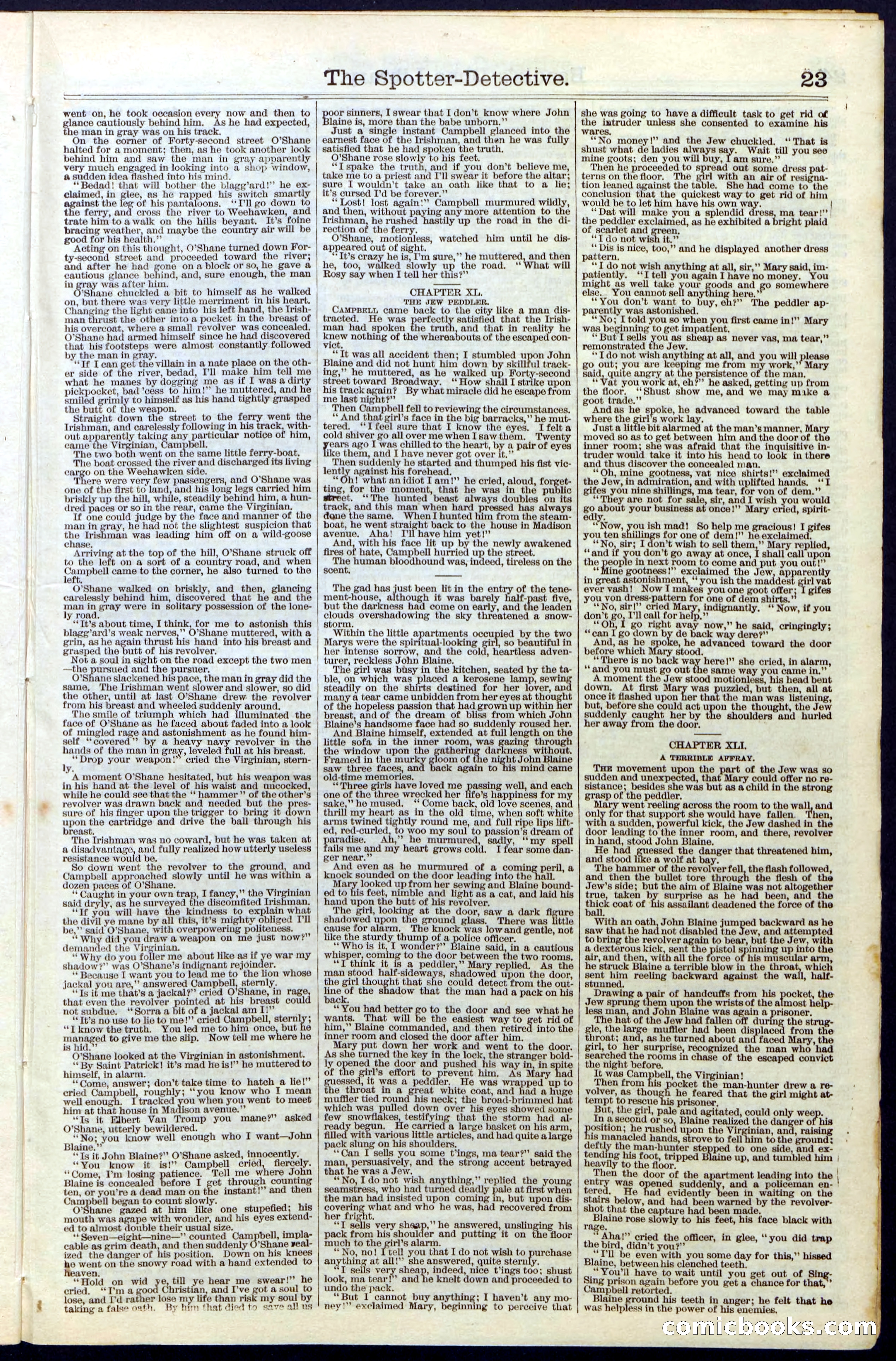
A restored page from Pulp Fiction, 1878. Page through the whole issue in the reader above.
📄 Transcribed text from this page (OCR, searchable)
Machine-transcribed from the original scan — historical spelling and the odd misread are preserved.
went on, he took occasion every now and then to glance cautiously behind him. As he had expected, the man in gray was on his track. On the corner of Forty-second street O’Shane halted for a moment; then, as he took another look behind him and saw the man in gray apparently very much engaged in looking into a shop window, a sudden idea flashed into his mind. ‘**Bedad! that will bother the blagg’ard!” he ex- claimed, in glee, as he rapped his switch smartly against the og of his pantaloons. ‘‘Tll go down to the ferry, and cross the river to Weehawken, and trate him to a walk on the hills beyant. It’s foine bracing weather, and maybe the country air will be good for his health.” Acting on this thought, O’Shane turned down For- ty-second street and proceeded toward the river; and after he had gone ona block or so, he gave a cautious apy he 1ind, and, sure enough, the man in gray was after him. ‘Shane chuckled a bit to himself as he walked on, but there was very little merriment in his heart. Changing the light cane into his left hand, the Irish- man thrust the other into a pocket in the breast of his overcoat, where a small revolver was concealed, O’Shane had armed himself since he had discovered that his footsteps were almost constantly followed by the man in gray. “Tf IT can get the villain in a nate place on the oth- er side of the river, bedad, I'll make him tell me what he manes by dogging me as if I was a dirty pickpocket, bad ‘cess to him!” he muttered, and he smiled grimly to himself as his hand tightly grasped the butt of the weapon. Straight down the street to the ferry went the Irishman, and carelessly following in his track, with- out apparently taking any particular notice of him, came the Virginian, Campbell. ; The two both went on the same little ferry-boat, The boat crossed the river and discharged its living cargo on the Weehawken side. There were very few passengers, and O’Shane was one of the first to land, and his long legs carried him briskly up the hill, while, steadily behind him, a hun- dred paces or so in the rear, came the Virginian, If one could judge by the face and manner of the man in gray, he had not the slightest suspicion that the Irishman was leading him off on a wild-goose chase. Arriving at the top of the hill, O’Shane struck off to the left on a sort of a country road, and when tee ee came to the corner, he also turned to the eft. O’Shane walked on briskly, and then, glancing carelessly behind him, discovered that he and the eg = gray were in solitary possession of the lone- y road. ‘“*Tt’s about time, I think, for me to astonish this blagg’ard’s weak nerves,’’ O’Shane muttered, with a grin, as he again thrust his hand into his breast and grasped the butt of his revolver. Not a soul in sight on the road except the two men —the pursued and the pursuer. O’Shane slackened his pace, the man in gray did the same, The Irishman went slower and slower, so did the other, until at last O’Shane drew the revolver from his breast and wheeled suddenly around. The smile of triumph which had illuminated the face of O’Shane as he faced about faded into a look of mingled rage and astonishment as he found him- self “covered’’ by a heavy navy revolver in the hands of the man in gray, leveled full at his breast. ‘Drop your weapon!”’ cried the Virginian, stern- A moment O’Shane hesitated, but his weapon was in his hand at the level of his waist and uncocked, while he could see that the ‘* hammer” of the other's revolver was drawn back and needed but the pres- sure of his finger upon the rigger to bring it down upon the cartridge and drive the ball through his breast. The Irishman was no coward, but he was taken at a disadvantage, and fully realized how utterly useless resistance would be, So down went the revolver to the ground, and Campbell approached slowly until he was within a dozen paces of O’Shane, ‘Caught in your own trap, I fancy,” the Virginian said dryly, as iss surveyed the discomfited Irishman, “Tf you will have the kindness to explain what the divil ye mane by all this, it’s mighty obliged Pll be,”’ said O’Shane, with overpowering politeness, ty “Why did you draw a weapon on me just now? demanded the Virginian. 5 “Why do you foller me about like as if ye war my shadow?” was O’Shane’s indignant rejoinder. ‘ Because I want you to lead me to the lion whose jackal you are,” answered Campbell, sternly. “Ts ib me that’s a jackal?’ cried O’Shane, in rage that even the revolver pointed at his breast coul not subdue. “Sorra a bit of a jackal am I! “It’s no use to lie to me!"’ cried Campbell, sternly; “TI know the truth. You led me to him ae 8 mame to give me the slip. Now tell me where he is hid,”’ O’Shane looked at the Virginian in astonishment. ‘By Saint Patrick! it’s mad he is!’ he muttered to himself, in alarm. 3 “Come, answer; don’t take time to hatch a lie! cried Campbell, roughly; ‘“‘you know who I mean well anctagh: I tracked you when you went to meet him at that house in Madison avenue.” ; “Ts it Elbert a a you mane?’ asked O’Shane, utterly bewildered. “Ne: you ence well enough who I want—John Blaine.” ‘Ts it John Blaine?” O’Shane asked, innocently. “You know it is!” Campbell cried, fiercely. ‘*Come, I’m losin panne Tell me where John Blaine is sandenlalt fore I get through counting ten, or you're a dead man on the instant! and then Campbell began to count slowly. O’Shane gazed at him like one stupefied; his mouth was agape with wonder, and his eyes extend- ed to almost double their usual size. ‘* Seven—eight—nine—” counted Campbell, impla- cable as grim death, and then suddenly O’Shane real- ized the danger of his position, Down on his knees ae went on the snowy road with a hand extended to saven. 4 “Hold on wid e, till ye hear me swear!’ he cried. “I’m a good Christian, and I’ve got a soul to lose, and I’d rather lose my life than risk my soul by taking a false oath. By him that died to save all us The Spotter-Detective. —_ oor sinners, I swear that I don’t know where John laine is, more than the babe unborn.” Just a single instant Campbell glanced into the earnest face of the Irishman, and then he was fully satisfied that he had spoken the truth. O’Shane rose slowly to his feet. “Tspake the truth, and if you don’t believe me, take me to a priest and I'll swear it before the altar; sure I wouldn’t take an oath like that to a lie; it’s cursed I’d be forever.” “Lost! lost again!’? Campbell murmured wildly, and then, without paying any more attention to the Irishman, he rushed hastily up the road in the di- rection of the ferry. O’Shane, motionless, watched him until he dis- appeared out of sight. ‘It’s crazy he is, I’m sure,” he muttered, and then he, too, walked slowly up the road. “What will Rosy say when I tell her this?” CHAPTER XL. THE JEW PEDDLER. CAMPBELL came back to the city like a man dis- tracted. He was perfectly satisfied that the Irish- man had spoken the truth, and that in reality he sre te nothing of the whereabouts of the escaped con- vict. “Tt was all accident then; I stumbled upon John Blaine and did not hunt him down by skillful track- ing,’’ he muttered, as he walked up Forty-second street toward Broadway. ‘ How shall I strike upon his trackagain? By what miracle did he escape from me last night?” Then Campbell fell to reviewing the circumstances. ‘*‘ And that girl’s face in the big barracks,” he mut- tered. “Ifeel sure that I know the eyes. I felt a cold shiver go all overme when I sawthéem. Twenty ene ago I was chilled to the heart, by a pair of eyes ike them, and I have never got over it.” Then suddenly he started and thumped his fist vic- lently against his forehead. _““Oh! what an idiot I am!’’ he cried, aloud, forget- ting, for the moment, that he was in the public street. “‘The hunted beast always doubles on its track, and this man when hard pressed has always dqne the same. WhenI hunted him from the steam- boat, he went straight back to the house in Madison avenue. Aha! I'll have him yet!” And, with his face lit up by the newly awakened fires of hate, Campbell hurried up the street. mei human bloodhound was, indeed, tireless on the scent, The gad has dust been lit in the entry of the tene- ment-house, although it was barely half- five, but the darkness had come on early, and the leaden jae overshadowing the sky threatened a snow- storm. Within the little apartments occupied by the two Marys were the spiritual-looking girl, so beautiful in her intense sorrow, and the cold, heartless adven- turer, reckless John Blaine. The girl was busy in the kitchen, seated by the ta- ble, on which was placed a kerosene lamp, se steadily on the shirts destined for her lover, an many a tear came unbidden from her eyes at thought of the hopeless passion that had grown up within her breast, and of the dream of bliss from which John Blaine’s handsome face had so eT roused her. And Blaine himself, extended at full length on the little sofa in the inner room, was gazing through the window upon the es ange darkness without. Framed in the murk nips of the night John Blaine saw three faces, an k again to mind came old-time memories. “Three girls have loved me sing well, and each one of the three wrecked her life’s happiness for my sake,” he mused, ‘* Come back, old love scenes, and thrill my heart as in the old time, when soft white arms twined tightly round me, and full ripe lips lift- ed, red-curled, to woo my soul to passion’s dream of aradise. Ah,’ he murmured, sadly, ‘‘my s ails me and my heart grows cold. I fear some . ger near.” And even as he murmured of a co peril, a knock sounded on the door leading into the ‘ erst looked up from her sewing and Blaine bound- ed to his feet, nimble and light as a cat, and laid his hand upon the butt of his revolver. The girl, looking at the door, saw a dark shadowed upon the ground glass. There was little cause for alarm. The knock was low and gentle, not like the sturdy thump of a police officer. ‘Who is it, 1 wonder?” Blaine said, in a cautious whisper, coming to the door between the two rooms, “I think it is a peddler,” Mary replied. As the man stood half-sideways, shadowed upon the door, the girl thought that she could detect from the out- line of the shadow that the man had a pack on his “You had better go to the door and see what he wants. That will the easiest way to get rid of him,” Blaine commanded, and then retired into the inner room and closed the door after him. Mary put down her work and went to the door. As she turned the key in the lock, the stranger bold- ly opened the door and pushed his way in, in spite of the girl’s effort to prevent him, As Mary had essed, it was a peddler, He was wrapped up to e throat_ in a great white coat, and had a huge muffler tied round his neck; the broad-brimmed hat which was pulled down over his eyes showed some few snowflakes, testifying that the storm had al- ee begun. He carried a large basket on his arm, filled with various little articles, and had quite alarge pack slung on his shoulders. ‘Can I sells you some t’ings, ma tear?” said the man, persuasively, and the strong accent betrayed that he was a Jew. “No, Ido not wish anything,” replied the young seamstress, who had turned deadly - at first when the man had insisted upon coming in, but upon dis- age ‘Nees and who he was, had recovered from er fright. oe s very dip oR answered, gong om his pack from his shoulder and putting it on the floor much to the girl’s alarm. “No, no! I tell you that I do not wish to penenese anythin at all!’’ she answered, quite sternly. “T se yey sheap, indeed, nice t'ings too; shust look, ma tear!’’ and he knelt down and proceeded to undo the pack. “But 1 cannot buy anything; I haven’t any mo- ney!” exclaimed Mary, beginning to perceive that 23 she was going to have a difficult task to get rid of the intruder unless she consented to examine his wares, *““No money!”’ and the Jew chuckled, ‘“ That is shust what de ladies always say. Wait till you see mine roots; den you will buy, l am sure,”’ Then he proceeded to spread out some dress pat- terns on the floor. The girl with an air of resigna- tion leaned against the table. She had come to the conclusion that the quickest way to get rid of him would be to let him have his own way. ‘Dat will make you a splendid pg by tear!’’| the peddler exclaimed, as he exhibited a bright plaid of scarlet and n. ‘“*T do not wish it,” ‘ Dis is nice, too,” and he displayed another dress pattern. “I do not wish anything at all, sir,"’ Mary said, im- patiently. ‘I tell you again I have no money, You might as well take your goods and go somewhere else. You cannot sell anything here,’ ‘You don’t want to buy, eh?” The peddler ap- parently was astonished. “No; I told you so when you first came in!” Mary was beginning to get impatient, ‘But I sells you as sheap as never vas, ma tear,” remonstrated the Jew. “Tdo not wish anything at all, and you will please go out; you are keeping me from my work,’’ Mary said, quite angry at the persistence of the man, “Vat you work at, eh?’ he asked, getting up from the floor, “Shust show me, and we may mike a goot trade.” Andas he spoke, he advanced toward the table where the girl’s work lay, Just a little bit alarmed at the man’s manner, Mary moved so as to get between him and the door of the inner room; she was afraid that the inquisitive in- truder would take it into his head to look in there and thus discover the concealed man. “Oh, mine gootness, vat nice shirts!’ exclaimed the Jew, in admiration, and with uplifted hands. ‘“T gifes you nine shillings, ma tear, for von of dem.” “They are not for sale, sir, and I wish you would go about your business at once!’’ Mary cried, spirit- edly. oh Now, you ish mad! §8o help me gracious! I gifes you ten shillings for one of dem!" he exclaimed. ‘No, sir; I don’t wish to sell them,” Mary replied, “and if you don't go away at once, I shall call upon the ple in next room to come and put you out!” **Mine gootness!” exclaimed the Jew, apparently in great astonishment, “ you ish the maddest girl vat ever vash! Now I makes you one goot offer; I gifes you von dress-pattern for One of dem shirts.” ‘No, sir!’ cried Mary, in tly. ‘* Now, if you don’t go, I'll call for help,” “Oh, I go right avay now,” he said, cringingly; “can I go down by de way dere?” And, as he so @, he advanced toward the door before which Mary stood. “There is no back way here!” she cried, in alarm, ‘and you must go out the same way you came in.” A moment the Jew stood motionless, his head bent down, At first Mary was puzzled, but then, all at once it flashed upon her that the man was listening, but, before she could act upon the thought, the Jew suddenly caught her by the shoulders and hurled her away from the door. CHAPTER XLI. A TERRIBLE AFFRAY. micdden and enaspeteed, that mats continent, en and unexpec could offer no re- sistance; besides she was but as a child in the strong grasp of the peddler. went reeling across the room to the wall, and Se or that support she would have fallen. Then, with a sudden, powerful kick, the Jew dashed in the door leading to the inner room, and there, revolver in nar, rand a agg sh rhe e ha ess e danger that threatened him, and stood like a wolf at bay. The hammer of the revolver fell, the flash followed, and then the bullet tore through the flesh of the Jew’s side; but the aim of Blaine was not altogether true, taken Pi ip as he had been, and the thick coat of his assailant deadened the force of the With an oath, John Blaine jum backward as he saw that he had not disabled the ew, and attempted to bring the rere ae to bear, but the Jew, with a dexterous kick, sent the pistol spinning up into the air, and then, witb all the force of his muscular arm, he struck Blaine a terrible blow in the which sent him reeling backward against the wall, half- ed, Drawing a oul of handcuffs from his ket, the Jew sprung them upon the wrists of the almost p- less man, and John e was _ a prisoner. The hat of the Jew had fallen off d the strug- le, the e muffler had been displaced from the hroat; and, as he turned about and faced Mary, the girl, to her surprise, recognized the man who had searched the rooms in chase of the escaped convict my ce Fy neceate was Cam , the Virginian! Then from his pockes the man-hunter drew a re- volver, as tho he feared that the girl might at- tempt to rescue his prisoner, But, the girl, pale and agitated, could only weep. In a second or so, Blaine realized the danger of] paseo; he rushed upon the Vir n, and, rai manacled hands, strove to fell to the ground; deftly the man-hunter stepped to one side, and ex- tending his foot, tripped e up, and tumbled him heavily to the floor, Then the door of the apartment leading into the entry was opened sudd , and a policeman en- tered. He had evidently n in waiting on the stairs below, and had been warned by the revolver- shot that the capture had been made. rages rose slowly to his feet, his face black with Aha!” cried the officer, in glee, “you did the 9 didn’t roe . a ay ays even w ou some for this,” hissed Blaine, between his elamcbed teeth. rs Bh here = wee until pone Sed ont of Bing: prison again before you t ¢ Campbell satorted. See ee Blaine ground his teeth in anger; he felt that he | was helpless in the power of his enemies, Ss NiGDoOo (E(0) (E(0)