
Pulp Fiction, 1878 · page 22 of 28
Beadle's Dime Library No. 27 — page 22: what you’re looking at
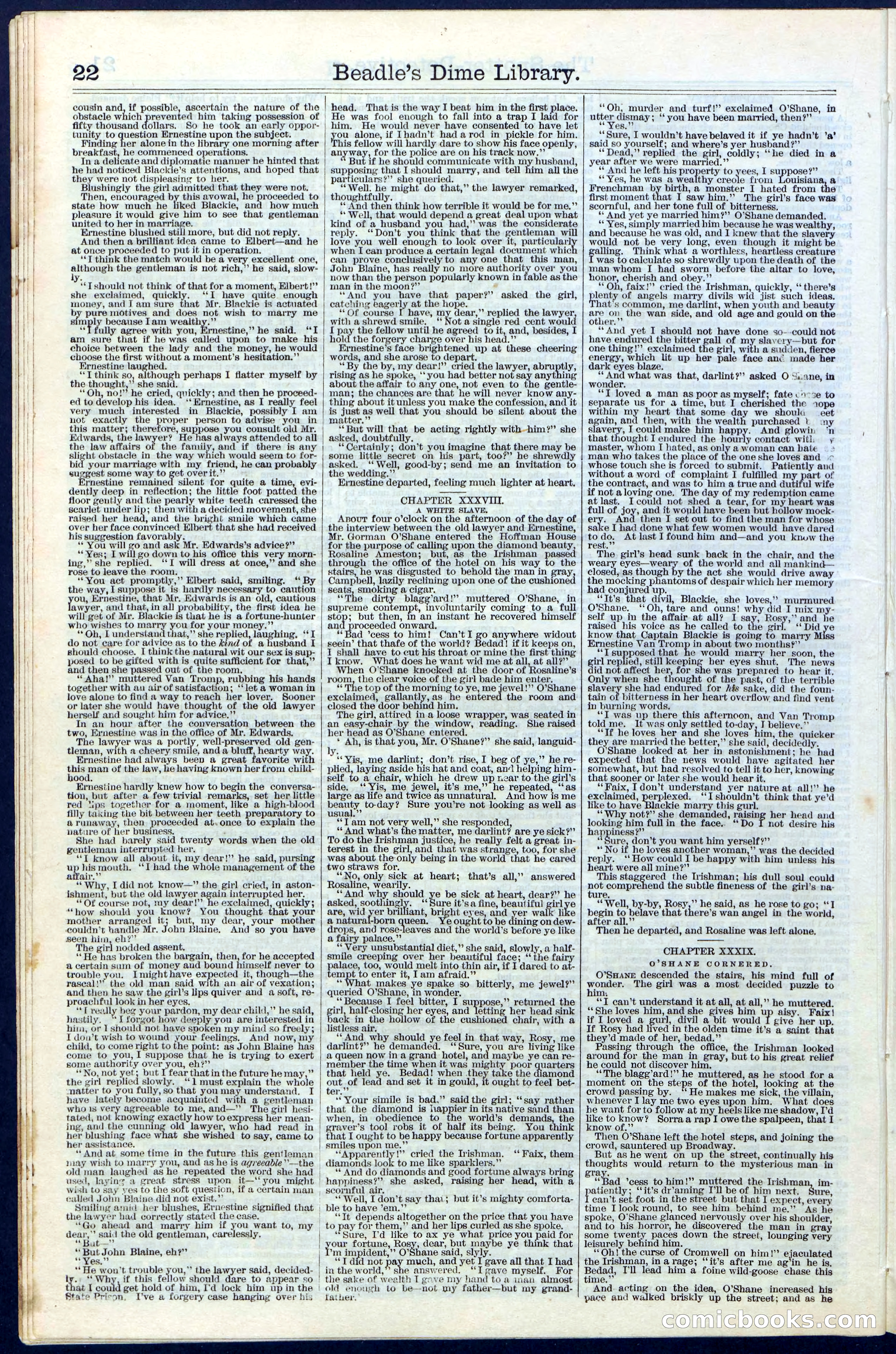
A restored page from Pulp Fiction, 1878. Page through the whole issue in the reader above.
📄 Transcribed text from this page (OCR, searchable)
Machine-transcribed from the original scan — historical spelling and the odd misread are preserved.
ecouldn’t handle Mr. 22 cousin and, if possible, ascertain the nature of the obstacle which fifty thousand dollars. So he took an early oppor- tunity to question Ernestine upon the subject. Finding her alonein the aoa one morning after breakfast, he commenced operations. In a delicate and diplomatic manuer he hinted that he had noticed Blackie’s attentions, and hoped that they were not displeasing to her. Blushingly the girl admitted that they were not. Then, encouraged by this avowal, he proceeded to state how much he liked Blackie, and how much pleasure it would give him to see that gentleman united to her in marriage. Ernestine blushed still more, but did not reply. And then a brilliant idea came to Elbert—and he at once proceeded to put it in operation. ‘*T think the match would be a very excellent one, although the gentleman is not rich,’ he said, slow- ly. Me IT should not think of that for a moment, Elbert!’’ she exclaimed, quickly. “I have quite enough money, and Jam sure that Mr. Blackie is actuated by pure motives and does not wish to marry me simply because lam wealthy.” “T fully agree with you, Ernestine,” he said. “TI am sure that if he was called upon to make his choice between the lady and the money, he would choose the first without a moment’s hesitation.” Ernestine laughed. ‘‘T think so, although perhaps I flatter myself by the thought,’’ she said. ‘Oh, no!” he eried, quickly; and then he proceed- ed to develop his idea. ‘‘ Ernestine, as I really feel very much interested in Blackie, possibly I am not exactly the proper person to advise you in this matter; therefore, suppose you consult old Mr. Edwards, the lawyer? He has always attended to all the law affairs of the family, and if there is any slight obstacle in the way which would seem to for- bid your marriage with my friend, he can probably suggest some way to get overit.” rnestine remained silent for quite a time, evi- dently deep in reflection; the little foot patted the floor gently and the pearly white teeth caressed the scarlet under lip; then with a decided movement, she raised her head, and the bright sinile which came over her face convinced Elbert that she had received his suggestion favorably. “You will go and ask Mr. Edwards’s advice?”’ “Yes; I will go down to his office this very morn- ing,’’ she replied. ‘‘I will dress at once,’’ and she rose to leave the room. ‘*You act promptly,’’ Elbert said, smiling. ‘‘ By the way, I suppose it is hardly necessary to caution ou, Ernestine, that Mr. Edwards is an old, cautious awyer, and that, in all probability, the first idea he will get of Mr. Blackie is that he is a fortune-hunter who wishes to marry you for your money.” ‘*Oh, L understand that,” she rape laughing, ‘I do not care for advice as to the kind of a husband I should choose. I think the natural wit our sex is sup- posed to be gifted with is quite sufficient for that,” and then she passed out of the room, “Aha!”’ muttered Van Tromp, rubbing his hands together with au air of satisfaction; ‘let a woman in love alone to find a way to reach her lover. Sooner or later she would have thought of the old lawyer herself and sought him for advice,”’ In an hour after the conversation between the two, Ernestine was in the office of Mr. Edwards. The lawyer was a portly, well-preserved old gen- tleman, with a cheery smile, and a bluff, hearty way. Ernestine had always beep a great favorite with thie pen of the law, he having known her from child- ood, Ernestine hardly knew how to begin the conversa- tion, but after a few trivial remarks, set her little red tips together for a moment, like a high-blood filly taking the bit between her teeth preperciery, to @ runaway, then proceeded at. once explain the nature of her business, , She had barely said twenty words when the old gentleman interrupted her. “T know all about it, my dear!” he said, pursing up his mouth. “ I had the whole management of the aifair.”’ “Why, I did not know—” the girl cried, in aston- ishment, but the old lawyer again interrupted her, “Of course vot, my dear!” he exclaimed, quickly; “how should you Know? You thought that your mother arranged it; but, my dear, your mother John Blaine. And‘so you have seen him, eh?” The girl nodded assent, ‘‘He has broken the bargain, then, for he accepted a certain sum of money and bound himself never to trouble you. Imighthave expected it, though—the raseal!”’ the old man said with an air of vexation; and then he saw the girl’s lips quiver and a soft, re- proachful look in her eyes. sd redlly beg your pardon, my dear child,’’ he said, hastily. “I forgot how deeply you are interested in hii, or 1 should not have spoken my mind so freely; I don’t wish to wound your feelings. And now, my child, to come right to the point: as John Blaine has come to you, I suppose that he is trying to exert some authority over you, eh?’’ “No, not yet; but I fear thatin the future he may,” the girl replied slowly. “1 must explain the whole natter to you fully, so that you may understand. I have lately become acquainted with a gentleman who 18 reny agreeable to me, and—’’ The girl hesi- tated, not knowing exactly how to express her mean- ing, and the cunning old lawyer, who had read in her blushing face what she wished to say, came to her assistance. “And at some time in the future this gentleman may wish to marry you, and as he is agreeable’’—the old man laughed as he repeated the word she had used, layin a great stress upon it—‘‘ you might Wish to say yes to the soft questicn, if a certain man culled John Blaine did not exist.” revented him taking possession of | Smiling amid her blushes, Ernestine signified that | the lawyer had correctly stated the case. “Go ahead and marry him if you want to, my dear,’ said the old gentleman, carelessly. oe i oan I “But John Blaine, eh?’’ ‘es Yes,” **He won't trouble you,” the lawyer said, decided- ee ‘Why, if this fellow should dare to appear so that I could get hold of him, I'd lock him up in the State Prison, I’ve a forgery case hanging over his head. That is the way I beat him in the first place. He was fool enough to fall into a trap I laid for him. He would never have consented to have let you alone, if Ihadn’t had arod in pickle for him. his fellow will hardly dare to show his face openly, anyway, for the police are on his track now,”’ * But if he should communicate with my husband, supposing that I should marry, and tell all the particulars?’ she queried. “Well. he might do that,” the lawyer remarked, thoughtfully. ‘** And then think how terrible it would be for me.” ‘Well, that would depend a great deal upon what kind of a husband you had,’’ was the considerate reply. ‘Don’t you think that the gentleman will love you well enough to look over it, Sipe te when I can produce a certain legal document whic can prove conclusively to any one that this man, John Blaine, has really no more authority over you now than the person popularly known in fable as the man in the moon?” @ “And you have that paper?’ asked the girl, catching eagerly at the hope. “Of course I have, ny dear,’’ replied the lawyer with a shrewd smile, ‘‘ Not asingle red cent woulc I pay the fellow until he agreed to it, and, besides, I hold the forgery charge over his head.” Krnestine’s face brightened up at these cheering words, and she arose to depart. “By the by, my dear!” cried the lawyer, Shri rising as he spoke, ‘‘ you had better not say anything about the affair to any one, not even to the gentle- man; the chances are that he will never know any- thing about it unless you make the confession, and it is just as well that you should be silent about the matter.” ‘*But will that be acting rightly with-him?” she asked, doubtfully. “Certainly; don’t you imagine that there may be some little secret on his part, too?’ he shrewdly asked. ‘*‘ Well, good-by; send me an invitation to the wedding.” Ernestine departed, feeling much lighter at heart, CHAPTER XXXVIII. A WHITE SLAVE. Anout four o’clock on the afternoon of the day of the interview between the old lawyer and Ernestine, Mr. Gorman O’Shane entered the Hoffman House for the purpose of calling upon the diamond beauty, Rosaline Ameston; but, as the Irishman passed through the office of the hotel on his way to the stairs, he was disgusted to behold the man in gray Campbell, lazily reclining upon one of the cushione seats, smoking a cigar, “The dirty blagg’ard!” muttered O’Shane, in supreme contempt, involuntarily coming to a f stop; but then, in an instant he recovered himself and proceeded onward. **Bad ’cess to him! Can’tI go anywhere widout seein’ that thafe of the world? Bedad! if it keeps on, IT shall have to cut his throat or mine the first thing I know. What does he want wid me at all, at all?” When O'Shane knocked at the door of Rosaline’s room, the clear voice of the girl bade him enter. “The top of the morning to ye, me jewel!’’ O’Shane exclaimed, gallantly,as he entered the room and closed the door behind him, The girl, attired in a loose wrapper, was seated in an easy-chair by the window, reading. She raised her head as O’Shane entered. ; * Ah, is that you, Mr. O’Shane?”’ she said, languid- ly. ‘‘Yis, me darlint; don’t rise, I beg of ye,” he re- plied, laying aside his hat and coat, an4 helping him- self to a chair, which he drew up near to the girl’s side. ‘‘ Yis, me jewel, it’s me,’ he repeated, ‘‘as large as life and twice as unnatural. And how is me beanky to-day? Sure you’re not looking as well as usual,”’ ‘**T am not very well,” she responded, ‘“‘ And what’s the matter, me darlint? are ye sick?” To do the Irishman justice, he really felt a great in- terest in the girl, and that was strange, too, for she was about the only being in the world that he cared two straws for. “No, only sick at heart; that’s all,” answered Rosaline, wearily. ‘*‘And why should ye be sick at heart, dear?’ he asked, soothingly. ‘Sure it’sa fine, beautiful girlye are, wid yer brilliant, bright eyes, and yer walk like a natural-born queen. Ye ought to be dini g on dew- drops, and rose-leaves and the world’s before ye like a fairy palace.” “Very unsubstantial diet,’’ she said, slowly, a half- smile creeping over her beautiful face; * the fair alace, too, would melt into thin air, if I dared to at- empt to enter it, Iam afraid.” “What makes ye spake so bitterly, me jewel?” queried O’Shane, in wonder, ‘Because I feel bitter, I suppones': returned the girl half-closing her eyes, and letting her head sink ack in the hollow of the cushioned chair, with a listless air. _‘* And why should ye feel in that way, Rosy, me darlint?” he demanded. ‘Sure, you are living like a queen now in a grand hotel, and maybe ye can re- member the time when it was mighty poor quarters that held ye. Bedad! when they take the diamond a of lead and set it in gould, it ought to feel bet- er,”’ ‘“Your simile is bad,” said the girl; “‘say rather that the diamond is happier in its native sand than when, in obedience to the world’s demands, the raver’s tool robs it of half its being. You think | that I ought to be happy because fortune apparently smiles upon me,”’ “Apparently!” cried the Irishman. ‘ Faix, them diamonds look to me like sparklers.”’ “And do diamonds and good fortune always bring happiness?” she asked, raising her head, with a scornful air. ‘* Well, I don’t say thai; but it’s mighty comforta- ble to have ’em.”’ “Tt depends altogether on the price that you have to pay for them,” and her lips curled as she spoke. “Sure, I’d like to ax ye what pgs you paid for our fortune, Rosy, dear, but maybe ye think that (’m impident,’’ O’Shane said, slyly. ‘**T did not pay much, and yet I gave all that I had in the world,” she answered. “TI gave myself. For the sake of wealth I gave my hand to a inian almost old enough to be--not my father—but my grand- lather, ‘Oh, murder and turf!’? exclaimed O’Shane, in a dismay ; ‘“vou have been married, then?”’ es,” ‘“Sure, I wouldn’t have belaved it if ye hadn’t ’a’ said so yourself; and where’s yer husband?”’ ‘‘Dead,”’ replied the girl, coldly; ‘‘he died in a year after we were married,” ‘** And he left his property to yees, I suppose?” “Yes, he was a wealthy creole from Louisiana, a Frenchman by birth, a monster I hated from the first moment that I saw him.’’ The girl’s face was scornful, and her tone full of bitterness. * And yet ye married him?” O’Shane demanded. ‘Yes, simply married him because he was wealthy, and because he was old, and I knew that the slavery would not be very long, even though it might be galling. Think what a worthless, heartless creature was to calculate so shrewdly upon the death of the man whom I had sworn before the altar to love, honor, cherish and obey.”’ ** Oh, faix!” cried the Irishman, quickly, ‘‘ there’s plea of angels marry divils wid jist such ideas. hat’s common, me darlint, when youth and beauty ere on the wan side, and old age and gould on the other.”’ ““And yet I should not have done so--could not have endured the bitter gall of my slavery—but for one thing!’’ exclaimed the girl, with a sudden, fierce energy, Which lit up her pale face anc made her dark eyes blaze. ““And what was that, darlint?’’ asked O “:.ane, in wonder. ‘I loved a man as poor as myself; fate «-se to separate us for a time, but I cherished the .ope within my heart that some day we shoula eet again, and then, with the wealth purchased } my slavery, I could make him happy. And glowin ‘n that thought I endured the hourly contact with — master, whom I hated, as only a woman can bate man who takes the place of the one she loves and « whose touch she is forced to submit. Patiently and without a word of complaint I fulfilled my part of the contract, and was to him a true and duti ul wife if not aloving one. The day of my redemption came at last. Icould not shed a tear, for my heart was full of joy, and it would have been but hollow mock- ery. And then I set out to find the man for whose sake I had done what few women would have dared to om At last I found him and—and you know the rest.”’ The girl’s head sunk back in the chair, and the weary bir i ok of the world and all mankind— closed, as though by the act she would drive away the mocking phantoms of despair which her memory had conjured uP “Tt’s that divil, Blackie, she loves,’ murmured O’Shane. ‘Oh, tare and ouns! why did I mix my- self up in the affair at all? I say, Rosy,” and he raised his voice as he called to the girl. ‘Did ye know that Captain Blackie is going to marry Miss Ernestine Van Tromp in about two months?” et suppeted that he would marry her soon, the irl replied, still keeping her eyes shut. The news id not affect her, for she was prepared to hear it, Only when she thought of the past, of the terrible slavery she had endured for Hés sake, did the foun- tain of bitterness in her heart overflow and find vent in burning words. ‘I was up there this afternoon, and Van Tromp told me. It was only settled to-day, I believe.’ “Tf he loves her and she loves him, the quicker they are married the better,” she said, decidedly. O’Shane looked at her in astonishment; he had expected that the news would have agitated her somewhat, but had resolved to tell it to her, knowing that sooner or later she would hear it. *Faix, I don’t understand yer nature at all!” he exclaimed, perplexed. ‘I shouldn’t think that ye’d like to have Blackie marry this gurl. ‘“Why not?” she demanded, raisin looking him fullin the face.. ‘*Do happend: “Sure, don’t you want him yerself?”’ ‘No if he loves another woman,”’ was the decided reply. ‘How could I be happy with him unless his heart were all mine?”’ This staggered the Irishman; his dull soul could not comprehend the subtle fineness of the girl’s na- her head and not desire his re. ‘““ Well, by-by, Rosy,”’ he said, as he rose to go; * begin to belave that there’s wan angel in the world, after all.” Then he departed, and Rosaline was left alone. CHAPTER XXXIX. O’SHANE CORNERED. O’SHANE descended the stairs, his mind full of wonder. The girl was a most decided puzzle to m, ‘‘T can't understand it at all, at all,’’ he muttered. ‘‘ She loves him, and she gives him up aisy. Faix! if I loved a gurl, divil a bit would I give her up. If Rosy had lived in the olden time it’s a saint that they’d made of her, bedad.”’ hei g eer va we office, one ines looked around for the man ray, but to his great relief he could not discover tae - “The blagg’ard!’’ he muttered, as he stood for a moment on the steps of the hotel, looking at the crowd passing by. ‘‘He makes me sick, the villain, whenever I lay me two eyes upon him. What does he want for to follow at my heels like me shadow, I’d ee to gah Sorra a rap I owe the spalpeen, that I now of.” Then O’Shane left the hotel steps, and joining the crowd, sauntered up Broadway. But_as he went on up the street, continually his thoughts would return to the mysterious man in gray. “Bad *cess to him!’’ muttered the Irishman, im- pelea: “it’s dr’aming I'll be of him next, aereet can’t set foot in the street but that I expect, every time I look round, to see him behind me.”’ As he spoke, O'Shane glanced nervously over his shoulder, and to his horror, he discovered the man in gray some twenty paces down the street, lounging very leisurely behind him. ‘Oh! the curse of Cromwell on him!’’ ejaculated the Irishman, in a rage; ‘it’s after me ag’in he is, Boe Tl lead him a foine wild-goose chase this ime,” And acting on the idea, O’Shane increased his pace and walked briskly up the street; and as he MICOOOLKS (EO) (E(@) & }