
Pulp Fiction, 1878 · page 19 of 28
Beadle's Dime Library No. 27 — page 19: what you’re looking at
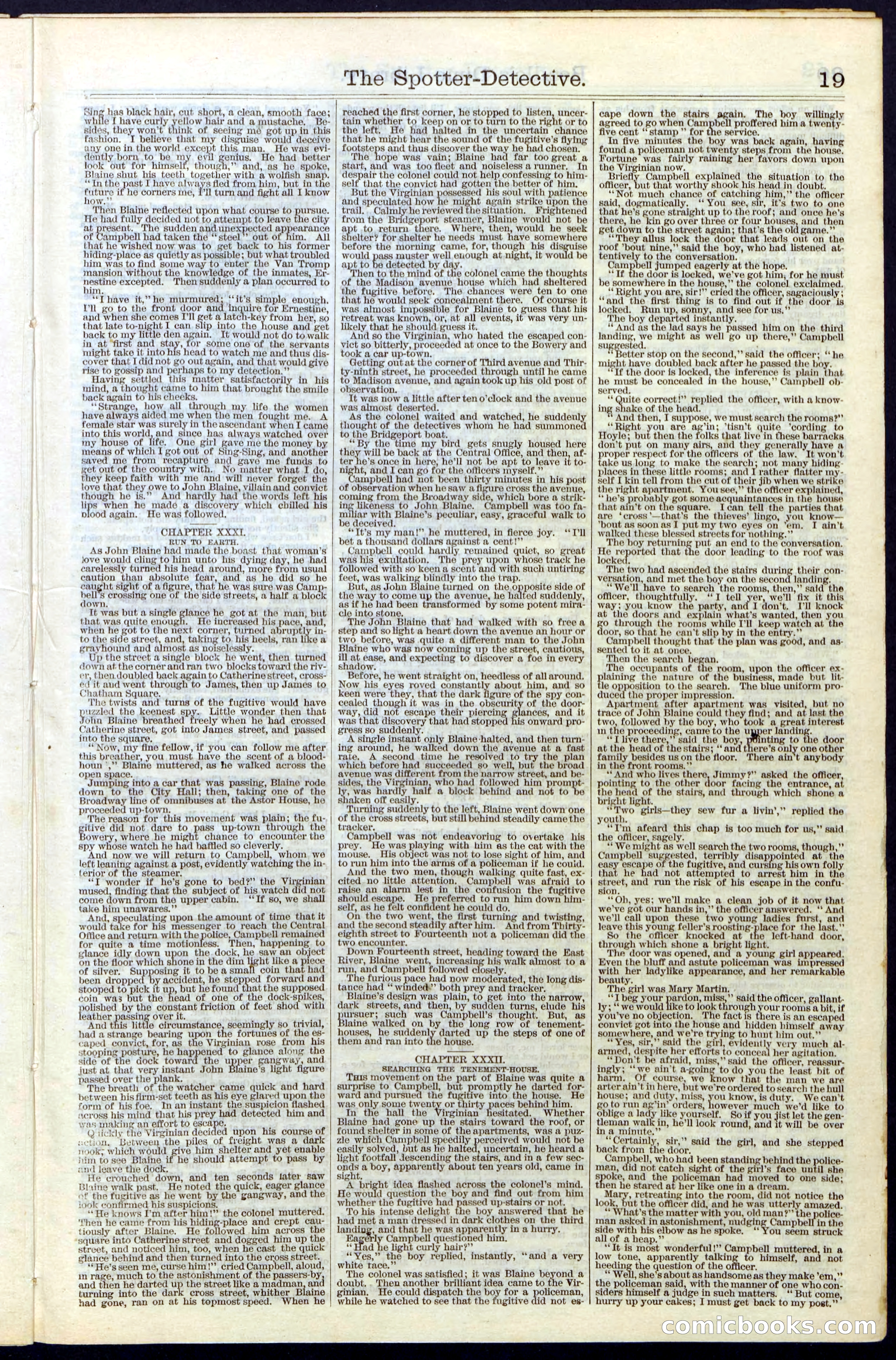
A restored page from Pulp Fiction, 1878. Page through the whole issue in the reader above.
📄 Transcribed text from this page (OCR, searchable)
Machine-transcribed from the original scan — historical spelling and the odd misread are preserved.
a one “ - Oe 7 2 ene Sing has black hair, cut short, a clean, smooth face; while [ have curly yellow hair and a mustache. Be- sides, they won't think of seeing mé got up in this fashion. I believe that my disguise would deceive any one in the world except this man. He was evi- flently born to be my evil genius. He had better look ‘out for himself, though,” and, as he spoke, Blaine shut his teeth together with a wolfish snap. “In the past I have always fled from him, but in the bea’ if he corners me, I'll turn and fight all I know LOW, Then Blaine reflected upon what course to pursue. He had fully decided not to attempt to leave the city at present. The sudden and unexpected prePstencs of Campbell had taken the “steel”’ out of him. All that he wished now was to get back to his former hiding-place as quietly as possible; but what troubled him was to find some way to enter the Van Tromp mansion without the knowledge of the inmates, Er- rh apa excepted. Then suddenly a plan occurred to nm. “Thave it,” he murmured; ‘it’s simple enough, I'll go to the front door and ‘inquire for Ernestine, and when she comes Ill get a latch-key from her, so that late to-night I can slip into the house and get back to my little den again. It would not do to walk in at first and Bay for some one of the servants might take if into his head to watch me and thus dis- cover that I did not go outagain, and that would give rise to gossip and perhaps to my detection.” Having settled this matter satisfactorily in his mind, a thought came to him that brought the smile back again to his cheeks. “Strange, how all through my life the women have always aided me when the men fought me. A female star was surely in the ascendant when I came into this world, and since has always watched over my house of life. One girl fave me the money by means of which I got out of Sing-Sing, and another saved me from recapture and gave me funds to ret out of the country with. No matter what I do, they keep faith with me and will never forget the love that they owe to John Blaine, villain and convict though he is.” And hardly had the words left his i when he made a discovery which cbilled his piood again. He was followed, CHAPTER XXXT. RUN TO EARTH. As John Blaine had made the boast that woman's love would cling to him unto his dying day, he had carelessly turned his head around, more from usual caution than absolute fear, and as he did so he caught sight of a figure, that he was sure was Camp- bee 8 crossing one of the side streets, a half a block down, Tt was but a single pine he got at the man, but that was quite enough, He increased his pace, and, when he got to the nexf corner, turned abruptly in- | to the side street, and, taking to. his heels, ran like a | grayhound and almost as noiselessly. Up the street a single block he went, then turned | down at the corner and ran two blocks toward the riv- | er, then doubled back again to Catherine street, cross- ed it aud went through to James, then up James to Chatham Square. The twists and turns of the fugitive would have pugzled the keenest spy. Little wonder then that John Blaine breathed freely when he had crossed Catherine street, got into James street, and passed into the square, ‘** Now, my fine fellow, if you can follow me after this breather, you must have the scent of a blood- houn ',”’ Blaine muttered, as he walked across the open space. Jumping into a car that was passing, Blaine rode down to the City Hall; then, takin Broadway line of omnibuses at the Astor House, he proceeded up-town. * | The reason for this movement was plain; the fu- ritive did not dare to pa up-town through the owery, where he might chance to encounter the spy whose watch he had baffled so cleverly. And now we will return to Campbell, whom we left leaning against a post, evidently watching the in- terior of the steamer, ; “T wonder if he’s gone to bed?” the Virginian mused, finding that the subject of his watch did not come down from the upper cabin. “If so, we shall take him unawares.” And, speculating upon the amount of time that it would inks for his messenger to reach the Central Office and return with the police, Campbell remained for quite a time motionless. Then, happening to glance idly down upon the dock, he saw an object on the floor which shone in the dim light like a piece of silver. Supposing it to be asmall coin that had been acobied vy accident, he stepped forward and stooped to pick it up, but he found that the supposed coin was but the head of one of the dock-spikes, volished by the constant friction of feet shod with feather assing over it. And this little circumstance, s had a strange bearing upon the fortunes of the es- caped convict, for, as the Virginian rose from his stooping posture, he happened to glance along the side of the dock toward the upper gangway, and just at that very instant John Blaine’s light figure passed over the plank. . The breath of the watcher came quick and hard between his firm-set teeth as his eye glared upon the form of his foe. In an instant the suspicion flashed across his mind that his prey had detected him and was making an effort to ee pe ; Q iickly the Virginian decided upon his course of section. Between the piles of freight was a dark ook; which would give him shelter and yet enable him to see Blaine if he should attempt to pass by and leave the dock, He crouched down, and ten seconds later saw Blaine walk past. He noted the quick, eager glance of the fugitive as he went by the gangway, and the iook confirmed his suspicions. “He knows I’m atter him!” the colonel muttered. ‘Then he came from his hiding-place and crept cau- tiously after Blaine. He followed him across the eemingly so trivial, ‘square into Catherine street and dogged him up the street, and noticed him, too, when he cast the quick elance behind and then turned into the cross street. ~ “He's seen me, curse him!’ cried Campbell, aloud, in rage, much to the astonishment of the passers-by and Shien he darted up the street like a madman, an turning into the dark cross street, whither Blaine had gone, ran on at his topmost speed. When he one of the | The Spotter-Detective. reached the first corner, he id to listen, uncer- tain whether to keep on or to turn to the right or to the left. He had halted in the uncertain chance that he might hear the sound of the fugitive’s flying a and thus discover the way he had chosen. The hope was vain; Blaine had far too great a start, and was too fleet and noiseless a runner, In despair the colonel could not help confessing to him- self that the convict had gotten the better of him. But the Virginian possessed his soul with patience and speculated how he might again strike upon the trail. Calmly he reviewed thesituation. Frightened from the Bridge vort steamer, Blaine would not be apt to return there. Where, then, would he seek shelter? for shelter he needs must have somewhere before the morning came, for, though his disguise would pass muster well enough at night, it would be apt to be detected by day. Then to the mind of the colonel came the thoughts of the Madison avenue house which had sheltered the fugitive before. The chances were ten to one that he would seek concealment there. Of course it was almost impossible for Blaine to guess that his retreat was known, or, at all events, it was very un- likely that he should guess it, And so the Virginian, who hated the escaped con- vict so bitterly, proceeded at once to the Bowery and took a car up-town, Getting outat the corner of Third avenue and Thir- ty-ninth street, he proceeded through until he came to Madison avenue, and again took up his old post of observation. It was now a little after ten o'clock and the avenue was almost deserted. As the colonel waited and watched, he suddenly thought of the detectives whom he had summoned to the Bridgeport boat. “By the time my bird gets snugly housed here they will be back at the Central Office, and then, af- ter he’s once in here, he'll not be apt to leave it to- night, and I can go for the officers myself.” Jampbell had not been thirty minutes in his post of observation when he saw a figure cross the avenue, coming from the Broadway side, which bore a strilk- ing likeness to John Blaine. Campbell was too fa- miliar with Blaine’s peculiar, easy, graceful walk to be deceived. “It's my man!” he muttered, in flerce joy. “Tl bet a thousand dollars against a cent!” Campbell could hardly remained quiet, so great was his exultation. The prey upon whose track he followed with so keen a scent and with such untiring feet, was walking blindly into the trap. But, as John Blaine turned on the, opposite side of the way to come up the avenue, he halted suddenly, as if he had been transformed by some potent mira- cle into stone. The John Blaine that had walked with so free a step and so light a heart down the avenue an hour or two before, was quite a different man to the John Blaine who was now coming up the street, cautious, ill at ease, and expecting to discover a foe in every shadow. Before, he went straight on, heedless of all around, Now his eyes roved constantly about him, and so keen were they, that the dark figure of the spy con- cealed though it was in the obscurity of the door- way, did not escape their piercing fit ces, and it was that discovery that had stopped onward pro- gress so suddenly. A single instant only Blaine-halted, and then turn- ing around, he walked down the avenue at a fast rate, A second time he resolved to try the plan which before had succeeded so well, but the broad avenue was different from the narrow street, and be- sides, the Virginian, who had followed him prompt- ly, was hardly half a block behind and not to be shaken off easily. Turning suddenly to the left, Blaine went down one oe ne cross streets, but still behind steadily came the racker, Campbell was not endeavoring to overtake his prey. He was playing with him as the cat with the mouse. His object was not to lose sight of him, and to run him into the arms of a policeman if he couid. And the two men, though walking quite fast, ex- cited no little attention. Campbell was afraid to raise an alarm lest in the confusion the fugitive should escape. He preferred to run him down him- self, as he felt confident he could do. On the two went, the first turning and twisting, and the second steadily after him. And from ane eighth street to Fourteenth not a policeman did the two encounter. Down Fourteenth street, heading toward the East River, Blaine went, increasing his walk almost to a run, and Campbell followed closely. The furious pace had now moderated, the long dis- tance had “ winded’ both prey and tracker. Blaine’s design was plain, to Ret into the narrow, dark streets, and then, by sudden turns, elude his yursuer; such was Campbell’s thought. But, as laine walked on by the long row of tenement- houses, he suddenly darted up the steps of one of them and ran into the house. CHAPTER XXXII. SEARCHING THE TENEMENT-HOUSE. THIs movement on the part of Blaine was quite a surprise to Campbell, but ony he darted for- ward and pursued the fugitive into the house. He was only some irony or thirty pecs behind him. In the hall the Virginian hesitated. Whether Blaine had gone up the stairs toward the roof, or found shelter in some of the apartments, was a puz- zle which Campbell speedily perceived would not be easily solved, but as he halted, uncertain, he heard a light footfall descending the stairs, and in a few sec- one a boy, apparently about ten years old, came in sight. A bright idea flashed across the colonel’s mind. He ould question the boy and find out from him whether the fugitive had ae up-stairs or not. To his intense delight the boy answered that he had met a man dressed in dark clothes on the third landing, and that he was apparently in a hurry. Eagerly Campbell questioned him. ad he light curly hair?” “Yes,” the boy replied, instantly, “and a very white tace.”’ 5 The colonel was satisfied; it was Blaine beyond a doubt. . Then another brilliant idea came to the Vir- ginian. He could dispatch the boy for a policeman, while he watched to see that the fugitive did not es- 1 cape down the stairs ain. The boy willingly agreed to RO when Campbell proffered him a twenty- five cent “stamp "’ for the service. In five minutes the boy was back again, having found a policeman not twenty steps from the house. Fortune was fairly raining her favors down upon the Virginian now. ae, Campbell explained the situation to the officer, but that worthy shook his head in doubt. **Not much chance of catching him,” the officer said, dogmatically. ‘‘ You see, sir, it’s two to one that he’s gone straight up to the roof; and once he's there, he kin go over three or four houses, and then get down to the street again; that’s the old game.”’ ‘They allus lock the door that leads out on the roof *bout nine,” said the boy, who had listened at- ai alee to the conversation. Campbell Jumped eagerly at the hope. “If the door is locked, we've got him, for he must be somewhere in the house," the colonel exclaimed. “Right you are, sir!” cried the officer, sagaciously ; ‘“‘and the first thing is to find out if the door is locked. Run up, sonny, and see for us,” The boy departed instantly, ** And as the lad says he passed him on the third landing, we might as well go up there,’ Campbell suggested, ' etter stop on the second,” said the officer; “he might have doubled back after he passed the boy. “Tf the door is locked, the inference is plain that he a be concealed in the house,”’ Campbell ob- served, ie ew correct!’ replied the officer, with a know- ing shake of the head. And then, I suppose, we must search the rooms?" * Right yon are ag’in; ‘tisn’t quite ‘cording to Hoyle; but then the folks that live in these barracks don’t put on many airs, and they generally have a roper respect for the officers of the law. It won't ake us long to make the search; not many hiding- places in these little rooms; and I rather flatter my- self I kin tell from the cut of their jib when we strike the right apartment. You see,”’ the officer explained, “he’s probably got some acquaintances in the house that ain't on the square. Ican tell the parties that are ‘cross’—that’s the thieves’ lingo, you know— ‘bout as soon as I put my two eyes on ‘em, T ain't walked these blessed streets for nothing.” The boy returning put an end to the conversation. a Ole ni ne that the door leading to the roof was ocked. The two had ascended the stairs during their con- versation, and met the boy on the second landing. “We'll have to search the rooms, then,"’ sald the officer, thoughtfully. “TI tell yer, we'll fix it this way; you know the party, and I don’t. Ill knock at the doors and explain what's wanted, then you o through the rooms while 'll keep watch at the door, so that he can't slip by in the entry.” Campbell thought that the plan was good, and as- sented to it at onee. Then the search began, The occupants of the room, upon the officer ex- Sgginend the nature of the business, made but lit- le opposition to the search. The blue uniform pro- duced the proper impression. Apartment after apartment was visited, but no trace of John Blaine could they find; and at last the two, followed by the boy, who took a great interest in the proceeding, canre to the upper landing. ‘*T live there,’’ said the boy, ting to the door at the head of the stairs; ‘and there's only one other family besides us on the floor, There ain't anybody in the front rooms.” ‘And who lives there, Jimmy?” asked the officer pointing to the other door facing the entrance, at the head of the stairs, and through which shone a bright light. : ha girls—they sew fur a livin’,” replied the youth. “I'm afeard this chap is too much for us,” said the officer, sagely. ‘We might as well search the two rooms, though,” Campbell suggested, terribly Reappeney at the easy escape of the fugitive, and cursing his own folly that he had not attempted to arrest him in the aeehs and run the risk of his escape in the confu- on, “Oh, yes; we'll make a clean job of it now that we've got our hands in,’’ the officer answered. “ And we'll call upon these two young ladies furst, and leave this young feller’s roosting-place for the last."’ So the officer knocked at the left-hand door, through which shone a bright light. The door was opened, and a young girl appeared, Even the bluff and astute policeman was impressed a ae ladylike appearance, and her remarkable eauty. The girl was Mary Martin, . ‘“*T beg your rerdon, miss,’’ said the officer, gallant- ly; ‘we would like to look through your rooms a bit, if you've no objection. The fact is there is an escaped convict got into the house and hidden himself away somewhere, and we're trying to hunt him out,” “Yes, sir,”’ said the girl, evidently very much al- armed, despite her efforts to conceal her agitation, “Don't be afraid, miss,” said the officer, reassur- ingly; ‘we ain't a-going to do you the least bit of harm. Of course, we know that the man we are arter ain't in here, but we're ordered to search the hull house; and duty, miss, you know, is duty. We can't go to run ag in’ orders, however much we'd like to oblige a lady like yourself. So if you jist let the gen- tleman walk in, he'll look round, and it will be over "Certain, sir,” id th ertainly, sir,’ said the girl, and she ste back from the door. win aere Campbell, who had been standing behind the police- men, did not catch sight of the girl’s face until she spoke, and the pyocnes had moved to one side; then he stared at her like one in a dream. Mary, retreating into the room, did not notice the look, but the officer did, and he was utterly amazed, ‘What's the matter with you, old man?” the police- man asked in astonishment, pat Me a in the side with his elbow as he spoke. ‘ You seem struck all of a heap.” “It is most wonderful!’’ Campbell mutte in a low tone, apparently talking to himself, and not heeding the question of the o cer, = , she’s about as handsome as they make ’em,” the policeman said, with the manner of one who con- siders himself a judge in such matters. ‘ But come, hurry up your cakes; I must get back to my post.” <S Gomichboo (E(0)