
Pulp Fiction, 1878 · page 18 of 28
Beadle's Dime Library No. 27 — page 18: what you’re looking at
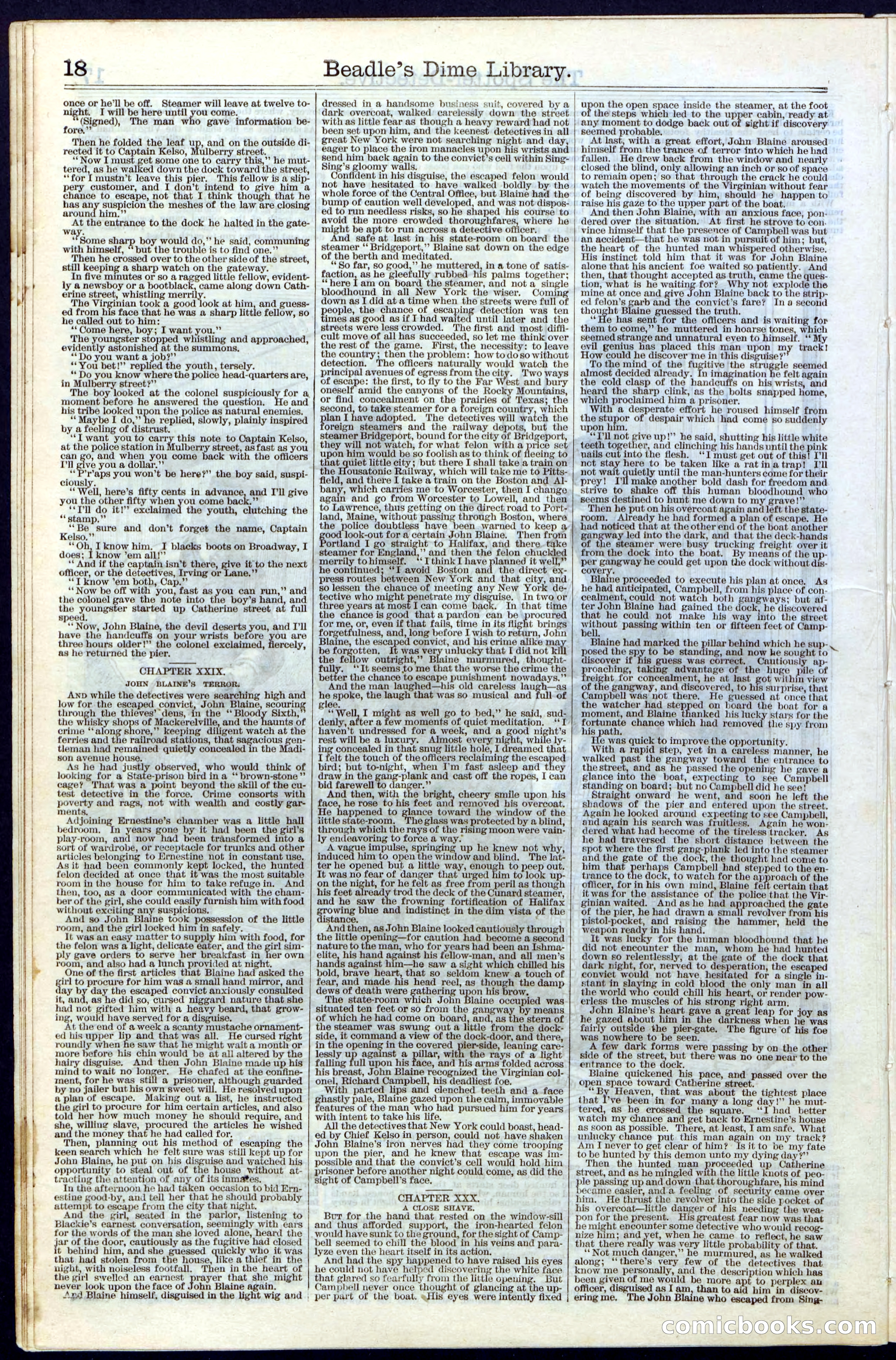
A restored page from Pulp Fiction, 1878. Page through the whole issue in the reader above.
📄 Transcribed text from this page (OCR, searchable)
Machine-transcribed from the original scan — historical spelling and the odd misread are preserved.
LS ma —— a ~o 18 _——- once or he'll be off. Steamer will leave at twelve to- night. I will be here until you come. fore. Then he folded the leaf up, and on the outside di- rected it to Captain Kelso, Mulberry street. ‘*Now I must get some one to carry this,’’ he mut- tered, as he walked down the dock toward the street, ‘**for [ mustn’t leave this pier. This fellow is a slip- pery customer, and I don’t intend to around him.” At the entrance to the dock he halted in the gate- way. Some sharp with himself, ‘‘ but the trouble is to find one.”’ Then he crossed over to the other side of the street, still yey a sharp watch on the gateway. In five min ly a newsboy or a bootblac erine street, whistling merril The Virginian took a good Nook at him, and guess- face that he was a sharp little fellow, so ve it to the next e,”’ ed from h he called out to him: ‘“*Come here, boy; I want you.” The youngster stopped whistling and approached, evidently astonished at the summons, “Do you want a job?” * You bet!’’ replied the youth, tersely. **Do you know where the police head-quarters are, in Mulberry street?’ The boy looked at the colonel suspiciousl moment before he answered the question. He and his tribe looked upon the police as natural enemies. ‘*Maybe I do,” he replied, slowly, plainly inspired by a feeling of distrust. “IT want you to carry this note to Captain Kelso, at the police station in Mulberry street, as fast as you can go, and when you come back with the officers I'll give you a dollar.”’ ‘*‘P’r’aps you won’t be here?” the boy said, suspi- ae = ‘Well, here’s fifty cents in advance, and I'll give you the other fifty when you come back.” : AM. do it!’ exclaimed the youth, clutching the ia) sg mp. ” ee Be sure and don’t forget the name, Captain elso.”’ ‘**Oh, Iknow him. I blacks boots on Broadway, I does; I know ’em ail!” ‘* And if the captain isn’t there, officer, or the detectives, Irving or ““T know ’em both, Cap.”’ ‘*Now be off with you, fast as you can run,” and the colonel “ate the note into the boy’s hand, and the young er started up Catherine street at full speed, ‘** Now, John Blaine, the devil deserts you, and I’ll have the handcuffs on your wrists before you are three hours older!’ the colonel exclaimed, fiercely, as he returned the pier. CHAPTER XXIX. JOHN BLAINE’S TERROR: Anp while the detectives were searching high and low for the escaped convict, John Blaine, scourin through the thieves’ dens, in the “ Bloody Sixth, the whisky shops of Mackerelville, and the haunts of crime ‘along shore,”’ keeping diligent watch at the ferries and the railroad stations, that os page gen- tleman had remained quietly concealed in the Madi- son avenue house. As he had justly observed, who would think of looking for a State-prison bird in a ** brown-stone”’ cage? That was a point beyond the skill of the cu- test detective in the force. Crime consorts with st and rags, not with wealth and costly gar- ments, Adjoining Ernestine’s chamber was a little hall bedroom, In years gone by it had been the girl’s play-room, and now had been transformed into a sort of wardrobe, or receptacle for trunks and other articles belonging to Ernestine not in constant use. As it had been commonly kept locked, the hunted felon decided at once that it was the most suitable room in the house for him to take refuge in. And then, too, as a door communicated with the cham- ber of the girl, she could easily furnish him with food without exciting any suspicions. And so John Blaine took possession of the little room, and the girl locked him in safely. It was an easy matter to supply him with food, for the felon was a light, delicate éater, and the girl sim- ply gave orders to serve her breakfast in her own room, and also had a lunch provided at night. One of the first articles that Blaine had asked the a to procure for him was a small hand mirror, and day by day the escaped convict anxiously consulted it, and, as he did so, cursed niggard nature that she had not gifted him with a heavy beard, that grow- ing, would have served for a disguise. t the end of a week a scanty mustache ornament- ed his upper lip and that was all. He cursed right roundly when he saw that he might wait a month or more before his chin would be at all altered by the hairy disguise. And then John Blaine made up his mind to wait no longer. He chafed at the confine- ment, for he was still a prisoner, although guarded by no jailer but his own sweet will. He resolved upon a plan of escape. Making out a list, he instructed the girl to procure for him certain articles, and also told her how much money he should require, and she, willing slave, oe the articles he wished and the money that he had called for. Then, planning out his method of escaping the keen search which he felt sure was still kept up for John Blaine, he put on his disguise and watched his opportunity to steal out of the house without at- tracting the attention of any of its inmates. In the afternoon he had taken occasion to bid Ern- estine good-by, and tell her that he should probably attempt to escape from the city that night. And the girl, seated in the parlor, listening to Blackie’s earnest conversation, seemingly with ears for the words of the man she loved alone, heard the jar of the door, cautiously as the fugitive had closed t behind him, and she guessed et who it was that had stolen from the house, like a thief in the night, with noiseless footfall. Then in the heart of the girl swelled an earnest prayer that she might never look upon the face of John Blaine again, Apa Blaine himself, disguised in the light wig and (Signed), The man who gave information be- give him a chance to escape, not that I think though that he has any suspicion the meshes of the law are closing boy would do,” he said, communing utes or s0 a sh bi little fellow, evident- came along down Cath- for a dressed in a handsome business suit, covered by a dark overcoat, walked carelessly down the street with as little fear as though a heavy reward had not been set upon him, and the keenest detectives in all great New York were not searching night and day eager to place the iron manacles upon his wrists and send him back again to the convict’s cell within Sing- Sing’s gloomy walls. Confident in his disguise, the escaped felon would not have hesitated to have walked boldly by the whole force of the Central Office, but Blaine had the bump of caution well developed, and was not dispos- ed to run needless risks, so he shaped his course to avoid the more crowded thoroughfares, where he might be apt to run across a detective officer. nd safe at last in his state-room on board the steamer ‘‘ Bridgeport,’’ Blaine sat down on the edge of the berth and meditated. **So far, so good,”’ he muttered, in a tone of satis- faction, as he gleefully rubbed his palms together; ‘here lam on board the steamer, and not a single bloodhound in all New York the wiser. Coming down as I did at a time when the streets were full of eople, the chance of pace oie detection was ten imes as good as if I had waited until later and the streets were less crowded. The first and most diffi- cult move of all has succeeded, so let me think over the rest of the game. First, the necessity: to leave the country; then the problem: how to doso without detection. The officers naturally would watch the principal avenues of egress from the city. Two ways of escape: the first, to fly to the Far West and bury oneself amid the canyons of the Rocky Mountains, or find concealment on the prairies of Texas; the second, to take steamer for a foreign country, which plan [have adopted. The detectives will watch the oreign steamers and the railway depots, but the steamer Bridgeport, bound for the city of Bridgeport, they will not watch, for what felon with a price set upon him would be so foolish as to think of fleeing to that A hei little city; but there I shall take a train on the Housatonic Railway, which will take me to Pitts- field, and there I take a train on the Boston and AlI- bany, which carries me to Worcester, then I change again and go from Worcester to Lowell, and then to Lawrence, thus getting on the direct road to Port- land, Maine, without passing through Boston, where the police doubtless have been warned to keep a ood look-out for a certain John Blaine. Then from ortland I go straight to Halifax, and there. take steamer for Eng y and then the felon chuckled merrily tohimself. ‘‘ I think I have plese? it well,” he continued; “I avoid Boston and the direct ex- press routes between New York and that city, and so lessen the chance of meeting any New York de- tective who might penetrate my disguise. In two or three years at most I can come back. In that time the chance is good that a pardon can be procured for me, or, even if that fails, time in its flig t brings fo etfulness, and, long before I wish to return, John Blaine, the esca convict, and his crime alike may be forgotten, was very unlucky that I did not ki the fellow outright,’ Blaine murmured, thought- fully. ‘It seems to me that the worse the crime the etter the chance to escape punishment nowadays.” And the man laughed—his old careless laugh—as he spoke, the laugh that was so musical and full of glee, “Well, I might as well go to bed,’ he said, sud- denly, after a few moments of quiet meditation, ‘TI haven’t undressed for a week, and a good night’s rest will be a luxury. Almost every night, while ly- ing concealed in that snug little hole, I ed that I felt the touch of the officers reclaiming the oe bird; but to-night, when I’m fast asleep and they draw in the gang-plank and cast off the ropes, I can bid farewell to danger.” And then, with the bright, cheery smile upon his face, he rose to his feet and removed his overcoat. He happened to glance toward the window of the little state-room, e glass was protected by a blind, through which the rays of the rising moon were vain- ly endeavoring to force a way, A vague impulse, s ringing up he knew not why, induced him to open the window and blind. The lat- ter he opened but a little way, ok te to peep out, It was no fear of danger that urged him to look up- on the night, for he felt as free from peril as though his feet er trod the deck of the Cunard steamer, and he saw the frowning fortification of Halifax Ae blue and indistinct in the dim vista of the nce. . And then, as John Blaine looked cautiously through the little opening—for caution had become a second nature to the man, who for years had been an elite, his hand against his fellow-man, and all men’s hands against —he saw a sight which chilled his bold, brave heart, that so seldom knew a touch of fear, and made his head reel, as though the damp dews of death were gathering upon his brow, The state-room which John Blaine occupied was situated ten feet or so from the gang way y means of which he had come on board, and, as the stern of the steamer was swung out a little from the dock- side, it command a view of the dock-door, and there, in the ope in the covered pier-side, leaning care- lessly up against a pillar, with the rays of a light falling full upon his face, and his arms folded across his breast, John Blaine recognized the Virginian col- onel, Richard Campbell, his deadliest foe. With parted lips and clenched teeth and a face ghastly pale, Blaine gazed upon the calm, immovable features of the man who had pursued him for years with intent to take his life. All the detectives that New York could boast, head- ed by Chief Kelso in person, could not have shaken John Blaine’s iron nerves had they come trooping upon the pier, and he knew that escape was im- possible and that the convict’s cell would hold him prisoner before another night could come, as did the sight of Campbell's face. CHAPTER XXX. A CLOSE SHAVE. But for the hand that rested on the window-sill and thus afforded support, the iron-hearted felon _would have sunk to the ground, for the sight of Camp- bell seemed to chill the blood in his veins and para- lyze even the heart itself in its action. And had the spy happened to have raised his eyes he could not have helped discovering the white face that glared so fearfully from the little opening. But ' Campbell never once thought of glancing at the up- | per part of the boat, eHis eyes were intently fixed Beadle’s Dime. Library. ES i the open space inside the steamer, at the foot of the steps which led to the upper cabin, ready at any moment to dodge back out of sight if discovery seemed probable. At last, with a great effort, John Blaine aroused himself from the trance of terror into which he had fallen, He drew back from the window and nearly closed the blind, a allowing an inch or so of space to remain open; so that through the crack he could watch the movements of the Virginian without fear of being discovered by him, should he happen to raise his gaze to the upper part of the boat. And then John Blaine, with an anxious face, pon- dered over the situation. At first he strove to con. vince himself that the presence of Campbell was but an accident—that he was not in pursuit of him; but, the heart of the hunted man whispered otherwise. His instinct told him that it was for John Blaine alone that his ancient foe waited so patiently. And then, that thought accepted as truth, came the ques- tion, what is he waiting for? Why not explode the mine at once and give John Blaine back to the strip- ed felon’s garb and the convict’s fare? In a second thought Blaine guessed the truth. ‘He has sent for the officers and is waiting for them to come,’’ he muttered in hoarse tones, which seemed strange and unnatural even to himself. ‘* My evil genius bas placed this man upon my track! How could he discover me in this disguise?’ To the mind of the fugitive the struggle seemed almost decided already. In imagination he felt again the cold clasp of the handcuffs on his wrists, and heard the sharp clink, as the bolts snapped home, which proclaimed him a prisoner. With a desperate effort he roused himself from the stupor of despair which had come so suddenly upon him, “Tl not give up!”’ he said, + i his little white teeth together, and clinching his hands until the pink nails cut into the flesh. “I must get out of this! Pll not stay here to be taken like a ratinatrap! Dll not wait Cord until the man-hunters come for their prey! T'llmake another bold dash for freedom and strive to shake off this human bloodhound who seems destined to hunt me down to my grave!” Then he put on his overcoat again and left the state- room. Already he had formed a plan of escape. He had noticed that at the other end of the boat another gangway led into the dark, and that the deck-hands of the steamer were busy trucking freight over it from the dock into the boat. By means of the up- per gangway he could get upon the dock without dis- covery. Blaine proceeded to execute his plan at once. As he had anticipated, Campbell, from his place of con- cealment, could not watch both gangways; but af- ter John Blaine had gained the dock, he discovered that he could not make his way into the street Me passing within ten or fifteen feet of Camp- Fs Blaine had marked the pillar behind which he sup- ‘| posed the spy to be standing, and now he sought to discover if guess was correct. Cautiously ap- roaching, taking advantage of the huge pile of reight for concealment, he at last got within view of the gangway, and discovered, to his surprise, that Campbell was not there. He guessed at once that the watcher had Beepped on board the boat for a moment, and Blaine thanked his lucky stars for the ' ae chance which had removed the spy from s path, e was quick to improve the opportunity. With a rapid step, yet in a careless manner, he walked past the gangway toward the entrance to the street, and as he passed the opening he gave a glance into the boat, expecting to see Campbell standing on board; but no Campbell did he see! Straight onward he went, and soon he left the shadows of the pier and entered upon the street. Again he looked around expecting to see Campbell, and again his search was fruitless. Again he won- dered what had become of the tireless tracker, As he had traversed the short distance hetween the spot where the first gang-plank led into the steamer and the gate of the dock, the thought had come to him that poner Campbell had stepped to the en- trance to the dock, to watch for the approach of the officer, for in his own mind, Blaine felt certain that it was for the assistance of the police that the Vir- ginian waited. And ashe had approached the gate of the pier, he had drawn a small revolver from his pistol-pocket, and raising the hammer, held the weapon ready in his hand. It was lucky for the human bloodhound that he did not encounter the man, whom he had hunted down so relentlessly, at the gate of the dock that dark night, for, nerved to desperation, the escaped conviet would not have. hesitated for a single in- stant in Penk in cold blood the only man in all the world who could chill his heart, or render pow- erless the muscles of his strong right arm, John Blaine’s heart gave a great leap for joy as he gazed about in the darkness when he was fairly outside the pier-gate. The figure ‘of his foe ny 8 habe be seen. * ew orms were passing by on the other side of the street, but thane was a ie. near to the entrance to the dock. Blaine quickened his pace, and passed over the open space toward Catherine street. fr Heaven, that was about the tightest place that ve been in for many a long day!” he mut- tered, as he crossed the square. ‘I had better watch my chance and get back to Ernestine’s house as soon as possible. There, at least, I amsafe. What unlucky chance put this man again on my track? Am I never to get clear of him? Is it to be my fate to be hunted by this demon unto my dying day?” Then the hunted man proceeded up Catherine street, and as he mingled with the little knots of peo- ve passing up and down that thoroughfare, his mind ecame easier, anda feeling of security came over him. He thrust the revolver into the side pocket of his overcoat—little danger of his needing the wea- pas for the present. His greatest fear now was that 1e might encounter some detective who would recog- nize him; and yet, when he came to reflect, he saw that there really was very little probability of that. ‘*Not much danger,” he murmured, as he walked along; ‘‘there’s very few of the detectives that know me personally, and the description which has been given of me would be more apt to perplex au officer, di as I am, than to aid him in discov- ering me, The John Blaine who escaped from Sing- Gomicbooks (E(@)