
Pulp Fiction, 1878 · page 13 of 28
Beadle's Dime Library No. 27 — page 13: what you’re looking at
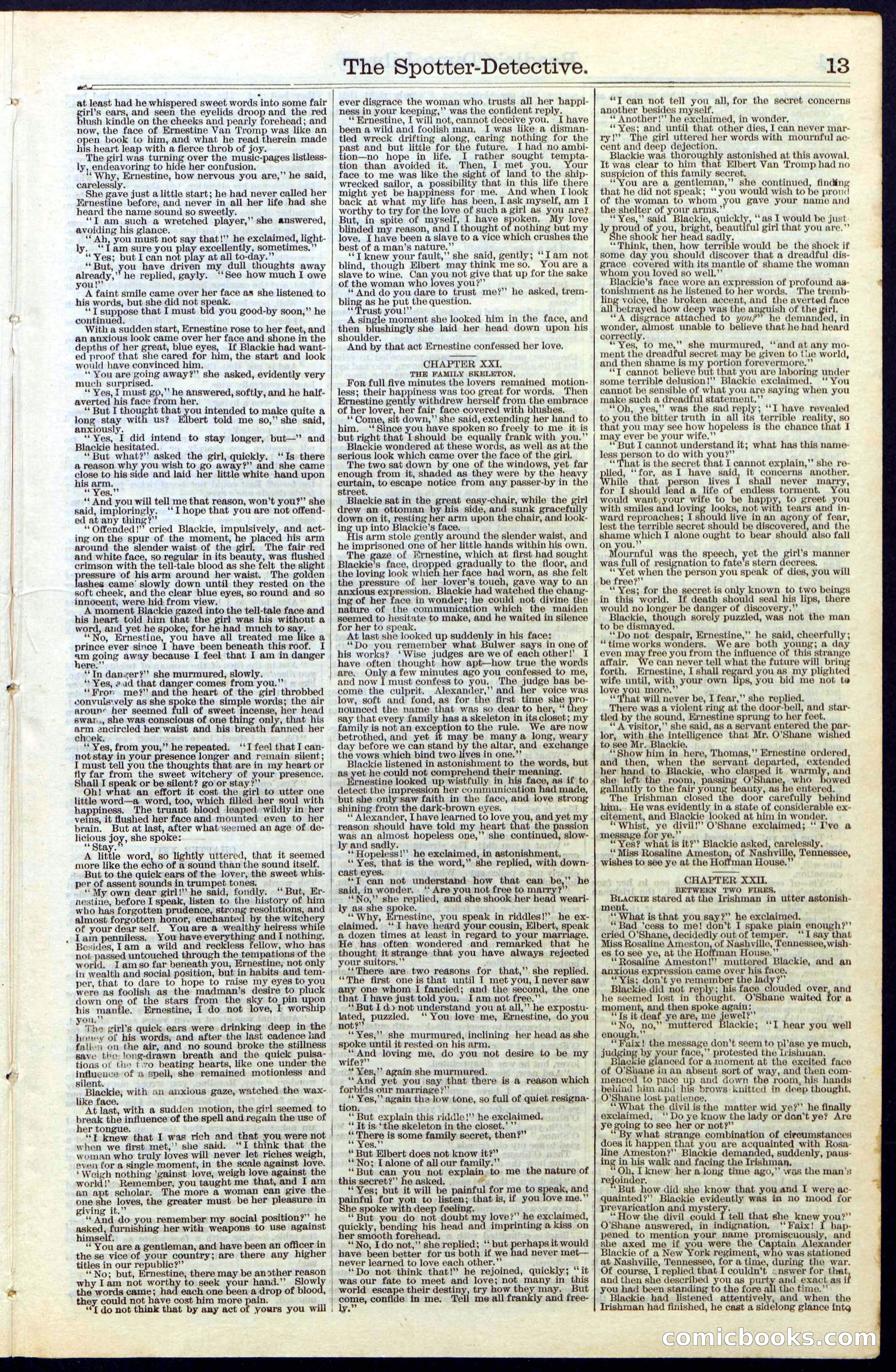
A restored page from Pulp Fiction, 1878. Page through the whole issue in the reader above.
📄 Transcribed text from this page (OCR, searchable)
Machine-transcribed from the original scan — historical spelling and the odd misread are preserved.
. Lam penniless. me at least had he whispered sweet words into some fair gus ears, and seen the eyelids droop and the red lush kindle on the cheeks and pearly forehead; and now, the face of Ernestine Van Tromp was like an open book to him, and what he read therein made his heart leap with a fierce throb of joy. The girl was turning over the music-pages listless- ly, endeavoring to hide her confusion. ‘Why, Ernestine, how nervous you are,”’ he said, carelessly. She gave just a little start; he had never called her Ernestine before, and never in all her life had she heard the name sound so sweetly. ‘‘I am such a wretched player,’ she answered, avoiding his glance. ‘* Ah, you must not say that!’’ he exclaimed, light- ly. ‘Tam sure you vlan excellently, sometimes.” “Yes; but I can not play at all to-day.” “But, you have driven my dull thoughts away already,”’ he replied, gayly. ‘‘See how much I owe you!”’ A faint smile came over her face as she listened to his words, but she did not speak, ‘**T suppose that I must bid you good-by soon,” he continued. With a sudden start, Ernestine rose to her feet, and an anxious look came over her face and shone in the depths of her great, blue eyes, If Blackie had want- ed proof that she cared for him, the start and look would have convinced him. “ You are going away?’’ she asked, evidently very much surprised, ‘* Yes, I must go,’’ he answered, softly, and he half- averted his face from her. “ But I thought that you intended to make quite a long stay with us? Elbert told me so,’ she said, anxiously. ‘“Yes, I did intend to stay longer, but—”’ and Blackie hesitated. ‘But what?’ asked the girl, quickly. ‘Is there a reason why 2 pa wish to go away?” and she came close to his side and laid her little white hand upon his arm, ee Yes.”’ ‘‘ And you will tell me that reason, won’t you?” she said, imploringly. ‘‘I hope that you are not offend- ed at any thing?’ “Offended!” cried Blackie, impulsively, and act- ing on the spur of the moment, he placed his arm around the slender waist of the girl. The fair red and white face, so regular in its beauty, was flushed crimson with the tell-tale blood as she felt, the slight ressure of his arm around her waist. The golden hes came’ slowly down until they rested on the soft cheek, and the clear blue eyes, so round and so innocent, were hid from view. A moment Blackie gazed into the tell-tale face and his heart told him that the girl was his without a word, aud yet he spoke, for he had much to say. ‘No, Ernestine, you have all treated me like a prince ever since I have been beneath this roof. I — going away because I feel that I am in danger ere.”” ‘*In danzer?”’? she murmured, slowly. ‘Yes, ead that danger comes from you.” “ron me?’ and the heart of the girl throbbed ©onvuls'vely as she spoke the simple words; the air aroun her seemed full of sweet incense, her head swar., She was conscious of one thing _ that his wi acer her waist and his breath fanned her choek. ‘* Yes, from you,” he repeated. ‘‘I feel that I can- not stay in your es me longer and remain silent; I must tell you the thoughts that are in my heart or fy far from the sweet witchery of your presence. Shall I speak or be silent? go or stay’”’ Oh! what an effort it cost the girl to utter one little word—a word, too, which filled her soul with happiness. The truant blood leaped. wildly in her | veins, it flushed her face and mounted even to her brain. But at last, after what seemed an age of de- licious joy, she spoke: “Stay.” ; A little word, so lightly uttered, that it seemed more like the echo of a sound than the sound itself. But to the quick ears of the lover, the sweet whis- per of assent sounds in trumpet tones. “My own dear girl!’’ he said, fondly. “ But, Er- nestine, before I speak, listen to the mretini of him who has forgotten prudence, strong resolutions, and almost forgotten honor, enchanted by the witche of your dear self. Youare a wealthy heiress while You have everything and I nothing, Besides, lam a wild and reckless fellow, who has not passed untouched through the tempations of the | world. I amso far beneath you, Ernestine, not only in wealth and social position, but in habits and tem- per, that to dare to hope to raise my eyes to you were as foolish as the madman’s desire to pluck | any down one of the stars from the sky to pin upon his mantle. ou,” . The girl’s quick ears were drinking deep in the honey of his words, and after the last cadence kad fallen on the air, and no sound broke the stillness save the long-drawn breath and the quick pulsa- tions of the tivo beating hearts, like one under the influcnee of a spell, she remained motionless and silent. Ernestine, I do not love, l worship | Blackie, with an anxious gaze, watched the wax-— like face. At last, with a sudden motion, the girl seemed to break the influence of the spell and regain the use of her tongue, iE: knew that I was rich and that when we first met,’’ she said. “I think that the woman who truly loves will never let riches weigh, even for a single moment, in the scale against love. ‘Weigh nothing 'gainst love, weigh love against the world!’ Remember, you taught me that, and I am an apt scholar. The more a woman can give the one 8 . heat the greater must be her pleasure in giving it.” it ‘ And do you remember my social position?” he asked, furnishing her with weapons to use against ell, “You are a gentleman, and have been an Officer in the se vice of your country; are there any higher titles in our republic?” ‘‘No; but, Ernestine, there may be another reason why Iam not worthy to seek your hand.’’ Slow the words came; had each one been a drop of blood, they could not have cost him more pain. : ‘“[ do not think that by any act of yours you will ou were not | The Spotter-Detective. ever disgrace the woman who trusts all her happi- ness in your keeping,’’ was the confident reply. ‘Ernestine, I will not, cannot deceive you. Ihave been a wild and foolish man, I was like a disman- tled wreck drifting along, caring nothing for the vast and but little for the future. I had no ambi- ion—no hope in life. I rather sought tempta- tion than avoided it. Then, I met you. our face to me was like the sight of land to the ship- wrecked sailor, a possibility that in this life there might yet be happiness for me. _ And when I look back at what my life has been, Iask myself, am I worthy to try for the love of such a girl as you are? But, in spite of myself, I have spoken. My love blinded my reason, and I thought of nothing but my love, I have been a slave to a vice which crushes the best of a man’s nature.”’ ; ‘‘T knew your fault,” she said, gently; ‘Iam not blind, though Elbert may think meso, You are a slave to wine. Can you not give that up for the sake of the woman who loves you?” __ “ And do you dare to trust me?” he asked, trem- bling as he put the question. “Trust you!” A single moment she looked him in the face, and then hroshing ty she laid her head down upon his shoulder. And by that act Ernestine confessed her love. CHAPTER XXt1. THE FAMILY SKELETON. For full five minutes the lovers remained motion- less; their happiness was too great for words. Then Ernestine gently withdrew herself from the embrace of her lover, her fair face covered with blushes. ** Come, sit down,’’ she said, extending her hand to him. ‘Since you have spoken go freely to me it is but right that [should be equally frank with you.” Blackie wondered at these words, as well as at the serious look which came over the face of the girl. The two sat down by one of the windows, yet far enough from it, shaded as they were by the heavy curtain, to escape notice from any passer-by in the street. Blackie sat in the great easy-chair, while the girl drew an ottoman by his side, and sunk gracefully down on it, resting her arm upon the chair, and look- ing up into Blackie’s face. His arm stole gently around the slender waist, and he imprisoned one of her little hands within his own. The gaze of Ernestine, which at first had sought Blackie’s face, Bugnpec gradually to the floor, and the loving look which her face had worn, as she felt the pressure of her lover's touch, gave way to an anxious expression, Blackie had watched the chang- ing of her face in wonder; he could not divine the nature of the communication which the maiden seemed to hesitate to make, and he waited in silence for her to speak. At last she looked up suddenly in his face: “Do you remember what Bulwer says in one of his works? ‘Wise judges are we of each other!’ I have often thought how apt—how true the words are, Only a few minutes ago you confessed to me, and now | must confess to you. The judge has be- come the culprit. Alexander,’’ and her voice was low, soft and fond, as for the first time she pro- nounced the name that was so dear to her, “ they say that every family has a skeleton in its closet; my family is not an exception to the rule. We are now betrothed, and yet it may be many a long, weary day before we can stand by the altar, and exchange the vows which bind two lives in one,”’ Blackie listened in astonishment to the words, but as yet be could not comprehend their me ; Ernestine looked up wistfully in his face, as if to detect the impression her communication had made, but she only saw faith in the face, and love strong shining from the dark-brown eyes. ** Alexander, [ have learned to love you, and yet my reason should have told my heart that the passion was an almost hopeless one,” she continued, slow- ly and sadly. ‘* Hopeless!” he exclaimed, in astonishment, ‘* Yes, that is the word,” she replied, with down- cast eyes. it *T can not understand how that can be,” he said, in wonder. ‘ Are you not free to mauve ‘ ‘*No,’’? she replied, and she shook her head weari- ly as she a ‘““Why, Ernestine, you speak in riddles!” he ex- claimed. “I have heard your cousin, Elbert, k a dozen times at least in regard to your marriage. He has often wondered and remarked that he thought it strange that you have always rejected your suitors.”’ ‘There are two reasons for that,’ she replied. “The first one is that until I met you, [never saw one whom I fancied; and the second, the one that I have just told you. Iam not free.” ‘*But I do not understand you at all,’’ he ex wnat puzzled. ‘‘ You love me, Ernestine, not?’ ‘Yes,’ she murmured, inclining her head as she spoke until it rested on his arm. ae loving me, do you not desire to be my e ” “ Yes,’’ again she murmured. hi tie “And yet you say that there is a reason which forbids our marriage?” : if ** Yes,” again the low tone, so full of quiet resigna- on, ‘But explain this riddle!’ he exclaimed, ‘* Tt is ‘the skeleton in the closet.’ ” ff There is some family secret, then?” ‘* Yes.” “ But Elbert does not know it?” ‘*No; Lalone of all our family.” ‘But can you not explain, to me the nature of this secret?” he asked. . o | ‘Yes; but it will be painful for me to speak, and ul for you to listen; that is, if you love me.” he spoke with deep feeling. j . “But you do not doubt my love?”’ he exclaimed, quickly, ang ae head and imprinting a kiss on her smooth forehead. ‘“No, Ido not,” she replied; ‘‘ but Peepers it would have been better for us both if we had never met— never learned to love each other,” “Do not think that!” he rejoined, quickly; “it was our fate to meet and love; not many in this world escape their a try how they may. But = confide in me. Tell me allf and free- stu- o you eee 13 *T can not tell you all, for the secret concerns another besides myself. ‘** Another!’ he exclaimed, in wonder, ‘Yes; and until that other dies, I can never mar- ry!’ The girl uttered her words with mournful ac- cent and deep dejection. Blackie was thoroughly astonished at this avowal. It was clear to him that Elbert Van Tromp had no suspicion of this family secret. ‘*You are a gentleman,’ she continued, finding that he did not speak; ‘‘ you would wish to be proud of the woman to whom you gave your name and the shelter of your arms.’ ‘Yes,’ said Blackie, quickly, ‘as I would be just ly * ad of you, bright, beautiful girl that you are.” he shook her head sadly. “Think, then, how terrible would be the shock if some day you should discover that a dreadful dis- grace covered with its mantle of shame the woman whom you loved so well.” Blackie’s face wore an expression of profound as- tonishment as he listened to her words. The tremb- ling voice, the broken accent, and the averted face all betrayed how coer was the anguish of the girl. “A disgrace attached to you?’ he demanded, in nost unable to believe that he had heard wonder, correctly. “Yes, to me,” she murmured, ‘and at any mo- ment the dreadful secret may be given to the world, and then shame is my portion forevermore.”’ “T cannot believe but that you are laboring under some terrible delusion!’ Blackie exclaimed. ‘ You cannot be sensible of what you are saying when you make such a dreadful statement,”’ “Oh, yes,” was the sad reply; ‘I have revealed to you the bitter truth in all its terrible reality, so that you may see how hopeless is the chance that I may ever be your wife.” ‘* But I cannot understand it; what has this name- less person to do with you?” “That is the secret that I cannot explain,’’ she re- lied, ‘‘for, as I have said, it concerns another. ile that person lives I shall never marry, for I should lead a life of endless torment. You would want, your wife to be happy, to greet. you with smiles and loving looks, not with tears and in- ward reproaches; I should live in an agony of fear, lest the terrible secret should be discovered, and the shame which I alone ought to bear should also fall on you. ournful was the speech, yet the girl’s manner was full of resignation to fate’s stern decrees. ‘Yet when the person you speak of dies, you will be free?” ‘Yes; for the secret is only known to two beings in this world. If death should seal his lips, there would no longer be danger of discovery.” Blackie, though sorely puzzled, was not the man to be dismayed, “Do not despair, Ernestine,” he said, cheerfully; “time works wonders. Weare both young; a day even may free you from the influence of this strange affair. e can never tell what the future will bring forth. Ernestine, I shall regard you as my plighted wife until, with your own lips, you bid me not te love you more,” ‘*That will never be, I fear,’’ she replied. There was a violent ring at the door-bell, and star- tled by the sound, Ernestine sprung to her feet. “A visitor,’ she said, as a servant entered the par- lor, with the intelligence that Mr, O’Shane wished to see Mr. Blackie. ‘‘Show him in here, Thomas,” Ernestine ordered and then, when the servant Meparted, extended her hand to Blackie, who clasped it warmly, and she left the room, passing O’Shane, who wed gallantly to the fair young beauty, as he entered. ‘The Irishman closed the door carefully behind him... He was evidently in a state of considerable ex- citement, and Blackie looked at him in wonder, “Whist ye divil!’’ O’Shane exclaimed; “ Ive a message for ye.”’ ; “Yes? what is it?’ Blackie asked, carelessly. **Miss Rosaline Ameston, of Nashville, Tennessee, wishes to see ye at the Hoffman House.” CHAPTER XXII, BETWEEN TWO FIRES, BLACK stared at the Irishman in utter astonish- ment. ‘* What is that you say?” he exclaimed. “Bad ’cess to me! don’t I spake plain enough?”’ cried O’Shane, decidedly out of temper. ‘I say that Miss Rosaline Ameston, of Nashville, Tennessee, wish- es to see ye, at the Hoffman House.” f “Rosaline Ameston!’? muttered Blackie, and an anxious expression came over his face, “Vis; don’t ye remember the lady?” Blackie did not reply; his face clouded over, and he seemed lost in thought. O’Shane waited for a moment, and then spoke again: ‘Ts it deaf ye are, me jewel?” “No, no,’’ muttered Blackie; ‘‘I hear you well eno c “Raix! the message don’t seem to pl’ase ye much, Judging by our face,”’ protested the Leishman. Blackie glanced for a moment at the excited face of O’Shane in an absent sort of way, and then com- menced to pace up and down the room, his hands behind him and his brows knitted in deep thought. O’Shane lost patience, ‘What the divilis the matter wid ye?” he finally exclaimed, ‘Do ye know the lady or dan't ye? Are ye going to see her or not?” By what str combination of circumstances does it happen that you are es with Rosa- line Ameston?”’ Blackie demanded, suddenly, paus- ing in his walk and facing the Irishman, Oh, I knew her a long time ago,” was the man’s rejoinder. ‘But how did she know that you and I were ac- quainted?” Blackie evidently was in no mood for prevarication and matory ‘How the divil could I tell that she knew you?” O’Shane answered, in indignation, ‘‘Faix! I hap- pened to mention your name promiscuously, and she axed me if you were the Ca Alexander Blackie of a New York regiment, who was stationed at Nashville, Tennessee, for a time, during the war. Of course, I replied that I couldn't -nswer for that and then she described you as purty and exact as if you had been standing to the fore all the time.” Blackie had listened attentively, and when the Irishman had finished, he cast a sidelong glance intg (e(o) al (E(0) Gbooks