
Pulp Fiction, 1878 · page 12 of 28
Beadle's Dime Library No. 27 — page 12: what you’re looking at
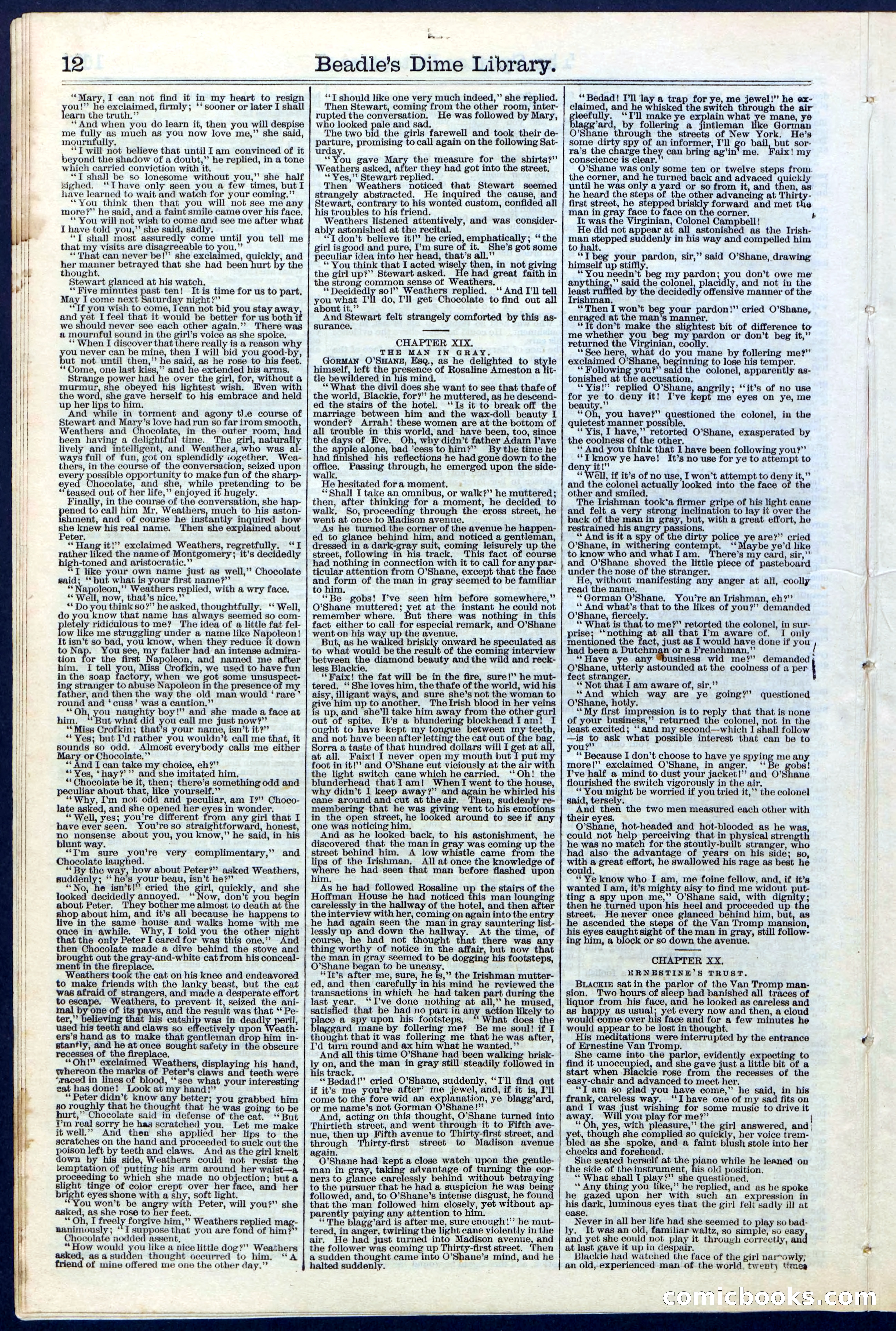
A restored page from Pulp Fiction, 1878. Page through the whole issue in the reader above.
📄 Transcribed text from this page (OCR, searchable)
Machine-transcribed from the original scan — historical spelling and the odd misread are preserved.
reese Aa 12 “Mary, I can not find it in my heart to resign ou!”’ he exclaimed, firmly; ‘‘ sooner or later I shall earn the truth.’’ ‘*And when you do learn it, then you will despise me fully as much as you now love me,” she said, mournfully, ‘*T will not believe that until Iam convinced of it beyond the shadow of a doubt,” he replied, in a tone which carried conviction with it. ‘‘{ shall be so lonesome without you,” she half bighed. “TIT have only seen you a few times, but I have learned to wait and watch for your coming.”’ “You think then that you will not see me any more?” he said, and a faint smile came over his face. ‘You will not wish to come and see me after what I have told you,” she said, sadly. *‘T shall most assuredly come until you tell me that my visits are disagreeable to you.”’ “That can never be!" she exclaimed, wera , and ra ee betrayed that she had been hurt a the thought. Stewart glanced at his watch. ‘Five minutes re ten! Itis time for us to part, May I come next Saturday night?” “If you wish to come, Ican not bid you stay away and yét I feel that it would be better for us both if we should never see each other again.’”’ There was a mournful sound in the girl’s voice as she spoke. ** When I discover that there really is a reason why ou never can be mine, then I will bid you good-by, ut not until then,” he said, as he rose to his feet. ‘*Come, one last kiss,”’ and he extended his arms. Strange power had he over the girl, for, without a murmur, she obeyed his lightest wish. Even with the word, she gave herself to his embrace and held up her lips to him. And while in torment and agony tle course of Stewart and Mary’s love had run so far trom smooth Weathers and Chocolate, in the outer room, had been a a delightful time. The girl, naturall lively and intelligent, and Weather 3, who was al- ways full of fun, got on splendidly cogether. Wea- thers, in the course of the conversation, seized upon ever poe opportunity to make fun of the sharp- eye hocolate, and she, while bhi te to be “teased out of her life,’’ enjoyed it hugely. Finally, in the course of the conversation, she hap- ened to call him Mr, Weathers, much to his aston- hment, and of course he instantly inquired how ae knew his real name. Then she explained about eter. Ply it!’ exclaimed Weathers, regretfully. ‘I rather liked the name of Montgomery; it’s decidedly high-toned and aristocratic.” I like your own name just as well,’’ Chocolate said; ‘‘ but what is your first name?’’ ‘*Napoleon,’’ Weathers replied, with a wry face, ** Well, now, that’s nice,”’ ** Do you think so?” he asked, thoughtfully. ‘‘ Well, do rc know that name has always seemed so com- letely ridiculous to me? The idea of a little fat fel- ow like me struggling under a name like N apoleon | It isn’t so bad, you know, when they reduce it down to Nap. You see my father had an intense admira- tion for the first apoleon, and named me after him. I tell you, Miss Crofkin, we used to have fun in the soap tory, when we got some unsuspect- ing stranger to abuse Napoleon in the presence of my father, and then the way the old man would ‘rare’ round and ‘ cuss’ was a caution.” " Oh, you naughty boy!” and she made a face at him. “ But what did you call me just now?’’ ‘*Miss Crofkin; that’s your name, isn’t it?” “Yes; but I’d rather you wouldn't call me that, it sounds so odd. Almost everybody calls me either Mary or Chocolate.” ‘And I can take my choice, eh?”’ ““'Yes, ‘hay?’’’ and she imitated him. “‘ Chocolate be it, then; there’s something odd and peculiar about that, like yourself.”’ ‘Why, I’m not odd and peculiar, am I?’’ Choco- late asked, and she opened her eyes in wonder. ““Well, yes; you’re different from any girl that I have ever seen. You’re so straightforward, honest, no nonsense about you, you know,” he said, in his blunt way. “I’m sure you’re very complimentary,’’ and Chocolate laughed. * By the way, how about Peter?’ asked Weathers, suddenly; ‘* he’s your beau, isn’t he?” ‘‘No, he isn’t!” cried the girl, quickly, and she looked decidedly annoyed. ‘Now, don’t you begin about Peter. They bother me almost to death at the shop about him, and it’s all because he happens to live in the same house and walks home with me once in awhile. Why,I told you the other night that the only Peter I cared for was this one.” And then Chocolate made a dive behind the stove and brought out the ment in the fireplace. Weathers took the cat on his knee and endeavored to make friends with the lanky beast, but the cat was afraid of strangers, and made a desperate effort to escape. Weathers, to prevent it, seized the ani- mal by one of its paws, and the result was that “ Pe- ter,” that his catship was in deadly peril, used his teeth and claws so effectively upon Weath- ers’s hand as to make that easier drop him in- stantly, and he at once sought safety in the obscure recGhi” exclaimed We thers, displaying his hand e eathers a n thereon the marks of Peter’s ‘clans and teeth were ‘raced in lines of blood, ‘‘see what your interesting “at Petr duane now an? beter, “* Peter ; Ow an tter; you grabbed him so roughly that he thought that La eras githur to be hurt,”’ Chocolate said in defense of the cat. ‘But Ym real sorry he has scratched you. Let me make it well.” And then she applied her lips to the scratches on the hand and proceeded to suck out the Sea left by teeth and claws. And as the girl knelt own by his side, Weathers could not resist the temptation of putting his arm around her waist—a proceeding to which she made no objection; but a noe tinge of color crept over her face, and her bright eyes shone with a shy, soft light. “You won’t be angry with Peter, will you?” she asked, as she rose to her feet. “Oh, I freely forgive him,’ Weathers replied mag- nanimously; “I rod baa that you are fond of him?” Chocolate nodded assent, “How would you like a nice little dog?’ Weathers asked, asa sudden thought occurred to him. “A friend of mine offered me one the other day.” y-and-white cat from his conceal- Beadle’s Dime Library. ‘‘T should like one very much indeed,”’ she replied. Then Stewart, coming from the other room, inter- rupted the conversation. He was followed by Mary, who looked pale and sad. The two bid the girls farewell and took their de- parture, promising to call again on the following Sat- rda day. “You gave Mary the measure for the shirts?” Weathers asked, after they had got into the street. ‘* Yes,’ Stewart replied. Then Weathers noticed that Stewart seemed strangely abstracted. He inquired the cause, and Stewart, contrary to his wonted custom, confided all his troubles to his friend. Weathers listened attentively, and was consider- ably astonished at the recital. ““T don’t believe it!’’ he cried, emphatically; “the girl isgood and pure, I’m sure of it. She’s got some peculiar idea into her head, that’s all.”’ ** You think that I acted wisely then, in not giving the girl up?’ Stewart asked. e had great faith in the strong common sense ot Weathers. ‘‘ Decidedly so!’ Weathers replied. ‘' And I'll tell you ea Vil do, Pll get Chocolate to find out all about it.” And Stewart felt strangely comforted by this as- surance. CHAPTER XIX. THE MAN IN GRAY. GorMAN O’SHANE, Esq., as he delighted to style himself, left the presence of Rosaline Ameston a lit- tle bewildered in his mind. ‘What the divil does she want to see that thafe of the world, Blackie, for?’ he muttered, as he descend- ed the stairs of the hotel. ‘Is it to break off the marriage between him and the wax-doll beauty I wonder? Arrah! these women are at the bottom of all trouble in this world, and have been, too, since the days of Eve. Oh, why didn’t father Adam l’ave the apple alone, bad ’cess to him?’ By the time he had finished his reflections he had gone down to the oe Passing through, he emerged upon the side- walk. He hesitated for a moment. ‘*Shall I take an omnibus, or walk?’ he muttered; then, after thinking for a moment, he decided to walk, So, proceeding through the cross street, he went at once to Madison avenue. As he turned the corner of the avenue he happen- ed to sience behind him, and noticed a gentleman, dressed in a dark-gray suit, coming leisurely up the street, following in his track. This fact of course had nothing in connection with it to call for any par- ticular attention from O’Shane, except that the face and form of the man in gray seemed to be familiar o him, “Be gobs! I’ve seen him before somewhere,”’ O’Shane muttered; yet at the instant he could not remember where. But there was nothing in this fact either to call for especial remark, and O’Shane went on his way up the avenue, But, as he walked briskly onward he speculated as to what would be the result of the coming interview between the diamond beauty and the wild and reck- less Blackie. ‘* Waix! the fat will be in the fire, sure!’’ he mut- tered, ‘‘ She loves him, the thafe of the world, wid his aisy, illigant ways, and sure she’s not the woman to ee him up to another. The Irish blood in her veins s up, and she'll take him away from the other gurl out of spite. It’s a blundering blockheadI am! I ought to have kept my tongue between ef teeth, sod not have been after letting the cat out of the bag. Sorra a taste of that hundred dollars will I get at all, at all. Faix! I never open my mouth but I put m foot in it!’ and O’Shane eut viciously at the air wit the light switch cane which he carried. ‘‘Oh! the blunderhead that Iam! WhenI went to the house, why didn’t I keep away?” and again he whirled his cane around and cut at theair. Then, suddenly re- membering that he was giving vent to his emotions in the open street, he looked around to seeif any one was noticing him, And as he looked back, to his astonishment, he discovered that the manin gray was coming up the street behind him. A low whistle came from the lips of the Irishman. All at once the knowledge of ee he had seen that man before flashed upon As he had followed Rosaline up the stairs of the Hoffman House he had noticed man lo g carelessly in the hallway of the hotel, and then after the interview with her, coming on again into the ent he had again seen the man in gray sauntering list- lessly up and down the hallway. At the time, of course, he had not thought that there was any thing worthy of notice in the affair, but now that the man in gray seemed to be dogging his footsteps, O’Shane began to be uneasy. “It’s after me, sure, he is,” the Irishman mutter- ed, and then carefully in his mind he reviewed the transactions in which he had taken part during the last year. ‘I’ve done nothing at all,” he mused, satisfied that he had no part in any action likely to pac a spy upon his footsteps. “‘What does the laggard mane by follering me? Be me soul! if I thought that it was follering me that he was after, I’d turn round and ax him what he wanted.”’ And all this time O’Shane had been walking brisk- ly on, Pee the man in gray still steadily followed in his track. ‘‘Bedad!”’ cried O’Shane, suddenly, “I'll find out if it’s me you're after’ me jewel, and, if it is, Pil come to the fore wid an explanation, ye blageg’ard, or me name’s not Gorman O’Shane!”’ And, acting on this thought, O’Shane turned into Thirtieth street, and went through it to Fifth ave- nue, then up Fifth avenue to Thirty-first street, and through irty-first street to on avenue ain. *“O'Shane had kept a close watch upon the gentle- man in gray, ta advantage of turning the cor- ners to giitied carelessly behind without betraying to the pursuer that he had a suspicion he was being followed, and, to O’Shane’s intense disgust, he found that the man followed him closely, yet without ap- parently paying any attention to him. “The blagg’ard is after me, sure enough!’’ he mut- tered, in anger, twirling the light cane violently in the air. He ha just turned into Madison avenue, and the follower was coming up Thirty-first street. ‘Then a sudden thought came into O’Shane’s mind, and he halted suddenly. **Bedad! I'll lay a trap for ye, me jewel!" he ax- claimed, and he whisked the switch through the air leefully. ‘I'll make ye explain what ye mane, ye ie’ard, by follering a jintleman like Gorman O’Shane through the streets of New York. He’s some dirty spy of an informer, I'll gO bail, but sor- ra’s the charge they can bring ag’in’ me. Faix! my conscience is clear.’’ O’Shane was only some ten or twelve steps from. the corner, and he turned back and advaced quickly until he was only a yard or so from it, and then, as he heard the steps of the other advancing at Thirty- first street, he stepped briskly forward and met the man in gray face to face on the corner. bs It was the Virginian, Colonel Campbell! He did not 4 ed at all astonished as the Irish- ree eli suddenly in his way and compelled him ‘“‘IT beg your pardon, sir,” said O’Shane, drawing himself up stiffly. “You needn’t beg my pardon; you don’t owe me anything,” said the colonel, placidly, and not in the least rufiled by the decidedly offensive manner of the Irishman. “Then I won't beg your pardon!” cried O’Shane, enraged at the man’s manner, ‘“‘It don’t make the slightest bit of difference to me whether you beg my pardon or don’t beg it,” returned the Virginian, coolly. ‘*See here, what do you mane by follering me?” exclaimed O’Shane, beginning to lose his temper. ‘* Following you?”’ said the colonel, apparently as- tonished at the accusation, ‘““Yis!”” replied O’Shane, angrily; ‘‘it’s of no use a to deny it! I’ve kept me eyes on ye, me eauty.” “Oh, you have?’”’ questioned the colonel, in the quietest manner possible. ‘‘ Yis, I have,” retorted O’Shane, exasperated by the coolness of the other. ** And you think that 1 have been following you?”’ : es oe ye have! It’s no use for ye to attempt to en : “Well, if it’s of no use, I won't attempt to deny it,” and the colonel actually looked into the face of the other and smiled, The Irishman took'a firmer gripe of his light cane and felt a very strong inclination to lay it over the back of the man in gray, but, with a great effort, he restrained his angry ions, “ And is it a spy of the dirty police we are?’ cried O’Shane, in withering 9 eos 8 ‘*Maybe ye’d like to know who and what I am. ere’s my card, sir,"’ and O’Shane shoved the little piece of pasteboard under the nose of the stranger. He, without manifesting any anger at all, coolly read the name. ‘Gorman O’Shane, You’re an Irishman, eh?”’ ‘** And what’s that to the likes of you?” demanded O’Shane, fiercely. ‘* What is that to me?’’ retorted the colonel, in sur- prise; ‘‘not at all that I’m aware of. I only mentioned the fact, just as I would have done if you had been a Dutchman or a Frenchman,” { “Have ye any “business wid me?’ demanded O’Shane, utterly astounded at the coolness of a per. fect stranger. ‘** Not that I am aware of, sir.” ‘“‘And which way are ye going?’ questioned O’Shane, hotly. ‘My first impression is to reply that that is none of your business,’’ returned the colonel, not in the least excited; ‘‘and my second—which I shall follow —is to ask what possible interest that can be to ‘* Because I don’t choose to have ye spying me any more!’’ exclaimed O’Shane, in anger. ‘Be gobs! I’ve half a mind to dust your jacket!” and O’Shane flourished the switch vigorously in the air. “You might be worried if you tried it,”’ the colonel said, tersely. then the two men measured each other with their eyes. O’Shane, hot-headed and hot-blooded as he was, could not help perceiving that in renyatcal strength he was no match for the stoutly-built stranger, who had also the advantage of years on his side; so, Mi great effort, he swallowed his rage as best he could. “Ye know who I am, me foine fellow, and, if it’s wanted I am, it’s mighty aisy to find me widout eg ting a spy upon me,” O’Shane said, with dignit then he, ed upon his heel and ERE up the street. He never once glanced behind him, but, as he ascended the steps of the Van Tromp mansion, his eyes caught sight of the man in gray, still follow- ing him, a block or so down the avenue. CHAPTER XX. MRNESTINE’S TRUST. BLACKIE sat in the porlor of the Van Tromp man- sion. Two hours of sleep bad banished all traces of liquor from his face, and he looked as careless and as happy as usual; yet every now and then, a cloud would come over face and for a few minutes he would appear to be lost in thought. His meditations were interrupted by the entrance of Ernestine Van Tromp. She came into the eae evidently expecting to find it peace and she gave just a little bit of a start when B ackie rose from the recesses of the easy-chair and advanced to meet her. “T am so glad you have come,” he said, in his frank, careless way. ‘‘I have one of my sad fits on and T was ust wishing for some music to drive it a yf Will you play for me?” | ‘Oh, yes, with pleasure,” the gir] answered, and; et, bhougt she complied so quickly, her voice trem- led as she spoke, and a faint blush stole into her cheeks and forehead. She seated herself at the pane while he leaned on the side of the instrument, his old position. ‘* What shall T a et she questioned. ‘“ Any thing you like,” he replied, und as be spoke he Fees upon her with such an expression in his dark, luminous eyes that the girl felt sadly ill at ease, Never in all her life had she seemed to play so bad- ly. It was an old, familiar waltz, so simple, so easy and yet she could not play it through correctly, an at last ante it up in despair. Blackie had watched the face of the girl nar*owly; an old, experienced man of the world, twenty times S) (E(0) COMmIcbDoo