
Pulp Fiction, 1883 · page 5 of 32
Beadle's New York Dime Library No. 262 — page 5: what you’re looking at
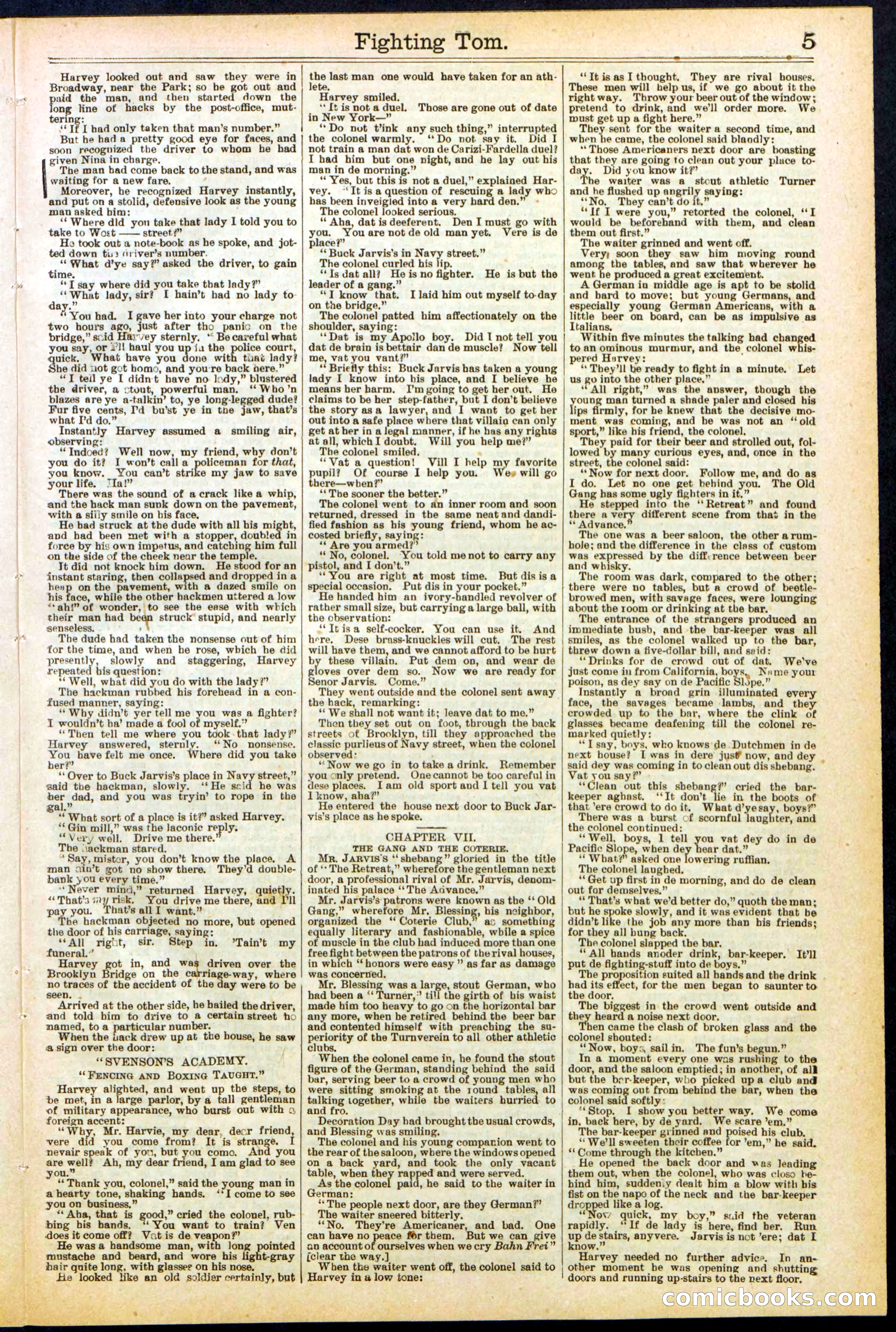
A restored page from Pulp Fiction, 1883. Page through the whole issue in the reader above.
📄 Transcribed text from this page (OCR, searchable)
Machine-transcribed from the original scan — historical spelling and the odd misread are preserved.
eae at beeen “ ee en eee ee —-+- Harvey looked out and saw they were in Broadway, near the Park; so he got out and aid the man, and then started down the ong line of hacks by the post-office, mut- tering: y if had only taken that man’s number.” But he had a pretty good eye for faces, and soon recognized the driver to whom he had given Nina in charge, The man bad come back to the stand, and was waiting for a new fare, Moreover, he recognized Harvey instantly, and put on a stolid, defensive look as the young man asked bim: ‘* Where did you take that lady I told you to take to Wost —— street?” He took out a note-book as he spoke, and jot- ted down ti2 criver’s number. ‘What d’ye say?” asked the driver, to gain time. **T say where did you take that lady?” ‘*What lady, sir? I hain’t had no lady to day.” ‘You had. I gave her into your charge not two hours ago, just after tho panic on the bridge,” scid Harvey sternly. “ Be careful what you say, or 1]! haul you up ia the police court, uick, What have you done with thaé lady? he did not gct homo, and you're back here,” “T teil ye [I didnt have no lady,” blustered the driver, a stuut, powerful man. ‘‘ Who’n blazes are ye a-talkin’ to, ye long-legged dude? Fur five cents, Pd bu’st ye in the jaw, that’s what Id do.” Instantly Harvey assumed a smiling air, observing: “Indoed? Well now, my friend, why don’t you do it? I won’t calla policeman for that, you know. You can’t strike my jaw to save your life. TIa!” There was the sound of acrack like a whip, and the hack man sunk down on the pavement, with a siily smile on bis face, He bad struck at the dude with all his might, apd had been met with a stopper, doubled in foree by his own impetus, and care ae him full on the side of the cheek near the temple. Tt did not knock him down. He stood for an instant staring, then gd 2g and dropped ina heap onthe pavement, with a dazed smile on his face, while the other hackmen uttered a low “*ah!” of wonder, to see the ease with which their man had bean struck stupid, and nearly senseless. ' The dude had taken the nonsense out of him for the time, and when he rose, which he did presently, slowly and staggering, Harvey repeated bis question: ** Well, what did you do with the lady?” The hackman rubbed his forehead in a con- fused manner, saying: ‘Why didn’t yer tell me you was a fighter? T wouldn’t ha’ made a foo) of myself.” ‘Then tell me where you took. that lady?’ Harvey answered, sternly. ‘No nonsense, You have felt me once. Where did you take ber? ‘*Over to Buck Jarvis’s place in Navy street,” said the hackman, slowly. ‘‘He scid he was ber dad, and you was tryin’ to rope in the zal,” “What sort of a place is it?” asked Harvey. **Gin mill,” was the laconic reply, ‘Very well. Drive me there.’ The \ackman stared. “Say, mister, you don’t know the place, A man in’t got no show there. They’d double- bank you every time.” ‘Never mind,” returned Harvey, quit “That's sry risk. You drive me there, and Pil you. That’s allI want.” he hackman objected no more, but opened the door of his carriage, saying: ‘All right, sir. Step in. °Tain’t my funeral.” Harvey got in, and wag driven over the Brooklyn Bridge on the carriage-way, where no traces of the accident of the day were to be seen. . Arrived at the other side, he hailed the driver, and told bim to drive to a certain street ho named, toa ticular number. When the iack drew up at the house, he saw @ sign over the door: “SVENSON’S ACADEMY. ‘“ FENCING AND BoxinG TAUGHT.” Harvey alighted, and went up the steps, to be met, in a large parlor, by a tall gentleman of military appearance, who burst out with o foreign accent: “Why, Mr. Harvie, my dear, decr friend vere did you come from? It is strange. i nevair speak of you, but you como, And you are well Ah, my dear friend, I am glad to see ou. ‘‘Thank you, colonel,” said the young man in a hearty tone, shaking hands. ‘‘I come to see you on business,” “* Aha, that is bing bis bands. ‘ You want to train? Ven does it come off? Vatis de veapon?’ He was a handsome man, with long pointed mustache and beard, and wore his light-gray hair quite long, with glasses on his nose. looked like an old soldier certainly, but a. > 3 ood,” cried the colonel, rub- | - « * “ Fighting Tom. 5 me last man one would have taken for an ath- ete, Harvey smiled. ‘‘ [tis not a duel. in New York—” ‘Do not t’ink any such thing,” interrupted the colonel warmly. ‘*Do not say it. Did I not train a man dat won de Carizi-Fardella duel? I had him but one night, and he lay out his man in de morning.” “Yes, but this is not a duel,” explained Har- vey. “‘It is a question of rescuing a lady who has been inveigied into a very bard den.” The colonel looked serious. “Aha, dat is deeferent. Den I must go with you. You are not de old man yet. Vere is de place?” ** Buck Jarvis’s in Navy street.” The colonel curled his lip. **TIs dat all? He is no fighter. leader of a gang.” “I know that. on the bridge.” The colonel patted him affectionately on the shoulder, saying: ‘*Dat is my Apollo boy. Did I not tell you dat de brain is bettair dan de muscle? Now tell me, vat you vant?” ‘* Briefly this: Buck Jarvis has taken a young lady I know into bis place, and I believe he means her harm. I’m going to get her out. He claims to be her step-father, but I don’t believe the story asa lawyer, and I want to get her out into a safe place where that villaio can only get at her in a legal manner, if he has any rights at all, which I doubt. Will you help me?” The colonel smiled. ' “Vat a question! Vill I help my favorite pupil? Of course I help you. Wey will go there—when?” ‘* Tbe sooner the better.” The colonel went to an inner room and soon returned, dressed in the same neat and dandi- fied fashion as his young friend, whom he ac- costed briefly, saying: ‘* Are you armed? ** No, colonel. You told me not to carry any pistol, and I don’t.” ‘You are right at most time. But disisa special occasion. Put dis in your pocket.” He handed him an ivory-bandled revolver of rather small size, but carrying a large ball, with the observation: ‘‘Itisa self-cocker. You can use it. And here. Dese brass-knuckles will cut. The rest will have them, and we cannot afford to be hurt by these villain. Put dem on, and wear de patio over dem so. Now we are ready for Senor Jarvis. Come,” They went outside and the colonel sent away the hack, remarking: ** We shall not want it; leave dat to me.” Then they set out on foot, through the back streets of Brooklyn, till they approached the classic purlieus of Navy street, when the colonel observed: ‘Now we go iv totakeadrink. Remember you only pretend. Onecannot be too careful in dese places. Iam old sport and I tell you vat I know, aha?” He entered the house next door to Buck Jar- vis’s place as he spoke. CHAPTER VII. THE GANG AND THE COTERIE. Mr. JARVIS'S ‘“‘ shebang” gloried in the title of ‘* The Retreat,” wherefore the gentleman next door, a professional rival of Mr. Jarvis, denom- inated his palace ‘‘ The Advance,” Mr. Jarvis’s patrons were known as the ‘‘ Old Gang,” wherefore Mr, Blessing, bis neighbor, organized the ‘ Coterie Club,” as something equally literary and fashionable, while a spice of muscle in the club had induced more than one free fight between the patrons of the rival houses, in which “honors were easy ” as far as damage was concerned, Mr, Blessing was a large, stout German, who had been a “‘ Turner,” till the girth of bis waist made him too heavy to go on the horizontal bar any more, when be retired behind the beer bar and contented himself with preaching the su- eee of the Turnverein to all other athletic clubs, When the colonel came in, he found the stout figure of the German, standing behind the said bar, serving beer to a crowd of young men who were sitting smoking at the round tables, all talking together, while the waiters hurried to and fro. Decoration Day bad brought the usual crowds, and Blessing was smiling. The colonel and his young comparion went to the rear of thesaloon, where the windows opened on a back yard, and took the only vacant table, when wont _ and were served. As the colonel paid, he said to the waiter in erman;: **The people next door, are they German?” The waiter sneered bitterly. ‘“‘No. They’re Americaner, and bad. One can have no peace férthem. But we can give an account of ourselves when wecry Bahn Frei” (clear the way.] When the waiter went off, the colonel said to Harvey in a low tone: Those are gone out of date He is but the I laid him out myself to-day ™," 5 P 6) Mis, i “Itisas I thought, They are rival houses. These men will help us, if we go about it the right way. Throw your beer out of the window; pretend to drink, and we'll order more. We must get up a fight here.” They sent for the waiter a second time, and when he came, the colonel said blaodly: “Those Americaners next door are boasting that they are going to clean out your place to- ye Did you know it?” he waiter was a stout athletic Turner and he flushed up angrily saying: ‘*‘No, They can’t do it,” “If I were you,” retorted the colonel, “I would be beforehand with them, and clean them out first.” The waiter grinned and went off. Very; soon they saw him moving round am the tables, and saw that wherever he went he produced a arene excitement. A German io middle age is apt to be stolid and bard to move; but young Germans, and especially young German Americans, with a little beer on board, can be as impulsive as Italians, Within five minutes the talking bad changed to an ominous murmur, and the colonel whis- pered Harvey: “They’ll be ready to fightin a minute. Let us go into the other place,” “All right,” was the answer, though the young man turned a shade paler and closed his ips firmly, for he knew that the decisive mo- ment was coming, and be was not an “old sport,” like his friend, the colonel, They paid for their beer and strolled out, fol- lowed by many curious eyes, and, once in the street, the colonel said: ** Now for next door. Follow me, and do as I do. Let no one get behind you. The Old Gang has some ugly fighters in it,” He stepped into the ‘ Retreat” and found there a very different scene from that in the ** Advance, The one was a beer saloon, the other a rum- hole; and the difference in the class of custom was expressed by the diffrence between beer and whisky. The room was dark, compared to the other; there were no tables, but a crowd of beetle- browed men, with savage faces, were lounging about the room or drinking at the bar. The entrance of the strangers produced an immediate bush, and the bar-keeper was all smiles, as the colonel walked up to the bar, threw down a five-dollar bill, and said: “Drinks for de crowd out of dat. We've just come in from California, poy Name your poison, as dey say on de Pacific Slope.” Instantly a broad grin illuminated every face, the savages became lambs, and they crowded up to the bar, where the clink of glasses became deafening till the colonel re- marked quietly: ‘Tsay, boys, wko knows de Dutchmen in de next house? I was in dere jus now, and dey said dey was coming in to clean out dis shebang. Vat you say?” ‘Clean out this shebang?’ cried the bar- keeper aghast. ‘‘It don’t lie in the boots of that ‘ere crowd to doit. What d’yesay, boys?” There was a burst of scornful faughten, and the colonel continued: ‘Well, boys, 1 tell you vat dey do in de Pacific Slope, when dey hear dat.” ‘* What?” asked one lowering ruffian. The colonel laughed, ‘*Get up first in de morning, and do de clean out for demselves,” “* That’s what we'd better do,” quoth the man; but he oe slowly, and it was evident that be didn’t like the job any more than bis friends; for they all bung back. The colonel slapped the bar. “All hands anoder drink, bar-keeper. It'll put de fighting-stuff into de boys.” — . —s é i ~+ ty tee —_- The proposition euited all hands and the drink . had its effect, for the men began to saunter to the door. The biggest in the crowd went outside and Shey heard a noise next door. hen came the clash of broken glass and the colonel shouted: “Now, boys, sailin. The fun’s begun.” In a moment every one was rushing to the door, and the saloon emptied; in another, of all but the bor-keeper, who picked upa club and was coming out from behind the bar, when the colonel said softly : ' “*Stop. I show you better way. We come in, back here, by de yard, We scare ’em.” The bar-keeper grinned and poise his club. ‘“‘ We'll sweeten their coffee for ’em,” he said. ** Come through the kitchen.” He opened the back door and was leading them out, when the colonel, who was closo be- hind him, sudden.y dealt him a blow with bis fist on the napo of the neck and the bar-keeper dro like a log. “* Now quick, my boy,” said the veteran rapidly. ‘If de lady is here, find ber. Run up de stairs, anyvere. Jarvis is not ’ere; dat I ow. Harvey needed no further advice, In an- other moment he was opening and shutting doors and running up-stairs to the next floor, ~~ <* Comiebooks (e{o) ot a Ve AO