
Pulp Fiction, 1883 · page 4 of 32
Beadle's New York Dime Library No. 262 — page 4: what you’re looking at
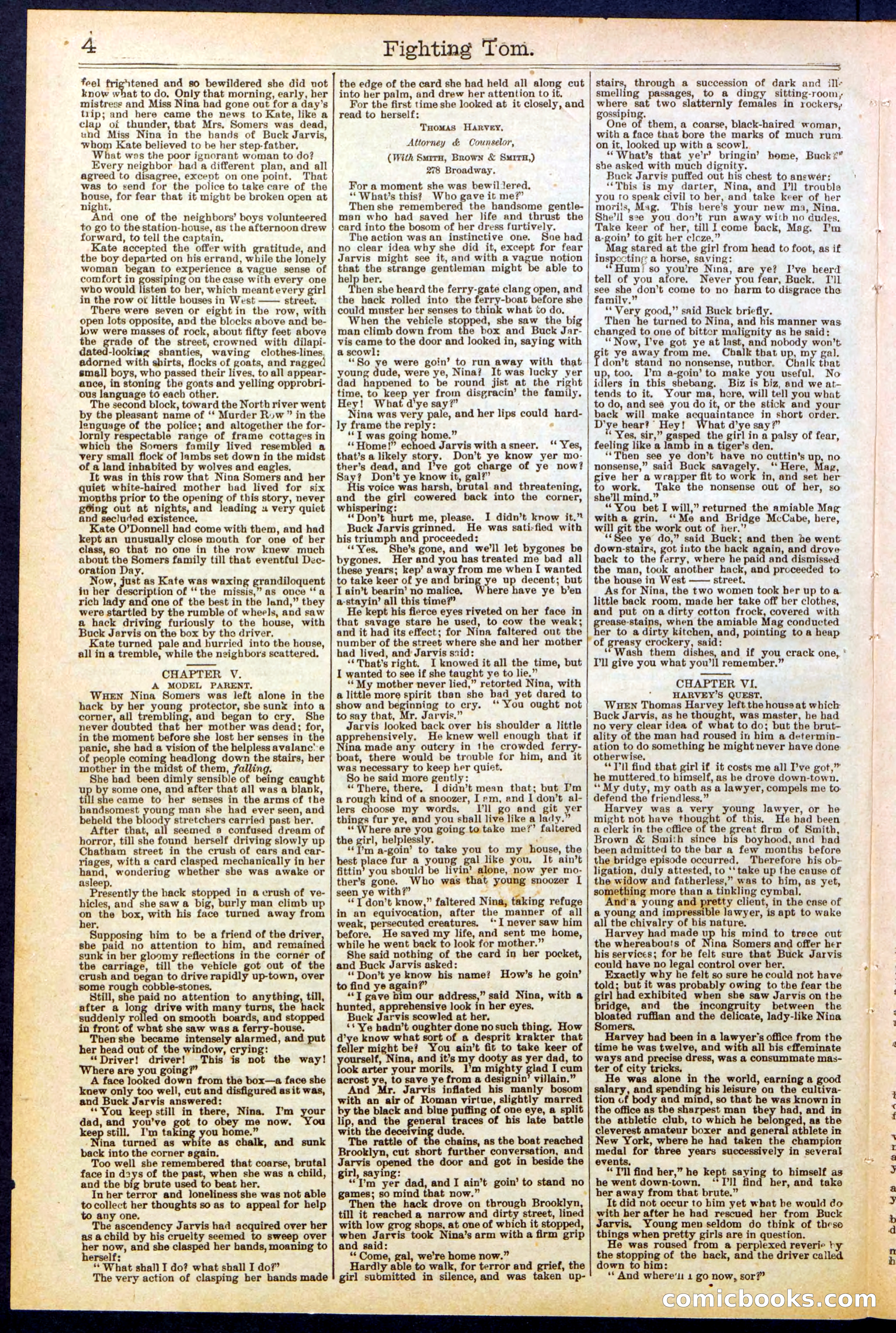
A restored page from Pulp Fiction, 1883. Page through the whole issue in the reader above.
📄 Transcribed text from this page (OCR, searchable)
Machine-transcribed from the original scan — historical spelling and the odd misread are preserved.
os s 4 F ?. ° 4 Fighting Toni. feel frightened and so bewildered she did not know what to do. Only that morning, early, her mistress and Miss Nina bad gone out for a day’s tiip; and here came the news to Kate, like a clap of thunder, that Mrs. Somers was dead, und Miss Nina in the hands of Buck Jarvis, whom Kate believed to be her step-father, What wes the poor ignorant woman to do? Every neighbor had a different plan, and all agreed to disagree, except on one point, That was to send for the police to take care of the — for fear that it might be broken open at night. And one of the neighbors’ boys volunteered to go to the station-house, as the afternoon drew forward, to tell the captain. Kate accepted the offer with gratitude, and the boy departed on his errand, while the lonely woman began to experience a vague sense of comfort in gossiping on the case with every one who would listen to ber, which meantevery girl in the row ot little houses in West street. There were seven or eightin the row, with open lots opposite, and the blocks above and be- low were masses of rock, about fifty feet above po tae of the street, crowned with dilapi- dated-lookiug shanties, waving clothes-lines. adorned with shirts, flocks of goats, and ragged small boys, who passed their lives, to all appear- ance, in stoning the goats and yelling opprobri- ous language to each other. The second block, toward the North river went by the pleasant name of ‘‘ Murder Row ” in the lenguage of the police; and altogether the for- lornly respectable range of frame cottages in which the Somers family lived resembled a very small flock of lambs set down in the midst of a land inhabited by wolves and eagles. It was in this row that Nina Somers and her quiet white-haired mother bad lived for six months prior to the os of this story, never g0ing out at nights, and leading 4 very quiet and secluded existence. Kate O'Donnell had come with them, and had kept an unusually close mouth for one of ber class, s0 that no one in the row knew much about the Somers family till that eventful Dec- oration Day. Now, just as Kate was waxing grandiloquent in ber description of ‘‘the missis,” as once ‘‘a rich lady and one of the best in the Jund,” they were startled by the rumble of wheels, and saw a hack driving furiously to the house, with Buck Jarvis on the box by tho driver. Kate turned pale and burried into the house, all in a tremble, while the neighbors scattered. CHAPTER V. A MODEL PARENT. Wuen Nina Somers was left alone in the hack by her young protector, sbe sunx into a corner, all trembling, and began to cry. She never doubted that her mother was dead; for, in the moment before she lost her senses in the panic, she had a vision of the helpless avalanc' e of people coming headlong down the stairs, her mother in the midst of them, falling. She had been dimly sensible of being caught pe oY some one, and after that all was a blank, till she came to her senses in the arms of the handsomest young man she had ever seen, and beheld the b noey stretchers carried past her. After that, all seemed s confused dream of horror, till she found herself driving slowly up Chatham street in the crush of cars and car- riages, with a card clasped mechanically in her hand, wonderiug whether she was awake or asleep. Pckecsitl the hack stopped in a crush of ve- hicles, and she saw a big, burly man climb up = the box, with his face turned away from er. Supposing him to be a friend of the driver she paid no attention to him, and remain sunk in ber gloomy reflections in the corner of the carriage, till the vehicle got out of the crush and began to drive rapidly up-town, over some rough cobble-stones. ‘ Still, she paid no attention to anything, till, after a long drive with many turns, the hack suddenly rolled on smooth boards, and stopped in front of what she saw was a ferry-bouse. Then she became intensely alarmed, and put her head out of the window, crying: “Driver! driver! This is not the way! Where are you going?” A face looked down from the box—a face she knew only too well, cut and disfigured as it was, and Buck Jarvis answered: ‘*You keep still in there, Nina. I’m your dad, and you’ve got to obey me now. You keep still. I'm taking * home.” Nina turned as white as chalk, and sunk back into the corner sgain. Too well she remembered that coarse, brutal face in days of the past, when she was a child, and the big brute used to beat her. In her terror and loneliness she was not able to collect her thoughts so as to appeal for help to any one. The ascendency Jarvis had acquired over her as achild by his cruelty seemed to sweep over nee now, and she clasped her bands, moaning to erself: ‘** What shall I do? what shall I do?” The very action of clasping ber bands made the edge of the card she had held all along cut into her palm, and drew her attention to it. For the first time she looked at it closely, and read to herself: THomaAS Harvey, Attorney & Counselor, (With Smrrn, Brown & Smirs,) 278 Broadway. For a moment she was bewil Jered, ‘*What’s this? Who gave it me?” Then she remembered the handsome gentle- man who had saved her life and thrust the card into the bosom of her dress furtively. The action was an instinctive one. Soe had no clear idea why she did it, except for fear Jarvis might see it, and with a vague notion that the strange gentleman might be able to aR ber. hen she heard the ferry-gate clang open, and the hack rolled into the ferry-boat before she could muster her senses to think what to do. When the vehicle mopped, she saw the big man climb down from the box and Buck Jar- vis came to the door and looked in, saying with a scowl: “So ye were goin’ to run away with that young dude, were ye, Nina? It was lucky yer dad hapvened to be round jist at the right time, to keep yer from disgracin’ the family. Hey! What d'ye say?” Nina was very pale, and her lips could hard- ly frame the reply: " ‘‘T was going home.” ‘‘Home!” echoed Jarvis with asneer. ‘‘ Yes, that’s a likely story. Don’t ye know yer mo- ther’s dead, and I’ve got charge of ye now? Say? Don’t ye know it, gal?’ His voice was harsh, brutal and threatening, and the girl cowered back into the corner, ee: ““Don’t hurt me, please. I didn’t know it.” Buck Jarvis grinned. He was sati:fied with his triumph and proceeded: ‘Yes, She’s gone, and we'll let bygones be bygones. Her and you has treated me bad all these years; kep’ away from me when I wanted to take keer of ye and betog. ve up decent; but I ain’t bearin’ no malice, here have ye b’en a-stayin’ all this time?” He kept his fierce eyes riveted on her face in that savage stare he used, to cow the weak; and it had its effect; for Nina faltered out the number of the street where she and her mother had lived, and Jarvis sid: ‘‘That’s right. I knowed it all the time, but I wanted to see if she taught ye to lie.” ‘* My mother never lied,” retorted Nina, with a little more spirit than she bad yet dared to show and beginning to ery. ‘* You ought not to say that, Mr. Jarvis.” Jarvis looked back over bis shoulder a little apprehensively, He knew well enough that if ina made any outery in the crowded ferry- boat, there would be trouble for him, and it was necessary to keep ber quiet. So he said more gently: “There, there. I didn’t mean that; but I’m a rough kind of a snoozer, I pm, and 1 don’t al- lers choose my words. I'll go and git yer things fur ye, and you shall live like a lady.” ‘‘ Where are you going totake me?’ faltered the girl, helplessly. 7 ‘I'm a-goin’ to take you to my house, the best place fur a young gal like you. It ain’t fittin’ you should be livin’ alone, now yer mo- ther’s gone. Who was that young snoozer | seen ye with?” mou Se, ‘“‘T don’t know,” faltered Nina, taking refuge in an equivocation, after the manner of all weak, persecuted creatures. ‘I never saw him before. He saved my life, and sent me home, while he went back to look for mother.” She said nothing of the card in her pocket, and Buck Jarvis asked: “Don’t ye know his name? How’s he goin’ to find ye again?” ve him our address,” said Nina, with a hunted, apprehensive look in her eyes, Buck Jarvis scowled at her. ‘* Ye badn’t oughter done nosuch thing. How d’ye know what sort of a desprit krakter that feller might be? You ain’t fit to take keer of ina, and it’s my dooty as yer dad, to ook arter your morils, I’m mighty glad I cum acrost ye, to save ye from a designin’ villain.” And Mr. Jarvis inflated his manly bosom with an air of Roman virtue, slightly marred by the black and blue puffing of one eye, a split ae pel lip, and the general ces of his late battle with the deceiving dude. The rattle of the chains, as the boat reached Brooklyn, cut short further conversation, and Jarvis ed the door and got in beside the girl, saying: “Tm yer dad, and I ain’t goin’ to stand no games; so mind that now.” . Then the hack drove on through Brooklyn, till it reached a narrow and dirty street, lined with low grog shops, at one of which it stopped, when Jarvis took Nina’s arm with a firm grip and said: . “Come, gal, we’re home now.” Hardly able to walk, for terror and grief, the girl submitted in silence, and was taken up- bya Pn RE SO eel stairs, through a succession of dark and ill- smelling passages, to a dingy sitting-room, where sat two slatternly females in rockers, gossiping. One of them, a coarse, black-haired woman, with a face that bore the marks of much rum. on it, looked up with a scowl. ‘““What’s that ye’r’ bringin’ home, Buck*¢” she asked with much dignity. Buck Jarvis puffed out his chest to answer: ‘This is my darter, Nina, and Il trouble you ro speak civil to ber, and take keer of her mori!ls, Mag. This bere’s your new ma, Nina. She’ll see you don’t run away with no dudes. Take keer of her, till 1 come back, Mag. I’m a-goin’ to git her cloze,” Mag stared at the girl from head to foot, as if inspocting: a horse, saving: ‘*Hum/ so you’re Nina, are tell of you afore. Never see she don’t come to no family.” ** Very good,” said Buck briefly. Then he turned to Nina, and his manner was changed to one of bittcr malignity as he said: ‘Now, I've got ye at last, and nobody won’t. it ye away from me. Chalk that up, my gal. don’t stand no nonsense, nuther. Chalk that up, too, I’m a-goin’ to make you useful, No idlers in this sbebang, Biz is biz, and we at- tends to it. Your ma, here, will tell you what to do, and seé you do it, or the stick and your back will make acquaintance in short order. D'ye hear? Hey! hat d’ye say?” ‘ Yes, sir,” gasped the girl in a palsy of fear, feeling like a lamb in a tiger’s den. ‘*Then see ye don’t have no cuttin’s up, no nonsense,” said Buck savagely. ‘ Here, Mag, give her a wrapper fit to work in, and set her to work. Take the nonsense out of her, so she'll mind.” “You bet I will,” returned the amiable Mag witha grin. ‘‘Me and Bridge McCabe, bere, will git the work out of her.” ‘*See ye do,” said Buck; and then be went down-stairs, got into the back again, and drove back to the ferry, where he paid and dismissed the man, took another hack, and proceeded to the house in West —— street. As for Nina, the two women took her up toa. little back room, made her take off ber clothes, and put onadirty cotton frock, covered with greage-staine, when the amiable Mag conducted er to a dirty kitchen, and, pointing to a heap of greas crockery, said: ‘Wash them dishes, and if you crack one, ' I'll give you what you’ll remember.” CHAPTER VI. , HARVEY’S QUEST. WueEn Thomas Harvey left the houss at which Buck Jarvis, as he thought, was master, he had no very clear idea of what to do; but the brut- ality of the man had roused in him a determin- ation to do something he might never have done otherwise, “Tl find that girl if it costs me all I’ve got,” he muttered to himself, as he drove down-town. ‘** My duty, my oath as a lawyer, compels me to defend the friendless,” Harvey was a very young lawyer, or he might not have thought of this. He had been a clerk in the office of the great firm of Smith, Brown & Smith since bis boyhood, and had been admitted to the bar a few months before the bridge episode occurred, Therefore his ob- ligation, duly attested, to ‘‘take up the cause of . widow and fatherless,” was to bim, as yet, ething more than a tinkling cymbal. And’a young and pretty client, in the case of a young and impressible lawyer, is apt to wake all the chivalry of his nature. Harvey had made up his mind to trece out the whereabouts of Nina Somers and offer her his services; for he felt sure that Buck Jarvis could have no legal control over ber. Exactly why he felt so sure he could not have told; but it was probably owing to the fear the gir! had exhibited when she saw Jarvis on the lage, and the incongruity between the bloated ruffian and the delicate, lady-like Nina Somers. Harvey had been in a lawyer's office from the time he was twelve, and with all his effeminate ways and precise dress, was a consummate mas- ter of city tricks. He was alone in the world, earning a salary, and spending his leisure on the cultiva- tion of body and mind, so that he was known in the office as the sharpest man they had, and in the athletic club, to which he belonged, as the cleverest amateur boxer and gene athlete in New York, where he had taken the champion medal for three years successively in several events, “‘T'll find her,” he kept saying to himself as he went down-town, ‘“‘I’Jl find her, and take her away from that brute.” It did not occur to him yet what he would do with her after he had rescued her from Buck Jarvis. Young men seldom do think of these things when pretty girls are in question. He was ro from a perplexed reverie by the stopping of the hack, and the driver called down to him: ; ‘* And where’l 1 go now, sor?” Sis jt | “cecomicboo e? T’ve heerd ou fear, Buck. Tl arm to disgrace tha * why” rs * , il Se. tA wo Em ido eA abi * *7e, S|