
Pulp Fiction, 1883 · page 15 of 32
Beadle's New York Dime Library No. 262 — page 15: what you’re looking at
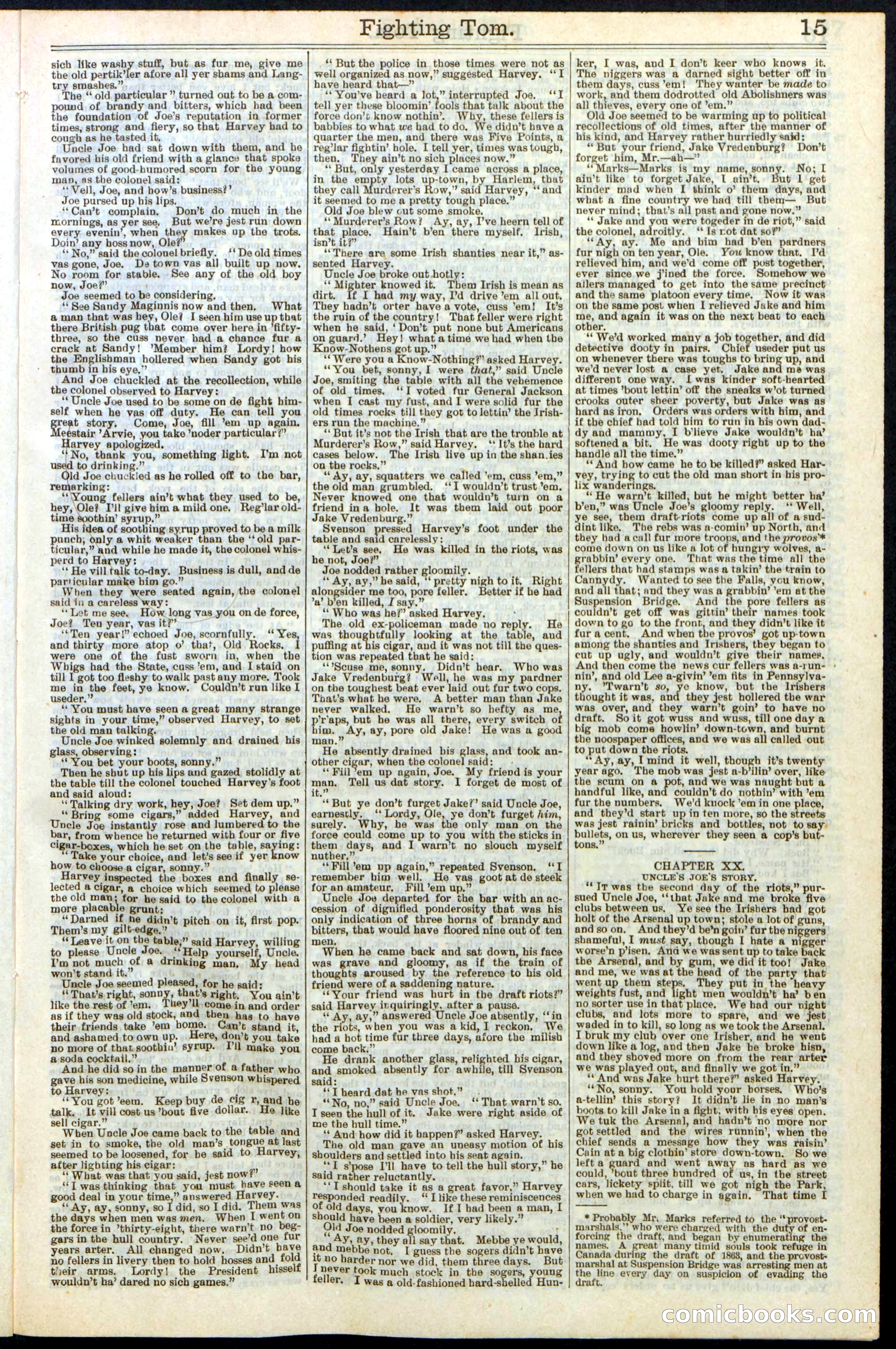
A restored page from Pulp Fiction, 1883. Page through the whole issue in the reader above.
📄 Transcribed text from this page (OCR, searchable)
Machine-transcribed from the original scan — historical spelling and the odd misread are preserved.
Fighting Tom 15 sich like washy stuff, but as fur me, give me the old pertik’ er afore all yer shams and Lang- try smashes.” The “ old particular ” turned out to be a com- pound of brandy and bitters, which had been the foundation of Joe’s reputation in former times, strong and fiery, so that Harvey had to cough as he tasted if, Uncle Joe had sat down with them, and he favored his old friend with a glance that spoke volumes of good-bumored scorn for the young man, as the colonel said: ‘Vell, Joe, and how’s business?’ Joe pursed up his lips. ‘‘Can’t complain. Don’t do much in the mornings, as yer see. But we’re jest run down every evenin’, when the ey makes up the trots. Doin’ any hoss now, Ole? ** No,” said the colonel briefly. ‘' De old times vas gone, Joe. Das town vas all built up now. No room for stable. See any of the old boy now, Joe?” Joe seemed to be considering, ** See Sandy Maginnis now and then, What a man that was hey, Ole? I seen him use up that there British pug that come over here in fifty- three, so the cuss never had a chance fur a crack at Sandy! ‘Member him? Lordy! how the Englishman | hollered when Sandy got his thumb in his eye,” And Joe chuckled at the recollection, while the colonel observed to Harvey: ‘Uncle Joe used to be some on de fight him- self when he vas off duty. He can tell you reat story. Come, Joe, fill ’em up again. eestair ’Arvie, you take ’noder particular?” arvey apologized, cada thank you, something light. I’m not to drinking.” ld Joe chuckled as he rolled off to the bar, remarking: ‘*\Young fellers ain’t what they used to be, hey, Ole? Dil give bim amildone, Reg’lar old- time soothin’ syrup.” His idea of soothing syrup proved to be a milk punch; only a whit weaker than the ‘‘old par- ticular, ” and while he made it, the colonel whis- perd to Harvey: ‘* He vill talk to-day. particular make bim go.” When they were seated again, the colonel said in a careless way: ‘Let me see. How long vas you on de force, Joe? Ten year, vas it?” ‘*Ten year!” echoed Joe, scornfully. “ Yes and thirty more atop o’ that, Old Rocks, were one of the fust sworn in, when the Whigs had the State, cuss ’em, and I staid on till 1 got too fleshy to walk past any more, Took me in the feet, ye know. Couldn’t run like L useder,” ‘You must have seen a great many strange sights in your time,” observed Harvey, to set the old man talking. Uncle Joe winked solemnly and drained his glass, observing: “You bet your boots, sonny,” Then he shut up his lips and gazed stolidly at the table till the colonel touched Harvey’s foot and said aloud: 2 eee dry work, hey, Joe? Set dem up.” ring some cigars,” added Harvey, and Uncle Joe instantly rose and lumbered to the bar, from whence he returned with four or five ci ar-boxes, which he set on the table, saying: ‘Take your choice, and let’s see if yer know how to choose.a cigar, sonny.” Harvey inspected the boxes and finally se- lected a cigar, a choice which seemed to please the old man; for he said to the colonel with a more placable grunt; “Darned if he didn’t pitch on it, first pop. Them’s my gilt-edge,” Business is dull, and de Leave it.on the table,” said Harvey, willing to please Uncle Joe. ‘Help yourself, Uncle. I’m not much of a drinking man, My head won't stand it.” Uncle Joe seemed pleased, for he said: “ That’s right, son ores that's right, You ain’t like the rest of em, They’ll.come in and order as if they was old stock, and then has to have their friends take ’em home. Can’t stand it, and ashamed to own up. Here, don’t you take no more of that.sootbiu’ syrup. Pil make you a soda cocktail.” And he did so in the manver of a father who gave his son medicine, while Svenson whispered to Harvey: ‘You got’eem. Keep buy de cig r, and he talk. It vill cost us bout five dollar. He like sell cigar.” When Uncle Joe came back to the table and set’ in to smoke, the old man’s tongue at last seemed to be loosened, for be said to Harvey, after ligbting his cigar: ‘‘ What was that you said, jest now?” ‘“T was thinking that you must_have seen a good deal in your time,” answered Harvey. * Ay, ay. sonny, so 1 did, so I did. Them was the days when men was men. When I went on the force in "thirty-eight, there warn’t no gars in the hull country. Never see’d one fur ears arter. All changed now. Didn’t bave no fellers in livery then to hold hosses and fold their arms. Lordy! the President hisself wouldn’t ha’ dared no sich games.” ** But the police in those times were not as well organized as now,” suggested Harvey. “I have heard that—” ‘* You've heard a lot,” interrupted Joe. ‘I tell yer these bloomin’ fools that talk about the force don’t know nothin’. Why, these fellers is babbies to what we had to do. We didn’t have a quarter the men, and there was Five Points, a reg lar fightin’ hole. I tell yer, times was tough, Ai They ain’t no sich places now.” ** But, only yesterday I came across a place, in the empty lots up- town, by Harlem, that they call Murderer’s Row,” said Harvey, **and it seemed to me a pretty tough place.” Old Joe blew cut some smoke, ‘*Murderer’s Row? Ay, ay, I’ve heern tell of that place, Hain’t b’en there myself, Irish, isn’t it?” ‘‘There are some Irish shanties near it,” as- sented Harvey. Uncle Joe broke out hotl ‘** Mighter knowed it. The em Irish is mean as dirt. If I had my way, Id drive ’em all out, They hadn’t orter have a vote, cuss ‘em! It’s the ruin of the country! That feller were right when he said, ‘ Don’t put none but Americans on guard.’ Hey! what a time we had when the Know-Nothens got up.” ‘* Were you a Know-Nothing?” asked Harvey. “You bet, sonny, I were that,” said Uncle Joe, smiting the table with all the vehemence of old times. ‘‘I voted fur General Jackson when I cast my fust, and I were solid fur the old times rocks till they got to lettin’ the Jrish- ers run the machine,” ‘* But it’s not the Irish that are the trouble at Murderer’s Row,” said Harvey, ‘It’s the hard cases below. The Irish live up in the shan.ies on the rocks,” “ Ay, ay, squatters we called ’em, cuss ’em,” the old man grumbled. ‘I wouldn’t trust ‘em. Never knowed one that wouldn’t turn on a friend in a hole. Jake Vredenburg.” Svenson pressed Harvey’s foot under the table and said carelessly: ‘*Let’s see, He was killed in the riots, was he not, Joe?” Joe nodded rather gloomily. ‘* Ay, ay,” be said, ‘‘ pretty nigh toit, Right alongsider me too, pore feller. Better if he had ’a’ b’en killed, J say.” “Who was he?” asked Harvey. The old ex-policeman made no eniy He was thoughtfully looking at the table, and puffing at his cigar, and it was not till the ques- tion was repeated that he said: ‘“'Scuse me, sonny. Didn't hear. Who was Jake Vredenburg? Well, he was my pesdner on the toughest beat ever ‘laid out fur two co That’s what he were, A better man than Jake never walked. He warn’t so hefty as Bim but he was all there, every switch ob im AY, ay, pore old Jake! He was a good man.’ He absently drained his glass and took an- other cigar, when the colonel sai ‘* Fill’em up again, Joe. My friend is your Tell us dat story. I forget de most of It was them laid out poor re | ” ‘*But ye don’t fargo Jake?” said Uncle J oe, earnestly, ‘‘ Lordy, Ole, ye cone furget him, surely. Why, he was he only man on the foree could come up to you with the sticks in them days, and I warn’t no slouch myself nuther,” ‘*Fill’em up again,” repeated Svenson, “TI remember bim well. He vas goot at de steek for an amateur, Fill ’em up,” Uncle Jove departed for the bar with an ac- cession of dignified ponderosity that was his only indication. of three horns of brandy and bitters, that would have floored nine out of ten men, When he came peak and sat down, his face was grave and gloomy, as if the train of thoughts aroused by the reference to his old friend were of a saddening nature. ‘¢Your friend was hurt in the draft riots?” said Harvey inquiringly, after a pause. “ Ay, ay,” answered Uncle Joe absently, ‘‘in the riots, when you was a kid, I reckon, We had a hot time fur three days, afore the milish come back.” He drank another glass, relighted his cigar, and smoked absently for ‘awhile, till Svenson said: ‘*T heard dat he vas shot.” ‘‘No, no,” said Uncle Joe, I seen the hull of it. me the hull time.” ‘* And how did it happen?” asked Harvey. The old man gave an uneasy motion of his Shoulders and settled into his seat again. ‘**I s’pose I'll have to tell the bull story,” he said rather reluctantly, ‘‘I should take it as a great favor,” Harvey responded readily. ‘“‘ Llike these reminiscences of old days, you oils If I bad been a man, should haye been a soldier, very likely.” oar ly nodded gloomily. wy BY they all say that. Mebbe ye ea ante mebbe not, I guess the sogers didn’t have ’ no harder nor we did, them three days. But ‘ xpi tock much stock in the oper ope eller, I was a old-fashioned hard-shelled Hun- “That warn’t so. Jake were right aside of ker, I was, and I don’t keer who knows it. The niggers was a darned sight better off in them days, cuss’em! They wanter be made to work, and them dodrotted old Abolishners was all thieves, every one of ’em.” Old Joe seeméd to be warming up to political recollections of old times, after the manner of his kind, and Harvey rather hurriedly said: “But your friend, Jake Vredenburg? Don’t forget him, Mr. —ah—” ‘““Marks—Marks is my name, sonn No; I ain’t like to forget Jake, I ain’t, ut 1 get kinder mad when I think o’ them days, and what a fine country we had till them— But never mind; that’s all past and gone now.” “ Jake and you were togeder in de riot,” said the colonel, adroit y. ‘“*Is rot dat sof’ “Ay, a Me and bim had b’en pardners fur nigh on ten year, Ole. You know that, I'd relieved him, and we'd come off post together, ever since we jined the force. Somehow we allers managed to get into the same precinct and the same platoon every time. Now it was on the same post when I relieved Jake and him eth and again it was on the next beat to each ot “We'd worked many a job mogetne and did detective dooty in pairs. Chief useder put us on whenever there was toughs to bring up, and we'd never lost a case yet, Jake and me was different one way. Iwas kinder soft-hearted at times *bout lettin’ off the sneaks w’ot turned crooks outer sheer poverty, but Jake was as hard asiron. Orders was orders with him, and if the chief had told bim to run in his own dad- dy and mammy, I b’lieve Jake wouldn’t ha’ softened a bit. He was dooty right up to the handle all the time.” ** And bow came he to be killed?” asked Har- vey, trying to cut the old man short in bis pro- lix wanderings. “He warn’t killed, but he might better ha’ b’en,” was Uncle Joe’s gloomy reply. ‘* Well, ye see, them draft-riots come up all of a sud- dint like, The rebs was a-comin’ up North, and they had acall fur more troops, and the provos™ come down on us like a lot of hungry wolves, a- Bard every one. That was the time all the ellers that had stamps was a takin’ the train to Cannydy. Wanted to see the Falls, you know, and all that; and they was a grabbin’’em at the Suspension Bridge. And the pore fellers as couldn’t get off was gittin’ their names took down to go to the front, and they didn’t like it furacent. And when the provos’ got up-town among the shanties and Irishers, they began to cut up ugly, and wouldn’t give their names, And then come the news cur fellers was a-run- - nin’, and old Lee a-givin’ ’em fits in Pennsylva- ny. "I'warn’t so, ye know, but the Irishers thought it was, and they jest hollered the war was over, and they warn’t goin’ to have no draft. Soit got wuss and wuss, till one day a big mob come howlin’ down-town, and burnt the noospaper offices, and we was all called out to put down the riots. “Ay, ay, [mind it well, et |} it’s twenty year ago. The mob was jest a-b’ilin’ over, like the scum on a Pot, and we was naught but a handful like, and couldn’t do nothin’ with ’em fur the numbers. We'd knock ’em in one place, and they’d start up in ten more, so the streets was jest rainin’ bricks and bottles, not to say pales on us, wherever they seen a cop’s bu ns.” CHAPTER XX, UNCLE'S JOE'S STORY. “IT was the second day of the riots,” pur- sued Uncle Joe, ‘‘that Jake and me broke five clubs between us, Ye see the Irishers had got holt of the Arsenal up town; stole a lot of guns, andsoon, And they’d be’n goin’? fur the niggers shameful, I must say, though I hate a nigger worse’n p’isen, And we was sent up to take back the Arsenal, and by gum, we did it too! Jake and me, we was at the peed of the party that went up them ie They put in the heavy weights fust, and light men wouldn’t ha’ ben no sorter use in that place, We had our night clubs, and lots more to spare, and we jest waded in to kill, so long as we took the Arsenal. I bruk my club over one Irisher, and he went down like a log, and then Jake be broke hisn, and they shoved more on from the rear arter we was played out, and finally we got in.” “And was Jake burt there?” asked Harvey. ‘No, sonny. You hold your borses, Who's a-tellin’ this story? It didn’t lie in no man’s boots to kill Jake in a fight, with bis eyes open. We tuk the Arsenal, and hadn’t no more nor got settled and the wires runnin’, when the chief sends a message how they was raisin’ Cain at a big clothin’ store down-town. So we lefta guard and went away as hard as we could, *bout three bundred of us,in the street cars, lickety split, till we got nigh the Park, when we had to charge in again. That time I * Probably Mr, Marks referred to the ‘provost- marshals,”’ who were charged with the duty of en- forcing the tbe and began by enum ng the names. A t many timid souls took refuge in Canada during the draft of 1868, and provost- marshal at Suspension Bridge was arres men at the ine every day on suspicion of cy the JOO (f(0) AMC S (E(@)