
Pulp Fiction, 1883 · page 14 of 32
Beadle's New York Dime Library No. 262 — page 14: what you’re looking at
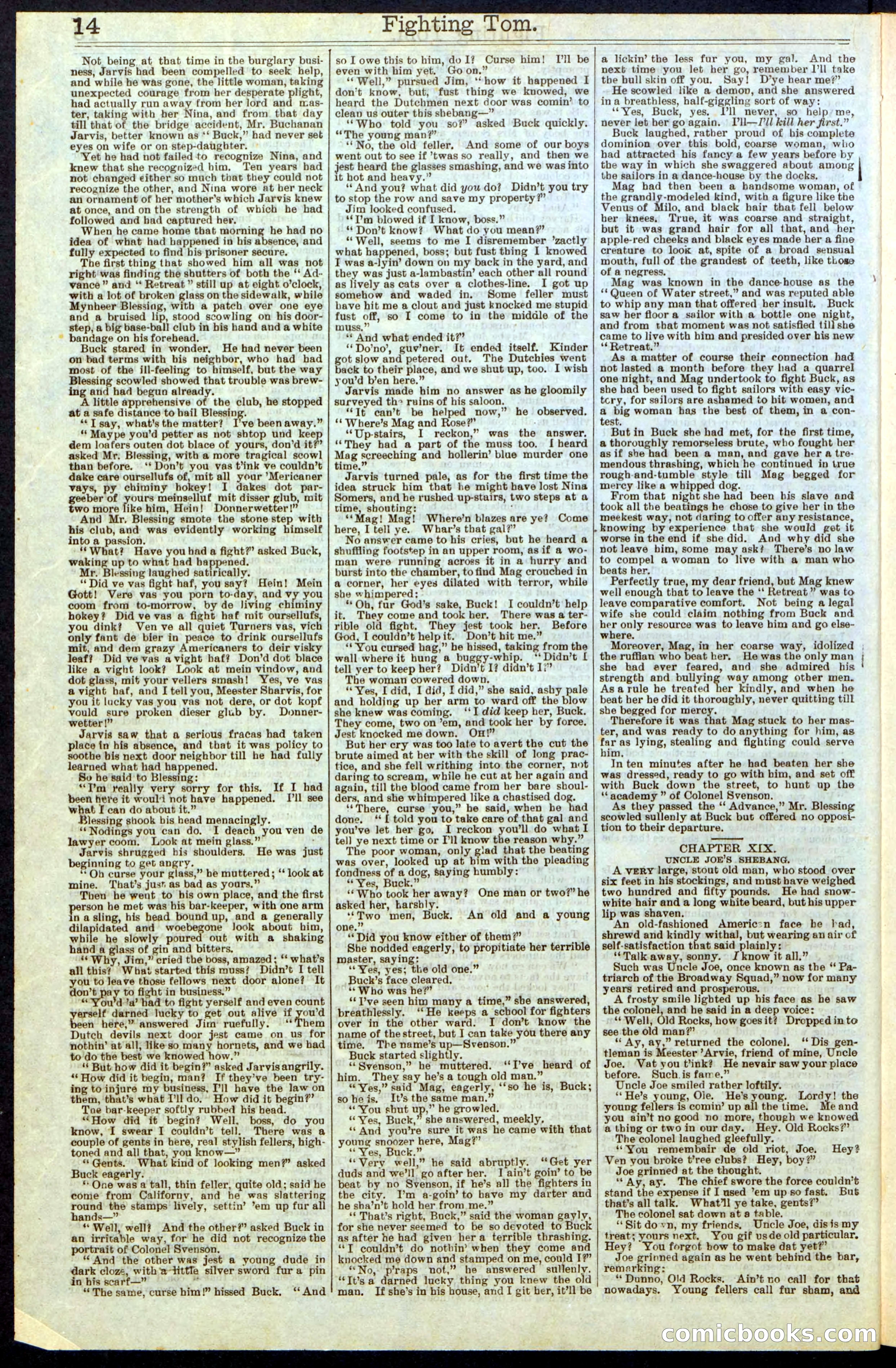
A restored page from Pulp Fiction, 1883. Page through the whole issue in the reader above.
📄 Transcribed text from this page (OCR, searchable)
Machine-transcribed from the original scan — historical spelling and the odd misread are preserved.
14 ness, Jarvis had been compelled to seek help, and while he was gone, the little woman, taking unexpected courage from her desperate plight, had actually run away from her lord and mas- ter, taking with ber Nina, and from that day till that of the bridge accident, Mr. Buchanan Jarvis, better known as *‘ Buck,” had never set eyes on wife or on step-daughter. Yet he had not failed to recognize Nina, and knew that she recognized bim. Ten years bad not changed either so much that they could not recognize the other, and Nina wore at ber neck an ornament of her mother’s which Jarvis knew at once, and on the strength of which he had followed and had captured her. When he came home that morning he had no idea of what had bappened in his absence, and fully e ted to find his prisoner secure. The first thing that showed him all was not right was finding the shutters of both the ‘‘ Ad- vance” and “ Retreat ” still - 3 at eight o’clock, with a lot of broken glass on the sidewalk, while Mynheer Blessing, with a patch over one eye and a bruised lip, stood scowling on his door- step, a big base-ball club in bis hand and a white bandage on his forehead. Buck stared in wonder, He had never been on bad terms with bis neighbor, who had had most of the ill-feeling to himself, but the way Blessing scowled showed that trouble was brew- ing and had begun already. A little apprehensive of the club, he stopped at a safe distance to bail Blessing. ‘“‘T say, what's the matter? I’ve been away.” ‘* Maype you'd petter as not shtop und kee dem loafers outen dot blace of yours, don’d it?” asked Mr: Blessing, with a more tragical scowl than before. ‘‘ Don’t you vas t’ink ve couldn’t dake care oursellufs of, mit all your ’Mericaner vays, py chiminy hokey! I dakes dot par- geeber of yours meinselluf mit disser glub, mit two more like him, Hein! Donnerwetter!” And Mr, Blessing smote the stone step with his club, and was evidently working himself into a passion. ‘*What? Have you had a fight?” asked Buck, waking up to what had bappened. Mr. Blessing laughed satirically. ** Did ve vas fight haf, yousay? Hein! Mein Gott! Vere vas you porn to-day, and vy you coom from to-morrow, by de living chiminy hokey? Did ve vas a fight haf mit oursellufs, you dink? Ven ve all quiet Turners vas, vich only fant de bier in peace to drink oursellufs mit, and dem grazy Americaners to deir visky leaf? Did ve vas avight baf? Don’d dot blace like a vight look? Look at mein vindow, and dot glass, mit your vellers smash! Yes, ve vas a wignt haf, and I tell you, Meester Sharvis, for you it lacky vas you vas not dere, or dot kopf vould sure proken dieser glub by. Donner- wetter!” Jarvis saw that a serious fracas had taken place in his absence, and that it was policy to soothe bis next door neighbor till he had fully learned what had happened. Sv he said to Blessing: “T’'m yeally very sorry for this. been here it would not have happened. what I can do about it.” lessing shook bis head menacingly. ‘“Nodings you can do. I deach you ven de lawyer coom. Look at mein glass.” Jarvis shrugged bis shoulders. He was just beginning to get angry. ‘Ob curse your glass,” be muttered; “‘ look at mine. That’s just as bad as yours.” Then he went to his own place, and the first rson he met was his bar-keeper, with one arm na sling, his head bound up, and a generally dilapidated and woebegone look about him, while he slowly pou out with a shaking hand a glass of gin and bitters, ** Why, Jim,” cried the boss, amazed; “‘ what’s all this? What started this muss! Didn’t I tell ae to leave those fellows next door alone? It po a to fight in business.” ou’d If I had Pll see — ta’ had to fight yerself and even count erself darned lucky to get out alive if you’d Heath here,” answered Jim ruefully. ‘* Them Dutch devils next door jest came on us for nothin’ at all, like so many hornets, and we had to do the best we knowed how.” ‘* But how did it begin?” asked Jarvis angrily. ‘‘ How did it begin, man? If they’ve been try- ing to injure my business, I'll have the law on them, that’s what I'll do.» How did it begin?’ Toe bar-keeper softly rubbed his bead. “How did if begin? Well, boss, do you know, I swear I couldn’t tell. There was a couple of gents in here, real stylish fellers, high- toned and all that, you know—” “Gents. What kind of looking men?” asked Buck eagerly. | * One was a tall, thin feller, quite old; said he come from Californy, and he was blacterioe round the stamps lively, settin’ ’em up fur al hands—” ** Well, well? And the other?” asked Buck in an irritable way, for he did not recognize the portrait of Colonel Svenson. * And the other was jest a young dude in dark clozé, with a-tittle silver sword fur a pin in his scarf—” * “The same, curse him!” hissed Buck, ‘And _ Fighting Tom. —— Not being at that time in the burglary busi- | so I owe this to him, dol? Curse him! Tl be even with him yet. Goon.” ‘* Well,” pursued Jim, “how it happened I don’t know, but, fust thing we knowed, we heard the Dutchmen next door was comin’ to clean us outer this shebang—” ‘‘Who told you so?’ asked Buck quickly. “The young man?” ‘* No, the old feller, And some of our boys went out to see if twas so really, and then we jest heard the glasses smashing, and we was into it hot and heavy.” * And you? what did you do? Didn’t you try to stop the row and save my property?’ Jim looked confused. **I’m blowed if I know, boss.” “Don’t know? What do you mean?’ ‘Well, seems to me I disremember ’zactly what happened, boss; but fust thing 1 knowed T was a-lyin’ down on my back in the yard, and they was just a-lambastin’ each other all round as lively as cats over a clothes-line. I got up somehow and waded in. Some feller must bave hit me a clout and just knocked me stupid fust off, so I come to in the midale of the muss,” ** And what ended it?” ‘“‘Do’no’*, guv’ner. It ended itself. Kinder got slow and petered out, The Dutchies went back to their place, and we shut up, too. I wish you’d b’en here.” Jarvis made him no answer as he gloomily surveyed th° ruins of his saloon. ‘Tt can’t be helped now,” he observed. ‘* Where’s Mag and Rose?” ‘‘Up-stairs, I reckon,” was the answer. ‘They had a part of the muss too. I heard oak screeching and hollerin’ blue murder one time, ; Jarvis turned pale, as for the first time the idea struck him that he might have lost Nina Somers, and he rushed up-stairs, two steps at a time, shouting: : ‘*Mag! Mag! Where’n blazes are ye? Come here, I tell ye. Whar’s that gal?” No answer came to his cries, but he heard a shuffling footstep in an upper room, as if a wo- man were running across it in a hurry and burst into the chamber, to find Mag crouched in a corner, her eyes dilated with terror, while she whimpered; ** Oh, fur God’s sake, Buck! I couldn’t help it. They come and took her, There was a ter- rible old fight. They jest took her. Before God, I couldn’t helpit. Don’t hit me.” ‘*- You cursed hag,” he hissed, taking from the wall where it hung a buggy-whip. **Didn’t [ tell yer to keep her? Didn’t If didn’t 1i” The woman cowered down, “Yes, I did, I did, I did,” she said, ashy pale and holding up her arm to ward off the blow she knew was coming. ‘‘I did keep her, Buck. They come, two on ’em, and took her by force. Jest knocked me down. On!” But her ery was too late to avert the cut the brute aimed at ber with the skill of long prac- tice, and she fell writhing into the corner, not daring to scream, while he cut at her again and again, till the blood came from her bare sboul- ders, and she whimpered like a chastised dog. ‘‘There, curse you,” he said, when he had done, “{[ told you to take care of that gal and you've let her go, I reckon you'll do what I tell ye next time or Ill know the reason why.” The poor woman, only giad that the beating was over, looked up at bim with the pleading fondness of a dog, Saying humbly: “Yes, Buck.” ‘‘Who took her away? One man or two?” he asked her, harshly. Ys Two men, Buck. ? “Did you know either of them?” She nodded eagerly, to propitiate her terrible master, saying: ‘* Yes, yes; the old one.” Buck’s face cleared, ‘*Who was he?” , ‘‘ ve seen him many a time,” sbe answered, breathlessly. ‘‘He keeps a_ school for fighters over in the other ward. I don’t know the name of thestreet, but I can take you there any time. The name’s up—Svenson.” Buck started slightly. ‘““Syenson,” he muttered. ‘I’ve heard of him. They say he’s a tough old man.” “Yes,” said Mag, eagerly, ‘‘so he is, Buck; so heis. It’s the same man. “You shut up,” he growled. “Yes, Buck,” she answered, meekly, ‘‘ And you’re sure it was he came with that young snoozer here, Mag?” ‘Yes, Buck.” ‘“Very well,” he said abruptly. “Get yer duds and we’ll go after her. I ain’t goin’ to be beat by no Svenson, if he’s all the fighters in the city. I’m a-goin’ to bave my darter and he sha’n’t hold her from me.” ‘‘ That’s right, Buck,” said the woman gayly, for she never seemed to be so deyoted to Buck as after he had given hera terrible thrashing. “T couldn’t do nothin’ when they come and knocked me down and stamped on me, could I?” “No, praps not,” he answered sullenly. “Tis a darned lucky thing you knew the old man. If she’s in his house, and I git her, it’ll be An old and a young a lickin’ the less fur you, my gal. And the next time you let her go, remember Ill take the bull skin off you. Say! D’ye hear me?’ He scowled like a demon, and she answered in a breathless, half-giggling sort of way: ‘“Yes, Buck, yes. I'll never, so help’ me, never let ber go again. VU—IJ’ll kill her first.” Buck laughed, rather proud of his complete dominion over this bold, coarse woman, who had attracted his fancy a few years before by the way in which she swaggered about among the sailors in a dance-house by the docks, Mag had then been a bandsome woman, of the grandly-modeled kind, with a figure like the Venus of Milo, and black hair that fell below ber knees, True, it was coarse and straight, but it was grand hair for all that, and her apple-red cheeks and black eyes made her a fine creature to look at, spite of a broad sensual mouth, full of the grandest of teeth, like those of a negress. Mag was known in the dance-house as the ** Queen of Water street,” and was reputed able to whip any man that offered ber insult. Buck saw her floora sailor with a bottle one night, and from that moment was not satisfied till she came to live with him and presided over his new ‘** Retreat.” As a matter of course their connection had not lasted a month before they had a quarrel one night, and Mag undertook to fight Buck, as she had been used to fight sailors with easy vic- tcry, for sailors are ashamed to hit women, and a big woman has the best of them, in a con- test. Butin Buck she had met, for the first time, a thoroughly remorseless brute, who fought ber as if she had been a man, and gave her a tre- mendous thrashing, which he continued in true rough-and-tumble style till Mag begged for mercy like a whip dog. From that night she had been bis slave and took all the beatings he chose to give her in the meekest way, not daring to offer any resistance, knowing by experience that she would get it worse in the end if she did. And why did she not leave bim, some may ask? There’s no law to compel a woman to live with a man who beats her. Perfectly true, my dear friend, but Mag knew well enough that to leave the ‘‘ Retreat” was to leave comparative comfort. Not being a legal wife she could claim nothing from Buck and her only resource was to leave him and go else- where. Moreover, Mag, in her coarse way, idolized . the ruffian who beat her. He was the only man ; she had ever feared, and she admired his ' strength and bullying way among other men. Asarule he treated her kindly, and when he beat ber he did it thoroughly, never quitting till she begged for moray: Therefore it was that Mag stuck to her mas- ter, and was ready to do anything for him, as i as lying, stealing and fighting could serve im, In ten minutes after he had beaten her she was dressed, ready to go with him, and set off with Buck down the street, to hunt up the ‘‘academy ” of Colonel Svenson. As they passed the ‘‘ Advance,” Mr. Blessing scowled sullenly at Buck but offered no opposi- tion to their departure. CHAPTER XIX. UNCLE JOE’S SHEBANG. A vERY large, stout old man, who stood over six feet in his stockings, and must bave weighed two hundred and fifty pounds. He had snow- white hair and a long white beard, but his upper lip was shaven. An old-fashioned Americ:n face he had, shrewd and kindly witha], but wearing an air of self-satisfaction that said plainly: ‘Talk away, sonny. J know it all.” Such was Uncle Joe, once known as the “ Pa- triarch of the Broadway Squad,” now for many years retired and pr rous. A frosty smile lighted up bis face as he saw the colonel, and he said in a deep voice: ‘* Well, Old Rocks, how goesit? Dropped into see the old man?” “ Ay, oy returned the colonel. ‘* Dis gen- tleman is Meester ’Arvie, friend of mine, Uncle Joe. Vat you tink? He nevair saw your place before. Such. is fame.” Uncle Joe smiled rather loftily. **He’s young, Ole. He's young. Lordy! the young fellers is comin’ up all the time. Me and you ain’t no good no more, though we knowed a thing or two in our day. Hey. Old Rocks?” The colonel laughed gleefully. ‘You remembair de old riot, Joe, Hey? Ven you broke t’ree clubs? Hey, boy e Joe grinned at the thought. ; “Ay, ay. The chief swore the force couldn’t stand the expense if I used "em up so fast. But that’s all talk. What’ll ye take, gents?” The colonel sat down at a table. “Sit dovn, my friends, Uncle Joe, disis my treat; yours next, You gif usde old particular, Hey? You forgot bow to make dat yet?” oe grinned again as he went behind the bar, remarking: * Dunno, Old Rocks. Ain’t no call for that nowadays. Young fellers call fur sham, and Eomicboo (E Se