
Pulp Fiction, 1883 · page 18 of 32
Beadle's Dime Library No. 260: The Masked Mystery; or, The Black Crescent — page 18: what you’re looking at
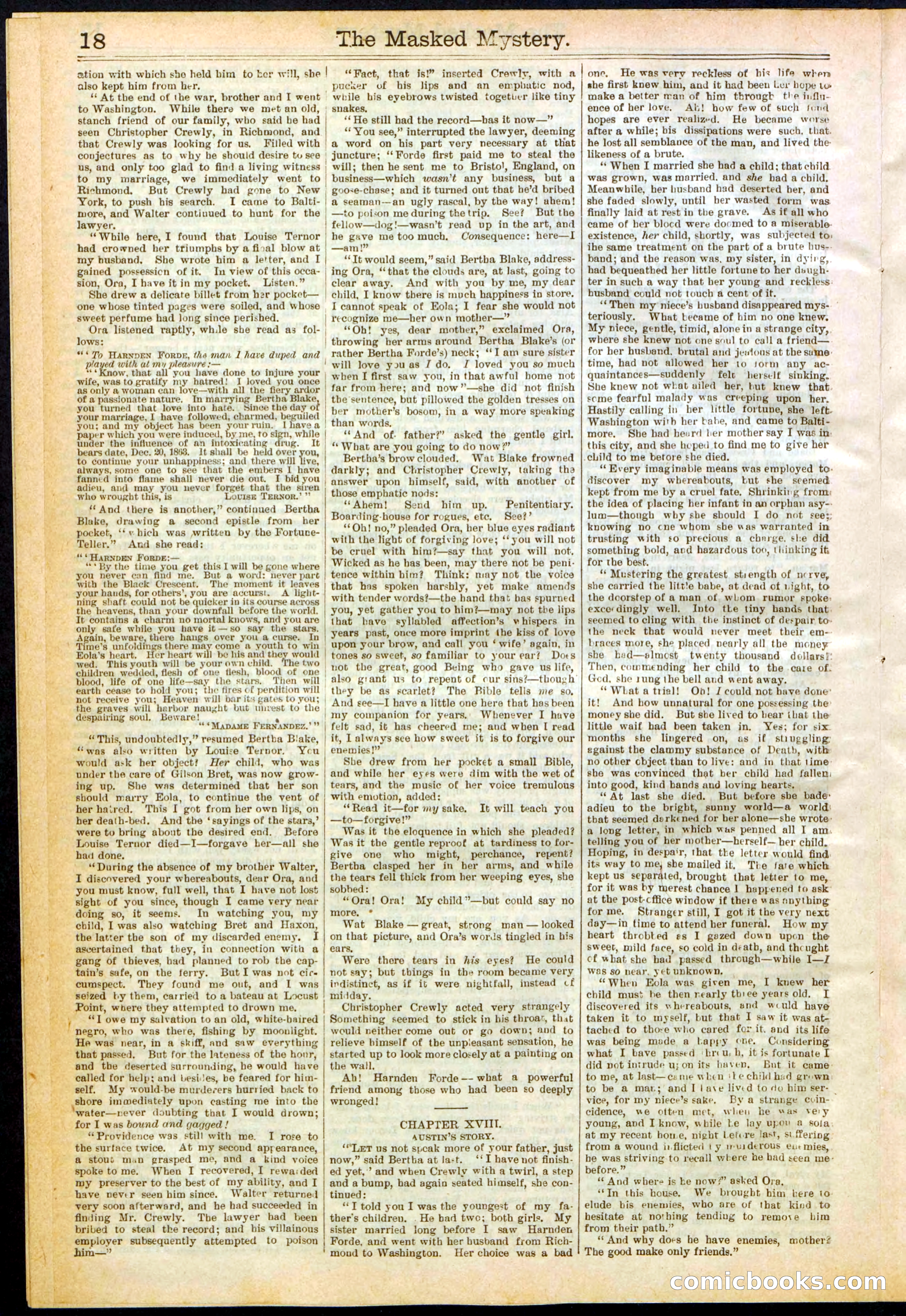
A restored page from Pulp Fiction, 1883. Page through the whole issue in the reader above.
📄 Transcribed text from this page (OCR, searchable)
Machine-transcribed from the original scan — historical spelling and the odd misread are preserved.
YY s i = ay sowed. =This youth will be your own child. 7 ¥ er. a eee te +* wey 7 ad ation with which she held him to ker will, she | also kept him from her, ‘* At the end of the war, brother and I went to Washington. While there we met an old, stanch friend of our family, who said be had ; seen Christopher Crewly, in Richmond, and fr that Crewly was looking for us. Filled with | covjectures as to why he should desire tu see us, and only too glad to find a living witness to my marriage, we immediately went to Richmond, But Crewly had gone to New York, to push his search. I came to Balti- | more, and Walter continued to hunt for the lawyer. “While here, I found that Louise Ternor had crowned her triumphs by a fixal blow at my husband. She wrote him a letter, and I gained possessicn of it. In view of this occa- sion, Ora, I have it in my pocket. Listen.” | She drew a delicate billet from her pocket— one whose tinted pages were soiled, and whose § 5 foe —_— = ~ . ¥ _ sweet perfume had Jong since perished. | te Ora listened raptly, wh.le she read as fol- | lows: | es ** 7) Harnnen Forpe, tha man I have duped and by ay with at my pleasure ;— ** Know, that all you have done to injure your wife, was to gratify my hatred! I loved you once as only a woman can love—with all the fiery ardor | of a passionate nature. In marrying Bertha Blake, | you turned that love into hate. Since the day of | your marriage, | have followed, charmed, beguiled | you; and my object has been yourruin. I havea) paper which you were induced, by me, to sign, while inter the influence of an intoxicatin rug. It | bears date, Dec. 20, 1863. It shall be held over you, to continue your unhappiness; and there will live, always, some one to see that the embers I have | fanned into flame shall never die out. I bid you | adieu, and may you never forget that the siren _ who wrought this, is Lovise TERNOR.’ ” “And there is another,” continued Bertha Blake, drawing a second epistle from her pocket, ‘‘v hich was written by the Forture- _' Teller.” And she read: “*HARNDEN ForDE:— **By the time you get this I will be gone where you never can find me. But a word: never part | with the Black Crescent. The moment it leaves _ your hands, for others’, you are accurst. A light- ning shaft could not be quicker in its course across the heavens, than your downfall before the world. Jt contains a charm no mortal knows, and you are only safe while you have it—so say the stars. ¥ Again, beware, there hangs over you a curse. In = Time's unfoldings there may come a youth to win ' a's heart. Her heart will be his and chey would 1e two oy children wedded, flesh of one ftiesh, blood of one -. plood, life of one life—say the stars. Then will ——s earth cease to hold you; the fires of perdition will . ‘not receive you; Heaven will bar its gates to you; | the graves will harbor naught but unrest to the wit he _ despairing soul. Beware! “MADAME FERNANDEZ,’” “This, undoubtedly,” resumed Bertba Blake, | “was also written by Louise Ternor. Yeu. . would ask her object? Her child, who was under the care of Gilson Bret, was now grow- ing up. She was determined that her son _ should marry Eola, to continue the vent of | -herhatred, This I got from her own lips, on her death-bed. And the ‘sayings of the stars,’ ss were to bring about the desired end. Before Louise Ternor died—I—forgave her—all she had done. “During the absence of my brother Walter, _ I discovered your whereabouts, dear Ora, and b | you must know, full well, that I have not lost Bight of you since, though I came very near doing so, it seems. In watching you, my - ebild, I was also watching Bret and Haxon, the latter the son of my discarded enemy, I a _ ascertained that they, in connection with a _ gang of thieves, had planned to rob the cap- _ tain’s safe, on the ferry. But I was not cic- cumspect. They found me out, and I was seized by them, carried to a bateau at Locust Point, where they attempted to drown me, “T owe my salvation to an old, white-baired | Negro, who was there, fishing by moonlight. | He was near, in a skiff, and saw everything - that passed. But for the lateness of the honr, and the deserted surrounding, be would have _ called for help; and besies, be feared for him- self. My would-be murderers hurried back to shore immediately upon casting me into the water—rnever doubting that I would drown; _ for I was bound and gagged ! & Providence was still with me. I rose to _ the surtace twice. At my second appearance, a stout man grasped me, and a kind voice _ spoke tome. When I recovered, I rewarded ss my =preserver to the best of my ability, and I _ have never seen him since. Walter returned very soon afterward, and he had succeeded in finding Mr. Crewly. Tbe lawyer bad been bribed to steal the record; and his villainous ‘Szoployer subsequently attempted to poison eS “ ‘ - s a a 7. =. — oe Ls % m, “i? The Masked Mystery. “Fact, that is!” inserted Crewly, with a pucker of his lips and an emphatic nod, while bis eyebrows twisted togetuer like tiny ' snakes, ** He still had the record—hbas it now—” “You see,” interrupted the lawyer, deeming a word on his part very necessary at that juncture; ‘‘Forde first paid me to steal the will; then he sent me to Bristo!, England, on business—which wasn’t any business, but a goose-chase; and it turned out that he’d bribed a seaman—an ugly rascal, by the way! ahem! —to poison me during thetrip. See? But the fellow—dog!—wasn’t read up in the art, and he gave me too much. Consequence: here—I —am!” ‘Tt would seem,” said Bertba Blake, address- | ing Ora, “‘that the clouds are, at last, going to clear away. And with you by me, my dear child, I know there is much happiness in store. I cannot speak of Eola; I fear she would not recognize me—her own mother—” “Ob! yes, dear mother,” exclaimed Ora, throwing her arms around Bertha Blake’s (or rather Bertha Forde’s) neck; ‘‘I am sure sister will love youas 7 do, J loved you so much when I first saw you, in that awful home not far from here; and now’’—she did not finish the sentence, but pillowed the golden tresses on ber mother’s bosom, in a way more speaking than words. ‘*And of. father?” asked the gentle girl. ‘What are you going to do now?” Bertha’s brow clouded. Wat Blake frowned darkly; and Christopher Crewly, taking tha answer upon himself, said, with another of those emphatic nods: ‘‘Ahem! Send him up. Penitentiary. Boarding-house for rogues, etc. See?’ **Oh! no,” pleaded Ora, her blue eyes radiant with the light of forgiving love; ‘‘ you will not be cruel with him?—say that you will not, Wicked as he has been, may there not be peni- tence within bim? Think: may not the voice that has spoken harshly, yet make amends with tender words?—tbe hand that has spurned you, yet gather you to him?—may not the lips that have syllabled affection’s whispers in years past, once more imprint the kiss of love upon your brow, and call you ‘ wife’ again, in tones so sweet, so familiar to your ear? Does not the great, good Being who gave us life, also grant us to repent of cur sins?—tbhough they be as scarlet? The Bible tells me so, And see—I have a little one here that has been my companion for years. Whenever I huve felt sad, it has cheered me; and when I[ read it, lL always see how sweet it is to forgive our enemies!” She drew from her pocket a small Bible, and while her eyes were dim with the wet of tears, and the music of her voice tremulous with emotion, added: ‘Read it—for my sake, —to—forgive!” Was it the eloquence in which she pleaded? Was it the gentle reproof at tardiness to for- give one who might, perchance, repent? Bertba clasped her in ber arms, and while the tears fell thick from her weeping eyes, she sobbed: “Ora! Ora! more. * Wat Blake — great, strong man — looked on that picture, and Ora’s words tingled in his ears, Were there tears in his eyes? He could not say; but things in the room became very indistinct, as if it were nightfall, instead cf midday. Christopher Crewly acted very strangely Something seemed to stick in his throat, that would neither come out or go down; and to relieve bimself of the unpleasant sensation, he started up to look more closely at a painting on the wall. Ah! Harnden Forde-- what a powerful friend among those who had been so deeply wronged! It will teach you My child ”—but could say no CHAPTER XVIII. AUSTIN’S STORY. ‘*Let us not speak more of your father, just now,” said Bertha at la-t. ‘‘ I have not finish- ed yet,’ and when Crewly with a twirl, a step and a bump, bad again seated himself, she con- tinued: **T told you I was the youngest of my fa- ther’s children. . He bad two; both girls. My sister married long before I saw Harnden Forde, and went with her busband from Rich- moud to Washington. Her choice was a bad one, He was very reckless of his life when she first knew him, and it had been Ler hope tu make a better man of him througk the influ- ence of her love. Ab! how few of such fond hopes are ever realized. He became worse after a while; bis dissipations were such, that. he lost all semblance of the man, and lived the likeness of a brute. ‘* When I married she had a child; that child was grown, was married, and she bad a child. Meanwhile, her husband had deserted her, and she faded slowly, until ber wasted form was finally laid at rest in the grave. As if all who came of her blocd were docmed to a miserable existence, her child, shortly, was subjected to: ihe same treatment on the part of a brute hus-. band; and the reason was, my sister, in dying, had bequeathed her little fortune to her dsugh- ter in such a way that ber young and reckless: busband could not touch a cent of if. **Then my niece’s husband disappeared mys- teriously. What became of him no one knew. My niece, gentle, timid, alone in a strange city,. where she knew not one soul to call a friend— for her husband, brutal and jewious at the sume: time, had not allowed her to storm any ac- quaintances—suddenly felt herself sinking. She knew not what uiled her, but knew that some fearful malady was creeping upon her. Hastily calling in ber little fortune, she left. Washington with her tabe, and came to Balti- more. She bad hesrd her mother say I was in: this city, and she hoped to find me to give her cLild to me betore she died. “Every imaginable means was employed to. discover my whereabouts, but she seemed kept from me by a cruel fate, Shrinki:g from: the idea of placing her infant in an orphan asy-- lum—though why she should I do not see: knowing no cne whom she was warranted in trusting with so precious a charge, she did something bold, and hazardous too, thinking it for the best. ** Mustering the greatest stisength of nerve, she carried the litt!e babe, at dead of night, to the doorstep of a man of, whom rumor spoke: excedingly well. Into tke tiny bands that. seemed to cling with the instinct of despair to- the neck that would never meet their em- braces more, she placed nearly all the money she bed—almost twenty thousand dollars?: Then, commending her child to the care of. God, she :ung the bell and went away. ‘What a trial! Ob! J could not have done’ it! And bow unnatural for one possessing the’ money she did. But she lived to bear that the little waif bad been taken in. Yes; for six. months she lingered on, as if stiuggling: egainst the clammy substance of Death, with no other object than to live: and in that time she was convinced that ber child had fallen, into good, kind bands and loving hearts, “At last she died. But before sbe bade: adieu to the bright, sunny world—a world: tbat seemed derkened for ber alone—she wrote: a long letter, in which was penned all I am. telling you of her mother—herself— her child. Hoping, in despair, that tke letter would find its way to me, she mailed if, The fate which kept us separated, brought that letter to me, for it was by merest chance | happened to ask’ at the post-cflice window if there was anything forme. Stranger still, I got it the very next day—in time to attend ber funeral, How my heart throbted es I gezed down upon the sweet, mild face, so cold in déeatb, and theught cf what she had passed through—while I—J was so near, yet unknown. “When Eola was given me, I knew her child must be then nearly thiee years old. [ discovered its whereabouts, end wceuld have taken it to myself, but that I saw it was at- tached to thore who cared for it. and its life was being made a tappy cone. Considering what I bave passed hrcu, h, it is fortunate I did not intrude uj; on its haven, to me, at last—ceme when ‘te child had grewn to be a mar; and I lave lived to do him ser- — vice, for my niece’s sake, By a strange cvin- cidence, we otten met, when he was very young, and I know, while Le lay upov a sola. at my recent home, night Lefure last, si. ffering: from a wound inflicted ty muiderous exe mies, he was striving to recall where be bad seen me- before.” “And where is ke now?’ asked Ora, ‘In this house, elude bis enemies, who are of that kiod to hesitate at nothing tending to remo.e him from their patb.” ** And why dors he have enemies, mother? The good make only friends.” COMIC ,OO 4 i But it ecame- We brought him bere to- |