
Pulp Fiction, 1883 · page 17 of 32
Beadle's Dime Library No. 260: The Masked Mystery; or, The Black Crescent — page 17: what you’re looking at
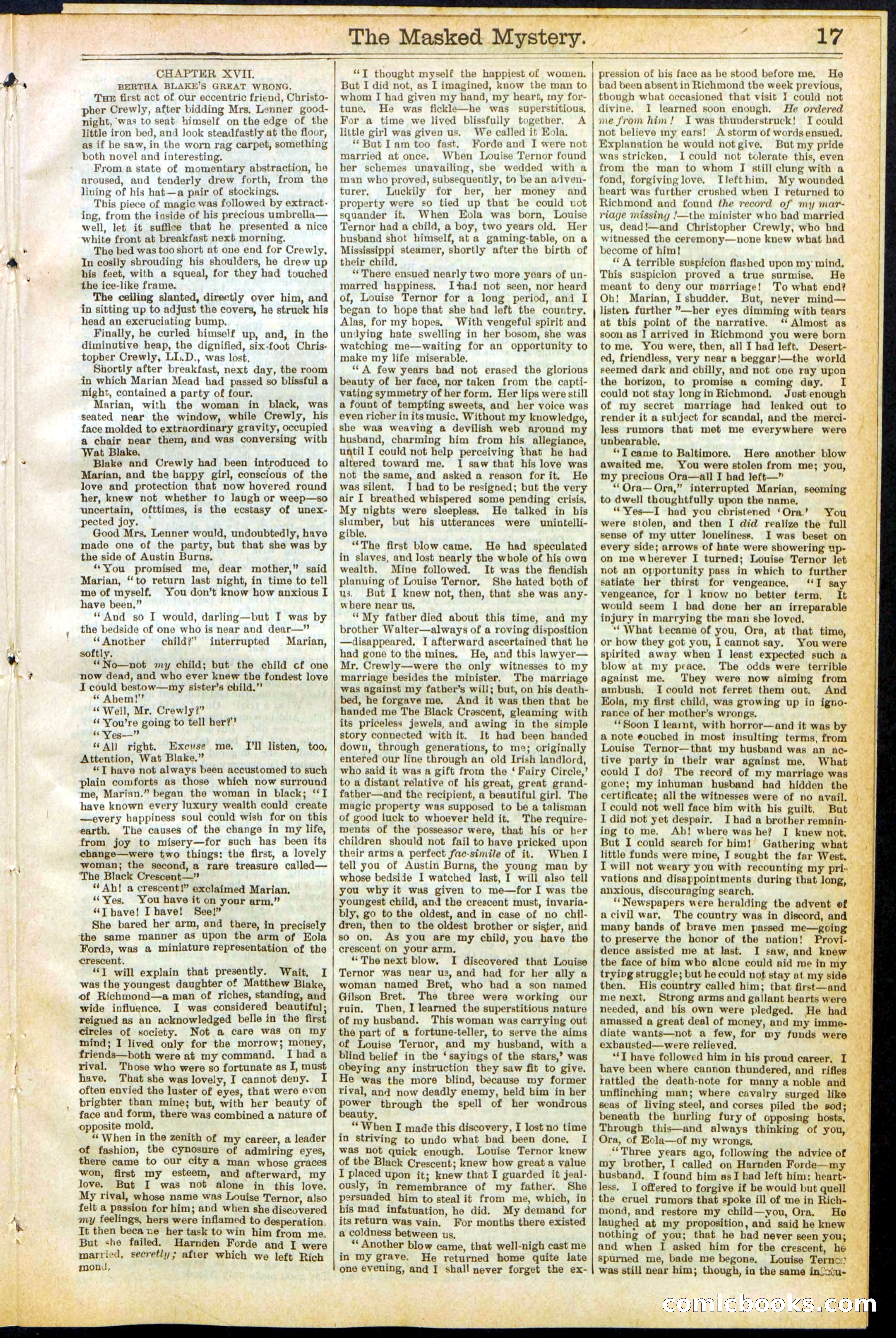
A restored page from Pulp Fiction, 1883. Page through the whole issue in the reader above.
📄 Transcribed text from this page (OCR, searchable)
Machine-transcribed from the original scan — historical spelling and the odd misread are preserved.
CHAPTER XVII. BERTHA BLAKE’S GREAT WRONG. Tre first act of our eccentric friend, Christo- pher Crewly, after bidding Mrs. Lenner good- night, was to seat himself on the edge of the little iron bed, and Jook steadfastly at the floor, as if he saw, in the worn rag carpet, something both novel and interesting. From a state of momentary abstraction, he aroused, and tenderly drew forth, from the lining of his hat—a pair of stockings. This piece of magic was followed by extract- ing, from the inside of his precious umbrella— well, let it suffice that he presented a nice white front at breakfast nex6 morning. The bed was too short at one end for Crewly, In cosily sbrouding his shoulders, he drew up his feet, with a squeal, for they had touched the ice-like frame. The ceiling slanted, directly over him, and in sitting up to adjust the covers, he struck his head an excruciating bump. Finally, be curled himself up, and, in the diminutive heap, the dignified, six-foot Chris- topher Crewly, LL.D., was lost, Shortly after breakfast, next day, the room in which Marian Mead had passed so blissful a night, contained a party of four. Marian, with the woman in black, was seated near the window, while Crewly, his face molded to extraordinary gravity, occupied a chair near them, and was conversing with Wat Blake. Blake and Crewly had been introduced to Marian, and the bappy girl, conscious of the love and protection that now hovered round her, knew not whether to laugh or weep—so uncertain, ofttimes, is the ecstasy of unex- pected joy. — Good Mrs, Lenner would, undoubtedly, have made one of the party, but that she was by the side of Austin Burns. ‘*You promised me, dear mother,” said Marian, “to return last night, in time to tell me of myself. You don’t know how anxious I have been,” ‘And so I would, darling—but I was by the bedside of one who is near and dear—” “Another child?’ interrupted Marian, softly. **No—not my child; but the child cf one now dead, and who ever knew the fondest love I could bestow—my sister’s child.” “ Ahem!” “Well, Mr. Crewly?” ‘¢-You’re going to tell her?” ‘“ Yes-—”? ‘All right. Exeuse me, Attention, Wat Blake.” “T have not always been accustomed to such plain comforts as those which now surround me, Marian.” began the woman in black; ‘I have known every luxury wealth could create —every happiness soul could wish for on this earth. The causes of the change in my life, from joy to misery—for such has been its change—were two things: the first, a lovely woman; the second, a rare treasure called— ‘The Black Crescent—” “Ah! a crescent!” exclaimed Marian. ‘Yes, You have it on your arm,” “T have! Ihave! See!” She bared her arm, and there, in precisely the same manner as upon the arm of Eola Fords, was a miniature representation of the crescent. ‘‘Y will explain that presently. Wait, I was the youngest daughter of Matthew Blake, of Richmond—a man of riches, standing, and wide influence. I was considered beautiful; reigued as an acknowledged belle in the first circles of society. Not a care was on my mind; I lived only for the morrow; money, friends—both were at my command. I had a rival. Those who were so fortunate as I, must have. That she was lovely, I cannot deny. often envied the luster of eyes, that were even brighter than mine; but, with her beauty of face aud form, there was combined a nature of opposite mold, ‘‘ When in the zenith of my career, a leader of fashion, the cynosure of admiring eyes, there came to our city a man whose graces won, first my esteem, and afterward, my love. But I was not alone in this love. My rival, whose name was Louise Ternor, also felt a passion for him; and when she discovered my feelings, hers were inflamed to desperation. Tt then beca ne her task to win him from me. But she failed. Harnden Forde and I were married, secretly; after which we left Rich mond, I'll listen, too, - The Masked Mystery. ED ee ee a ee Se “‘T thought myself the happiest of women. But I did not, as I imagined, know the man to whom I had given my hand, my heart, my for- tune. He was fickle—he was superstitious. For a time we lived blissfully togetber. A little girl was given us. We called it Hola. ‘But Iam too fast. Forde and I were not married at once. When Louise Ternor found her schemes unavailing, she wedded with a man who proved, subsequently, to be an adven- turer, Luckily for her, her money and property were so tied up that he could uot squander it, When Eola was born, Louise Ternor had a child, a boy, two years old, Her busband shot himself, at a gaming-table, on a Mississippi steamer, shortly after the birth of their child, “There ensued nearly two more years of un- marred happiness. Ithad not seen, nor heard of, Louise Ternor for a long period, and I began to hope that she had left the country. Alas, for my bopes. With vengeful spirit and undying hate swelling in her bosom, she was watching me—waiting for an opportunity to make my life miserable, ‘A few years had not erased the glorious beauty of her face, nor taken from the capti- vating symmetry of her form. Her lips were still a fount of tempting sweets, and her voice was even richer in its music, Without my knowledge, she was weaving a devilish web around my husband, charming him from his allegiance, until I could not help perceiving that he bad altered toward me. I saw that his love was not the same, and asked a reason forit. He was silent, I had to be resigned; but the very air I breathed whispered some pending crisis, My nights were sleepless. He talked in his slumber, but his utterances were unintelli- gible. “The first blow came, He had speculated in slaves, and lost nearly the whole of his own wealth. Mine followed. It was the fiendish planuing of Louise Ternor. She hated both of us. But I knew not, then, that she was any- where near us, “My father died about this time, and my brother Walter—always of a roving disposition —disappeared. I afterward ascertained that he had gone to the mines. He, and this lawyer— Mr, Crewly—were the only witnesses to my marriage besides the minister. The marriage was against my father’s will; but, on his death- bed, he forgave me, And it was then that he handed me The Black Crescent, gleaming with its priceless jewels, and awing in the simple story connected with it. It had been handed down, through generations, to me; originally entered our line through an old Irish landlord, who said it was a gift from the ‘ Fairy Circle,’ to a distant relative of his great, great grand- father—and the recipient, a beautiful girl. The magic property was supposed to be a talisman of good luck to whoever held it. The require- ments of the possessor were, that his or her children should not fail to have pricked upon their arms a perfect fac-simile of it. When I tell you of Austin Burns, the young man by whose bedside I watched last, I will also tell you why it wus given to me—for I was the youngest child, and the crescent must, invaria- bly, go to the oldest, and in case of no chil- dren, then to the oldest brother or sister, and so on. As you are my child, you have the crescent on your arm, “The next blow, I discovered that Louise Ternor was near us, and had for her ally a woman named Bret, who had a son named Gilson Bret. The three were working our ruin. Then, I learned the superstitious nature of my husband. This woman was carrying out the part of a fortune-teller, to serve the aims of Louise Ternor, and my husband, with a blind belief in the ‘sayings of the stars,’ was obeying any instruction they saw fit to give. He was the more blind, because my former rival, and now deadly enemy, beld bim in her power through the spell of her wondrous beauty, “When I made this discovery, I lost no time in striving to undo what bad been done, I was not quick enough. Louise Ternor knew of the Black Crescent; knew how great a value I placed upon it; knew that I guarded it jeal- ously, in remembrance of my father. She persuaded him to steal it from me, which, in bis mad infatuation, he did. My demand for its return was vain. For months there existed a coldness between us, ** Another blow came, that well-nigh cast me in my grave. He returned home quite late one evening, and I shall never forget the ex- i - ‘ ad y ve “ a) ; fi is ’ : ’ pression of bis face as be stood before me, He bad been absent in Richmond the week previous, though what occasioned that visit I could not divine. I learned soon enough. He ordered me from him! I-was thunderstruck! I could not believe my ears! A storm of words ensued, Explanation be would not give. But my pride was stricken, I could not tolerate this, even from the man to whom I still clung with a fond, forgivinglove, Ilefthim, My wounded heart was further crushed when I returned to Richmond and found the record of my mar- riage missing !—the minister who had married us, dead!—and Christopber Crewly, who bad witnessed the ceremony—none knew what had become of him! “A terrible suspicion flashed upon my mind, This suspicion proved a true surmise, He meant to deny our marriage! To what end? Oh! Marian, I shudder, But, never mind— listen. further ”—her eyes dimming with tears at this point of the narrative. “Almost as == | soon as I arrived in Richmond you were born to me. You were, then, all I had left. Desert- __ ed, friendless, very near a beggar!—the world \ seemed dark and chilly, and not one ray upon Sf the horizon, to promise a coming day. I could not stay longin Richmond. Justenough =| of my secret marriage had leaked out to render it a subject for scandal, and the merci- = less rumors that met me everywhere were = unbearable, “IT came to Baltimore. Here another blow awaited me, You were stolen from me; you, my precious Ora—all I had left—” ‘“‘Ora—Ora,” interrupted Marian, seoming to dwell thoughtfully upon the name, ie **Yes—I had you christened ‘Ora’ You | were stolen, and then I did realize the full sense of my utter loneliness. I was beset on every side; arrows of hate were showering wp- on me wherever I turned; Louise Ternor le6 not an opportunity pass in which to further Se satiate her thirst for vengeance. ‘I say — vengeance, for 1 know no better term, It would seem 1 bad done her an irreparable injury in marrying the man she loved, | “What became of you, Ora, at that time, — or how they got you, Icannot say, Youwere spirited away when I least expected sucha blow at my peace. The odds were terrible | against me. They were now aiming from ambush, I could not ferret them out. And Eola, my first child, was growing up in igno- rance of her mother’s wrongs. Se “Soon I learnt, with horror—and it was by | a note eouched in most insulting terms, from Louise Ternor—that my husband was an ac- tive party in their war against me. What could I do? The record of my marriage was gone; my inhuman husband had hidden the certificate; all the witnesses were of no avail. I could not well face him with his guilt. But I did not yet despair. Ihadabrotherremain. | fe ‘ 4 i” Av ms \ » 2 . 1 ' fen A rf | | ‘id. ing to me. Ah! where was he? I knew not, But I could searcb for him! Gathering what little funds were mine, I sought the far West. I will not weary you with recounting my priv — vations and disappointments during that long, t anxious, discouraging search. sat, ‘‘ Newspapers were heralding the advent of | a civil war, The country was in discord, and mavy bands of brave men passed me—going _ to preserve the honor of the nation! Provi- ¢ dence assisted me at last. I saw, and knew the face of him who alone could aid mein my _ trying struggle; but he could not stay at my side | then. His country called him; tbat first-—and me next, Strong arms and gallant hearts were needed, and bis own were pledged. He had amassed a great deal of money, and my imme- diate wants—not a few, for my funds were exbausted—were relieved. a “T have followed him in his proud career, I have been where cannon thundered, and rifles — rattled the death-note for many a noble and unflinching man; where cavalry surged i ko seas of living steel, and corses piled the sod; | beneath the hurling fury of opposing hosts. | Through this—and always thinking of you, Ora, of Eola—of my wrongs. lias ie “Three years ago, following the advice of — my brother, I called on Harnden Forde—my ~ husband. I found bim asI had left bim: heart- “ | less. I offered to forgive if be would but quell the cruel rumors that spoke ill of mein Rich. mond, and restore my child—you, Ora, en laughed at my proposition, and said he knew nothing of you; that he had never seen you; and when I asked him for the crescent, he spurned me, bade me begone. Louise Terna? was still near him; though, in the same inictu- a = “| comicbooks.;com * . P - - J % | a. . ae al — ] erat |