
Pulp Fiction, 1883 · page 12 of 32
Beadle's Dime Library No. 260: The Masked Mystery; or, The Black Crescent — page 12: what you’re looking at
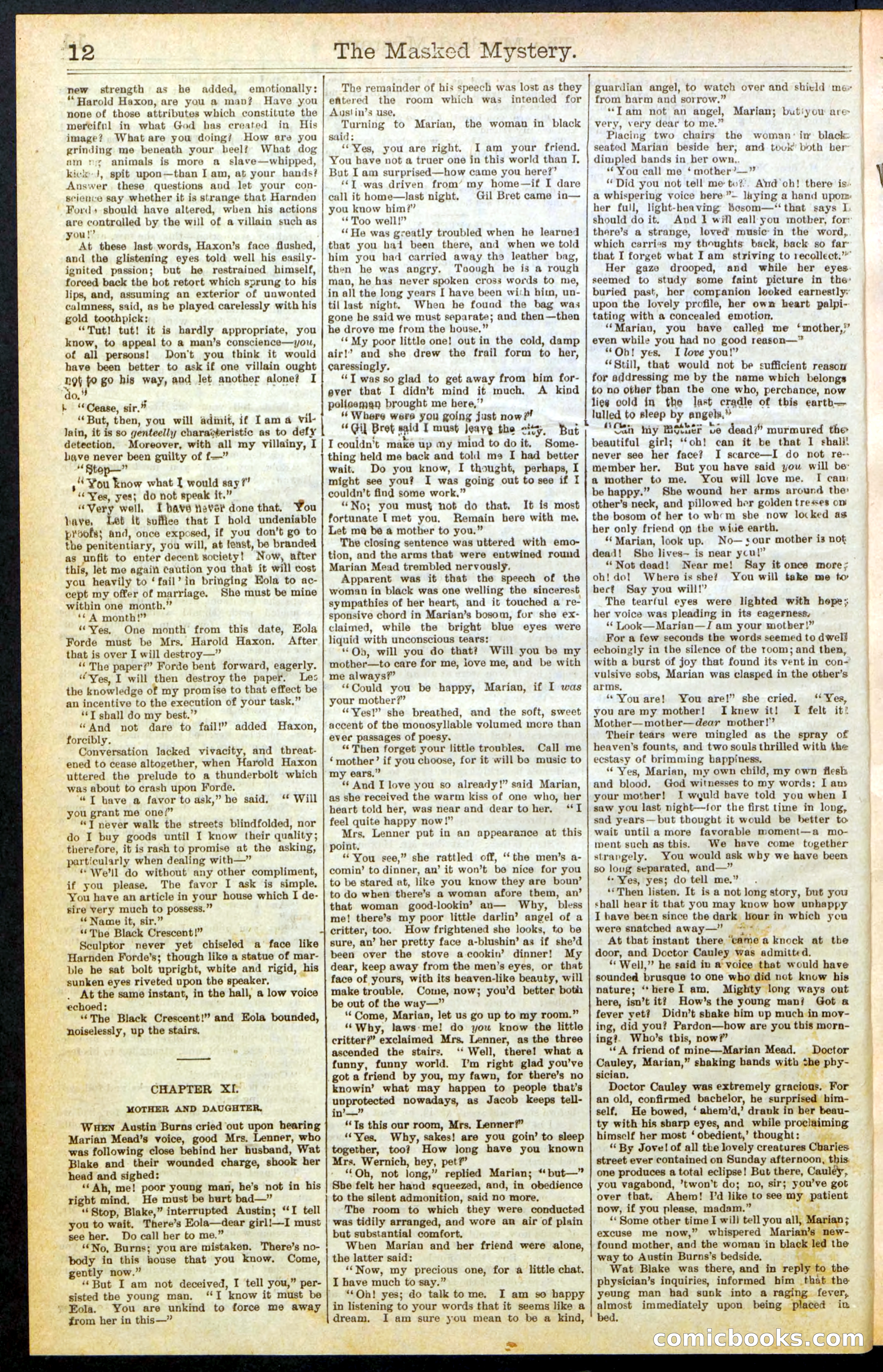
A restored page from Pulp Fiction, 1883. Page through the whole issue in the reader above.
📄 Transcribed text from this page (OCR, searchable)
Machine-transcribed from the original scan — historical spelling and the odd misread are preserved.
new strength as he added, emotionally: “Harold Haxon, are you a man? Have you none of those attributes which constitute the mereiful in what God has created in His image? What are you doing? How are you grinding me beneath your beelf What dog am rz animals is more a slave—whipped, kick}, spit upon—than I am, at your bands? Answer these questions and let your con- science say whether it is strange that Harnden ' Ford» sbould have altered, when his actions ua . ih as ~—- ’ "1 , * Bae ‘yore ' * £ Ma a) ~ rr. ’ = ' Dis Eola. . pat Fa P| >s s Pe body in this house that you know, Py | on i are contralled by the will of a villain such as you!” At these last words, Haxon’s face flushed, and the glistening eyes told well his easily- ignited passion; but he restrained himself, forced back the bot retort which sprung to his lips, and, assuming an exterior of unwonted calmness, said, as be played carelessly with his gold toothpick: “Tut! tut! it is hardly appropriate, you know, to appeal to a man’s conscience—you, of all persons! Don't you think it would have been better to askif one villain ought ng} fo go his way, and let another alone? I j W do,’ k ‘Cease, sir.? ‘But, then, you will adimit, if Iam a vil- lain, it is so genteelly characteristic as to defy detection. Moreover, with all my villainy, I have never been guilty of f—” sé Step—” ,' You know what I would say?” ‘Ves, yes; do not speak it.” “Very well, Ihave never done that. You have, b it suffiee that I hold undeniable proofs; and, once exposed, if you don’t go to the penitentiary, you will, at feast, be branded agen to enter decent society! Now, after this, let me again Caution you that it will cost you heavily to ‘fail’ in bringing Hola to ac- cept my offer of marriage. She must be mine witbin one month.” ‘¢ A month!” “Yes, One month from this date, Eola Forde must be Mrs. Harold Haxon, After that is over I will destroy—” ‘The paper?” Forde bent forward, eagerly. ‘Yes, I will then destroy the paper. Les the knowledge of my promise to that effect be an incentive to the execution of your task,” ‘*T shall do my best.” “And not dare to fail!” added Haxon, forcibly. Conversation lacked vivacity, and tbreat- ened to cease altogether, when Harold Haxon uttered the prelude to a thunderbolt which was about to crash upon Forde. ‘“T bave a favor to ask,” he said, you grant me one?” “T never walk the streets blindfolded, nor do I buy goods until I know their quality; therefore, it is rash to promise at the asking, particularly when dealing with—” “We'll do without any other compliment, if you please. The favor I ask is simple. You have an article in your house which I de- sire very much to possess.” “Name it, sir.” “Tbe Black Crescent!” ; Sculptor never yet chiseled a face like Harnden Forde’s; though like a statue of mar- ble he sat bolt upright, white and rigid, his sunken eyes riveted upon the speaker. . At the same instant, in the hall, a low voice echoed: | “The Black Crescent!” and Eola bounded, noiselessly, up the stairs. “ Will “ —_— oe CHAPTER XI MOTHER AND DAUGHTER. - Wuen Austin Burns cried out upon hearing Marian Mead’s voice, good Mrs, Lenner, who was following close bebind her husband, Wat Blake and their wounded charge, shook her head and sighed: ; ‘Ah, me! poor young man, he’s not in his right mind. He must be burt bad—” “Stop, Blake,” interrupted Austin; “TI tell you to wait, There’s Eola—dear girl!—I must see her. Do call her to me.” “No, Burns; you are mistaken. There’s no- Come, gently now.” ‘But I am not deceived, I tell you,” per- sisted the young man. ‘Eol You are unkind to force me away from her in this—” . Z, nie oe -_ — “T know it must be | The Masked Mystery. The remainder of his speech was lost as they efitered the room which was intended for Austin’s use, Turning to Marian, the woman in black said; ‘Yes, you are right. I am your friend, You have not a truer one in this world than I, But I am surprised—how came you here?’ ‘‘T was driven from’ my home—if I dare call it home—last night. Gil Bret came in— you know him?” ‘* Too well!” “He was greatly troubled when he learned that you hai been there, and when we told him you had carried away tho leather bag, then he was angry. Toough he is a rough man, he has never spoken cross words to me, in all the long years I have been with him, un- til last night. When he found the bag was gone he said we must separate; and then—then he drove me from the house.” ‘* My poor little one! out in the cold, damp air!’ and she drew the frail form to her, caressingly. “‘T was so glad to get away from him for- ever that I didn’t mind it much, A kind policeman brought me here,” ‘Where were you going just now?” Gil Bret said I must jeayg the <y. But I couldn't make up my mind to doit. Some- thing held me back and told me I had better wait. Do you know, I thought, perhaps, I might see you? I was going out to see if I couldn’t find some work,” “No; you must not do that, It is most fortunate [met you. Remain here with me, Let ma be a mother to you.” The closing sentence was uttered with emo- tion, and the arms that were entwined round Marian Mead trembled nervously, Apparent was it that the speech of the woman in black was one welling the sincerest sympathies of her heart, and it touched a re- sponsive chord in Marian’s bosom, for she ex- claimed, while the bright blue eyes were liquid with unconscious tears: ‘Ob, will you do that? Will you be my mother—to care for me, love me, and be with me always?” ‘Could you be happy, Marian, if I was your mother?” ‘‘Yes!” she breathed, and the soft, sweet accent of the monosyllable volumed more than ever passages of poesy. “Then forget your little troubles. Call me ‘mother’ if you choose, for it will be music to my ears.” ‘¢ And I love you so already!” said Marian, as she received the warm kiss of one who, her heart told her, was near and dear toher. “I feel quite happy now!” Mrs, Lenner put in an appearance at this point. “You see,” she rattled off, “the men’s a- comin’ to dinner, an’ it won’t be nice for you to be stared at, like you know they are boun’ to do when there’s a woman afore them, an’ that woman good-lookin? an— Why, bless me! there’s my poor little darlin’ angel of a critter, too. How frightened she looks, to be sure, an’ her pretty face a-blushin’ as if she’d been over the stove acookin’ dinner! My dear, keep away from the men’s eyes, or that face of yours, with its beaven-like beauty, will make trouble, Come, now; you'd better both be out of the way—” ‘Come, Marian, let us go up to my room.” ‘‘Why, laws:-me! do you know the little critter?’ exclaimed Mrs, Lenner, as the three ascended the stairs. ‘‘ Well, there! what a funny, funny world. I’m right glad you’ve got a friend by you, my fawn, for there’s no knowin’ what may happen to people that’s unprotected nowadays, as Jacob keeps tell- in’——” ‘“‘Ts this our room, Mrs, Lenner?” ‘‘Yes, Why, sakes! are you goin’ to sleep together, too? How long have you known Mrs. Wernich, hey, pet?’ - Qh, not long,” replied Marian; *‘but—” She felt her hand squeezed, and, in obedience to the silent admonition, said no more, The room to which they were conducted was tidily arranged, and wore an air of plain but substantial comfort. When Marian and her friend were alone, the latter said: ‘Now, my precious one, for a little chat. I have much to say.” ’ ‘“‘Oh! yes; do talk tome. I am so bappy in listening to your words that it seems like a (dream. I am sure you mean to be a kind, Lee, as Pwd tin CN ASO : =< guardian angel, to watch over and shield mer from harm and sorrow.” “Tam not an angel, Marian; butiyou are very, very dear to me.” Piacing two chairs the woman: in’ black: seated Marian beside ber; and tovk’ both her dimpled bands in her own,. ‘You call me ‘ mother’—” “Did you not tell me to? should do it. And 1 will eall you mother, for there’s a strange, loved’ music’ in the word, which carries my thoughts back, back so far that I forget what Iam striving to recollect.” Her gaze drooped, and while her eyes seemed to study some faint picture in the: buried past, her companion leoked earnestly- upon the lovely profile, her own heart palpi- tating with a concealed emotion. “Marian, you have called me ‘mother,’ even while you had no good reason—” “Ob! yes. I love you!” “Still, that would not be sufficient reason for addressing me by the name which belongs to no other than the one who, perchance, now lieg cold in the last cradle of this earth— lulled to sleep by angels,” fi (lee. uy be b- (an biy Mother oe dead?’ murmured the beautiful girl; ‘‘oh! can it be that I shall! never see her face? I scarce—I do not re-- member her. But you have said you will be a mother to me. You will love me. I can be happy.” Sbe wound her arms around the: other’s neck, and pillowed ber golden tresses on the bosom of her to whim sbe now locked as her only friend on the wide earth. “Marian, look up. No—sour mother is not dead! She lives— is near ycu}” ‘““Not dead! Near me! Say it once more; oh! dol! Where is she? You will take me to bect Say you will!’ The tearful eyes were lighted with hepe; her voice was pleading in its eagerness, ‘‘ Look—Marian—J am your motber!” For a few seconds the words seemed to dwell echoingly in the silence of the room; and then, with a burst of joy that found its vent in con- vulsive sobs, Marian was clasped in the other’s arms. ‘You are! You are!” she cried. ‘ Yes, you are my mother! Iknew it! I felt itt Mother—motber—dear mother!” Their tears were mingled as the spray of heaven's founts, and two souls thrilled with the ecstasy of brimming bappiness, ‘“ Yes, Marian, my own child, my own flesh and blood. God witnesses to my words: I am your mother! I wyuld bave told you when I saw you last night—for the first time in long, sad years— but thought it would be better to wait until a more favorable moment—a mo- ent such as this. We have come together strangely. You would ask why we have been so loug separated, and—” ‘Yes, yes; do tell me.” ‘‘Then listen. It is a not long story, but you shall hear it that you may know bow unhappy I bave been since the dark lour in which you were snatched away—” <—" © At that instant there ‘eame a knock at the door, and Doctor Cauley as admitted. ‘* Well,”’ he said in a voice that would have sounded brusque to one who did not know his nature; ‘‘hereI am, Mighty long ways out here, isn’t it? How’s the young man? Got a fever yet? Didn’t sbake bim up much in moy- ing, did you? Pardon—how are you this morn- ing?. Who’s this, now?’ m ‘‘A friend of mine—Marian Mead. Doctor Cauley, Marian,” shaking bands with sician., SE a Doctor Cauley was extremely gra an old, confirmed bachelor, he surpri self, He bowed, ‘ ahem’d,’ drank in ber beau- ty with his sharp eyes, and while proclaiming himself her most ‘ obedient,’ thought: as “By Jove! of all the lovely creatures es. street ever contained on Sunday afternoon, this _ one produces a total eclipse! But there, Cauléy, you vagabond, ’twon’t do; no, sir; you’ve got over that. Ahem! I'd like to see my patient now, if you please, madam.” eat ‘Some other time I will tell you all, Marian excuse me now,” whispered Marian’s new found mother, and the woman in blac way to Austin Burns’s bedside. Wat Blake was there, and in reply to physician’s inquiries, informed him that the yeung man had sunk into a raging fever, almost immediately upon being placed in : ; = bed. m "co — And oh! there is. a whispering voice here”- laying a hand upom her full, light-beaving bosom—*‘ that says L ar © 4% 7 EDOOKS-E€O “as —— Perk,