
Pulp Fiction, 1883 · page 11 of 32
Beadle's Dime Library No. 260: The Masked Mystery; or, The Black Crescent — page 11: what you’re looking at
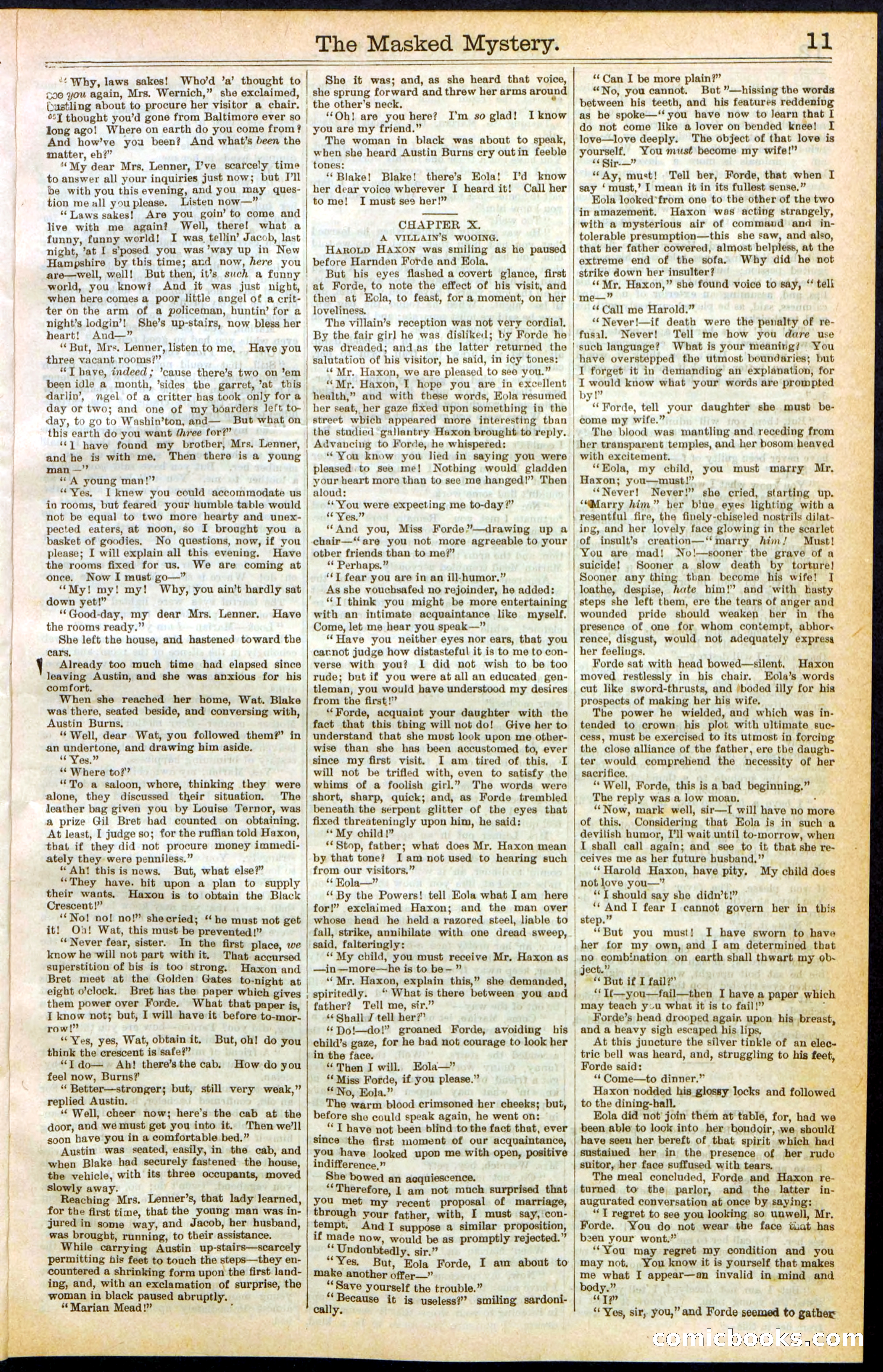
A restored page from Pulp Fiction, 1883. Page through the whole issue in the reader above.
📄 Transcribed text from this page (OCR, searchable)
Machine-transcribed from the original scan — historical spelling and the odd misread are preserved.
_ : se —_ * ' - . - , p ‘ The Masked Mystery. ‘t Why, laws sakes! Who'd ’a’ thought to She it was; and, as she heard that voice, S96 you again, Mrs. Wernich,” she exclaimed, | she sprung forward and threw her arms around (sustling about to procure her visitor a chair. | the other’s neck. 6ST thought you’d gone from Baltimore ever so ‘‘Oh! are you here? I’m so glad! we ‘—- — I know . - ae _ _} long ago! Where on earth do you come from? And how’ye you been? And what’s been the matter, eh?” “My dear Mrs, Lenner, I’ve scarcely time | to answer all your inquiries just now; but I'll | be with you this evening, and you may ques- tion me all youplease. Listen now—” ‘‘ Laws sakes! Are you goin’ to come and live with me again? Well, there! what a funny, funny world! Hampshire by this time; and now, here you are—well, well! But then, it’s such a funny world, you know? And it was just night, when here comes a poor little angel of a crit- ter on the arm of a policeman, huntin’ for a. She’s up-stairs, now bless her | night’s lodgin’! heart! And—” * But, Mrs. Lenner, listen to me, three vacant rooms?” “I have, indeed; ’cause there’s two on ’em been idle a month, ’sides the garret, ’at this darlin’, ngel of a critter bas took only for a Have you day or two; and one of my boarders left to- | her seat, her gaze fixed upon something in the | day, to go to Washin’ton, and— But what on this earth do you want ‘hree for?” ‘‘) have found my brother, Mrs. Lenner, and he is with me, Then there is a young man —”’ ‘A young man!” “Yes. I knew you could accommodate us in rooms, but feared your humble table would not be equal to two more hearty and unex- pected eaters, at noon, so I brought you a basket of goodies. No questions, now, if you please; I will explain all this evening. Have the rooms fixed for us. We are coming at once. Now I must go—” ‘My! my! my! Why, you ain’t hardly sat down yet!” ‘“Good-day, my dear Mrs. Lenner. the rooms ready.” She left the house, and hastened toward the cars. Already too much time had elapsed since leaving Austin, and she was anxious for his comfort. When she reached her home, Wat. Blake was there, seated beside, and conversing with, Austin Burns. ‘* Well, dear Wat, you followed them?’ in an undertone, and drawing him aside. ‘é Yes.” “Where to?” “To a saloon, whore, thinking they were alone, they discussed their situation. The leather bag given you by Louise Ternor, was a prize Gil Bret had counted on obtaining. At least, I judge so; for the ruffian told Haxon, that if they did not procure money immedi- ately they were penniless.” “Ah! this is news. But, what else?” “They have. hit upon a plan to supply their wants. Haxon is to obtain the Black Crescent!” ‘No! no! no!” shecried; “he must not get On! Wat, this must be prevented!” “Never fear, sister. In the first place, we know he will not part with it. That accursed superstition of his is too strong. Haxon and Bret meet at the Golden Gates to-night at eight o’clock. Bret has the paper which gives them power over Forde. What that paper is, I know not; but, I will have it before to-mor- row!” “Yes, yes, Wat, obtain it. think the crescent is safe?” “Tdo— Ah! there’sthe cab. How do you feel now, Burns? “ Better—stronger; but, still very weak,” replied Austin. ‘‘ Well, cheer now; here’s the cab at the door, and we must get you into it. Then we'll soon have you in a comfortable bed.” Austin was seated, easily, in the cab, and when Blake had securely fastened the house, the vehicle, with its three occupants, moved slowly away. Reaching Mrs. Lenner’s, that lady learned, Have it! But, oh! do you I was tellin’ Jacob, last | night, ’at I s’posed you was ’way up in New | NN eee ee EEE eee | you are my friend.” The woman in black was about to speak, when she heard Austin Burns cry outin feeble tones: ‘* Blake! Blake! there’s Eola! her dear voice wherever I heard it! to me! I must ses her!” I'd know Call her CHAPTER X. A VILLAIN’S WOOING. HaroLp Haxon was smiling as he paused before Harnden Forde and Eola, But his eyes flashed a covert glance, first | at Forde, to note the effect of his visit, and then at Eola, to feast, for a moment, on her loveliness. The villain’s reception was not very cordial. By the fair gir] he was disliked; by Forde he was dreaded; and.as the latter returned the salutation of his visitor, he said, in icy tones: ‘‘Mr. Haxon, we are pleased to see you.” “Mr. Haxon, I hope you are in excellent health,” and with these words, Eola resumed street wbich appeared more interesting tban the studied gallantry Haxon brought to reply. Advancing to Forde, he whispered: * You know you lied in saying you were pleased. to sea me! Nothing would gladden your heart more than to see me hanged!’ Then aloud: ‘You were expecting me to-day?’ ‘“ Yes.” ‘‘And you, Miss Forde”—drawing up a chair—‘“‘are you not more agreeable to your otber friends than to me?’ ** Perhaps.” ‘*T fear you are in an ill-humor,” As she youcbsafed no rejoinder, he added: “TI think you might be more entertaining with an intimate acquaintance like myself. Come, let me hear you speak—” “Have you neither eyes nor ears, that you cannot judge how distasteful it is to me to con- verse with you? IL did not wish to be too rude; but if you were at all an educated gen- tleman, you would have understood my desires from the first!’ “Forde, acquaint your daughter with the fact that this thing will not do! Give her to understand that she must look upon me other- wise than she has been accustomed to, ever since my first visit. I am tired of this, I will not be trifled with, even to satisfy the whims of a foolish girl.” The words were short, sharp, quick; and, as Forde trembled beneath the serpent glitter of the eyes that fixed threateningly upon him, he said: ** My child!” ** Stop, father; what does Mr. Haxon mean by that tone? Iam not used to hearing such from our visitors.” “é Eola—” ‘‘ By the Powers! tell Eola what Iam here for!” exclaimed Haxon; and the man over whose head he held a razored steel, liable to fall, strike, annihilate with one dread sweep, said, falteringly: ** My child, you must receive Mr. Haxon as —in—more—he is to be— ” ‘‘ Mr. Haxon, explain this,” she demanded, spiritedly. “ What is there between you and father? Tell me, sir.” ‘¢ Shall J tell her?” ‘‘Do!—do!” groaned Forde, avoiding his child’s gaze, for he bad not courage to look her in the face. “Then I will. Eola—” ‘Miss Forde, if you please.” ** No, Eola.” The warm blood crimsoned her cheeks; but, before she could speak again, he went on: “T have not been blind tothe fact that, ever since ‘the first moment of our acquaintance, you have looked upop me with open, positive indifference,” She bowed an acquiescence. “‘Therefore, | am not much surprised that you met my recent proposal of marriage, | such language? = of one for whom contempt, abhors Ps Baa ‘‘ Can I be more plain?” “No, you cannot. But ”—hissing the words between his teeth, and his features reddening as he spoke—‘‘ you have now to Jearn that I do not come like a lover on bended knee! I love—love deeply. The object of that love is yourself. You must become my wife!” ‘(Sir ‘““Ay, must! Tell ber, Forde, that when I say ‘must,’ I mean it in its fullest sense,” Eola looked*from one to the other of the two in amazement. Haxon was acting strangely, with a mysterious air of command and in- tolerable presumption—this she saw, and also, that her father cowered, almost belpless, at the extreme end of the sofa. Why did he not * strike down her insulter? iy ‘‘Mr, Haxon,” she found voice to say, “ tell “A me—” *¢ Call me Harold.” ‘‘ Never!—if death were the penalty of re- fusal. Never! Tell me how you dare use What is your meaning? You have overstepped the utmost boundaries; but I forget it in demanding an explanation, for *) I would know what your words are prompted rs by!” ‘Forde, tell your daughter she must be- come my wife.” The blood was mantling and receding from her transparent temples, and her bosom heaved with excitement. ; “Eola, my child, you must marry Mr, “7 Haxon; you—must!”’ sy ‘‘Never! Never!’ she cried, starting up. ‘“Marry him” her blue. eyes lighting with a resentful fire, the finely-chiseled nostrils dilat- ing, and her lovely face glowing in the scarlet of insult’s creation—‘‘marry him! Must! + You are mad! No!—sooner the grave of a es suicide! Sooner a slow death by torture! 2 a =f Sooner any thing than become his wife! JT loathe, despise, hate him!” and ‘with hasty steps she left them, ere the tears ot angerand == ' wounded pride should weaken ber in the he a rence, disgust, would not adequately expresa — her feeliugs. oh Forde sat with head bowed—silent. Haxon moved restlessly in bis chair. Eola’s words — cut like sword-thrusts, and /boded illy for his prospects of making her his wife. : "ra The power he wielded, and which was in- tended to crown his plot with ultimate suc- cess, must be exercised to its utmost in forcing the close alliance of the father, ere the daugh- ter would comprehend the necessity of her sacrifice. “Well, Forde, this is a bad beginning.” The reply was a low moan, Aaa ‘“Now, mark well, sir—I will have nomore sy of this, Considering that Eola is in sucha devilish humor, I’ll wait until to-morrow, when | I shall call again; and see to it thatshere- - 'ceives me as her future husband,” Bie | “Harold Haxon, have pity, My child does — 4 not love you—” sn Ne] : , 77 $i >: |. “TIshould say she didn’t!” ye x ‘‘And I fear I cannot govern her in this step.” a, Cad | “But you must! I have sworn to have — * | her for my own, and I am determined that no combination on earth shall thwart my ob~ . ject.” om “But if I fail?” lg 2) ‘‘If—you—fail—then I have a paper which may teach you what it is to fail!” pious | Forde’s head drooped again upon hisbreast, | and a heavy sigh escaped his lips, Spe. ‘ r } P. Aal ae! * af + ’ * ' 3 rw ul At this juncture the silver tinkle of an elec- tric bell was heard, and, struggling to his feet, — Forde said: “aoe ‘* Come—to dinner.” a. ee Haxon nodded his glossy locks and followed to the dining-hall. Noa 4 a) ? ¢ A ~ Eola did not’ join them at table, for, had we | have seeu her bereft of that spirit which had sustained her in the presence of her rudo suitor, her face suffused with tears... ‘ The meal concluded, Forde and Haxon re- turned to the parlor, and the latter in- augurated conversation at once by saying: | been able to look into her /boudgir, we should for the first time, that the young man was in- | through your father, with, I must say, con- “T regret to see you looking so unwell, Mr. jured in some way, and Jacob, her husband, | tempt. And I suppose a similar proposition, | Forde. You do not wear the face iat has was brought, running, to their assistance. if made now, would be as promptly rejected.” | been your wont.” haa aS While carrying Austin up-stairs—scarcely ‘* Undoubtedly, sir.” ‘‘You may regret my condition and you ~ permitting his feet to touch the steps—they en- | “Yes. But, Eola Forde, I am about to | may not, You know it is yourself that makes countered a shrinking form upon the first land- | make another offer—” me what I appear—an invalid in mind and wie, ing, and, with an exclamation of surprise, the “Save yourself the trouble.” body.” oe woman, in black paused 'abruptly.: “‘Because it is useless?’ smiling sardoni- | ‘I? p> em Marian Mead! cally. “Yes, sir, you,” and Forde seemed to gather ‘ o ’ oy ee : oo = ij ee) & = oe, i ‘= aie i —_— = P &) 47 wes.