
Pulp Fiction, 1883 · page 21 of 24
Beadle's New York Dime Library, No. 259 — page 21: what you’re looking at
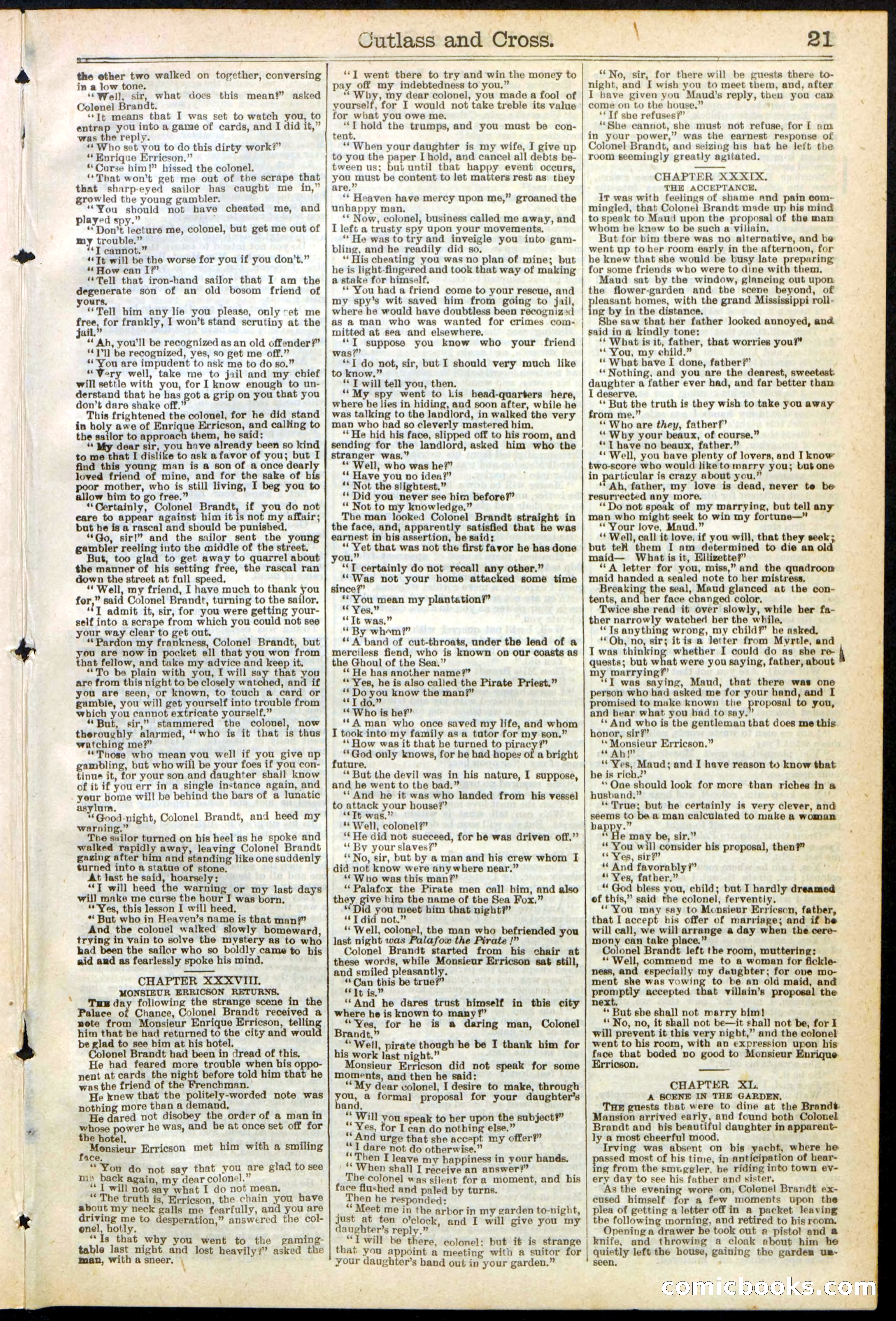
A restored page from Pulp Fiction, 1883. Page through the whole issue in the reader above.
📄 Transcribed text from this page (OCR, searchable)
Machine-transcribed from the original scan — historical spelling and the odd misread are preserved.
“a 0 SS the ether two walked on together, conversing in a low tone. ‘©Well, sir, what does this mean?’ asked Colenel Brandt. ‘*It means that I was set to watch you, to entrap you into a game of cards, and I did it,” was the reply. ‘*Who set you to do this dirty work?” “Enrique Erricson.” *Carse him!” hissed the colonel. “That won't get me out of the scrape that that sharp-eyed sailor bas caught me in,” growled the young gambler. ‘You should not have cheated me, and played spy.” ' ‘Don’t lecture me, colonel, but get me out of my trouble.” ‘I cannot.” ‘‘Tt will be the worse for you if you don’t.” “ How can I?” ‘*Tell that iron-hand sailor that I am the degenerate son of an old bosom friend of yours, ‘Tell him any lie you please, only -et me free, for frankly, I won’t stand scrutiny at the ail.” ; “* Ah, you'll be recognized as an old offender?” **1"l] be recognized, yes, so get me off.” “You are impudent to ask me to do so.” “WYory well, take me to jail and my chief will settle with you, for I know enough to un- derstand that he bas got a grip on you that you don’t dare shake off.’ This frightened the colonel, for he did stand in holy awe of Enrique Erricson, and calling to the saiton to approach them, he said: “ My dear sir, you have already been so kind to me that I dislike to ask afavor of you; but I find this young man is a son of a once dear! loved friend of mine, and for the sake of b poor mother, who is still living, I beg you to allow him to go free.” ‘Certainly, Colonel Brandt, if you do not eare to appear against him it is not my affair; but he is a rascal and should be punished, ‘Go, sir!” and the sailor sent the young gambler reeling into the middle of the street. But, too glad to get away to quarrel about the manner of his setting free, the rascal ran down the street at full speed. “Well, my friend, I have much to thank you for,” said Colonel Brandt, turning to the sailor. ‘“‘T admit it, sir, for you were getting your- self into a scrape from which you could not see your way clear to get out. “Pardon my frankness, Colone] Brandt, but you are now in pocket ell that you won from that fellow, and take my advice and keep it. “To be plain with you, I will say that you are from this night to be closely watched, and if you are seen, or known, to touch a card or gamble, you will get yourself into trouble from which you cannot extricate yourself.” “But, sir,” stammered the colonel, now theroughly alarmed, ‘‘who is it that is thus watching me?” ‘Those who mean vou well if you give up gambling, but who will be your foes if you con- tinue it, for your son and daughter shall know of it if you err in a single instance again, and your bome will be behind the bars of a lunatic asylum. “Good-night, Colonel Brandt, and heed my warning.” The sailor turned on his heel as he spoke and walked rapidly away, leaving Colonel Brandt gaging after him and standing like one suddenly turned into a statue of stone. At last he said, hoarsely: “‘T will heed the warning or my last days will make me curse the hour I was born. “Yes, this lesson I will heed. *‘ But who in Heaven’s name is that man?” And the colonel walked slowly bomeward, trying in vain to solve the mystery as to who had been the sailor who so boldly came to his aid and as fearlessly spoke his mind. CHAPTER XXXVITI. MONSIEUR ERRICSON RETURNS, Tus day following the strange scene in the Palace of Chance, Colonel Brandt received a pote from Monsieur Enrique Erricson, ba him that be had returned to the city and woul be glad to see him at his hotel. Colonel Brandt had been in dread of this. He had feared more trouble when his o nent at cards the night before told him that he was the friend of the Frenchman. He knew that the politely-worded note was nothing more than a demand, : He dared not disobey the order of a man in whose power he was, and be at once set off for the hotel. E , : Monsieur Erricson met him with a smiling ace. “You do not say that you are glad to see mio back again, my dear colonel.” * 1 will not say what I do not mean. “ The truth is, Erricson, the chain you have about my neck galls me fearfully, and you are driving me to desperation,” answered the col- onel, hotly. “‘Is that why you went to the gaming- table last night and lost heavily?’ asked the man, with a sneer, | , nt «ts - ; | Cutlass and Cro Ss, ‘*]T went there to try and win the money to pay off my indebtedness to you.” “Why, my dear colonel, you made a fool of yourself, for I would not take treble its value for what you owe me, ‘*T hold the trumps, and you must be con- tent. “When your daughter is my wife, I give up to you the paper I hold, and cancel all debts be- tween us; but until that happy event occurs, you must be content to let matters rest as they are. ‘* Heaven have mercy upon me,” groaned the unbappy man. ‘* Now, colonel, business called me away, and I left a trusty spy upon your movements, “He was totry and inveigle you into gam- bling, and he readily did so. ‘* His cheating you was no plan of mine; but he is light-fingered and took that way of making a stake for himself. ** You had a friend come to your rescue, and my spy’s wit saved him from going to jail, where he would have doubtless been recognized as a man who was wanted for crimes com- mitted at sea and elsewhere, ‘‘T suppose you know who your friend was?” “I do not, sir, but I should very much like to know. ** T will tell you, then. ‘*My spy went to Lis head-quarters here, where he lies in hiding, and soon after, while he was talking to the landlord, in walked the very man who had so cleverly mastered him. ‘“* He hid his face, slipped off to his room, and sending for the landlord, asked him who the stranger was.” ** Well, who was he?” ‘** Have you no idea?” ** Not the slightest.” ‘* Did you never see him before?” ‘** Not to my knowledge.” Tbe man looked Colonel Brandt straight in the face, and, certo satisfied that he was earnest in his assertion, be said: . Yet that was not the first favor he has done ou. ‘“*T certainly do not recall any other.” ‘““Was not your home attacked some time since?” ** You mean my plantation?’ a“ Yes.” “Tt was,” “By whom?” ** A band of cut-throats, under the lead of a merciless fiend, who is known on our coasts as the Ghoul of the Sea,” ** He has another name?” ‘* Yes, he is also called the Pirate Priest.” **Do you know the man?” “Tt do” ** Who is he?’ ‘*A man who once saved my life, and whom I took into my family as a tator for my son.” ‘*How was it that be turned to piracy?” “*God only knows, for he had hopeg of a bright future. ‘“* But the devil was in his nature, I suppose, and he went to the bad.” ‘*And he it was who landed from his vessel to attack your house?” ‘*Tt was.” ** Well, colonel?” ‘* He did not sueceed, for he was driven off,’ ““ By your slaves?” ‘* No, sir, but by a man and his crew whom I did not know were any where near.” “Who was this man?” “‘Palafox the Pirate men call bim, and also they give him the name of the Sea Fox.” “Did you meet him that night?’ ‘*T did not.” * Well, pps the man who befriended you last night was Palafow the Pirate !” Colonel Brandt started from his chair at these words, while Monsieur Erricson sat still, and smiled pleasantly. ‘‘Can this be true?” oe ea ‘‘And he dares trust himself in this city where he is known to manyf”’ “Yes, for he is a daring man, Colonel Brandt,” “Well, pirate though he be I thank him for his work last night.” Monsieur Erricson did not speak for some moments, and then he said: “My dear colonel, I desire to make, through you, a formal proposal for your daughter’s and, ** Will you speak to her upon the subject?” We Yes, for I Ae do nothing else.” a And urge that she accept my offer?” rs I dare not do otherwise.” ~ Then I leave my happiness in your bands. When shall I receive an answer?” The colonel was silent for a moment, and his face flushed and paled by turns. Then he responded: _ “ Meet me in the arbor in my garden to-night, Just at ten o’clock, and I will give you my daughter’s reply.” “I will be there, colonel: but it is strange that you appoint a meeting with a suitor for your daughter’s band out in your garden.” — Opening a drawer he took out a pistol and a | \ 21 ‘No, sir, for there will be guests there to- night, and [ wish you to meet them, and, after I have given you Maud’s reply, then you can come on to the house.” ‘* If she refuses?” “She cannot, sbe must not refuse, for [ am in your power,” was the earnest response of Colonel Brandt, and seizing his hat he left the room seemingly greatly agitated. CHAPTER XXXIX, THE ACCEPTANCE. if was with feelings of shame and pain com- mingled, that Colonel Brandt made up his mind to speak to Maud upon the proposal of the mam whom he knew to be such a villain. But for bim tbere was no alternative, and he went up toher room early in the afternoon, for he knew that she would be busy late preparing for some friends who were to dine with them, Maud sat by the window, glancing out upon the flower-garden and the scene beyond, of »leasant homes, with the grand Mississippi roll- ing by in the distance, She saw that her father looked annoyed, and said in a kindly tone: ‘* What is it, father, that worries youl ** You, my child.” ‘* What bave I done, father?” ‘Nothing, and you are the dearest, sweetest daughter a father ever had, and far better tham I deserve, ‘** But the truth is they wish to take you away from me.” ** Who are they, fatherf’ “Why your beaux, of course.” **L have no beaux, father.” “ Well, you have fae of lovers, and I know two-score who would like to marry you; but one in particular is crazy about you.’ ‘* Ah, father, my love is dead, never te be resurrected any more. “Do not speak of my marrying, but tell any man who might seek to win my fortune—” “Your love, Maud.” ** Well, call it love, if you will, that they seek; but ted them I am determined to die an old maid— What is it, Ellizette?” ‘A letter for you, miss,” and the quadroom maid handed a sealed note to ber mistress, tgp ey seal, Maud glanced at the con- tents, and ber face changed color. Twice she read it over slowly, while her fa- ther narrowly watched ber the while, “Is anything wrong, my child?” he asked, ‘Oh, no, sir; itis a Jetter from Myrtle, and T was ne whether I could do as she re- quests; but what were you saying, father, about my marrying?’ ‘*T was saying, Maud, that there was one person who had asked me for your band, and I promised to make known thie proposal to you, and bear what you had to say.” ‘‘ And who is the gentleman that does me this honor, sir?” ‘*Monsieur Erricson.” “a Ab ha ‘* Yes, Maud; and I have reason t) know that he is rich.’ ‘**One should look for more than riches in a husband.” ' ‘* True; but he certainly is very clever, and seems to be a man calculated to make a woman bappy.” ** He may be, sir.” ‘You will consider bis proposal, then?” ‘* Yes, sir?” ** And favorably?” * Yes, father.” “ God bless you, cbild; but I hardly dreamed of this,” said the colonel, fervently. ‘*'You may say to Monsieur Erricson, father, that I accept his offer of marriage; and will call, we will arrange a day when the cere- mony can take | rear: * Colonel Brandt left the room, muttering: ‘Well, commend me to a woman for fickle- ness, and especially my daughter; for ove mo- ment she was vowing to be an old maid, and promptly accepted that villain’s proposal the next. “ But she shall not marry bim! ‘No, no, it shall not be—it shall not be, for I will prevent it this very nigbt,” and the Se ie rique went to his room, with an expression u face that boded no good to Monsieur cson,. CHAPTER XL. A SCENE IN THE GARDEN, Tre guests that were to dine at the Brandt Mansion arrived early, and found both Colonel Brandt and his beautiful daughter in apparent- ly a most cheerful mood, Irving was absent on bis yacht, where he ssed most of his time, in anticipation of bear- ing from the smuggler, he riding into town ev- ery day to see his father and sister. As the evening wore on, Colonel Brandt ex- cused himself for a few moments upon the plea of getting a letter off in a packet leaving the following morning, and retired to his room, knife, and throwing a cloak about him quietly left the house, gaining the gardem um- seen. ‘ Gomicboo (C S) - com