
Pulp Fiction, 1883 · page 20 of 24
Beadle's New York Dime Library, No. 259 — page 20: what you’re looking at
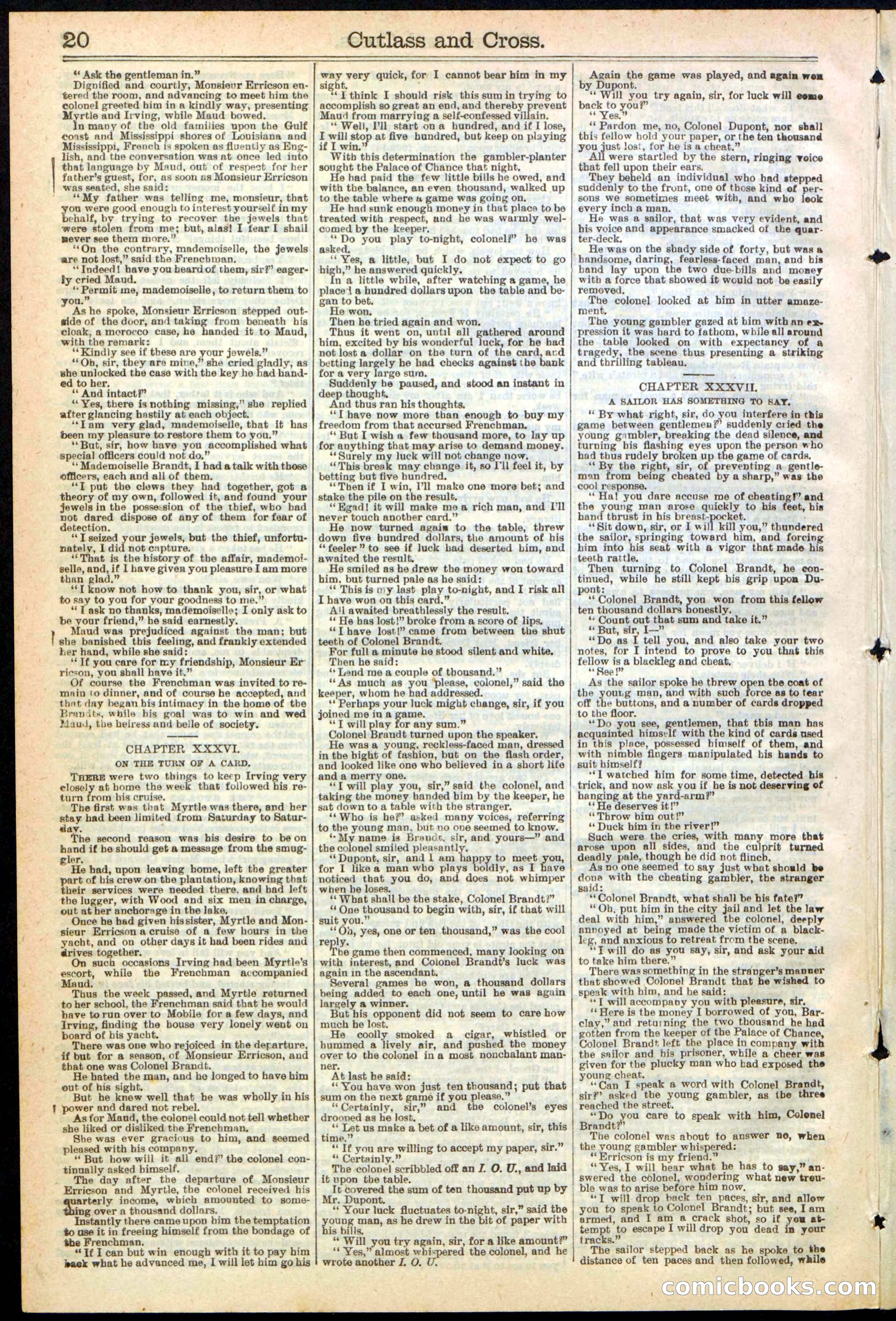
A restored page from Pulp Fiction, 1883. Page through the whole issue in the reader above.
📄 Transcribed text from this page (OCR, searchable)
Machine-transcribed from the original scan — historical spelling and the odd misread are preserved.
—- if but for a season, of 20 . Cutlass and Cross. “ Ask the gentleman in.” Dignified and courtly, Monsieur Erricson en- tered the room, and advancing to meet him the colonel greeted him in a kindly way, presenting Myrtle and Irving, while Maud bowed. nmaoy of the old families upon the Gulf coast and Mississippi shores of Louisiana and Mississippi, French is spoken as fluently as Eng- lish, and the conversation was at once led into that language by Maud, out of respect for her father’s guest, for, as soon as Monsieur Erricson was seated, she said: “My father was telling me, monsieur, that a were good enough to interest yourself inmy ehalf, by trying to recover the jewels that were stolen from me; but, alas! I fear I shall mever see them more.” “On the contrary, mademoiselle, the jewels are not lost,” said the Frenchman. ‘**Indeed! have you beard of them, sir?’ eager- ly cried Maud. is Permit ine, mademoiselle, to return them to ou. "; As he spoke, Monsieur Erricson stepped out- wide of the door, and a7 | from beneath his cloak, a merocco case, he handed it to Maud, with the remark: ‘Kindly see if these are your jewels.” **Oh, sir, they are mine,” she cried gladly, as she unlocked the case with the key he had hand- ed to her. ** And intact?” “Yes, there is nothing missing,” she replied after glancing hastily at each object. ‘*Tam very glad, mademoiselle, that it has been my pleasure to restore them to you.” ** But, sir, how have you accomplished what special officers could not do,” ‘* Mademoiselle Brandt, I had a talk with those officers, each and alli of them. “T put the clews they had together, got a theory of my own, followed it, and found your jewels in the possession of the thief, who bad not dared dispose of any of them for fear of detection. “T seized Doped jewels, but the thief, unfortu- nately, I did not capture. ‘‘That is the history of the affair, mademoi- selle, and, if I have given you pleasure I am more than glad.” **T know not how to thank you, sir, or what to say to you for your goodness to me.” “Task no thanks, mademoiselle; I only ask to be your friend,” he said earnestly. Maud was prejudiced against the man; but she banished this feeling, and frankly extended her hand, while she said: ‘If you care for my friendship, Monsieur Er ricson, you shall have it.” f course the Frenchman was invited to re- main \o dinner, and of course he accepted, and that day began bis intimacy in the home of the Brandts, while bis goal was to win and wed Maud, the heiress and belle of society. CHAPTER XXXVI. ON THE TURN OF A CARD, THERE were two things to keep Irving very closely at home the week that followed his re- turn from his cruise. The first wes that Myrtle was there, and her stay had been limited from Saturday to Satur- day. The second reason was his desire to be on — if he should get a message from the smug- er. He had, upon leaving home, left the greater t of bis crew on the plantation, knowing that heir services were needed there, and bad left the lugger, with Wood and six men in charge, out at ber anchorage in the lake, Once he had given hissister, Myrtle and Mon- sieur Erricson a cruise of a few hours in the yacht, and on other days it had been rides and drives together. On such occasions Irving had been Myrtle’s escort, while the Frenchman accompanied ud, © Thus the week passed, and Myrtle returned to her school, the Frenchman said that he would have torun over to Mobile for a few days, and Irving, finding the bouse very lonely went on board of his yacht. There was one who rig “pee in the departure, onsieur Erricson, and that one was Colonel Brandt. He bated the man, and he longed to have him out of his sight. But he knew well that be was wholly in his } power and dared not rebel. As for Mand, the colonel could not tell whether she liked or disliked the Frenchman. She was ever gracious to him, and seemed pleased with his company. ‘* But bow will it all end?’ the colonel con- tinually asked bimself. The day after the departure of Monsieur Erricson and Myrtle, the colonel received his rterly income, which amounted to some- ng over a thousand dollars. Instantly there came upon bim the temptation to use it in freeing himself from the bondage of the Frenchman. m3 , “Tf I can but win enough with it to pay him jpaex what he advanced me, I will let him go his weed very quick, for I cannot bear him in my sight, ’ ‘““} think I should risk this sumin trying to accomplish so great an end, and thereby prevent Maud from marrying a self-confessed villain. “* Well, Pll start on a hundred, and if I lose, I will stop at five hundred, but keep on playing if I win.’ With this determination the gambler-planter sought the Palace of Chance that night, He had paid the few little bills he owed, and with the balance, an even thousand, walked up to the table where & game was going on. He had sunk enough money in that place to be treated with respect, and he was warmly wel- comed by the keeper. ‘**Do you play to-night, colonel?’ he was asked. ‘* Yes, a little, buf I do not expect to go high,” he answered guickly. n a little while, after watching a game, he place’ a hundred dollars upon the table and be- gan to bet. He won, Then he tried again and won. Thus it went on, until all gathered around him, excited by bis wonderful luck, for he had not lost a dollar on the turn of the card, ard betting largely he had checks against ihe bank for a very large suro, Suddenly be paused, and stood an instant in deep thoughf, And thus ran his thoughts. ‘*T have now more than enough to buy my freedom from that accursed Frenchman. ‘** But I wish a few thousand more, to lay up for anything that may arise to demand money. **Surely my luck will not change now. “This break may change it, so I'll feel it, by betting but five hundred. “Then if I win, lll make one more bet; and stake the pile on the result, “Hgad! it will make mea rich map, and [ll never touch another card.” He now turned again to the table, threw down five bundred dollars, the amount of his ‘*feeler” to see if luck bad deserted bim, and awaited the result. He smiled as he drew the money won toward him, but turned pale as he said: “* This is my last play to-night, and I risk all I have won on this card.” A'l awaited breathlessly the result. ** He has lost!” broke from a score of lips, ‘*T have lost!” came from between the shut teeth of Colonel Brandt. For full a minute he stood silent and white. Then he said: ‘* Lend me a couple of thousand.” **As much as you ‘please, colonel,” said the keeper, whom he had addressed. ‘* Perhaps your luck might change, sir, if you joined me in a game. “T will es or any sum.” Colonel Brandt turned upon the speaker, He was a young, reckless-faced man, dressed in the bight of fashion, but on the flash order, and looked like one who believed in a short life and a merry one. ‘‘T will play you, sir,” said the colonel, and taking the money handed him by the keeper, he sat down to a table with the stranger. ‘* Who is he?’ asked many voices, referring to the young man, but no one seemed to know. ‘* My name is Brands, sir, and yours—” and the colonel smiled pleasantly. ‘* Dupont, sir, and 1 am happy to meet you, for I like a man who plays dly, as I have noticed that you do, and does not whimper when he loses. ‘* What shall be the stake, Colonel Brandt?” **‘ One thousand to begin with, sir, if that will suit you.” ‘Oh, yes, one or ten thousand,” was the cool a : he game then commenced, many looking on with interest, and Colonel Brandt’s luck was again in the ascendant. Several games he won, a thousand dollars being added to each one, until he was again largely a winner. But his opponent did not seem to care how much he lost. He coolly smoked a _ cigar, whistled or hummed a lively air, and pushed the money over to the colonel in a most nonchalant man- ner. At last he said: ‘* You have won just ten thousand; put that sum on the next gameé if you please.” Certainly, sir,” and the colonel’s eyes drooved as he lost, i ‘‘ Let us make a bet of a like amount, sir, this time,” : ‘Tf you are willing to accept my paper, sir.” * Certainly.” The colonel scribbled off an I. O. U., and laid if upon the table. It covered the sum of ten thousand put up by Mr. Dupont. 2 ee rn oo ae ——— I A a a a Sa Se SR ‘* Your luck fluctuates to-night, sir,” said the | young man, as he drew in the bit of paper with | is bills, * Will you try again, sir, for a like amount?” ** Yes,” almost pepened the colonel, and he wrote another J, O, U. Again the game was played, and again won by Dupont. ** Will you try again, sir, for luck will eeme back to you?” sé Yes.” ** Pardon me, no, Colonel Dupont, nor shall this fellow hold your paper, or the ten thousand you just lost, for he is a cheat.” All were startled by the stern, ringing voice that fell upon their ears. They beheld an individual who bad stepped suddenly to the front, one of those kind of per- sons we sometimes meet with, and who leok every inch a man. He was a sailor, that was very evident, and bis voice and appearance smacked of the quar- ter-deck. He was on the shady side of forty, but was a handsome, daring, fearless-faced man, and his hand lay upon the two due-bills and money with a force that showed it would not be easily removed, ay colonel looked at bim in utter amaze- ment. The young gambler gazed at him with an ex pression it was hard to fathom, while all around the table looked on with expectancy of a tragedy, the scene thus presenting a striking and thrilling tableau. CHAPTER XXXVIL A SAILOR HAS SOMETHING TO SAY. * By what right, sir, do you interfere in this game between gentlemen?’ suddenly cried the young gambler, breaking the dead silence, and turning his flashing eyes upon the person who had thus rudely broken up the game of cards. ‘* By the right, sir, of Drevensing a gentle- men from being cheated by a sharp,” was the cool response, ‘“Hal you dare accuse me of cheating?!’ and the young man arose quickly to his feet, his hand tbrust in bis bressiyecaer: “Sit down, sir, or I will kill you,” thundered the sailor, springing toward him, and forcing him into his seat with a vigor that made his teeth rattle, Then turning to Colonel Brandt, he eon- tinued, while he still kept his grip upom Du- t: pont: ‘* Colonel Brandt, you won from this fellow ten thousand dollars honestly. * Count out that sum and take it.” “ But, sir, I—” ‘“Do as I tell you, and also take your two notes, for I intend to prove to you that this fellow is a blackleg and cheat, iT) See ” As the sailor spoke he threw open the coat of the young man, and with such force as to tear off the buttons, and a number of cards dropped to the floor. “Do you see, gentlemen, that this man has acquainted himself with the kind of cards used in this place, possessed himself of them, and with nimble fingers manipulated his hands to suit himself? ‘*T watched him for some time, detected his trick, and now ask you if he is not deserving of hanging at the yard-arm?”’ ‘* He deserves it!” “Throw him out!” ‘* Duck him in the river!” Such were the cries, with many more that arose upon all sides, and the culprit turned deadly pale, though he did not flineb, As no one seemed to say just what should be pore with the cheating gambler, the stranger said: **Colonel Brandt, what shall be his fate?” “Oh, put bim in the city jail and let the law deal with him,” answered the colonel, deeply annoyed at being made the victim of a black- leg, and anxious to retreat from the scene, “T will do as you say, sir, and ask your aid to take him there.” There was something in the stranger’s manner that showed Colonel Brandt that he wished to speak with him, and he said: “T will accompany you with pleesure, sir, ‘‘ Here is the money I borrowed of yon, Bar- clay,” and returning the two thousand he had gotten from the keeper of the Palace of Chance, Colonel Brandt left the place in company with the sailor and his prisoner, while a cheer was given for the plucky man who had exposed the young cheat. ‘‘Can I speak a word with Colonel Brandt, sir?’ asked the young gambler, as the three reached the street. “Do you care to speak with him, Colenel Brandt?” The colonel was about to answer 10, when the young gambler whispered: **Erricson is my friend.” “Yes, I will hear what he has to gay,” an- swered the colonel, wondering what new treu- ble was to arise before him now, “T will drop back ten paces, sir, and allow you to speak to Colonel Brandt; but see, Iam armed, and I am a crack shot, so if you at- tempt to escape I will drop you dead your tracks.” The sailor stepped back as he spoke to the distance of ten paces and then followed, while | | | | ——— ” x (eCoypayicel eveve) KS com a rs