
Pulp Fiction, 1883 · page 22 of 32
Beadle's Dime Library No. 247 — page 22: what you’re looking at
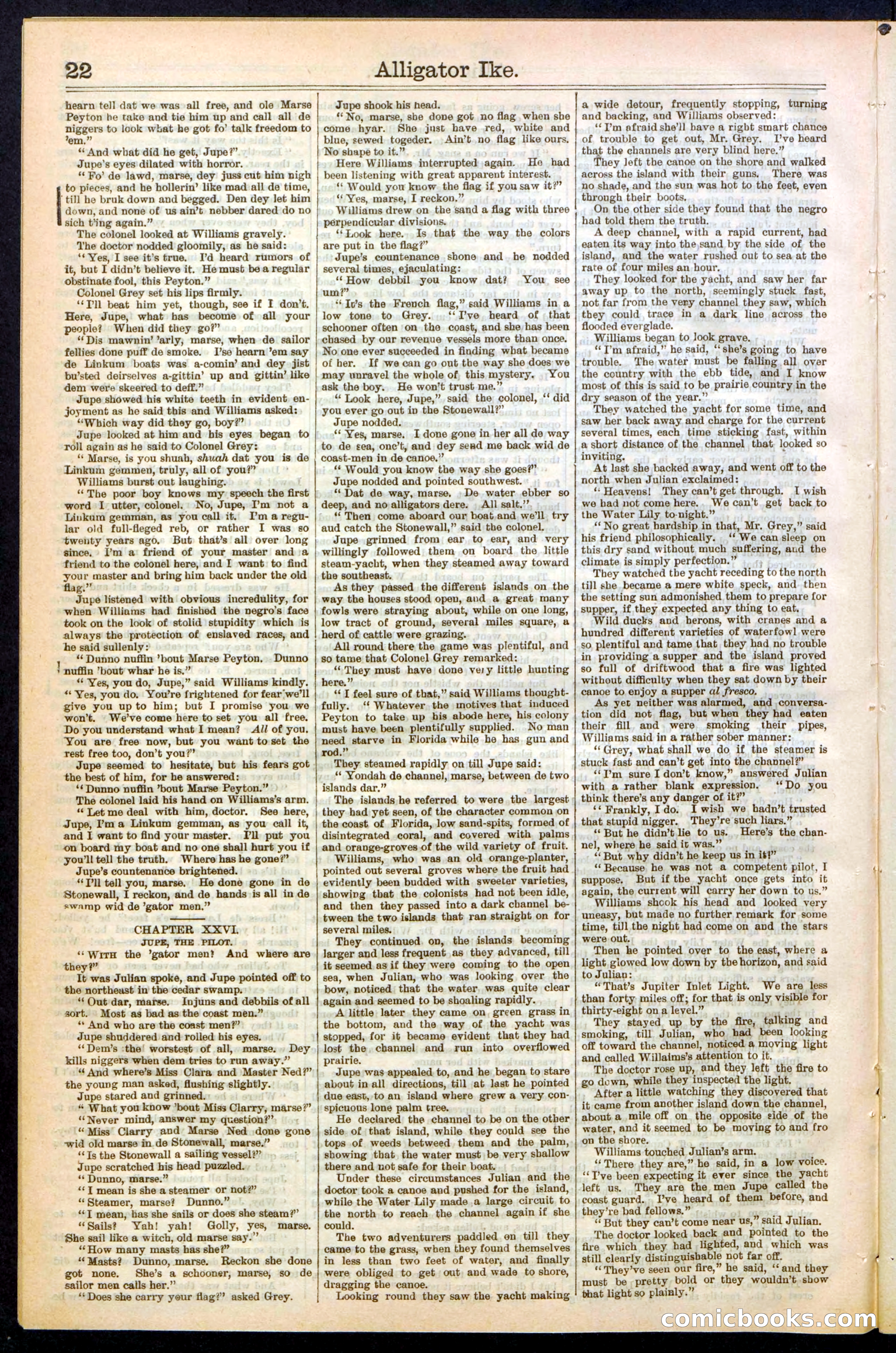
A restored page from Pulp Fiction, 1883. Page through the whole issue in the reader above.
📄 Transcribed text from this page (OCR, searchable)
Machine-transcribed from the original scan — historical spelling and the odd misread are preserved.
= ~_— Pe aed 22 hearn tell dat we was all free, and ole Marse Peyton be take and tie him up and call all de niggers to look what he got fo’ talk freedom to em.” * And what did he get, Jupe?” Jupe's eyes dilated with horror. ‘Fo’ de lawd, marse, dey juss cut him nigh till he bruk down and begged. Den dey let him down, and none of us ain’t nebber dared do no sich ting again.” The colonel looked at Williams gravely. The doctor nodded gloomily, as he said: ‘* Yes, I see it’s true. I’d heard rumors of it, but I didn’t believe it. He must bea regular obstinate fool, this Peyton.” Colonel Grey set his lips firmly. ‘“‘Tll beat him yet, though, see if I don’t. Here, Jupe, what has become of all your people? When did they go?” ‘‘Dis mawnin’ ’arly; marse, when de sailor fellies done puff de smoke. I’se hearn ’em say de Linkum boats was a-comin’ and dey jist bu’sted deirselves a-gittin’ up and gittin’ like dem were skeered to deff.” Jupe showed his white teeth in evident en- joyment as he said this and Williams asked: “Which way did they go, boy?” Jupe looked at him and bis eyes began to roll again as he said to Colonel Grey: ‘‘ Marse, is you shuah, shuah dat you is de Linkum gemmen, truly, all of you?” . Williams burst out laughing. ‘“‘The poor boy knows my speech the first word I utter, colonel. No, Jupe, ’m not a Linkam gemman, as you call it. I’m a regu- lar old full-fleged reb, or rather I was so twenty years ago. But that’s all over long since, I’m a friend of your master and a friend to the colonel here, and I want to find your master and bring him back under the old flag.” Jupe listened with obvious incredulity, for when Williams had finished the negro’s face took on the look of stolid stupidity which is always the protection of enslaved races, and he said sullenly: ‘‘ Dunno nuffin ’bout Marse Peyton. nuffin "bout whar he is.” ** Yes, you do, Jupe,” said Williams kindly. ** Yes, you do. You're frightened for fear we'll give you upto him; but I promise you we won't. _We’ve come here to set you all free. Do you understand what I mean? Ali of you. You are free now, but you want to set the rest free too, don’t you?” Jupe seemed to hesitate, but his fears got the best of him, for he answered: ‘¢ Dunno nuffin ’bout Marse Peyton.” The colonel laid his hand on Williams’s arm. ‘¢ Let me deal with him, doctor. See here, Jupe, ’ma Linkum gemman, as you call it, and I want to find your master. TP put you on board my boat and no one shall hurt you if you'll tell the truth. Where has he gone?” Jupe’s countenance brightened. “Tl tell you, marse. He done gone in de Stonewall, I reckon, and de hands is all in de swamp wid de ’gator men.” | to pieces, and he hollerin’ like mad all de time, Dunno CHAPTER XXXVI. JUPE, THE PILOT. ‘‘Wirn the ’gator men? And where are they?” It was Julian spoke, and Jupe pointed off to the northeast in the cedar swamp. ‘Out dar, marse. Injuns and debbils of all sort. Most as bad as the coast men.” ** And who are the coast men?” Jupe shuddered and rolled his eyes. ‘*Dem’s :the’ worstest of all, marse. Dey kills niggers when dem tries to run away.” “ And where’s Miss Clara and Master Ned?’ the young man asked, flushing slightly. Jupe stared and grinned. “ What you know ’bout Miss Clarry, marse?”’ ‘Never mind, answer my question?’ “ Miss’ Clarry and Marse Ned done gone _ wid old marse in. de Stonewall, marse.” ‘Ts the Stonewall a sailing vessel?’ Jupe scratched his head puzzled. ‘* Dunno, marse.” ‘TI mean is she a steamer or not?” “Steamer, marse? Dunno.” ‘‘T mean, has she sails or does she steam?’ “Sails? Yah! yah! Golly, yes, marse. She sail like a witch, old marse say.” ‘“‘How many masts has she?” ‘Masts? Dunno, marse. Reckon she done got none. She’s a schooner, marse, so de sailor men calls her.” |. **Does she carry your flag?’ asked Grey. Alligator Ike. Jupe shook his head. ‘* No, marse, sbe done got no flag when she come hyar. She just have red, white and blue, sewed togeder. Ain’t no flag like ours. No shape to it.” Here Williams interrupted again. He had been listening with great apparent interest. ‘“ Would you know the flag if you saw it?’ ‘‘ Yes, marse, I reckon.” Williams drew on the sand a flag with three perpendicular divisions. ‘‘Took here. Is that the way the colors are put in the flag?” Jupe’s countenance shone and he nodded several times, ejaculating: ‘How debbil you know dat? um?” ‘‘Iv’s the French flag,” said Williams in a low tone to Grey. ‘‘I’ve heard of that schooner often on the coast, and she has been chased by our revenue vessels more than once. No one ever succeeded in finding what became of her. If wecan go out the way she does we may unravel the whole of this mystery. You ask the boy. He won’t trust me.” “ Look here, Jupe,” said the colonel, ‘‘ did you ever go out iv the Stonewall?” Jupe nodded. ‘‘ Yes, marse. I done gone in her all de way to de sea, one’t, and dey sead me back wid de coast-men in de canoe,” ‘¢ Would you know the way she goes?” Jupe nodded and pointed southwest. ‘Dat de way, marse, De water ebber so deep, and no alligators dere. All salt,’’ ‘* Then come aboard our boat.and we'll try aud catch the Stonewall,” said the colonel. Jupe grinned from ear to ear, and very willingly followed them on board the little steam-yacht, when they steamed away toward the southeast. As they passed the different islands on the way the houses stood open, aud a great many fowls were straying about, while on one long, low tract of ground, several miles square, a herd of cattle were grazing. All round there the game was plentiful, and so tame that Colonel Grey remarked: ‘They must have done very little hunting here.” “ T feel sure of that,” said Williams thougbt- fully. ‘‘ Whatever the motives that induced Peyton to take up bis abode here, his colony must have been plentifully supplied. No man need starve in Florida while be has gun and rod.” They steamed rapidly on till Jupe said: ‘* Yondah de channel, marse, between de two islands dar.” The islands he referred to were the largest they had yet seen, of the character common on the coast. of Florida, low sand-spits, formed of disintegrated coral, and covered with palms and orange-groves of the wild variety of fruit. Williams, who was an old orange-planter, pointed out several groves where the fruit had evidently been budded with sweeter varieties, showing that the colonists had not been idle, and then they passed into a dark channel be- tween the two islands that ran straigbt on for several miles. They continued. on, the islands becoming larger and less frequent as they advanced, till it seemed. as if they were coming to the open sea, when Julian, who was looking over the bow, noticed that the water, was quite clear again and seemed to be shoaling rapidly. A little later they came on, green grass in the bottom, and the way of the yacht was stopped, for it became evident that they had lost the channel and run into overflowed prairie. Jupe was appealed to, and he began to stare about in all directions, till at last he pointed due east, to an island where grew a very con- spicuous lone palm tree, He declared the channel to be on the other side. of that island, while they could see the tops of weeds betweed them and the palm, showing that the water must be very sballow there and not safe for their boat. Under these circumstances Julian and the doctor took a canoe and pushed for the island, while the Water Lily made a large circuit. to the north to reach the channel again if she could. The two adventurers paddled on till they came to the grass, when they found themselves in less than two feet of water, and finally were obliged to get out and wade to shore, dragging the canoe. Looking round they saw the yacht making You see i Se eee eee eee es. _— ——-_-_--_-_—- --->-r——ej__aSS SS — eee OO __- OoOrrOrorOh9He Ore a wide detour, frequently stopping, turning and backing, and Williams observed: ‘‘’'m afraid she'll bave a rigbt smart chance of trouble to get out, Mr. Grey. I’ve heard that the channels are very blind here.” They left the canoe on the shore and walked across the island with their guns, There was no shade, and the sun was hot to the feet, even through their boots, On the other side they found that the negro had told them the truth. A deep channel, with a rapid current, had eaten its way into the,sand by the side of the island, and the water rushed out to sea at the rate of four miles an hour. They looked for the yacht, and saw her far away up to the north, seemingly stuck fast, not far from the very channel they saw, which they could trace in a dark line across the flooded everglade. Williams began to look grave. “T’m afraid,” he said, “she’s going to have trouble. The water must be falling all over the country with the ebb tide, and I know most of this is said to be prairie country in the dry season of the year.” They watched the yacht for some time, and saw her back away and charge for the current several times, each time sticking fast, within a short distance of the channel that looked so inviting. : At last she backed away, and went off to the north when Julian exclaimed: ‘‘ Heavens! They can’t get through. I wish we bad not come here.. We can’t get back to the Water Lily to-night.” ‘‘No great hardship in that, Mr. Grey,” said his friend philosophically. ‘‘ We can sleep on this dry sand without much suffering, aud the climate is simply perfection.” They watched the yacht receding to the north till she became a mere white speck, and then the setting sun admonished them to prepare for supper, if they expected any thing to eat, Wild ducks and herons, with cranes and a hundred different varieties of waterfowl were so. plentiful and tame that they had no trouble in providing a supper and the island proved so full of driftwood that a fire was lighted without difficulty when they sat down by their canoe to enjoy a supper al fresco, As yet neither was alarmed, and conversa- tion did not flag, but when they had eaten their fill and were smoking their pipes, Williams said in a rather sober manner: ‘‘ Grey, what shall we do if the steamer is stuck fast and can’t get into the channel?’ ‘‘7’m sure I don’t know,” answered Julian with a rather blank expression. ‘‘Do you think there’s any danger of it?” ‘¢ Frankly, Ido. I wish we hadn’t trusted that stupid nigger. They’re such liars.” ‘‘ But he didn’t lie to us. Here’s the chan- nel, where he said it was.” ‘‘But why didn’t he keep us in it?” ‘‘ Because he was not a competent pilot, I suppose, But if the yacht once gets into it again, the current will carry her down to us.” Williams shook his head and looked very uneasy, but made no further remark for some time, tiJl the night had come on and the stars were out. Then he pointed over to the east, where a light glowed low down by the horizon, and said to Julian: “That’s Jupiter Inlet Light. We are less than forty miles off; for that is only visible for thirty-eight on a level.” They stayed up by the fire, talking and smoking, till Julian, who had been looking off toward the channel, noticed a moving light and called Willaims’s attention to it, The doctor rose up, and they left the fire to go down, while they inspected the light, After a little watching they discovered that it came from another island down the channel, about a mile off on the opposite side of the water, and it seemed to be moving to and fro on the shore. Williams touched Julian’s arm, ‘There they are,” he said, in a low voice. ‘‘Tve been expecting it ever since the yacht left us. They are the men Jupe called the coast guard. I’ve heard of them before, and they’re bad fellows.” : ‘But they can’t come near us,” said Julian. The doctor looked back and pointed to the fire which they had lighted, and which was still clearly distinguishable not far off. “'They’ve seen our fire,” he said, ‘‘ and they must be pretty bold or they wouldn’t show phat light so plainly.” GoOmichboo (E S) (E | s= tis -