
Pulp Fiction, 1883 · page 21 of 32
Beadle's Dime Library No. 247 — page 21: what you’re looking at
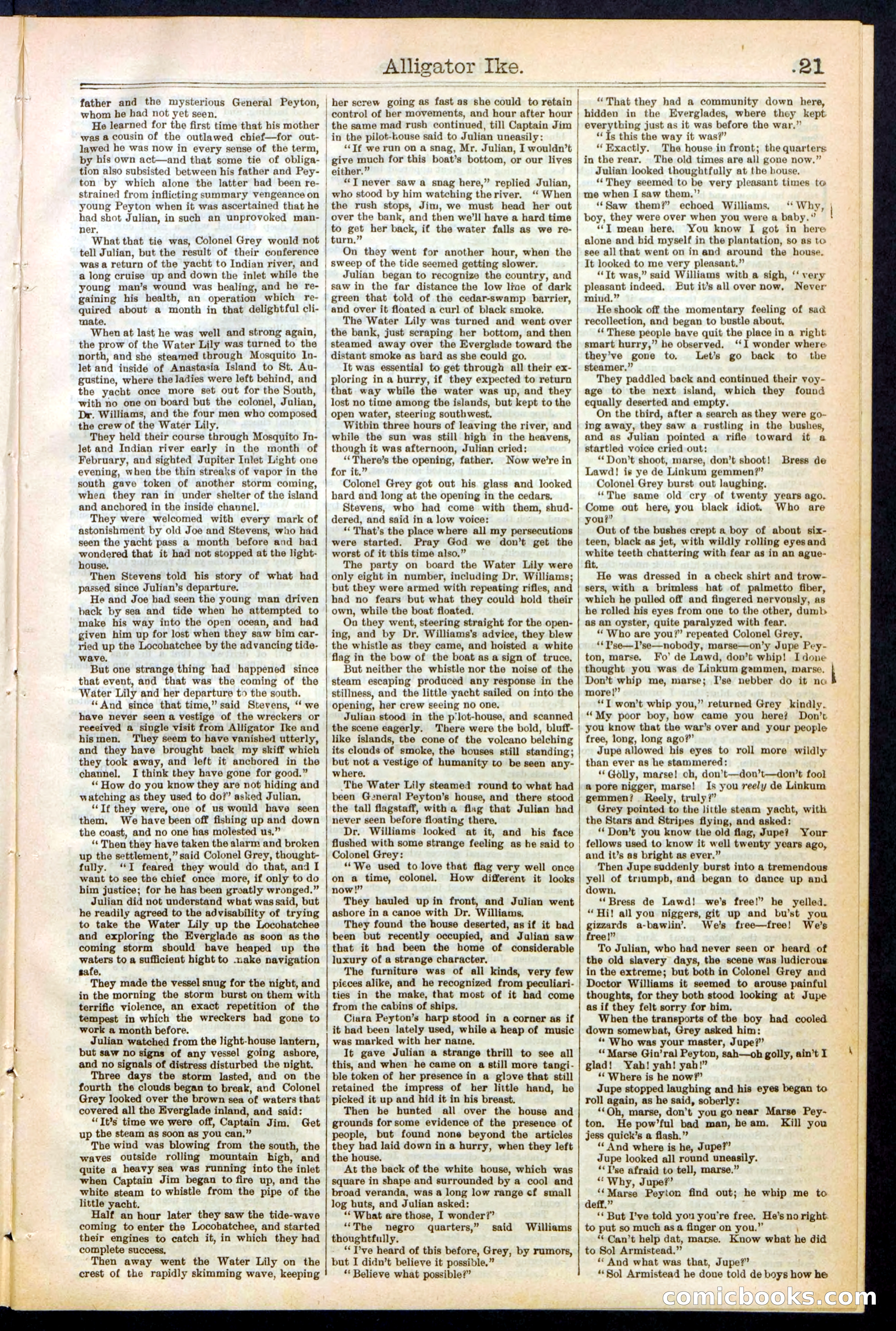
A restored page from Pulp Fiction, 1883. Page through the whole issue in the reader above.
📄 Transcribed text from this page (OCR, searchable)
Machine-transcribed from the original scan — historical spelling and the odd misread are preserved.
? —_ ————— oa . a (rr tl — —— father and the mysterious General Peyton, whom he had not yet seen. He learned for the first time that his mother was a cousin of the outlawed chief—for out- lawed he was now in every sense of the term, | by his own act—and that some tie of obliga- tion also subsisted between his father and Pey- ton by which alone the latter had been re- strained from inflicting summary vengeance on young Peyton when it was ascertained that he had shot Julian, in such an unprovoked man- ner. What that tie was, Colonel Grey would not tell Julian, but the result of their conference was a return of the yacht to Indian river, and a long cruise up and down the inlet while the young man’s wound was healing, and he re- gaining his health, an operation which re- quired about a month in that delightful cli- mate. When at last he was well and strong again, the prow of the Water Lily was turned to the north, and she steamed through Mosquito In- let and inside of Anastasia Island to St, Au- gustine, where the ladies were left behind, and the yacht once more set out for the South, with no one on board but the colonel, Julian, Dr. Williams, and the four men who composed the crew of the Water Lily. They held their course through Mosquito In- Jet and Indian river early in the month of February, and sighted Jupiter Inlet Light one evening, when the thin streaks of vapor in the south gave token of another storm coming, when they ran in under shelter of the island and anchored in the inside channel. They were welcomed with every mark of astonishment by old Joe and Stevens, who had seen the yacht pass a month before and bad wondered that it had not stopped at the light- house. Then Stevens told his story of what had passed since Julian’s departure. He and Joe had seen the young man driven back by sea and tide when he attempted to make his way into the open ocean, and had given him up for lost when they saw bim car- ried up the Locohatchee by the advancing tide- wave. But one strange thing had happened since that event, and that was the coming of the Water Lily and her departure to the south. ‘“‘And since that time,” said Stevens, “ we have never seen a vestige of the wreckers or reeeived a single visit from Alligator Ike and hismen. They seem to have vanished utterly, and they have brought back my skiff which they took away, and left it anchored in the channel. I think they have gone for good.” ‘‘ How do you know they are not hiding and watching as they used to do?” asked Julian, “Tf they were, one of us would have seen them, We have been off fishing up and down the coast, and no one has molested us.” ‘‘ Then they have taken the alarm and broken up the settlement,” said Colonel Grey, thought- fully. “I feared they would do that, and I want to see the chief once more, if only to do him justice; for he has been groatly wronged.” Julian did not understand what was said, but he readily agreed to the advisability of trying to take the Water Lily up the Locohatchee and exploring the Everglade as soon as the coming storm sbould have heaped up the waters to a sufficient hight to nake navigation safe. They made the vessel snug for the night, and in the morning the storm burst on them with terrific violence, an exact repetition of the tempest in which the wreckers bad gone to work a month before. Julian watched from the light-house lantern, but saw no signs of any vessel going ashore, and no signals of distress disturbed the night. Three days the storm lasted, and on the fourth the clouds began to break, and Colonel Grey looked over the brown sea of waters that covered all the Everglade inland, and said: “It’s time we were off, Captain Jim. up the steam as soon as you can,” The wind was blowing from the south, the waves outside rolling mountain high, and quite a heavy sea was running into the inlet when Captain Jim began to fire up, and the white steam to whistle from the pipe of the little yacht. Half an hour later they saw the tide-wave coming to enter the Locohatchee, and started their engines to catch it, in which they had complete success, Then away went the Water Lily on the crest of the rapidly skimming wave, keeping Get | On they went, steering straight for the open- ing, and by Dr. Williams’s advice, they blew Alligator Ike. a ——- —- her screw going as fast as she could to retain control of her movements, and hour after hour the same mad rush continued, till Captain Jim | in the pilot-house said to Julian uneasily: “Tf we run on a snag, Mr. Julian, I wouldn’t | give much for this boat’s bottom, or our lives either.” | “TT never saw a snag here,” replied Julian, | who stood by him watching theriver. ‘‘ When _the rush stops, Jim, we must head her out over the bank, and then we'll have a hard time to get her back, if the water falls as we re- turn.” On they went for another hour, when the sweep of the tide seemed getting slower. Julian began to recognize the country, and saw in the far distance the low line of dark green that told of the cedar-swamp barrier, and over it floated a curl of black smoke. The Water Lily was turned and went over the bank, just scraping her bottom, and then steamed away over the Everglade toward the distant smoke as bard as she could go. It was essential to get through all their ex- ploring in a hurry, if they expected to return that way while the water was up, and they lost no time among the islands, but kept to the open water, steering southwest, Within three hours of leaving the river, and while the sun was still high in the heavens, though it was afternoon, Julian cried: ‘*There’s the opening, father. Now we're in for it.” Colonel Grey got out his glass and looked bard and long at the opening in the cedars. Stevens, who had come with them, shud- dered, and said in a low voice: ‘‘ That’s the place where all my persecutions were started. Pray God we don’t get the worst of it this time also.” The party on board the Water Lily were only eight in number, including Dr, Williams; but they were armed with repeating rifles, and had no fears but what they could hold their own, while the boat floated. the whistle as they came, and hoisted a white flag in the bow of the boat as a sign of truce, But neither the whistle nor the noise of the steam escaping produced any response in the stillness, and the little yacht sailed on into the opening, her crew seeing no one, Julian stood in the p'lot-house, and scanned the scene eagerly. There were the bold, bluff- like islands, the cone of the volcano belching its clouds of smoke, the houses still standing; but not a vestige of humanity to be seen any- where. The Water Lily steamed round to what had been General Peyton’s house, and there stood the tall flagstaff, with a flag that Julian had never seen before floating there, Dr. Williams looked at it, and his face flushed with some strange feeling as he said to Colonel Grey: ‘We used to love that flag very well once on a time, colonel. now!” They hauled upin front, and Julian went ashore in a canoe with Dr. Williams, They found the house deserted, as if it had been but recently occupied, and Julian saw that it bad been the home of considerable luxury of a strange character. The furniture was of all kinds, very few pieces alike, and he recognized from peculiari- ties in the make, that most of it had come from the cabins of ships. Ciara Peyton’s harp stood in a corner as if it had been lately used, while a heap of music was marked with her narne. It gave Julian a strange thrill to see all this, and when he came on a still more tangi- ble token of her presence in a glove that still retained the impress of her little hand, he picked it up and hid it in his breast. Then be bunted all over the house and grounds forsome evidence of the presence of people, but found none beyond the articles they had laid down in a hurry, when they left the house. At the back of the white house, which was square in shape and surrounded by a cool and broad veranda, was a long low range cf small log huts, and Julian asked: ‘What are those, I wonder?” “The negro quarters,” thoughtfully. “ve heard of this before, Grey, by rumors, but I didn’t believe it possible,” ‘* Believe what possible?” How different it looks said Williams ————— Tres Te cs ee — Ee a : -21 ee ae — — oe oe) ee “That they had a community down here, hidden in the Everglades, where they kept everything just as it was before the war.” “Ts this the way it was?’ ‘‘ Exactly. The house in front; the quarters in the rear. The old times are all gone now.” Julian looked thoughtfully at the bouse, ‘‘They seemed to be very pleasant times to me when I saw them.” ‘‘Saw them?’ echoed Williams. ‘ Why, boy, they were over when you were a baby.” ‘‘T mean here. You know I got in here alone and bid myself in the plantation, so as to see all that went on in and around the house. It looked to me very pleasant.” “Tt was,” said Williams witb a sigh, “‘ very pleasant indeed. Eut it’s all over now, Never mind.” He shook off the momentary feeling of sad recollection, and began to bustle about. ‘* These people bave quit the place in a right smart hurry,” he observed. ‘I wonder where they’ve gone to, Let’s go back to the steamer.” They paddled back and continued their voy- age to the next island, which they found equally deserted and empty. On the third, after a search as they were go- ing away, they saw a rustling in the bushes, and as Julian pointed a rifle toward it a startled voice cried out: ** Don’t shoot, marse, don’t shoot! Lawd! is ye de Linkum gemmen?” Colonel Grey burst out laughing. “The same old cry of twenty years ago. Come out here, you black idiot. Who are you?” Out of the bushes crept a boy of about six- teen, black as jet, with wildly rolling eyesand white teeth chattering with fear as in an ague- fit. He was dressed in a check shirt and trow- sers, with a brimless hat of palmetto fiber, which he pulled off and fingered nervously, as he rolled his eyes from one to the other, dumb as an oyster, quite paralyzed with fear. “Who are you?” repeated Colonel Grey, ‘* se—T’se—nobody, marse—on’y Jupe Pey- ton, marse. Fo’ de Lawd, don’t whip! I done thought you was de Linkum gemmen, marse, Don’t whip me, marse; I’se nebber do it no more!” ““T won’t whip you,” returned Grey kindly. “My poor boy, how came you here? Don’t you know that the war’s over and your people free, long, long ago?” Jupe allowed his eyes to roll more wildly than ever as he stammered: ‘‘Golly, marse! oh, don’t—don’t—don’t fool a pore nigger, marse! Is you reely de Linkum gemmen? Reely, truly?’ Grey pointed to the little steam yacht, with the Stars and Stripes flying, and asked: ** Don’t you know the old flag, Jupe? Your fellows used to know it well twenty years ago, and it’s as bright as ever.” Then Jupe suddenly burst into a tremendous yell of triumpb, and began to dance up and down. ‘‘Bress de Lawd! we's free!” he yelled. “Hi! all you niggers, git up and bu’st you gizzards a-bawlin’. We'’s free—free! We’s free!” To Julian, who had never seen or heard of the old slavery days, the scene was ludicrous in the extreme; but both in Colonel Grey and Doctor Williams it seemed to arouse painful thoughts, for they both stood looking at Jupe as if they felt sorry for him. When the transports of the boy had cooled down somewhat, Grey asked him: ** Who was your master, Jupe?” ‘“‘Marse Gin’ral Peyton, sah—oh golly, ain’t I glad! Yah! yah! yah!” ‘* Where is he now?” Jupe stopped laughing and his eyes began to roll again, as he said, soberly: ‘‘Oh, marse, don’t you go near Marse Pey- ton. He pow’ful bad man, he am, Kill you jess quick’s a flash.” ‘“‘ And where is he, Jupe?” Jupe looked all round uneasily. ‘Tse afraid to tell, marse.” “Why, Jupe?’ ‘¢Marse Peyton find out; he whip me to deff.” ‘* But I’ve told you you're free. He’s no right. to put so much as a finger on you.” , ‘* Can’t help dat, marse. Know what he did to Sol Armistead.” ** And what was that, Jupe?’ “Sol Armistead he done told de boys how he COMME TOOLS Bress de —_— com