
Pulp Fiction, 1883 · page 9 of 32
Beadle's New York Dime Library No. 245 — page 9: what you’re looking at
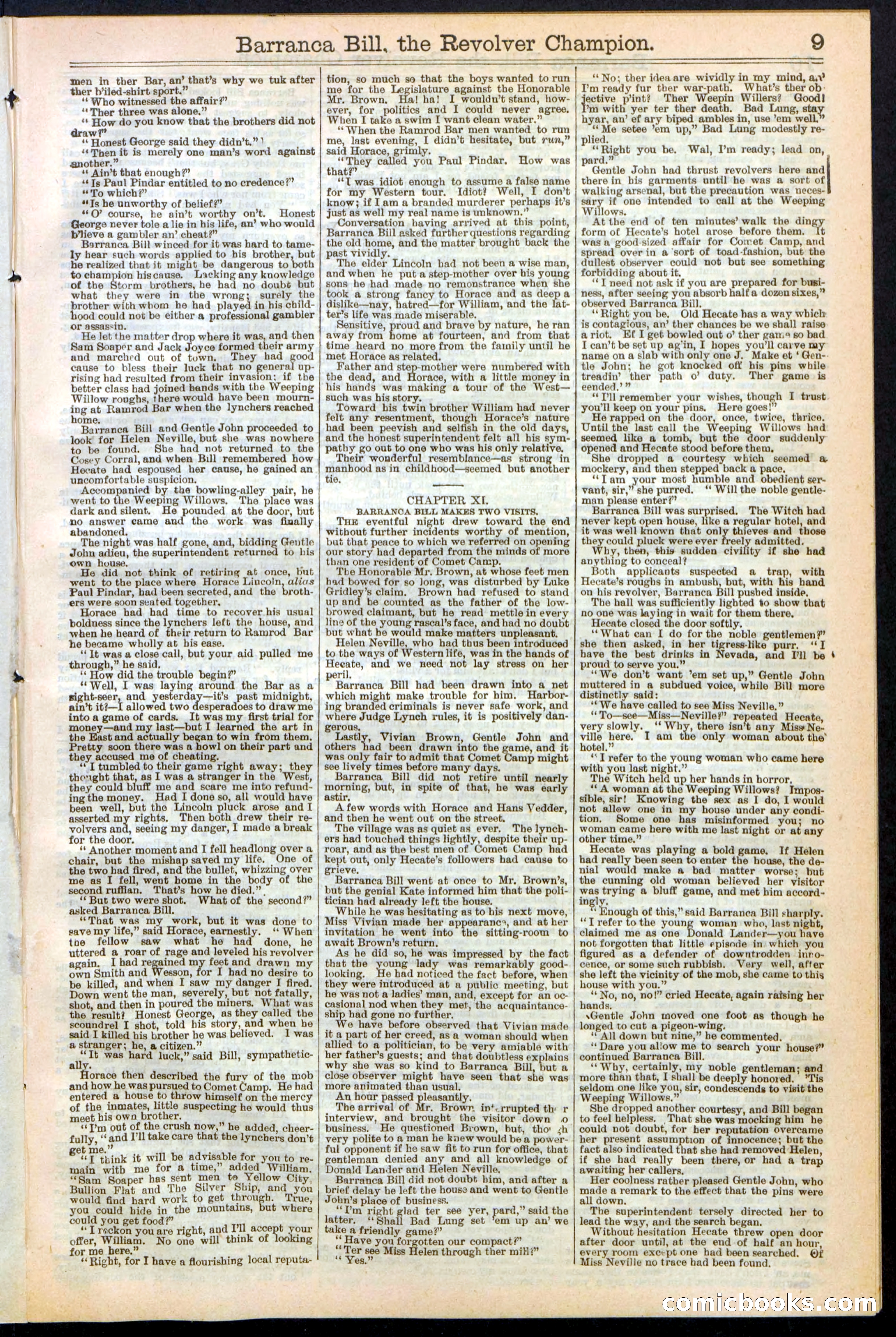
A restored page from Pulp Fiction, 1883. Page through the whole issue in the reader above.
📄 Transcribed text from this page (OCR, searchable)
Machine-transcribed from the original scan — historical spelling and the odd misread are preserved.
SS =>. Pc gc i tal cae ly aig 4 a * ‘és _- ee ee ES men in ther Bar, an’ that’s why we tuk after ther b’iled-shirt sport.” ‘‘ Who witnessed the affair?” “‘Ther three was alone,” ‘* How do you know that the brothers did not we ‘« Honest George said they didn’t.” ) ‘Then it is merely one man’s word against another.” “* Ain’t that enough?” ‘Ts Paul Pindar entitled to no credence?” “To which?” “Ts he unworthy of belief?’ “©” course, he ain’t worthy on’t. Honest George never tole a lie in his life, an’ who would b’lieve a gambler an’ cheat?” Bsrranca Bill winced for it was hard to tame- ly bear such words applied to his brother, bat he realized that it might be dangerous to both to champion hiscause. Lacking any knowledge of the Storm brothers, be had no doubt but what they were in the wrong; surely the brother with whom he had played in his child- hood could not be either a professional gambler or assassin. He let the matter drop where it was, and then Sam Soaper and Jack Joyce formed their ariny and marched out of tuwn, They had good cause to bless their luck that no general up- rising had resulted from their invasion: if the better class had joined hands with the Weeping Willow roughs, there would have been mourn- ing at Ramrod Bar when the lynchers reached home, Beckesind Bill and Gentle John proceeded to look for Helen Neville, but she was nowhere to be found. She had not returned to the Cosey Corral, and when Bill remembered how Hecate had espoused her cause, he gained an uncomfortable suspicion. Accompanied by the bowling-alley pair, he went to the Weeping Willows. The place was dark and silent. He pounded at the door, but mo answer came and the work was finally abandoned. The night was half gone, and, bidding Gentle John adieu, the superintendent returned to his own house, He did not think of retiring at once, but went to the place where Horace Lincoln, alias Paul Pindar, had been secreted, and the broth- ers were soon seated together, Horace had had time to recover his usual boldness since the lynchers left the house, and when he heard of their return to Ramrod Bar he became wholly at bis ease. ‘It was a close call, but your aid pulled me through,” he said, ‘‘ How did the trouble begin?” ‘Well, I was laying around the Bar as a sight-seer, and yesterday—it’s past midnight, ain't it?—I allowed two esperadoes to draw me into a game of cards. It was my first trial for money—and my last—but I learned the art in the East and actually began to win from them. Pretty soon there was a howl on their part and they accused me of cheating. ‘*T tumbled to their game right away; they thonght that, as I was a stranger in the West, they could bluff me and scare me into refund- ing the money. Had I done so, all would have been well, but the Lincoln pluck arose and I asserted my rights. Then both drew their re- volvers a seeing my danger, I made a break for the door. ‘*‘ Another moment and I fell headlong over a chair, but the mishap saved my life. One of the two had fired, and the bullet, whizzing over me as I fell, went home in the body of the second ruffian. That’s how he died.” . ‘* But two were shot. What of the second?” asked Barranca Bill. “That was my work, but it was done to eave my life,” said Horace, earnestly. ‘‘ When toe fellow saw what he had done, he uttered a roar of rage and leveled his revolver again. I had regained my feet and drawn my own Smith and Wesson, for I had no desire to be killed, and when I saw my danger I fired. Down went the man, severely, but not fatally, shot, and then in poured the miners, What was the result? Honest George, as they called the scoundrel I shot, told his story, and when he said I killed his brother be was believed. I was a stranger; he, a citizen.” “Tt was hard luck,” said Bill, sympathetic- ally. Horace then described the furv of the mob and how he was pursued to Comet Camp. He had entered a house to throw himself on the mercy of the inmates, little suspecting he would thus meet his owa brother. “Pm out of the crush now,” he added, cheer- fully, ‘‘and I'll take care that the lynchers don’t e,” - BT think it will be advisable for you to re- main with me for a time,” added William. “Sam Soaper has sent men to Yellow City, Bullion Flat and The Silver Ship, and you would find hard work to get tis is True, you could hide in the mountains, but where could you get food?” “IT rackon you are right, and I'll Oe your offer, William. No one will think of looking for me here,” “Right, for I have a flourishing local reputa- Barranca Bill, the Revolver Champion. tion, so much so that the boys wanted to run me for the Legislature against the Honorable Mr. Brown. Ha! ha! I wouldn’t stand, how- ever, for politics and I could never agree. When I take a swim I want clean water.” ‘*When the Ramrod Bar men wanted to run me, last evening, I didn’t hesitate, but run,” said Horace, grimly. “They called you Paul Pindar, that?” “Twas idiot enough to assume a false name for my Western tour. Idiot? Well, I don’t know; if Iam a branded murderer perhaps it’s just as well my real name is unknown.” Conversation having arrived at this point, Barranca Bill asked further questions regarding the old home, and the matter brought back the past vividly. The elder Lincoln bad not been a wise man, and when he put a step-mother over bis young sons he had made no remonstrance when she took a strong fancy to Horace and as deepa dislike—nay, hatred—for William, and the lat- ter’s life was made miserable, Sensitive, proud and brave by nature, he ran away from home at fourteen, and from that time heard no more from the farily until he met Horace as related. Father and step-mother were numbered with the dead, and Horace, with a little money in his hands was making a tour of the West— such was his story. Toward his twin brother William had never felt any resentment, though Horace’s nature had been peevish and selfish in the old days, and the honest superintendent felt all his sym- pathy go out to one who was his only relative, Their wonderful resemblance—as strong in manhood as in childhood—seemed but another tie. How was CHAPTER XI. BARRANCA BILL MAKES TWO VISITS, THe eventful night drew toward the end witbout further incidents worthy of mention, but that peace to which we referred on opening our story had departed from the minds of more than one resident of Comet Camp. Tbe Honorable Mr. Brown, at whose feet men had bowed for so Jong, was disturbed by Luke Gridley’s claim. Brown had refused to stand up and be counted as the father of the low- browed claimant, but he read mettle in every line of the young rascal’s face, and had no doubt but what he would make matters unpleasant. Helen Neville, who had thus been introduced to the ways of Western life, was in the hands of Hecate, and we need not lay stress on her ril, © Bareiiaion Bill had been drawn into a net which might make trouble for him. Harbor- ing branded criminals is never safe work, and where Judge Lynch rules, it is positively dan- gerous, ergs C Vivian Brown, Gentle John and others had been drawn into the game, and it was only fair to admit that Comet Camp might see lively times before many days. Barranca Bill did not retire until nearly rte. but, in spite of that, he was early astir, A few words with Horace and Hans Vedder, and then he went out on the street. The village was as quiet as ever. The lynch- ers had touched things lightly, despite their up- roar, and as the best men of Comet Camp had kept out, only Hecate’s followers had cause to grieve, Barranca Bill went at once to Mr, Brown’s, but the genial Kate informed him that the poli- tician had already left the house. While he was hesitating as to his next move, Miss Vivian made her appearancs, and at her invitation he went into the sitting-room to await Brown’s return. As he did so, he was impressed by the fact that the young lady was remarkably good- looking. He had noticed the fact before, when they were introduced at a public meeting, but he was not a ladies’ man, and, except for an oc- casional nod when they met, the acquaintance- ee had gone no further. e have before observed that Vivian made it a part of her creed, as a woman should when allied to a politician, to be very amiable with her father’s guests; and that doubtless explains why she was so kind to Barranca Bill, but a close observer might have seen that she was more animated than usual. An hour passed pleasantly, The arrival of Mr. Brown in‘ rrupted th: r interview, and brought the visitor down oo business. He questioned Brown, but, tho sh very polite to a man he knew would be a power- ful opponent if he saw fit to run for office, that gentleman denied any and all knowledge of Donald Lander and Helen Neville, Barranca Bill did not doubt bim, and after a brief delay he left the house and went to Gentle obn’s place of business. “Pm right glad ter see yer, pard,” said the latter, “Sha | Bad Lung set ’em up an’ we take a friendly game?’ e Have you forgotten our compact?” a fo see Miss Helen through ther mill” es. ew 9 _— ‘No; ther ideaare wividly in my mind, a,v I’m ready fur ther wd ah What’s ther ob: uve pint? Ther Weepin Willers? Good] m with yer ter ther death. Bad Lung, sta hyar, an’ ef ary biped ambles in, use ’em well,” “‘Me setee ’em up,” Bad Lung modestly re- lied. “Right you be. ard.” Gentle John had thrust revolvers here and therein his garments until he was a sort of walking arsenal, but the precaution was neces- sary if one intended to call at the Weeping Willows. At the end of ten minutes’ walk the ding form of Hecate’s hotel arose before them. It was a good-sized affair for Comet Camp, and spread over in a‘sort of toad-fashion, but the dullest observer could not but see something forbidding about it. ‘*T need not ask if you are prepared for busi- ness, after seeing you absorb halfa dozen sixes,” observed Barranca Bill. ‘Right you be. Old Hecate has a way which is contagious, an’ ther chances be we shall raise ariot. Ef I get bowled out o’ ther game so bad I can’t be set up ag’in, I hopes you'll carve my name on a slab with only one J. Make et ‘Gen-- tle John; he got knocked off his pins while treadin’ ther path o’ duty. Ther game is eended,’” “‘T'll remember your wishes, though I trust you'll keep on your pins. Here goes!” He rapped on the door, once, twice, thrice, Until the last call the Weeping Willows had seemed like a tomb, but the door suddenly opened and Hecate stood before them, She dropped a courtesy which seemed & mockery, and then stepped back a pace, ‘“‘Tam your most humble and obedient ser- vant, sir,” she purred, ‘‘ Will the noble gentle- man please enter?” Barranca Bill was surprised. The Witch had never kept open house, like a regular hotel, and it was well known that per thieves and those they could pluck were ever freely admitted. Why, then, this sudden civility if she had anything to conceal? Both applicants suspected a trap, with Hecate’s roughs in ambush, but, with his hand on his revolver, Barranca Bill pushed inside, The hall was sufficiently lighted to show that no one was laying in wait for them there, Hecate closed the door softly. ‘*What can [ do for the noble gentlemen?’ she then asked, in her tigress-like purr. ‘I have the best drinks in Nevada, and Ill be proud to serve you.” ‘““We don’t want ’em set up,” Gentle John muttered in a subdued voice, while Bill more distinctly said: ‘“We have called to see Miss Neville.” ** To—see—Miss—Neville?” repeated Hecate, very slowly. ‘* Why, there isn’t any Miss Ne. ville here. I am the only woman about the’ hotel.” ‘‘T refer to the young woman who came here with you last night.” The Witch held up her hands in horror, ‘“‘A woman at the Weeping Willows? Impos- sible, sir! Knowing the sex as I do, I would not allow one in my house under any condi- tion. Some one has misinformed you; no woman came here with me last night or at any wae time,” ete ecate was playing a bold game, If Helen had really been seen i enter the house, the de- nial would make a bad matter worse; but the cunning old woman believed her visitor was trying a bluff game, and met him accord- Wal, I’m ready; lead on, ingly. & Enough of this,” said Barranea Bill sharply. “T refer tothe young woman who, last night, claimed me as one Donald Lander—you have not forgotten that little episode in which you figured as a defender of downtrodden inro- cence, or some such rubbish. Very well, after she left the vicinity of the mob, she came to this house with you.” ‘“‘ No, no, no!” cried Hecate, again ratsing her ands. sGentle John moved one foot as though he longed to cut a pigeon-wing. ‘* All down but nine,” be commented, ‘Dare you allow me to search your house?” ae eee Bill. ‘Why, certainly, my noble gentleman: and more than that, I shall be deeply honored.’ seldom one like you, sir, condescends to visit the Weeping Willows.” She dropped another courtesy, and Bill to feel helpless. That she was mocking him he could not doubt, for her reputation overcame her present assumption of innocence; but the fact also indicated that she had removed ‘Helen, if she had really been there, or had a trap awaiting her callers, | Her coolness rather pleased Gentle John, who made a remark to the effect that the pins were all down. The superintendent tersely directed her to lead the way, and the search began. Without hesitation Hecate threw open door after door until, at the end of half an hour, every room except one had been searched. ©f Miss Neville no trace bad been found. ’ - GEomichbooks Cc (C a Ae