
Pulp Fiction, 1883 · page 6 of 32
Beadle's New York Dime Library No. 245 — page 6: what you’re looking at
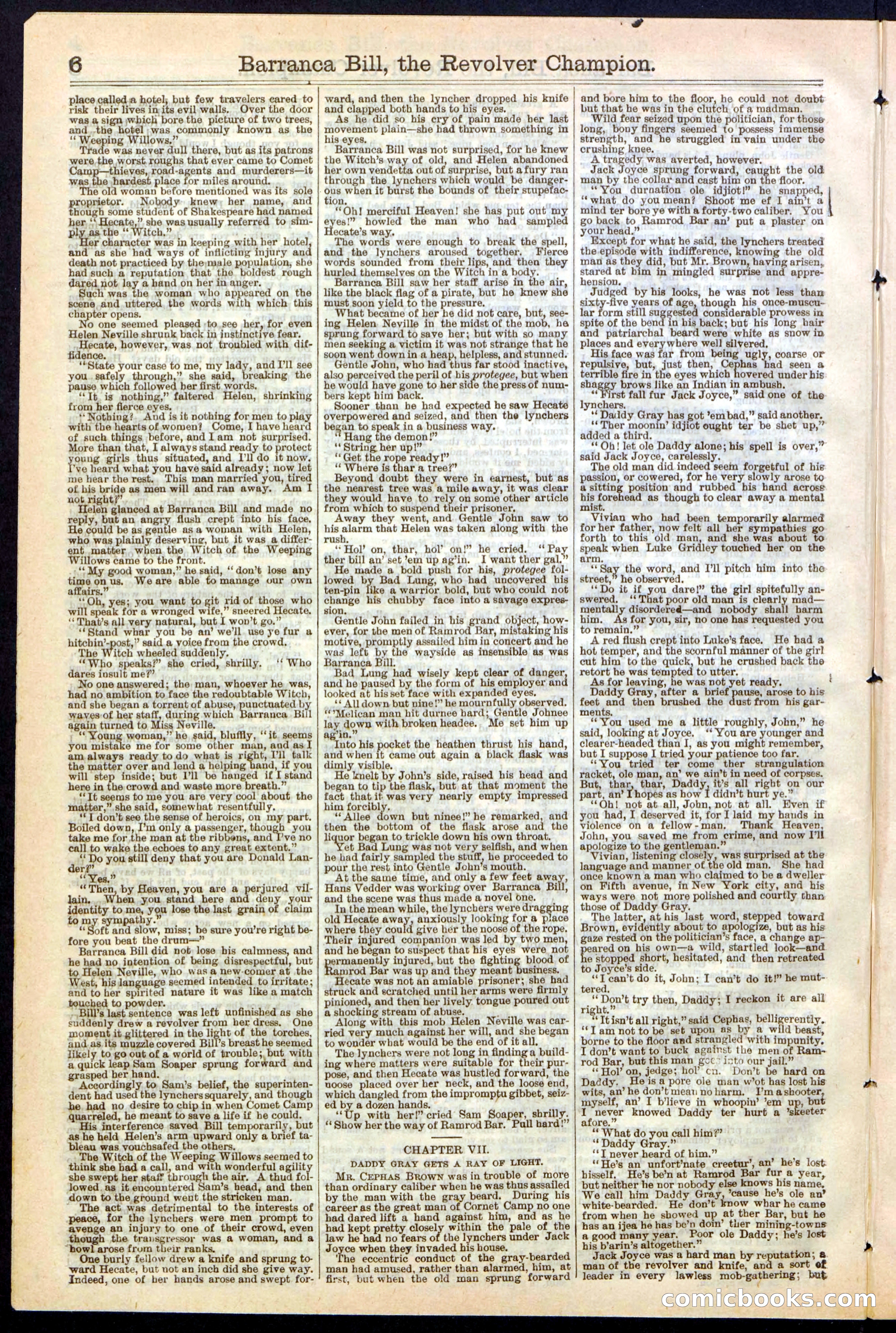
A restored page from Pulp Fiction, 1883. Page through the whole issue in the reader above.
📄 Transcribed text from this page (OCR, searchable)
Machine-transcribed from the original scan — historical spelling and the odd misread are preserved.
6 place called.a hotel; but few travelers cared to risk their lives in its evil walls. Over the door was @ sign which bore the picture of two trees, and..the hotel was commonly known as the ‘t Weeping Willows,” Trade was never dull there, but as its patrons were.the worst. roughs that ever came to Comet Camp—thieves, road-agents and murderers—it was the hardest place for miles around. e old woman before mentioned was its sole proprietor. . Nobody knew, her name, and though some student of Shakespeare had named her, ‘‘ Hecate,” she was usually referred to sim- Diy Aa the ‘ Witch,” character was in keeping with her hotel and as she had ways of inflicting injury and death not practiced by theymale population, she had such a reputation that the boldest rough dared not lay a hand on her in anger. Such was the woman who appeared on the scene and uttered the words with which this chapter opens. 0 one seemed pleased fo see her, for even Helen Neville shrunk back in instinctive fear. Hecate, however, was not troubled with dif- tidence. ‘*State your case to me, my lady, and I'll see you. safely through,” she said, breaking the pause which followed ber first. words, “It is nothing,” faltered Helen, shrinking from her fierce eyes, Nothing? And is it nothing for men to play with the heartsof women? Come, I have heard of such things before, and lam not surprised. More than that, I always stand ready to protect oung girls thus situated, and I'll do it now, I’ve heard what you have said already; now let me hear the rest. This man married you, tired of his bride as men will and ran away. I not igh ?” Helen glanced at Barranca Bill and made no reply, but an angry flush crept into his face, He could be as gentle asa woman with Helen, who was plainly deserving, but it was a differ- ent matter when the Witch of the Weeping Willows came to the front. “My good woman,” he said, “‘don’t lose any time on us. Weare able fo manage our own affairs.” ‘Oh, yes; you want to git rid of those who will k for a wronged wife,” sneered Hecate, ‘‘ That’s all very natural, but I won’t go.” ‘*Stand whar you be an’ we'll use ye fur a hitchin’-post,” said a yoice from the crowd, The Witch wheeled suddenly, “Who speaks?” she cried, shrilly. ‘‘ Who dares insult me?” No one answered; the man, whoever he was, had no ambition to face the redoubtable Witch, and she began a torrent of abuse, punctuated by waves of her staff, during which Barranca Bill again turned to Miss Neville. . “Young woman,” he said, bluffly, ‘it. seems you mistake me for some other man, and as I am.always ready to do what is right, Vl falk the matter over and lend a helping band, if you will step inside; but I’ll be hanged if I stand here in the crowd and waste more breath.” . Tt seems to me you are very cool about the matter,” she said, somewhat resentfully. ‘** T don’t see the sense of heroics, on my part. Boiled down, I’m only a passenger, though you me for the man at the ribbens, and I’ve no call to wake the echoes to any great extent.” , Do you still deny that you are Donald Lan- Red “Then, by Heaven, you are a perjared vil- lain. hen you stand here and deny your identity to me, you lose the last grain of claim tomy sympathy.” _ “Soft and slow, miss; be sure you’re right be- fore you beat the drum—” Barranca Bill did not lose bis calmness, and he had no intention of being disrespectful, but oe Belen Neville, who was @ new-comer at the est, his language seemed intended to irritate; and to her spirited nature it was like a match bouc to powder. Bi ae sentence was left unfinished as she suddenly drew a revolver from her dress, One moment it glittered in the Tene of the torches, and.as.its muzzle covered Bill’s breast he seemed likely to go out of a world of trouble; but. with a quick leap Sam Soaper sprung forward and grasped ber hand. Accordingly to Sam’s belief, the superinten- dent had used the lynchers squarely, and though had no desire to chip in when Comet Camp 'quarreled, he meant to save a life if he could. His interference saved Bill temporarily, but as he held Helen’s arm upward only a brief ta- bleau was youchsafed the others. The Witch of the Weeping Willows seemed to think she bad a call, and with wonderful agilit she swept her staff through the air. A thud fol- Jowed.as it encountered Sam’s head, and then down to the ground went the stricken man. The act was detrimental to the interests of ¢, for the lynchers were men prompt to avenge an injury to one of their crowd, even ’ the transgressor was a woman, and a “howl arose frum their ranks. One burly fellow drew a knife and sprung to- ward Hecate, but not an inch did she give way. Indeed, one of ber hands arose and swept for- ! ward, and then the lyncher dropped his knife and clapped both hands to his eyes. As he did so his ery of pain made ber last movement plain—she had thrown something in his eyes. Barranca Bill was not surprised, for he knew the Witch’s way of old, and Helen abandoned her own vendetta out of ep agg but afury ran through the lynchers which would be danger- on when it burst the bounds of their stupefac- ion, ‘Oh! merciful Heaven! she has put out my eyes!” howled the man who had sampled Hecate’s way, The words were enough to break the spell, and the lIynchers aroused together, Fierce words sounded from their lips, and then they hurled themselves on the Witch in a body. Barranca Bill saw her staff arise in the air, like the black flag of a pirate, but he knew she must soon yield to the pressure. _ What became of her he did not care, but, see- ing Helen. Neyille in the midst of the mob, ha sprung forward to save her; but with so many men seeking a victim it was not strange that he soon went down in a heap, helpless, and stunned. Gentle John, who had thus far stood inactive, also perceived the peril of bis protegee, but when he would have gone to her side the press of num- bers kept him back. Sooner than he had expected he saw Hecate overpowered and seized, and then the lynchers began to speak in a business way. ‘** Hang the demon!” ‘String her up!” “Get the rope ready!” ‘* Where is thar a tree?” Beyond doubt they were in earnest, but as the nearest tree was a mile away, it was clear they would have to rely on some other article from which to suspend their prisoner, Away they went, and Gentle John saw to his — that Helen was taken along with the rush, ‘* Hol’ on, thar, hol’ on!” he cried. ‘ Pay ther bill an’ set’emupag’in. I want ther gal.” He made a bold push for his, protegee fol- lowed by Bad Lung, who had uncovered his ten-pin like a warrior bold, but who could not change his chubby face into a savage expres- sion. Gentle John failed _in his grand object, how- ever, for the men of Ramrod Bar, mistaking his motive, promptly assailed him in concert and he was left by the wayside as insensible as was Barranca Bill. Bad Lung had wisely kept clear of danger and he paused by the form of his employer an looked at his set face with expanded eyes, ‘¢ All down but nine!” he mournfully observed. ‘’Melican man hit durnee hard; Gentle Johnee lay down with broken headee.. Me set him up ag’in. nto his pocket the heathen thrust his hand, and when it came out again a black flask was dimly visible. He Inelt by John’s side, raised his head and began to tip the flask, but at that moment the fact that it was very nearly empty impressed him forcibly, ‘Allee down but ninee!” he remarked, and then the bottom of the flask arose and the liquor began to trickle down his own throat. et Bad Lung was not very selfish, and when he had fairly sampled the stuff, he proceeded to pour the rest into Gentle John’s mouth. At the same time, and only a few feet away, Hans Vedder was working over Barranca Bill, and the scene was thus made a novel one. In the mean while, the lyncbers were dragging old Hecate ray anxiously looking for a place where they cou d give her the noose of the rope, Their injured companion was led by two men, and he began to suspect that his eyes were not pormnanen tay injured, but the fighting blood of mrod Bar was up and they meant business. Hecate was not an amiable prisoner; she had struck and scratched until her arms were firmly pinioned, and then her lively. tongue poured out a shocking stream of abuse. wk Along with this mob Helen Neville was car- ried very much against her will, and she began to wonder what would be the end of if all. The lynchers were not long in finding a build- ing where matters were suitable for their pur- pose, and then Hecate was hustled forward, the noose placed over her neck, and the loose end, which dangled from the impromptu gibbet, seiz- ed by a dozen hands. : ‘‘Up with her!’ cried Sam Soaper, shrilly. “ Show her the way of Ramrod Bar. Pall hard!” CHAPTER VII. DADDY GRAY GETS A RAY OF LIGHT. Mr. CePHAS Brown was in trouble of more than ordinary caliber when he was thus assailed by the man with the gray beard. During his career as the great man of Cornet Camp no one had dared lift a hand against him, and as he had kept pretty closely within the pale of the law he had no fears of the lynchers under Jack Joyce when they invaded his house. The eccentric conduct of the gray-bearded man had amused, rather than alarmed, him, at first, but when the old man sprung forward and bore him to the floor, he could not doubt Barranca Bill, the Revolver Champion. but that he was in the clutch of a madman. Wild fear seized upon the politician, for those long, bony fingers seemed to possess immense strength, and he struggled in vain under the crushing knee. A tragedy was averted, however. Jack Joyce sprung forward, caught the old man by the collar and cast him on the floor. “You durnation ole idjiot!” he snapped, “what do you mean? Shoot me ef I ain’t a mind ter bore ye with a forty-two caliber. You | go back to Ramrod Bar an’ put a plaster on your head.” Except for what he said, the lynchers treated the. episode with indifference, knowing the old man as they did, but Mr. Brown, haying arisen, stared at bim in mingled surprise and appre- hension. 4. Judged by his looks, he was not less tham | sixty-five years of age, though his once-muscu- lar form still su gested considerable prowess in spite of the bend in his batk; but his long hair and patriarchal beard were white as snow in places and every where well silvered, His face was far from being ugly, coarse or repulsive, but, just then, Cephas had seen a terrible fire in the eyes which hovered under his shaggy brows like an Indian in ambush, “First fall fur Jack Joyce,” said one of the ynchers. ‘‘Daldy Gray has pot ’em bad,” said another. “Ther moonin’ idjiot ought ter be shet up,” added a third, ‘Ob! let ole Daddy alone; his spell is over,” said Jack Joyce, carelessly, The old man did indeed seem forgetful of hig passion, or cowered, for he very slowly arose to a ries position and rubbed his hand across 7 none ead as though to clear away a mental mist. Vivian who had been temporarily alarmed for her father, now felt all her sympathies go forth to this old man, and she was about to speak when Luke Gridley touched her on the arm, ‘‘Say the word, and I'll pitch him into the street,” he observed. ‘*Do it if you dare!” the girl spitefully an- swered, ‘That poor old man is clearly mad— mentally disordered—and nobody shall harm him. for you, sir, no one has requested you to remain.” A red flush crept into Luke’s face. He had a hot temper, and the scornful manner of the gir! cut him tothe quick, but he crushed back the retort he was tempted to utter. , As for leaving, he was not yet ready. , Daddy Gray, after a brief pause, arose to his feet and then brushed the dust from his gar- ments. “You used me a little roughly, John,” he said, looking at Joyce, ‘‘ You are younger and clearer-headed than I, as you might remember, but I suppose I tried your patience too far. ‘You tried ter come ther strangulation racket, ole man, an’ we ain’t in need of corpses. But, thar, thar, Daddy, it’s all right on our part, an’ Thopes as how 1 didn’t hurt ye.” “Oh! not at all, John, not at all. Even if you had, I deserved it, for I laid my hands in violence on a fellow-man, Thank Heaven, John, you saved me from crime, and now I'll apologize to the gentleman.” Vivian, listening closely, was surprised at the language and manner of the old man. She had once known a man who claimed to be a dweller on Fifth avenue, in New York city, and his ways were not more polished and courtly than those of Daddy Gray. The latter, at his last word, stepped toward Brown, evidently about to apologize, but as his gaze rested on the politician’s face, a change ap- ared on his own—a wild, startled look—and e stopped short, hesitated, and then retreated i to Joyce’s side. ‘“‘T can’t do it, John; I can’t do it!” he mut- tered. ‘ ‘Don’t try then, Daddy; I reckon it are all right.” ’ ‘Ttisn’t all right,” said Cephas, belligerentiy. ‘‘T am not to be set upon as by a wild beast, borne to the floor and strangled with impunity, I don’t want to buck against the men of Ram- rod Bar, but this man goc> into our jail.” ‘* Hol’ on, jedge; hol’ cn. Don’t be hard on Daddy. Heisa pore ole man w’ot has lost his wits, an’ he don’t meat noharm. I’m ashooter myself, an’ I b’lieve in whoopin’ ’em Dp, but I never knowed Daddy ter hurt a ’skeeter afore.” “What do you call him?’ ‘Daddy Gray.” ‘*T never heard of him.” : ‘He's an unfort’nate creetur’, an’ he’s lost: hisself. He’s be’n at Ra Bar fur a year, but neither he nor nobody else knows his name, We call him Daddy Gray, cause he’s ole an’ white-bearded. He don’t know whar he came from when he showed up at ther Bar, but he has an ijea he has be’n doi’ ther mining-towns : a good many year. Poor ole Daddy; he’s lost his b’arin’s altogether.” Jack Joyce was a hard man by reputation; & man of the revolver and knife, and a sort of leader in every lawless mob-gathering ; but Gomicbooks.¢o A 7 . aS ie [ an oe : aoa