
Pulp Fiction, 1883 · page 30 of 32
Beadle's New York Dime Library No. 245 — page 30: what you’re looking at
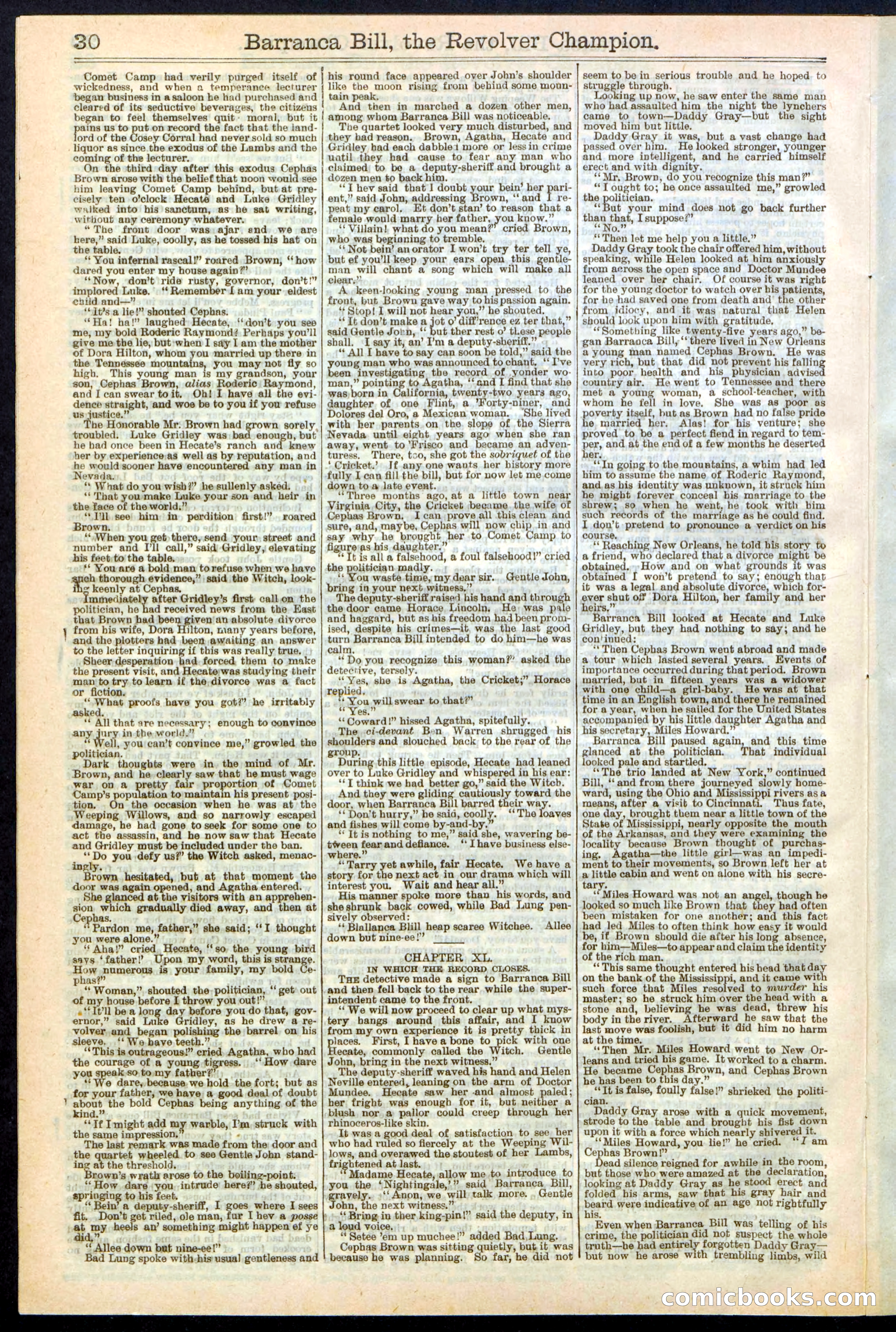
A restored page from Pulp Fiction, 1883. Page through the whole issue in the reader above.
📄 Transcribed text from this page (OCR, searchable)
Machine-transcribed from the original scan — historical spelling and the odd misread are preserved.
| | | f — ~~ 30 $ Comet Camp had verily purged itself of | h Ap ) wickedness, and when a temperance lecturer { like the moon rising from behind some moun- began business in asaloon he had purchased and cleared of its seductive beverages, the citizens Barranca Bill, the Revolver Champion. his round face appeared over John’s shoulder tain peak, And then in marched a dozen other men, began to feel themselves quit: moral, but it | among whom Barranca Bill was noticeable. ains us wd ir on record the fact that the iand- ord of the liquor as since.the exodus of the Lambs and the coming of the lecturer. On the third day after this exodus Cephas Brown arose with the belief that noon would see him leaving Comet Camp behind, but at pre- cisely ten o’clock Hecate and Luke Gridley walked into his sanctum, as he sat writing, withouf any ceremony whatever. “The front door was ajar end we are here,” said Luke, coolly, as he tossed his hat on the table, ** You infernal rascal!” roared Brown, “ how dared you enter my house again?” **Now, don’t ride mins Ph governor, don’t!” implored Luke. ‘ Remember lam your eldest ehild and—” ‘it?s a lie!” shouted Cephas. ‘‘Ha! ha!” laughed Hecate, ‘‘ don’t you see me, my bold Roderic Raymond? Perhaps you'll give me the lie, but when I say | am the mother of Dora Hilton, whom you married up there in the Tennessee mountains, you may not fly so high. This young man is my grandson, your son, Cephas Brown, alias Roderic Raymond, and I can swear toit. Oh! I have all the evi- dence straight, and woe be to you if you refuse us ge he Honorable Mr: Brown had grown sorely, troubled. Luke Gridley was enough, but he had once been in Hecate’s ranch and knew her by experience:as well as by reputation, and he would sooner have encountered any man in Nevada. ‘* What do you wish?” he sullenly asked. ** That you make Luke your son and heir in the face of the world,” ** TL see’ him in perdition first!” Brown. ‘When you get) there, send your street and number and I'll call,” said Gridley, elevating his feet:to the table. ** You are a bold man torefuse when we have a thorough evidence,” said the Witch, look- & keenly at Cephas, Immediately after Gridley’s first, call.on the politician, he had received news from the East that Brown had been given an absolute divorce from bis wife, Dora Hilton, nany years before, and the plotters had been awaiting an answer to the letter inquiring if this was really true, Sheer desperation had forced them to make the present visit, and Hecate;was studying their man to try to learn if the,divorce was a fact or fiction. ‘What proofs have you got?” he irritably roared asked. ** All that are necessary; enough to convince any jury in the world.” ‘* Well, you can’t convince me,” growled the politician. Dark thoughts were in the mind of Mr. Brown, and he clearly saw that he must wage war on a pretty f proportion of Comet Camp’s population to maintain his present posi- tion. n the occasion when he was at the Weeping Willows, and so narrowly escaped damage, he had gone to seek for some one to act the assassin, and he now saw that Hecate and Gridley must be included under the ban. ‘*Do you defy us?” the Witch asked, menac- RLY. Brown. hesitated, but at that moment the door was again opened, and Agatha entered. She mance’ at the visitors with an apprehen- mon hy ch gradually died away, and then at P Pardon me, father,” she said; ‘‘I thought you were alone.” / " ‘‘ Aha!” cried Hecate, ‘‘so, the young bird says ‘father!’ Upon my word, this is strange. Sto PPR OES is your family, my bold Ce- phas ** Woman,” shouted the: politician, ‘‘ get out of my house before I throw you out!” «‘*Itvll be a long day before you do that, gov- ni eat ae aa 8 iets * Bh a re. volver an gan po 8 rel on his sleeve, ‘‘ We bave teeth.” “This is outrageous!” eried, Agatha, who had the courage of a young tigress. ‘‘How dare you speak so. to my father?’ | ‘*We dare, because. we hold the fort; but as for your father, we have a good deal of doubt cea the bold Cephas being anything of the nd.” ery ‘ ‘If Imight add my warble, I’m, struck with the same impression, pads « The last remark was made from the door and the quartet wheeled to see Gentle John stand- _~— the threshold, rown’s wrath arose to the boiling-point. | “How dare you. intrude here?’ he shouted, springing to his feet. ‘* Bein’ a deputy-sheriff, I goes where I sees fit. Don’t get riled, ole man, fur I hev a posse } my as an’ something might happen ef ye _, “ Allee down bat nine-ee!” osey Corral had never sold so much | they bad reason. > Tbe quartet looked very much disturbed, and Brown, Agatha, Hecate and Gridley had each dabblei more or less in crime uatil they had cause to fear any man who claimed to be a deputy-sheriff and brought a dozen men to back him. ‘“‘T hev said that I doubt your bein’ her pari- ent,” said John, addressing Brown, ‘‘and I re- peat my carol, Et don’t stan’ to reason that a female would marry her father, you know.” ‘* Villain! what do you mean?” cried Brown, who was beginning to tremble. ‘* Not bein’ anorator I won’t try ter tell ye, but ef you’ll keep your ears open this gentle- man will chant a song which will 6 all clear,”’ A. keen-looking young man pressed to the front, but Brown gave way to his passion again. ** Stop! I will not hear you,” he shouted, ‘“‘ It don’t make a jot o’ diff’rence ez ter that,” said Gentle Jorn, ‘‘ but ther rest o’ these people shall, I say it, an’ I’m a deputy-sheriff.” ‘¢ All I have to say can soon be told,” said the young man who was announced to chant, ‘‘ I’ve been investigating the record of yonder wo- man,” pointing to Agatha, ‘‘and I find that she was born in California, twenty-two years ago, daughter of one Flint, a ’Forty-niner, and Dolores del Oro, a Mexican woman. She lived with her parents on the. slope of the Sierra Nevada until eight years ago when sbe ran away, went to’Frisco and became an adven- turess. There, too, she got the sobriquet of the ‘ Cricket.’ If any one wants her bistory more fully I can fill the bill, but for now let me come down to a late event. “Three months ago, at a little town near Virginia City, the Cricket became the wife of Cephas Brown, I can prove all this clean and sure, and, maybe, Cephas will now chip in and say why he brought her to Comet Camp to figure‘as his daughter.” ; ** Tt is all a falsehood, a foul falsehood!” cried the politician madly. ef You waste time, my dear sir.. Gentle John, bring in your next. witness,” The deputy-sheriff raised his hand and through the door came Horace Lincoln, He: was palo and haggard, but as his freedom had been prom- ised, despite his crimes—it, was the last good turn Barranca Bill intended to do him—he was calm. * Do you recognize this woman?” asked the detective, tersely. “Yes, she is Agatha, the Cricket,” Horace replied, ‘ You willswear to that?” 6s Yes.” “Coward!” hissed Agatha, spitefully. The ci-devant Ben Warren shrugged his shoulders and slouched back to the rear of the group. During this little episode, Hecate had leaned over to Luke Gridley and whispered in his ear: ‘‘T think we had better go,” said the Witcb. And they were gliding cautiously toward the door, when Barranca Bill barred their way. ‘* Don’t hurry,” be said, coolly. ‘‘The loaves and fishes will come by-and-by,.” ‘It is nothing to me,” said she, wavering be- tween fearand defiance. ‘ Ihave business else- where.” “'Tarry yet awhile, fair Hecate. We have a story for the next act in our drama which will interest you. Wait and hear all.” His manner spoke more than _ his words, and shesbrunk back cowed, while Bad Lung pen- sively observed: ‘+ Blallanca Blill heap scaree Witchee. Allee down but nine-ee!” CHAPTER XL. IN WHICH THE, RECORD, CLOSES. , THE detective made a sign to Barranca Bill and then fell back to the rear while the super- intendent came to the front. “ We will now proceed to clear up what mys- tery bangs around this affair, and | know from my own experience it is pretty thick in —— First, I have a bone to pick with one ecate, commonly called the Witch. Gentle John, bring in the next witness.” The deputy-sheriff waved his hand and Helen Neville entered, leaning on the arm of Doctor Mundee. ate saw her -and almost paled; her fright was enough for it, but neither a blush nor a pallor could creep through her rhinoceros-like skin. It was a good deal of satisfaction to see her who had wiied so flercely at the Weeping Wil- lows, and overawed the stoutest of her Lambs, frightened at last. F ‘* Madame Hecate, allow me to introduce to you the ‘Nightingale,’” said Barranca, Bill, qrovely. 7 we will talk more. . Gentle ohn, the next witness.” ’ “‘ Bring in ther king-pin!” said the deputy, in a loud voice, “ Setee ’em up muchee!” added Bad, Lung. Cephas Brown was sitting quietly, but. it was Bad Lung spoke with-his' usual] gentleness and | because he was planning. So far, he did not seem to be in serious trouble and he hoped. to struggle through. Looking up now, he saw enter the same man who had assaulted him the night the lynchers came to town—Daddy Gray—but the sight moved him but little. Daddy Gray it was, but a vast change had passed over him. He looked stronger, younger and more intelligent, and he carried himself erect and with dignity. ‘‘ Mr, Brown, do you recognize this man?” “T ought to; be once assaulted me,” growled the politician. ‘“‘But your mind does not go back further shea that, I suppose?’ ‘ Oo ” ‘Then let me help you a little.” Daddy Gray took the chair offered him, without speaking, while Helen looked at him anxiously from across the open space and Doctor Mundee leaned over her chair. Of course it was right for the young doctor to watch over his patients, for be had saved one from death and’ the other from idiocy, and it was natural that Helen should look upon him with gratitude, ‘‘Something like twenty-five years ago,” be- gan Barraoca Bill,‘ there lived in New Orleans a young man named Cephas Brown. He was very rich, but that did not prevent his fallin into poor. health and his physician advise country air. He went to Tennessee and there met a young woman, a school-teacher, with whom he fell in love. She was as poor as poveray. itself, but as Brown had no false pride e married her, Alas! for his venture; she proved to be a perfect fiend in regard to tem- per, and at the end of a few months he deserted er. ‘In going to the mountains, a whim had led him to assume the name of Roderic Raymond, and.as his identity was unknown, it struck him he might forever conceal his marriage to the shrew; so when he went, he took with bim such records of the marriage as he could find. I don’t pretend to pronounce a verdict on his course. ‘Reaching New Orleans, he told his story to a friend, who declared that a divorce might be obtained... How and on what grounds it was obtained I won’t pretend to say; enough that it was a legal and absolute divorce, which for- ever shut of Dora Hilton, ber family and her heirs,” Barranca Bill looked at Hecate and Luke Gridley, but they had nothing to say; and he con'inued:; ‘*Then Cepbhas Brown went abroad and made a tour which Jasted several years. Events of importance occurred during that period. Brown married, but in fifteen years was a widower with one child—a girl-baby. He was at that time in an English town, and there he remained for a year, when he sailed for the United States accompanied by his little daughter Agatha and his secretary, Miles Howard.” Barranca Bill paused again, and this time glanced at the politician. That individual looked pale and startled, “The trio landed at New York,” continued Bill, ‘‘ and from there journeyed slowly home- ward, using the Obio and Mississippi rivers as a means, after a visib to Cincinnati. Thus fate, one day, brought them near a little town of the State of Mississippi, nearly opposite the mouth of the Arkansas, and they were examining the locality because Brown thought of purchas- ing. gatha—the little girl—was an impedi- ment to their movements, so Brown left her at a little cabin and went on alone with his secre- tary. OM iles Howard was not an angel, though he looked so much like Brown that they had often been mistaken for one another; and this fact had led Miles to often think how easy it would be, if Brown should die after his long absence, for him—Miles—to appear and claim the identity of the rich man. “This same thought entered his head that day on the bank of the -pnygeenesd fea and it came wit! such force that Miles resolved to murder his master; so he struck him over the head with a stone and, believing he was dead, threw his body in the river. Afterward he saw that the last move was foolish, but it did him no harm at the time. “Then Mr. Miles Howard went to New Or- leans and tried his game. It worked to a charm. He became Cephas Brown, and Cephas Brown he has been to this day.” It is false, foully false!” shrieked the politi- cian. Daddy Gray arose with a quick movement, strode to the table and brought his fist down upon it with a force which nearly shivered it. ‘Miles Howard, you lie!” he cried. “‘J am Cephas Brown!” ; ead silence reigned for awhile in the room, but those who were amazed at the declaration looking at Daddy Gray as he stood erect an folded his arms, saw that his gray hair and beet were indicative of an age not rightfully is. | Even when Barranca Bill was telling of his crime, the politician did not suspect the whole truth—he had entirely forgotten Daddy Gray— but now he arose with trembling limbs, wild (E(o) milcboOoks?