
Pulp Fiction, 1883 · page 26 of 32
Beadle's New York Dime Library No. 245 — page 26: what you’re looking at
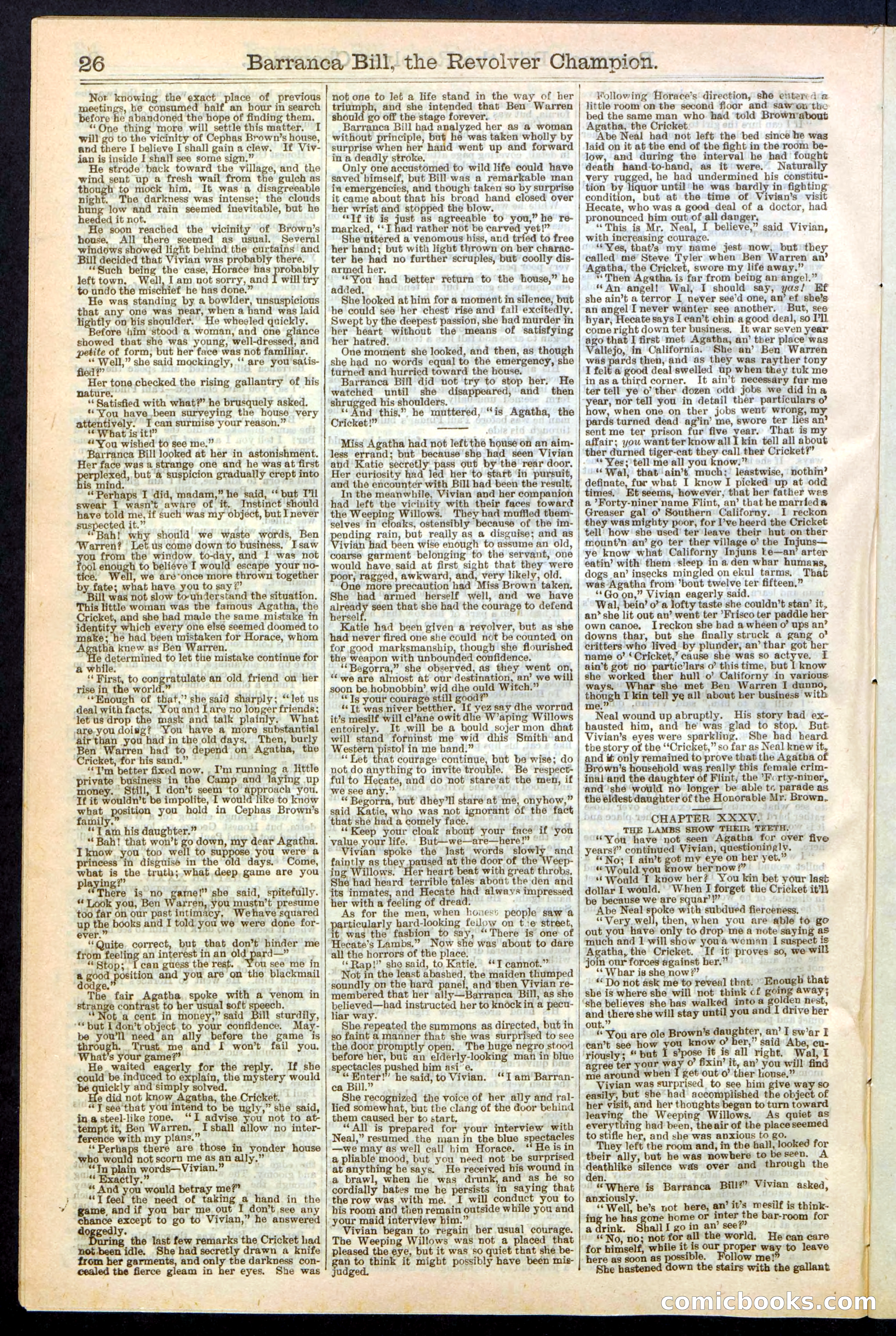
A restored page from Pulp Fiction, 1883. Page through the whole issue in the reader above.
📄 Transcribed text from this page (OCR, searchable)
Machine-transcribed from the original scan — historical spelling and the odd misread are preserved.
‘¥ air'than you had in the old days, ‘but don’t object to your confidence. < Not knowing the’ exact place of previous meetings, he consumed half an hour in search before he abandoned the hope of finding them. “(One thing more will settle this matter. I will go to the vicinity of Cephas Brown’s house, and there I believe I shall gainaclew. If Viv- ian is inside I shall see some sign.” He strode back toward the village, and the wind sent up a fresh wail from the gulch as though to mock him. It was a disagreeable night. The darkness was intense; the clouds hung low and rain seemed inevitable, but he heeded it not. He soon reached the vicinity of Brown’s house, All there seemed as usual. Several windows showed light behind the curtains and Bill decided that Vivian was probably there. “Such being the case, Horace has YM left town. . Well, I am not sorry, and I will try to undo the mischief he has done.” He was standing by a bowlder, unsuspicious that any one was near, when a hand was laid lightly on his shoulder. He wheeled quickly. Before him stood a woman, and one glance showed that she was young, well-dressed, and ite of form, but her face was not familiar. “* Well,” she said mockingly, ‘‘ are you'satis- fied?” Her tone checked the rising gallantry of his nature, ‘Satisfied with what?” he brusquely asked. “You have.been surveying the house very attentively. TI can surmise your reason.” ‘What is it!” “You wished to see me.” Barranca Bill looked at her in astonishment. Her face was a strange one and he was at first perplexeie but @ suspicion gradually crept into is mind. “Perhaps I did, madam,” he said, ‘but Mil swear I wasn’t aware of it. Instinct should have told me, if such was my objeéct, but I never suspected it.” . “Bah! why should we waste words, Ben ‘Warren? Let us come down to business. Isaw ou from the window, to-day, and I was not l enough to beliéve I would escape your no- 2, Well, we aré*once more thrown together by fate; what have you to say?” Bill was not slow to understand the situation. This little woman was the famous Agatha, the Cricket, and she had made the same mistake in identity which every one else seemed doomed to make; he had been mistaken for Horace, whom Agatha knew as Ben Warren. e determined to let the mistake continue for a while. ‘* First, to congratulate an old friend on her rise in the world.” ‘*Knough of that,’ she said sharply; “‘let us deal with facts, You and Lare no longer friends; let us drop the mask and talk plainly. What are-you doisg? “You have a more substantial Then, burly Ben Warren had to depend on Agatha, the Cricket, for his sand.” “I’m better fixed now. . I’m running a little private business in the Camp and laying up ™m . Still, I don’t seem ‘to approach you. If it wouldn’t be impolite, I would like to know what position you hold in Cephas Brown’s family. "Tam his daughter.” “Bah! that won’t go down, my dear Agatha. I know you too well to sup you were a princess in disguisé in the old days. Come, what is the truth; what deep.game are you ing?” Pee tiers is no game!” she said, spitefully. “Look you, Ben Warren, you mustn’t presume too far on our past intimacy, Wehave squared up the books and I told you we were done for- ever. “Quite. correct, but that don’t hinder me from feeling an interest in an old 3 eee “Stop; r can guéss the resf. . You see me in a good position and you are on the blackmail pe Se ; The fair Agatha. spoke with a venom in ae contrast to her usual soft speech. ‘Nota cent in money,” said Bill gy ay- be you'll need an ally before the game is through. Trust. me and I won’t fail you. What's your game?” He waited eagerly for the reply. If she could be induced to explain, the mystery would be quickly and simply solved. e did not know Agatha, the Cricket. “J see that you intend to be ugly,” sie said, in.a steel-like tone. “I advise you not to at- ‘tempt it, Ben Warren. Ishall allow no inter- ference with my plans.” ‘*‘ Perhaps there are those in yonder house who would not scorn me as an ally,” “Ty plain words—Vivian.” ~“ Exactly.” * And you would betray me?” ;' “JT feel the need of taking a hand in the game, and if chance excep y: re the last few remarks the Cricket had not.been idle. She had secretly drawn a knife from her garments, and only the darkness con- cealed the fierce gleam in her eyes. She was ’ you bar me. out I don’t see any to go to Vivian,” he answered not one to let a life stand in the way of her | triumph, and she intended that Ben Warren should go off the stage forever. Barranca Bill had analyzed her as a woman without principle, but he was taken wholly by surprise when her hand went up and forward in a deadly stroke. Only one accustomed to wild life could have saved bimself, but Bill was a remarkable man in emergencies, and though taken so by surprise it came about that his broad hand elosed over her wrist and stopped the blow. “If it is just as agreeable to you,” he re- marked, ‘‘I had rather not be carved yet!” She uttered a venomous hiss, and tried to free her hand; but with light thrown on ber charac- ter he had no further scruples, but coolly dis- armed her. “You had better return to the house,” he added. She looked at him for a moment in silence, but he could see her chest rise and fall excitedly. Swept by the deepest passion, she had murder in her heart without the means of satisfying her hatred. One moment she looked, and then, as though she had no words equal to the emergency, she turned and hurried toward the house. Barranca Bill did not try to stop her. He watched until she disappeared, and then shrugged his shoulders. : ‘And this,” he muttered, “is Agatha, the Cricket!” Miss Agatha had not left the house on an aim- less errand; but because she had seen Vivian and Katie secretly pass out by the rear door. Her curiosity had Jed her ‘to start ‘in pursuit, and the encounter with Bill had been the result, In the meanwhile, Vivian and her companion had left the vicinity with their faces toward the Weeping Willows. They had muffled them- selves in cloaks, ostensibly because of the im- nding rain, but really as a disguise; and as Vivian bad been wise enough to assume an old, coarse garment belonging to the servant, one would have said at first sight that they were poor} ragged, awkward, and, very likely, old. One more precaution had Miss Brown taken. She had armed herself well, and we have already seen that she had the courage to defend herself, : Katie had been given a revolver, but as she had never fired one she could not be counted on for good marksmanship, though she flourished the weapon with unbounded confidence. ‘‘Begorra,” she observed, as they went on, “we are almost at our destination, an’ we will soon be. hobnobbin’, wid dhe ould Witch.” “Ts your courage still good?” “Tt was niver betther. If yez say dhe worrud it’s mesilf will c’ane owit dhe W’aping Willows entoirely. It .will be a bould sojer mon dhat will stand forninst me wid dhis Smith and Western pray, in me hand.” ‘Let that courage continue, but be wise; do not. do anything to invite trouble. Be respect- ful to Hecate, and do not stare’at the men, if we see any.” “ Begorra, but dhey’ll stare at me, onyhow,” said Katie, who was not ignorant of the fact that she had a comely face. “Keep your cloak about your face if ‘you value. your life. But—we—are—here!” Vivian spoke the last words saat? f and faintly as they paused at the door of the Weep- ing Willows. Her heart beat with great throbs. She had heard terrible tales about the den and its inmates, and Hecate had alwavs impressed her with a feeling of dread. As for the men, when honess people saw a particularly bard-looking fellow on te street, t was the fasbion to say, “‘There is one of Hecate’s Lambs.” Now she was about to dare all the horrors of the place. ‘‘ Rap!” she said, to Katie. T cannot.” Not in the least abashed, the maiden thumped soundly on the hard panel, and then Vivian re- membered that her ally—Barranca Bill, as she believed—had instructed her to knockin a pecu- liar Way. She repeated the summons as directed, but in so faint a manner that she was surprised to see the door promptly open. The huge negro stood before her, but an aldetiy-looking man in blue spectacles pushed him asi’e. “Enter!” he said, to Vivian. ca Bill.” _She recognized the voice of her ally and ral- lied somewhat, but the clang of the door behind them caused her to start, | “All is prepared for your interview with Neal,” resumed the man in the blue spectacles —we may as well call him Horace. ‘‘ He is in a pliable mood, but you need not be surprised at anything he says. He received his wound in a brawl, when he was drunk, and as he so cordially bates me he persists Im saying that the row was with me. I will conduct you to his room and then remain outside while you and your maid interview him.” Vivian began to regain her usual courage. The Weeping Willows was not a placed that pleased the eye, but it was so quiet that she be- gan wo) think it might possibly have been mis- juag ““T am Barran- ; i Any ny & | eee eee eee eee = Barranca Bill, the Revolver Champion. Mollowing Horace’s direction, she eriter4 2 little room on the second floor and saw on the bed the same man who. had told Brown'about Agatha, the Cricket Abe Neal had not left the bed since he was laid on it at the end of the fight in the room be- low, and during the interval he had fought death hand-to-hand, as it were. Naturally very rugged, he had undermined his constitu- tion by liquor until he was bardly in fighting condition, but at the time of Vivian’s visit Hecate, who was a good deal of a doctor, had pronounced him out of all danger, ‘‘This is Mr. Neal, I believe,” said Vivian, with increasing courage. ‘Yes, that’s my name jest now, but they called’ mé Steve Tyler when Ben Warren an’ Agatha, the Cricket, swore my life away.” “Then Agatha is far from being an angel.” “An angel! Wal, I should say, yas! Ef she ain’t a terror I never see’d one, an’ ef she’s an i I never wanter see another. But, see hyar, Hecate says I can’t chin a good deal, so Pll come right down ter business, It war seven year ago that I first met Agatha, an’ ther place was Vallejo, in California. She an’ Ben Warren was pards then, and as they was rayther tony I felt a good deal swelled up when they tuk me in asathird corner. It ain’t necessary fur me ter tell ye o’ ther dozen odd jobs we didina ear, nor tell you in detail ther particulars o’ ow, when one on ther jobs went wrong, my pards turned dead ag’in’ me, swore ter lies an’ sent me ter prison fur five vear. That is my affair; you want ter know all I kin tell all about ther durned tiger-cat they call ther Cricket?” “Yes; tell me all you know.” “Wal, that ain’s much: leastwise, nothin’ definate, fur what I know I picked up at odd times. Et seems, however, that ber father wes a ’Forty-niner name Flint, an’ that he marrieda Greaser gal o’ Southern Californy. I reckon they was mighty poor, for I’ve heerd the Cricket tell how she used ter leave their hut on ther mount’n an’ go ter ther village o’ the Injuns— ye know what Californy Injuns te—an’ arter eatin’ with’ them sleep in a. den whar humans dogs an’ insecks mingled on ekul tarms, That was Agatha from ‘bout twelve ter fifteen,” ‘‘Go on,” Vivian eagerly said. Wal, bein’ o’ a lofty taste she couldn’t stan’ it, an’ she lit out an’ went ter Frisco ter paddle her own canoe. Ireckon she bad a wheen o’ ups an’ downs thar, but she finally struck a gang o’ critters who lived by plunder, an’ thar got her name o’ ‘Cricket,’ cause she was 80 actyve. ain't got no partic’lars o’ this time, but | know she worked ther hull o’ Californy in various ways. Whar she met Ben Warren I dunno, though I kin tell ye all about her business with me. Neal wound up abruptly. His story bad ex- bausted him, and he was glad to stop. But Vivian’s eyes were sparkling, She had heard the story of the “Cricket,” so far as Neal knew it, and i¢ only remained to prove that the Agatba of Brown’s household was really this female crim- inal and the daughter of Flint, the "Forty-niner, and ‘shé would no longer be able tc parade as ‘riously 5 the eldest daughter of the Honorable Mr. Brown. CHAPTER XXXV. - THE LAMBS SHOW THEIR TEETH. “You have not seen Agatha for over five years?” continued Vivian, questioningly. “No: I ain’t got my eye on her yet.” * Would you Snow her now ¢” ‘Would IT know ber? You kin bet your last dollar I would. When I forget the Cricket it’) be because we are squar’!”’ Abe Neal spoke with subdued fierceness, “Very. well, then, when you are able to go out Ny have only to drop me a note saying as much and 1 will show youa woman I suspect is Agatha, the Cricket. If it proves so, wew1 join our forces against ber.” ‘* Whar is she now?’ «Do not ask me to reveal that: » Enough that she is where she will not think cf going away; she believes she has walked intoa £9 en nest, and there she will stay until you an I drive her out.” ‘You are ole Brown’s daughter, an’ I sw’ar I can’t see how you know ©’ her,” said Abe, cu- * bat 1 s’pose it is all right. Wal, 1 agree ter yor way 0’ fixin’ it, an’ you will find me around when I get out o’ ther louse,” Vivian was surprised to see him give way so easily, but she had accomplished the object of her visit, and her thoughts began to turn toward leaving the Weeping Willows. As quiet as everything had been, theair of the placeseemed to stifle her, and she was anxious to go. They left the room and, in the hall, looked for their ‘ally, but he was nowhere to be seen. deathlike silence was over and through the den. - “Where is Barranca Billf? Vivian asked, anxiously. eRe Well. he’s not bere, an’ it’s mesilf is think- ing he has gone home or inter the bar-room for a drink. allI go in an’ see?” ‘No, no; not for all the world. He can care for himself, while it is our proper way to leave here as soon as ble. llow me! She hastened down the stairs with the gallant (ECO)! A AIICE cS J00 - ge NN L te