
Pulp Fiction, 1883 · page 3 of 32
Beadle's Dime Library, No. 240 — page 3: what you’re looking at
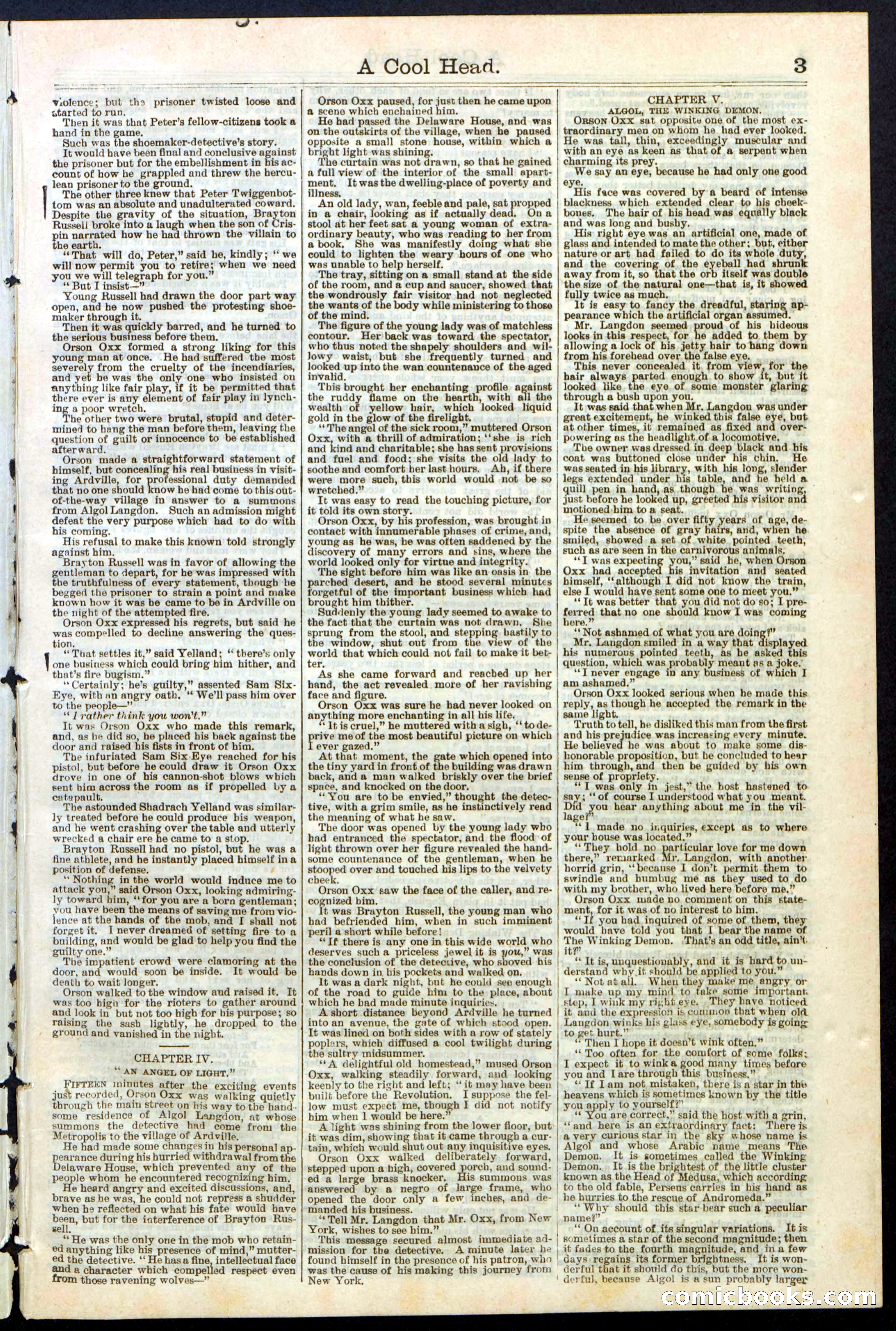
A restored page from Pulp Fiction, 1883. Page through the whole issue in the reader above.
📄 Transcribed text from this page (OCR, searchable)
Machine-transcribed from the original scan — historical spelling and the odd misread are preserved.
i | violence; but ths prisoner twisted loose and otarted to run. Then it was that Peter’s fellow-citizens took a band in the game, Such was the shoemaker-detective’s story. It would have been final and conclusive against the prisoner but for the embellishment in bis ac- count of how he grappled and threw the bercu- lean prisoner fo the ground. The other three knew that Peter T wiggenbot- tom was an absolute and unadulterated coward. Despite the gravity of the situation, Brayton Russell broke into a laugh when the son of Cris- in narrated how he had thrown the villain to he earth. “That will do, Peter,” said he, kindly; ‘ we will now permit you to retire; when we need you we will telegraph for you.” * But I insist —” Young Russell had drawn the door part way open, and he now pushed the protesting shoe- maker through it. Then it was quickly barred, and he turned to the serious business before them. Orson Oxx formed a strong liking for this young man atonce. He had suffered the most severely from the cruelty of the incendiaries, and yet be was the only one who insisted on anything like fair play, if it be permitted that there ever is any element of fair play in lynch- ing a poor wretch. he other two were brutal, stupid and deter- mined to hang the man before them, leaving the question of guilt or innocence to be established afterward. Orson made a straightforward statement of himself, but concealing his real business in visit- ing Ardville, for Pro essional duty demanded that no one should know he had come to this out- of-the-way village in answer to a summons from Algol Langdon. Such an admission might defeat the very purpose which had to do with his coming. His refusal to make this known told strongly against him. Brayton Russell was in favor of allowing the gentlemer to depart, for he was impressed with he truthfulness of every statement, though he begged the prisoner to strain a point and make known how it was be came to be in Ardville on the night of the attempted fire. Orson Oxx expressed his regrets, but said he was compelled to decline answering the ques- tion. “That settles it,” said Yelland; “ there’s only one business which could bring him hither, and that’s fire bugism.” ‘Certainly; he’s guilty,” assented Sam Six- Eye, with an angry oath, “ We'll pass him over to the people—” * T rather think you won't.” It was Orson Oxx who made this remark, and, as he did so, he placed bis back against the door and raised bis fists in front of him. The infuriated Sam Six-Eye reached for his pistol, but before he could draw it Orson Oxx drove in one of his cannon-shot blows which sent bim across the room as if propelled by a catepault. The astounded Shadrach Yelland was similar- ly treated before he could produce his weapon, and he went crashing over the table and utterly wrecked a chair ere he came to a stop. Brayton Russell had no pistol, but he was a fine athlete, and he instantly placed himself ina position of defense. J ‘‘ Nothing in the world would induce me to attack you,” said Orson Oxx, looking admiring- ly toward him, ‘for you are a born gentleman; you have been the means of saving me from vio- ilence at the hands of the mob, and [ shall not forget it. I never dreamed of setting fire to a building, and would be glad to help you find the guilty one.” The impatient crowd were clamoring at the door, and would soon be inside. It would be death to wait longer. Orson walked to the window and raised it. It was too high for the rioters to gather around and look in but not too high for bis purpose; so raising the sash lightly, he dropped to the ground and vanished in the night. CHAPTER IV. ‘AN ANGEL OF LIGHT.” FIrTEEN ininutes after the exciting events just recorded, Orson Oxx was walking quietly through the main street on his way to the hand. some residence of Algol Langdon, at whose summons the detective had come fron the Metropolis to the village of Ardville, He had made some changesin his personal ap- earance during his hurried withdrawal from the elaware House, which prevented any of the people whom he encountered recognizing him, e heard angry and excited discussions, and, brave as he was, he could not repress a shudder when he reflected on what his fate would have cect but for the iaterference of Brayton Rus- sell. **He was the only one in the mob who retain- ed anything like his presence of mind,” mutter- ed the detective. ‘‘ He hasa fine, intellectual face and a character which compelled respect even those ravening wolves—” A Coo ee es Head. Orson Oxx paused, for just then he came upon a scene which enchained him. He had passed the Delaware House, and was on the outskirts of the village, when he paused opposite a small stone house, within which a bright light was shining. The curtain was not drawn, so that he gained a full view of the interior of the small apart- ment. It was the dwelling-place of poverty and ilJness. An old lady, wan, feeble and pale, sat prop ne in a chair, looking as if actually dead. Ona stool at her feet sat a young woman of extra- ordinary beauty, who was reading to her from a book, She was manifestly doing what she could to lighten the weary hours of one who was unable to help herself. The tray, sitting on a small] stand at the side of the room, and a cup and saucer, showed that the basins ey 4 fair visitor had not neglected the wants of the body while ministering to those of the mind, The figure of the young lady was of matchless contour. Her back was toward the spectator, who thus noted the shapely shoulders and wil- Jowy waist, but she frequently turned and looked up into the wan countenance of the aged invalid. This brought her enchanting profile against the ruddy flame on the hearth, with all the wealth of yellow hair, which looked liquid gold in the glow of the firelight. ‘‘ The angel of the sick room,” muttered Orson Oxx, with a thrill of admiration; ‘‘she is rich and kind and charitable; she has sent provisions and fuel and food; she visits the old lady to soothe and comfort ber last hours. Ah, if there were more such, this world would not be so wretched.” It was easy to read the touching picture, for it told its own story. Orson Oxx, by his profession, was brought in contact with innumerable phases of crime, and, young as he was, he was often saddened by the discovery of many errors and sins, where the world looked only for virtue and integrity. The sight before him was like an oasis in the parched desert, and he stood several minutes forgetful of the important business which had brought him thither. Suddenly the young lady seemed to awake to the fact that the curtain was not drawn, sprung from the stool, and stepping bastily to the window, shut out from the view of the world that which could not fail to make it bet- ter. As she came forward and reached up her a) — ae - sressepeenemtneneeasieeaeserstaaasmrrrrmmasa imam -———— —- —— CHAPTER V. ALGOL, THE WINKING DEMON, ORSON Oxx sat opposite one of the most ex- traordinary men on whom he had ever looked. He was tall, thin, exceedingly muscular and with an eye as keen as that of a serpent when charming its prey. We say an eye, because he had only one good eye. His face was covered by a beard of intense blackness which extended clear to his cheek- bones. The hair of his head was equally black and was long and bushy. His right eye was an artificial one, made of glass and intended to mate the other; but, either nature or art had failed to do its whole duty, and the covering of the eyeball had shrunk away from it, so that the orb itself was double the size of the natural one—that is, it showed fully twice as much, It is easy to fancy the dreadful, staring ap- pearance which the artificial organ assumed. Mr. Langdon seemed ud of his hideous looks in this respect, for he added to them by allowing a lock of his jetty hair to hang down from his forehead over the false eye. This never concealed it. from view, for the hair always parted enough to show it, but it looked like the eye of some monster glaring through a bush upon you. It was said that when Mr, Langdon was under great excitement, he winked this false eye, but at other times, it remained as fixed and over- powering as the headlight, of a locomotive, The owner was dressed in deep black and _ his coat was buttoned close under his chin, He was seated in his library, with his long, slender legs extended under his table, and he held a quill pen in hand,as though be was writing just before he looked up, greeted his visitor and motioned him to a seat. He seemed to be over fifty gone of age, de- spite the absence of gray hairs, and, when he smiled, showed a set of white pointed teeth, such as are seen in the carnivorous animals, ‘‘T was expecting you,” said he, when Orson Oxx had accep is invitation and seated himself, ‘‘although I did not know the train, else I would have sent some one to meet you,” ‘It was better that you did not do so; I pre- ferred that no one should know I was coming ~— ———— ee ee She | here.” ‘* Not ashamed of what you are doing?” Mr. Langdon smiled in a way that rived his numerous pointed teeth, as be asked question, which was probably meant as a joke,’ ‘‘T never engage ip any business of which I hand, the act revealed more of her ravishing | am ashamed,” face and figure. Orson Oxx was sure he had never looked on anything more enchanting in all his life. ** It is cruel,” he muttered with a sigh, ‘‘ tode- pre me of the most beautiful picture on which ever gazed.” At that moment, the gate which opened into the tiny yard in front of the building was drawn back, and a man walked briskly over the brief space, and knocked on the door. “You are to be envied,” thought the detec- tive, with a grim smile, as he instinctively read the meaning of what he saw. The door was opened by the young lady who had entranced the spectator, and the flood of light thrown over her figure revealed the hand- some countenance of the gentleman, when he os ge over and touched his lips to the velvety cheek, Orson Oxx saw the face of the caller, and re- cognized bim. lt was Brayton Russell, the young man who had befriended him, when in such imminent peril a short while before! “Tf there is any one in this wide world who deserves such a priceless jewel it is you,” was the conclusion of the detective, who sboved his hands down in bis pockets and walked on. It was a dark night, but he could see enough of the road to guide him to the place, about which he bad made minute inquiries. A short distance beyond Ardville he turned into an avenue, the gate of which stood open. It was lined on both sides with a row of stately poplars, which diffused a cool twilight during the sultry midsummer. “A delightful old homestead,” mused Orson Oxx, walking steadily forward, and looking keenly to the right and left; “it may have been built before the Revolution. I suppose the fel- low must expect me, though I did not notify him when 1 would be here.” A light was shining from the lower floor, but it was dim, showing that it came through a cur- tain, which would shut out any inquisitive eyes. Orson Oxx walked deliberately forward, stepped upon a high, covered porch, and sound- ed a large brass knocker, His summons was answered by a negro of large frame, who opened the door only a few inches, and de- manded bis business. Se ee “Tell Mr. Langdon that Mr. Oxx, from New York, wishes to see him.” bi xs This message secured almost immediate ad- mission for the detective. A minute later he found himself in the presence of his patron, who was the cause of his making this journey from New York, | rson Oxx looked serious when he made this reply, as though he accepted the remark in the same light. Truth to tell, he disliked this man from the first and his pre judice was increasing every minute. He believed he was about to make some dis- honorable proposition, but be concluded to hear him through, and then be guided by his own sense of propriety. “IT was only in jest,” the host hastened to say; ‘‘of course I understood what you meant. pe a hear anything about me in the vil- age rs 1 made no inquiries, except as to where your bouse was located,” ‘‘They bold no particular love for me down there,” remarked . Langdon, with another horrid grin, ‘‘ because I don’t permit them to swindle and humbug me as they used to do with my brother, who lived here before me.” Orson Oxx made no comment on this state- ment, for it was of no interest to him. “TE you had inquired of some of them, they would bave told you that I bear the name of ane Winking Demon. .That’s an odd title, ain't. it : “ It is, unquestionably, and it is hard to un- derstand why if should be applied to you.” ‘Not atall. When they make me angry or I make up my mind to take some important. step, I wink my right eye. They have noticed it and the expen is common that when old Langdon winks his glass eye, somebody is going to get. hurt.” “Then I hope it doesn’t wink often.” ‘“Too often for the comfort of some folks: I expect it to winka good many times before you and [are through this business,” “If Lam not mistaken, there is a star in th heavens which is sometimes known by the title you apply to yourself?” ‘¢ You are correct,” said the host with a grin, ‘‘and here is an extraordinary fact: There is a very curious star in the sky whose name is Algol and whose Arabic name means The Demon. It is sometimes called the Winking Demon. It is the brightest of the little cluster known as the Head of Medusa, which according to the old fable, Perseus carries in his hand as he hurries to the rescue of Andromeda.” ‘*Why should this star bear such a peculiar name?” ‘‘ On account of its singular variations. It is sometimes a star of the second magnitude; then it fades to the fourth magnitude, and ina few days regains its former brightness. It is won- derful that it should do this, but the more won- derful, because Algol is a sun probably larger i Gomicbdoo Ss) (E(0)