
Pulp Fiction, 1883 · page 2 of 32
Beadle's Dime Library, No. 240 — page 2: what you’re looking at
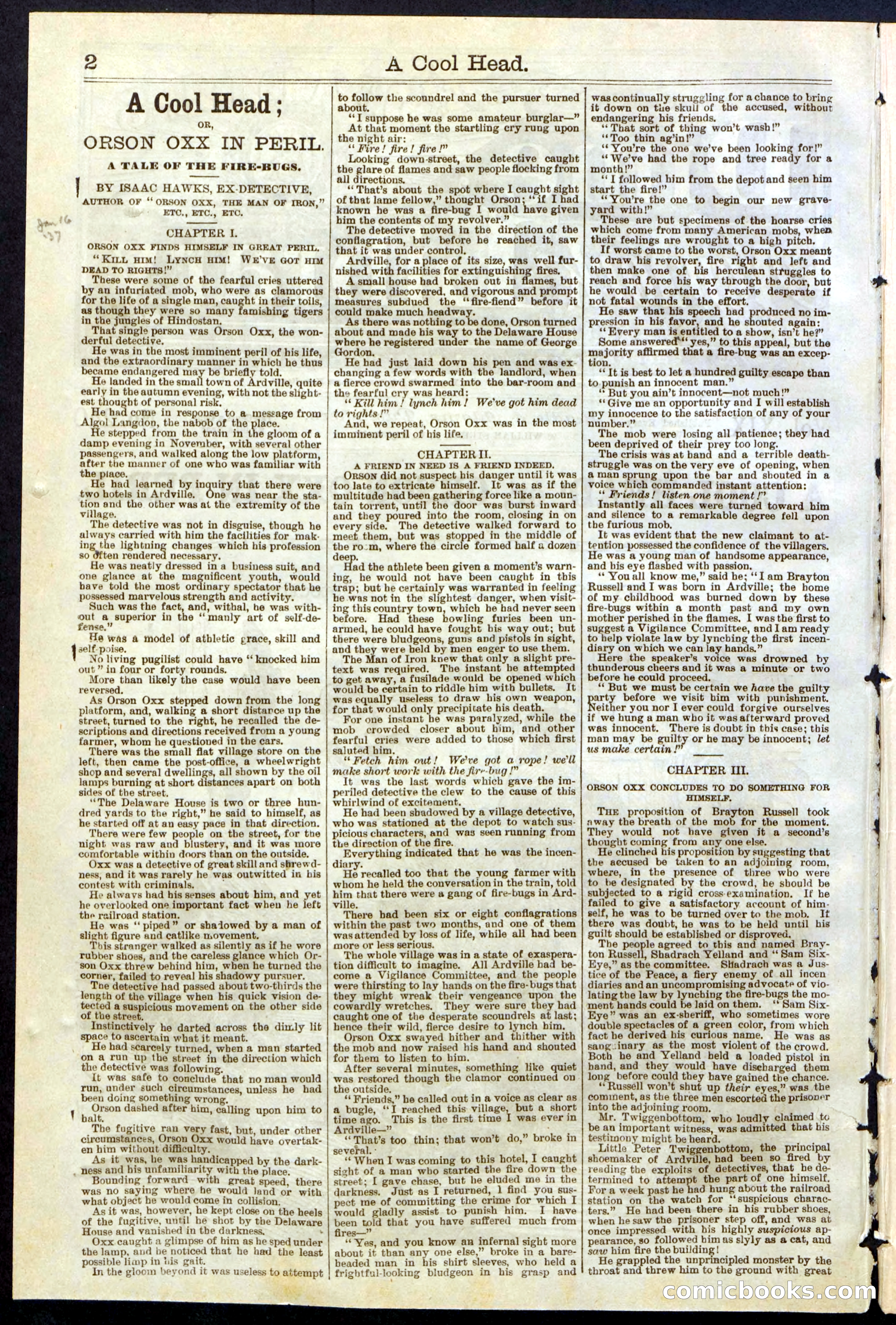
A restored page from Pulp Fiction, 1883. Page through the whole issue in the reader above.
📄 Transcribed text from this page (OCR, searchable)
Machine-transcribed from the original scan — historical spelling and the odd misread are preserved.
2 a ten ee = em eee a 5 oe ee. A Cool Head ; ORSON OXX IN PERIL, A TALE OF THE FIRE-BUGS, —_ -—- BY ISAAC HAWKS, EX-DETECTIVE, AUTHOR OF “ORSON OXX, THE MAN OF IRON,” ETC., ETC., ETC, CHAPTER I. ORSON OXX FINDS HIMSELF IN GREAT PERIL, “KILL wim! LYNCH HIM! WE'VE GOT HIM DEAD TO RIGHTS!” These were some of the fearful cries uttered by an infuriated mob, who were as clamorous for the life of a single man, caught in their toils, as though they were so many famishing tigers in the jungles of Hindostan. That single person was Orson Oxx, the won- derful detective. He was in the most imminent peril of his life, and the extraordinary manner in which he thus became endangered may be briefly told. He landed in the small town of Ardville, quite early in the autumn evening, with not the slight- est oh of personal risk, He had come in response to a message from A Langdon, the nabob of the place. e stepped from the train in the gloom of a damp evening in November, with several other passengers, and walked along the low platform, after the manner of one who was familiar with the piace. He had learned by inquiry that there were two hotels in Ardville. One was near the sta- a hy and the other was at the extremity of the village. The detective was not in disguise, though he rll? carried with him the facilities for mak- ing the lightning changes which his profession so Often rendered necessary. He was neatly dressed in a business suit, and one glance at the magnificent youth, would bave told the most ordinary spectator that he possessed marvelous strength and activity. Such was the fact, and, withal, he was with- out a superior in the ‘“‘manly art of self-de- fense.” He was a model of athletic grace, skill and | self. poise. No living pugilist could have “ knocked him out” in four or forty rounds. More than likely the case would have been reversed, As Orson Oxx stepped down from the long platform, and, walking a short distance up the street, turned to the right, he recalled the de- scriptions and directions received from a young farmer, whom he questioned in the cars. There was the small flat village store on the left, then came the post-office, a wheelwright shop and several dwellings, all shown by the oil lamps burning at short distances apart on both sides of the street. “The Delaware House is two or three hun- dred yards to the right,” he said to himself, as he started off at an easy pace in that direction. There were few people on the street, for the night was raw and blustery, and it was more comfortable within doors than on the outside. Oxx was a detective of great skill and shrewd- ness, and it was rarely he was outwitted in bis contest with criminals. He always had his senses about him, and yet he overlooked one important fact when he left the railroad station. He was “piped” or shalowed by a man of slight figure and catlike novement. This stranger walked as silently as if he wore rubber shoes, and the careless glance which Or- son Oxx threw behind him, when he turned the corner, failed to reveal his shadowy pursuer. The detective had passed about two-thirds the length of the village when his quick vision de- tected a suspicious movement on the other side of the trect. Instinctively he darted across the dimly lit space to ascertain what it meant. _ He had scarcely turned, when a man started on a run up the street in the direction which the detective was following. it was safe to conclude that no man would run, under such cireumstances, unless he had been doing something wrong. { oe dashed after him, calling upon him to _The fugitive ran very fast, but, under other circumstances, Orson Oxx would have overtak- en him without difficulty. As it was, he was handicapped by the dark- _ ness and his unfamiliarity with the place. Bounding forward with great speed, there was no saying where he would land or with what object be would come in collision, As it was, however, he kept close on the heels of the fugitive, until he shot by the Delaware House and vanished in the darkness. . Oxx caught a glimpse of him as he sped under the lamp, and be noticed that he had the least possible limp in tis gait. In the gloom beyond it was useless to attempt as A Cool Head. to an the scoundrel and the pursuer turned about. ‘*T suppose he was some amateur burglar—” At that moment the startling cry rung upon the night air: “‘ Fire! fire! fire!” " Looking down-street, the detective caught the ae of flames and saw people flocking from all directions. ‘“That’s about the spot where I caught sight of that lame fellow,” thought Orson; ‘‘if I had known he was a fire-bug I would have given him the contents of my revolver.” The detective moved in the direction of the conflagration, but before he reached it, saw that it was under control. Ardville, for a place of its size, was well fur- nished with facilities for extinguishing fires A small house had broken out in flames, but they were discovered, and vigorous and prompt measures subdued the ‘‘fire-fiend” before it could make much oe ralaben 68 As there was nothing to be done, Orson turned about and made his way to the Delaware House noere he registered under the name of George rdon. He had just laid down bis pen and was ex- changing a few words with the landlord, when a fierce crowd swarmed into the bar-room and the fearful cry was heard: : “ Kill him! lynch him! We've got him dead to rights!” And, we repeat, Orson Oxx was in the most imminent peril of his life. CHAPTER II. A FRIEND IN NEED IS A FRIEND INDEED, ORSON did not suspect his danger until it was too late to extricate himself. It was as if the multitude had been gathering force like a moun- tain torrent, until the door was burst inward and they poured into the room, closing in on every side. The detective walked forward to meet them, but was stopped in the middle of the ro-m, where the circle formed half a dozen deep. Had the athlete been given a moment’s warn- ing, he would not have been caught in this trap; but he certainly was warranted in feeling he was not in the slightest danger, when visit- ing this country town, which he had never seen before. these bowling furies been un- armed, he could have fought bis way out; but there were bludgeons, guns and pistols in sight, and they were beld by men eager to use them. The Man of Iron knew that only a slight pre- text was required. The instant he attempted to get away, a fusilade would be opened which would be certain to riddle him with bullets. It was equally useless to draw his own weapon, for that would only precipitate his death, For one instant be was paralyzed, while the mob crowded closer about him, and other fearful cries were added to those which first saluted him. “ Fetch him out! We've got a rope! we'll make short work with the firv-bug !” It was the last words which gave the im- periled detective the clew to the cause of this whirlwind of excitement. He had been shadowed by a village detective, who was stationed at the depot to watch sus- picious characters, and was seen running from the direction of the fire. ‘ Everything indicated that he was the incen- iary. He recalled too that the young farmer with whom he held the conversation in the train, told him that there were a gang of fire-bugs in Ard- ville. There bad been six or eight conflagrations within the past two months, and one of them was attended by loss of life, while all had been more or less serious. The whole village was in a state of exaspera- tion difficult to imagine. AJl Ardville had be- come a Vigilance Committee, and the people were thirsting to lay hands on the fire-bugs that they might wreak their vengeance n the cowardly wretches. They were sure they had caught one of the desperate scoundrels at last; hence their wild, fierce desire to lynch him, Orson Oxx swayed hither and thither with the mob and now raised his hand and shouted for them to listen to him. 3 After several minutes, something like quiet was restored though the clamor continued on the outside. : ‘‘ Friends,” be called out in a voice as clear as a bugle, “I reached this village, but a short time ago. This is the first time I was ever in Ardville—” “'That’s too thin; that won’t do,” broke in several. ‘When I was coming to this hotel, I caught sizht of a man who started the fire down the street; [ gave chase, but he eluded me in the darkness. Just as I returned, 1 find you sus- pect me of committing the crime for which I would gladly assist to punish him. I have been told that you have suffered much from fires—” ‘‘-Yes, and you know an infernal sight more about it than any one else,” broke in a bare- beaded man in his shirt sleeves, who held a | frigbtful-looking bludgeon in his grasp and ee - a re ee ee — was continually struggling for a chance to bring it down on tue skull of the accused, without endangering his friends. ‘That sort of thing won’t wash!” ‘*Too thin ag’in!” ‘*'You’re the one we’ve been looking for!” ‘We've had the rope and tree ready for a month!” ‘I followed him from the depot and seen him start the fire!” ‘“'You’re the one to begin our new grave- yard with!” These are but specimens of the hoarse cries which come from many American mobs, whepa their feelings are wrought to a bigh pitch. If worst came to the worst, Orson Oxx meant to draw his revolver, fire right and left and then make one of bis herculean struggles to reach and force his way through the door, but he would be certain to receive desperate if not fatal wounds in the effort. He saw that his speech had pees no im- pression in his favor, and he shouted again: ‘*Every man is entitled to a show, isn’t he?” Some answered“ yes,” to this appeal, but the mpasoesty affirmed that a fire-bug was an excep- tion. “Tt is best to let a hundred guilty escape than to. punish an innocent man.” ** But you ain’t innocent—not much!” **Give me an opportunity and I will establish my innocence to the satisfaction of any of your number.” The mob were losing all patience; they had been deprived of their prey too long. The crisis was at band and a terrible death- struggle was on the very eve of opening, when & man sprung upon the bar and shouted in a voice which commanded instant attention: ‘“* Friends! listen one moment !” Instantly all faces were turned toward him and silence to a remarkable degree fell upon the furious mob, It was evident that the new claimant to at- tention possessed the confidence of the villagers. He was a young man of handsome appearance, and his eye flashed with passion. ** You all know me,” said be; ‘‘I am Brayton Russell and I was born in Ardville; the home of my childhood was burned down by these fire-bugs within a month past and my own mother perished in the flames, I was the first to suggest a Vigilance Committee, and 1am ready to help violate law by lyncbing the first incen- diary on which we can lay hands.” Here the speaker’s voice was drowned by thunderous cheers and it was a minute or two before he could proceed, ** But we must be certain we have the guilty arty before we visit bim with punishment. either you nor I ever could forgive ourselves if we hung a man who it was afterward proved was innocent. There is doubt in this case; this man may be guilty or he may be innocent; let us make certain !’ CHAPTER III. ORSON OXX CONCLUDES TO DO SOMETHING FOR HIMSELF, THE proposition of Brayton Russell took away the breath of the mob for the moment. They would not have given it a second’s thought coming from any one else. He clinched his proposition by suggesting that the aecused be taken to an adjoining room, where, in the presence of three who were to be designated by the crowd, he should be subjected to a rigid cross-examination. If he failed to give a satisfactory account of him- self, he was to be turned over to the mob. It there was doubt, he was to be held until his guilt should be established or disproved. The people agreed to this and named PBray- ton Russell, Shadrach Yelland and “Sam Six- Eye,” as the committee. SHadrach was a Jus- tice of the Peace, a fiery enemy of all incen diaries and an uncompromising advocate of vio- lating the law b Sheer y) the fire-bugs the mo- ment hands could be laid onthem. ‘* Sam Six- Eye” was an ex-sheriff, who sometimes wore double spectacles of a green color, from which fact be derived his curious name. He was as sang inary as the most violent of the crowd. Both be and Yelland held a loaded pistol in band, and they would have diseharged them long before could they have gained the chance. Russell won’t shut up their eyes,” was the comment, as the three men escorted the prisoper into the adjoining room. Twiggenbottom, who aay claimed to be an important witness, was admitted that his testimony might be heard. ; Little Peter Twiggenbottom, the principal shoemaker of Ardville, had been so fired by reading the exploits of detectives, that he de- termined to attempt the part of one himself, For a week past he had hung about the railroad station on the watch for ‘‘suspicious charac- ters.” He had been there in his rubber shoes, when he saw the prisoner step off, and was at once impressed with his highly icious ap- pearance, so followed bimas slyly as a cat, and saw him fire the building! He grappled the unprincipled monster by the throat and threw him to the ground with great Eomichbooks (0) <> de entice tm i MMM ~ —