
Pulp Fiction, 1883 · page 29 of 32
Beadle's Dime Library, No. 240 — page 29: what you’re looking at
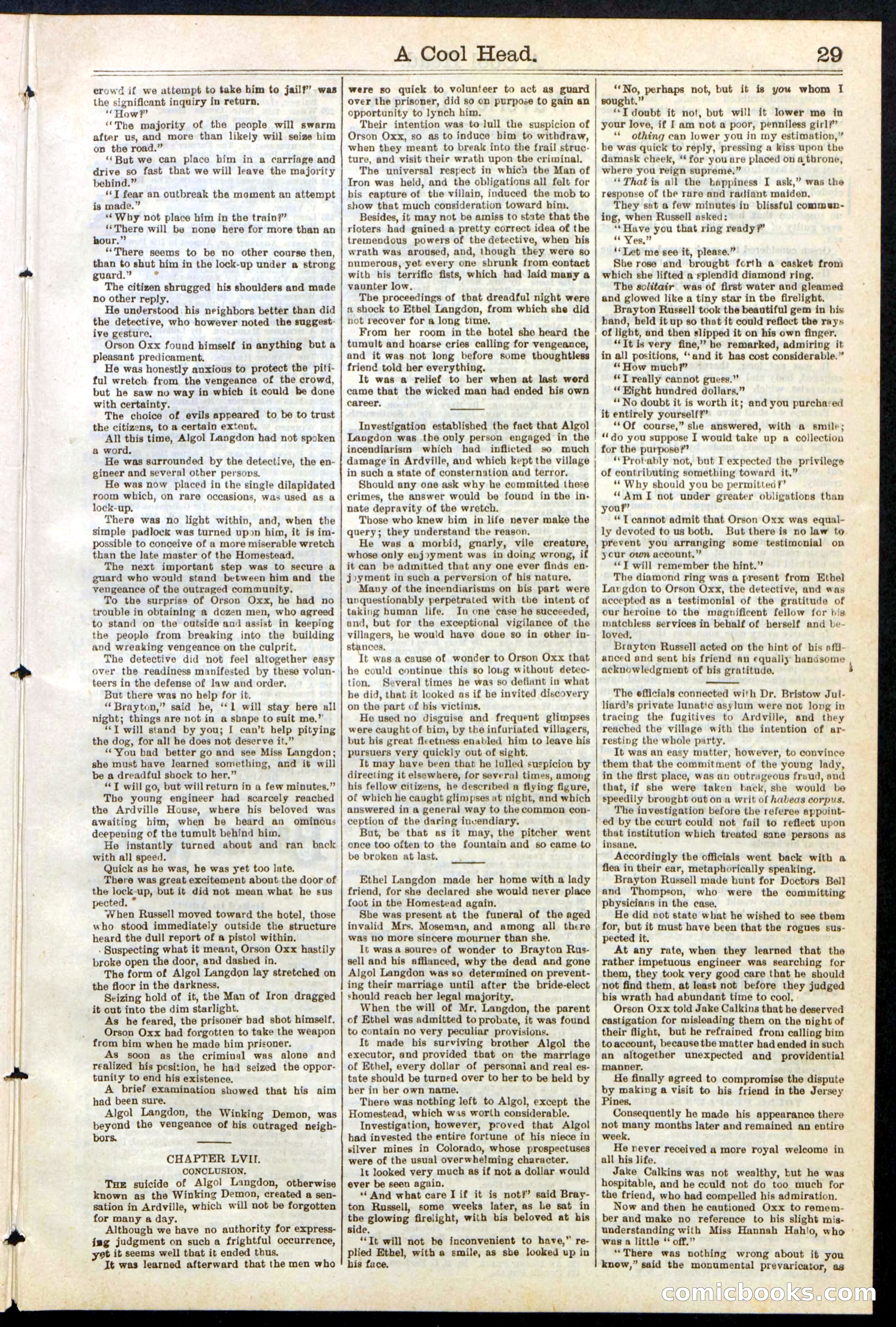
A restored page from Pulp Fiction, 1883. Page through the whole issue in the reader above.
📄 Transcribed text from this page (OCR, searchable)
Machine-transcribed from the original scan — historical spelling and the odd misread are preserved.
crowd if we attempt to take him to jailf’ was the significant inquiry in return, ‘How?’ ‘‘The majority of the people will swarm after us, and more than likely will seize him on the road.” ‘(But we can place bim in a carriage and drive so fast that we will leave the majority behind.” ‘‘T fear an outbreak the moment an attempt is made.” ‘“*Why not place him in the train?’ ‘*There will be none here for more than an hour.” ‘There seems to be no other course then, than to shut him in the lock-up under a strong guard.” ? The citizen shrugged his shoulders and made no other reply. He understood his neighbors better than did the detective, who however noted the suggest- ive gesture, Orson Oxx found himself in anything but a pleasant predicament. He was honestly anxious to protect the piti- ful wretch from the vengeance of the crowd, but he saw no way in which it could be done with certainty. The choice of evils appeared to be to trust the citizens, to a certain extent. All this time, Algol Langdon had not spoken a word. He was surrounded by the detective, the en- gineer and several other persons. He was now placed in the single dilapidated room which, on rare occasions, was used as a lock-up. There was no light within, and, when the simple padlock was turned upon him, it is im- possible to conceive of a more miserable wretch than the late master of the Homestead. The next important step was to secure a guard who would stand between him and the vengeance of the outraged community. To the surprise of Orson Oxx, he had no trouble in obtaining a dozen men, who agreed to stand on the outside and assist in keeping the people from breaking into the building and wreaking vengeance on the culprit. The detective did not feel altogether easy over the readiness manifested by these volun- teers in the defense of law and order, But there was no help for it. ** Brayton,” said he, ‘1 will stay here all night; things are not in a sbape to suit me,” ‘*T will stand by you; I can’t help pitying the dog, for all he does not deserve it.” ‘You bad better go and see Miss Langdon; she must have learned something, and it will be a dreadful shock to her.” “T will go, but willreturn in a few minutes.” The young engineer had scarcely reached the Ardvilla House, where his beloved was awaiting bim, when be heard an ominous deepening of the tumult behind him. He instantly turned about and ran back with all speed, Quick as he was, he was yet too late. There was great excitement about the door of the lock-up, but it did not mean what he sus pected, * When Russell moved toward the hotel, those who stood immediately outside the structure heard the dull report of a pistol within. . Suspecting what it meant, Orson Oxx hastily broke open the door, and dashed in. The form of Algol Langdon lay stretched on the floor in the darkness. Seizing hold of it, the Man of Iron dragged it out into the dim starlight. As he feared, the prisoner bad shot himself. Orson Oxx had forgotten to take the weapon - from bim when he made bim prisoner. As soon as the criminal was alone and realized his position, he had seized the oppor- tunity to end his existence. A brief examination showed that his aim had been sure. Algol Langdon, the Winking Demon, was beyond the vengeance of his outraged neigh- bors. CHAPTER LVII. CONCLUSION, Tue suicide of Algol Langdon, otherwise known as the Winking Demon, created a sen- sation in Ardville, which will not be forgotten for many a day. Although we have no authority for express- jag judgment on such a frightful occurrence, yet it seems well that it ended thus. It was learned afterward that the men who a - —_ —$—$—$—$—$—$— nn _An Poe! pete --—— + were so quick to volunteer to act as guard over the prisoner, did so on purpose to gain an opportunity to lynch him. Their intention was to lull the suspicion of Orson Oxx, so as to induce him to withdraw, when they meant to break into the frail struc- ture, and visit their wrath upon the criminal. The universal respect in which the Man of Tron was held, and the obligations all felt for bis capture of the villain, induced the mob to show that much consideration toward him. Besides, it may not be amiss to state that the rioters had gained a pretty correct idea of the tremendous powers of the detective, when his wrath was aroused, and, though they were so numerous, yet every one shrunk from contact with his terrific fists, which had laid many a vaunter low. The proceedings of that dreadful night were a shock to Ethel Langdon, from which she did not recover for a long time. From her room in the hotel she heard the tumult and hoarse cries calling for vengeance, and it was not long before some thoughtless friend told her everything. It was a relief to her when at last word came that the wicked man had ended his own career. Investigation established the fact that Algol Langdon was the ovly person engaged in the incendiarism which had inflicted so much damage in Ardville, and which kept the village in such a state of consternation and terror. Should any one ask why he committed these crimes, the answer would be found in the in- nate depravity of the wretch. Those who knew him in life never make the query; they understand the reason. He was a morbid, gnarly, vile creature, whose only enjoyment was in doing wrong, if it can be admitted that any one ever finds en- j>yment in such a perversion of his nature, Many of the incendiarisms on bis part were unquestionably perpetrated with the intent of taking buman life. In one case he succeeded, and, but for the exceptional vigilance of the villagers, he would have dove go in otber in- stances, It was a cause of wonder to Orson Oxx that he could continue this so loug without detec- tion. Several times he was so defiant in what he did, that it looked as if be invited discovery on the part of bis victims. He used no disguise and frequent glimpses were caught of bim, by the infuriated villagers, but his great fleetiess enabled him to leave his pursuers very quickly out of sight. It may have been that he lulled suspicion by directing it elsewhere, for several times, among his fellow citizens, he described a flying figure, of which he caught glimpses at night, and which answered in a general way to the common con- ception of the daring invendiary. But, be that as it may, the pitcher went once too often to the fountain and so came to be broken at last. Ethel Langdon made her home with a lady friend, for she declared she would never place foot in the Homestead again. She was present at the funeral of the aged invalid Mrs, Moseman, and among all there was no more sincere mourner than she. lt was a soures of wonder to Brayton Rus- sell and his afflanced, why the dead and gone Algol Langdon was so determined on prevent- ing their marriage until after the bride-elect should reach her legal majority. When the will of Mr, Langdon, the parent of Ethel was admitted to probate, it was found to contain no very peculiar provisions. It made his surviving brother Algol the executor, and provided that on the marriage of Ethel, every dollar of personai and real es- tate should be turned over to her to be held by ber in ber own name. There was nothing left to Algol, except the Homestead, which was worth considerable. Investigation, however, proved that Algol had invested the entire fortune of his niece in silver mines in Colorado, whose prospectuses were of the usual overwhelming character. lt looked very mucb as if not a dollar would ever be seen again. ‘‘ And what care lif it is not?’ said Bray- ton Russell, some weeks later, as Le sat in the glowing firelight, with bis beloved at his side, “Tt will not be inconvenient to have,” re- plied Ethel, with a smile, as sbe looked up in his face. = eee ease eee eee... 29 **No, perhaps not, but it is you whom I sought.” **T doubt it not, but will it lower me in your love, if I am not a poor, penniless girl?” ** othing can lower you in my estimation,” he was quick to reply, pressing a kiss upon the damask cheek, “‘ for you are placed on a throne, where you reign supreme.” ‘* That is all the happiness I ask,” was the response of the rure and radiant maiden. They sat a few minutes iv blissful commun- ing, when Russell asked: ‘*Have you that ring ready?” “ Yes,” ‘Let me see it, please.” She rose and brought forth a casket from which she lifted a splendid diamond ring. The solitair was of first water and gleamed and glowed like a tiny star in the firelight. Brayton Ruseell took the beautiful gem in bis hand, beld it up so that it could reflect the rays of light, and then slipped it on his own finger. “It is very fine,” be remarked, admiring it in all positions, ‘‘and it has cost considerable.” “How much?” — “T really cannot guess.” ‘Bight hundred dollars,” “No doubt it is worth it; and you purchased it entirely yourself?’ ‘Of course,” she answered, with a smile; ‘do you suppose I would take up a collection for the purpose?’ **Protably not, but I expected the privilege of contributing something toward it,” ‘* Why should you be permitted?’ “Am I not under greater obligations than your’ “T cannot admit that Orson Oxx was equal- ly devoted to us both. But there is no law to prevent you arranging some testimonial on your own account,” ‘*T will remember the hint.” The diamond ring was a present from Ethel Largdon to Orson Oxx, the detective, and was _ accepted as a testimonial of the gratitude of our heroine to the magnificent fellow for his matchless services in bebalf of herself and be- loved, Brayton Russell acted on the hint of bis affi- anced and sent bis friend an equally handsome acknowledgment of bis gratitude, The efficials connected with Dr. Bristow Jul- liard’s private lunatic asylum were not long in tracing the fugitives to Ardville, and they reached the village with the intention of ar- resting the whole party. It was an easy matter, however, to convince them that the commitment of the young lady, in the first place, was an outrageous fraud, and that, if she were taken back, she would be speedily brought out on a writ of habeas corpus. The investigation before the referee appoint- ed by the court could not fail to reflect upon that institution which treated sane persons as insane, Accordingly the officials went back with a flea in their ear, metaphorically speaking. Brayton Russell made hunt for Doctors Bell and Thompson, who were the committing pbysicians in the case. He did not state what he wished to see them for, but it must have been that the rogues sus- pected it. At any rate, when they learned that the rather impetuous engineer was searching for them, they took very good care that he should not find them, at least not before they judged his wrath had abundant time to cool. Orson Oxx told Jake Calkins that he deserved castigation for misleading them on the night of their flight, but he refrained from calling bim toaccount, because the matter had ended in such an altogether unexpected and providential manner. He finally agreed to compromise the dispute by making a visit to his friend in the Jersey Pines, Consequently he made his appearance there not many months later and remained an entire week. He never received a more royal welcome in all his life. Jake Calkins was not wealthy, but he was hospitable, and he could not do too much for the friend, who had compelled his admiration. Now and then he cautioned Oxx to remem- ber and make no reference to his slight mis- understanding with Miss Hannah Hahlo, who ~ was a little “‘ off.” “There was nothing wrong about it you know,” said the monumental prevaricator, ag eo Gomilcbooks (E(0) a