
Pulp Fiction, 1883 · page 28 of 32
Beadle's Dime Library, No. 240 — page 28: what you’re looking at
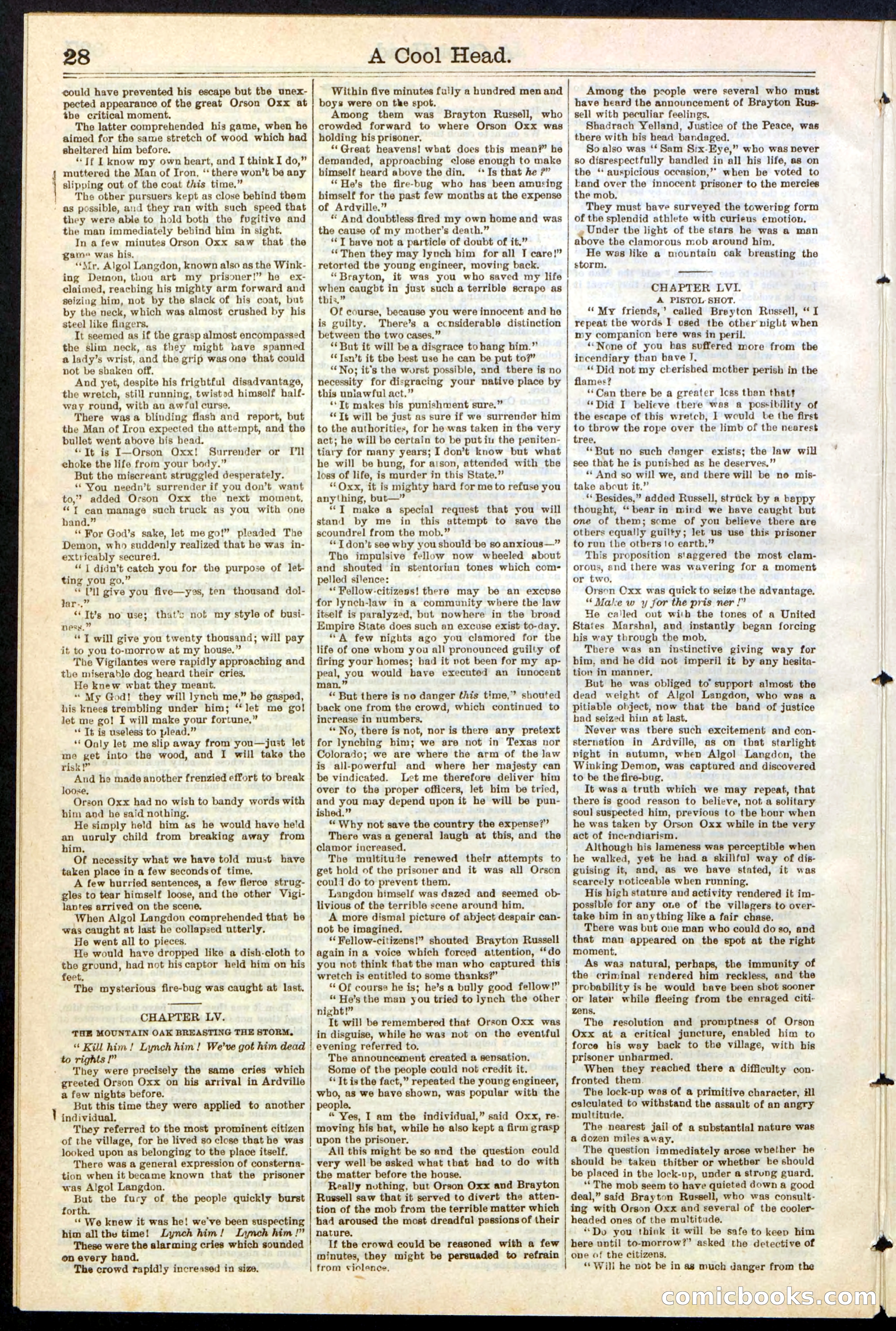
A restored page from Pulp Fiction, 1883. Page through the whole issue in the reader above.
📄 Transcribed text from this page (OCR, searchable)
Machine-transcribed from the original scan — historical spelling and the odd misread are preserved.
D8 em ow <n Lai, eS could have prevented his escape but the unex- A Cool Head. eo reo pow = come ee Within five minutes fully a bundred men and pected appearance of the great Orson Oxx at | boys were on the spot. tbe critical moment. The latter comprehended his game, when he aimed for the same stretch of wood which had sheltered him before. “If I know my own heart, and I think I do,” muttered the Man of Iron, ‘“ there won’t be any slipping out of the coat this time.” The other pursuers kept as close behind them as possible, and they ran with such speed that they were able to hold both the fugitive and the man immediately bebind him in sight, In a few minutes Orson Oxx saw that the game was bis. ‘Mr. Algol Langdon, known also as the Wink- ing Demon, thou art my prisoner!” he ex- claimed, reaching his mighty arm forward and seizing him, not by the slack of his coat, but by the neck, which was almost crushed by his steel like fingers. It seemed as if the grasp almost encompassed the slim neck, as they might have spanned a lady’s wrist, and the grip was one that could not be sbaken off. And yet, despite his frightful disadvantage, the wretch, still running, twisted himself half- way round, with an awful curse, There was a blinding flash and report, but the Man of Iron expected the attempt, and the bullet went above bis head. “It is I—Orson Oxx! Surrender or [ll choke the life from your body.” But the miscreant struggled desperately. ‘You needn’t surrender if you don’t want to,” added Orson Oxx the next moment, ‘‘T can manage such truck as you with one band.” ‘‘ For God’s sake, let me go!” pleaded The Demon, who suddenly realized that he was in- extricably secured. ‘« | didn’t catch you for the purpose of let- ting you go.” “ [tl give you five—yas, ten thousand dol- Jar-,” ‘ Tt’s no use; that’s nob my style of busi- ness.” “ T will give you twenty thousand; will pay it to you to-morrow at my house.” The Vigilantes were rapidly approaching and the miserable dog heard their cries, He knew what they meant. “My God! they will lynch me,” he gasped, his knees trembling under him; “let me gol let me go! I will make your fortune,” ‘Tt ig useless to plead.” ‘‘ Only let me slip away from you—just let me get into the wood, and I will take the risk!” And he made another frenzied effort to break loose, Orson Oxx had no wish to bandy words with him and he said nothing. He simply held him as he would have held an uoruly child from breaking away from him, Of necessity what we have told must have taken place in a few secondsof time. A few hurried sentences, a few fierce strug- gles to tear himself loose, and the other Vigi- lantes arrived on the scene, When Algol Langdon comprehended that he was caught at last he collapsed utterly. He went all to pieces. He would have dropped like a dish-cloth to the ground, had not his captor held him on his feet, The mysterious fire-bug was caught at last. CHAPTER LV. THE MOUNTAIN OAK BREASTING THE STORM, “ Kill hin ! Lynch him! We've got him dead to rights !” They were precisely the same cries which greeted Orson Oxx on his arrival in Ardville a few nights before. But this time they were applied to another Y individual. They referred to the most prominent citizen of the village, for he lived so close that he was looked upon as belonging to the place itself. There was a general expression of consterna- tion when it became known that the prisoner was Algol Langdon. But the fury of the people quickly burst forth. ‘‘ We knew it was he! we've been suspecting him all the time! Lynch him! Inmch him!” These were the alarming cries which sounded on every hand. The crowd rapidly increased in size. Among them was Brayton Ruesell, who crowded forward to where Orson Oxx was | holding his prisoner, ‘*Great heavens! what does this mean?” be demanded, approaching close enough to make himself heard above the din. ‘' Is that Ae ?” ‘‘He’s the fire-bug who has been amusing bimself for the past few months at the expense of Ardville.” * And doubtless fired my own home and was the cause of my mother’s death.” **T bave not a particle of doubt of it.” ‘Then they may lynch bim for all IT care!” retorted the young engineer, moving back. “Brayton, it was you who saved my life when caugbt in just such a terrible scrape as this.” Of course, because you were innocent and he is guilty. There’s a eccnsiderable distinction between the two cases.” ‘* But it will bea disgrace tohang him.” ‘**Isn’t it the best use he can be put to?” ““No; it’s the worst possible, and there is no necessity for disgracing your native place by this uniawful act.” ‘*Tt makes his punishment sure.” ‘¢Tt will be just as sure if we surrender him to the authorities, for he was taken in the very act; he will be certain to be putiu the peniten- tiary for many years; I don’t know but what he will be bung, for arson, attended with the loss of life, is murder in this State.” ‘*Oxx, it is mighty hard for me to refuse you anything, but—” ‘*T make a special request that you will stand by me in this attempt to save the scoundrel from the mob.” **T don’t see why you should be so anxious—” The impulsive fellow now wheeled about and shouted in stentorian tones which com- pelled silence: **Fellow-citizess! there may be an excuse for lynch-law in a community where the law itself is paralyzed, but nowhere in the broad Empire State does such an excuse exist to-day. ‘A few nights ago you clamored for the life of one whom you all pronounced guilty of firing your homes; bad it not been for my ap- peal, you would bave executed an innocent man.” “ But there is no danger this time,” shouted back one from the crowd, which continued to increase in numbers. “No, there is not, nor is there any pretext for lynching him; we are not in Texas nor Colorado; we are where the arm of the Jaw is all-powerful and where her majesty can be vindicated. Let me therefore deliver him over to the proper officers, let bim be tried, and you may depend upon it he will be pun- ished.” “ Why not save the country the expense?” There was a general laugh at this, and the clamor increased. The multituie renewed their attempts to get hold of the prisoner and it was all Orson could do to prevent them. Langdon himself was dazed and seemed ob- livious of the terrible scene around him. A more dismal picture of abject despair can- not be imagined. ‘“ Fellow-citizens!” shouted Brayton Russell again in a voice which forced attention, ‘‘do you not think that the man who captured this wretch is entitled to some thanks?” “ Of course he is; he’s a bully good fellow!” “ He’s the man you tried to lynch the other night!” It will be remembered that Orson Oxx was in disguise, while he was not on the eventful evening referred to. The announcement created a sensation. Some of the people could not credit it. ‘It is the fact,” repeated the young engineer, who, as we bave shown, was popular with the people, “ Yes, I am the individual,” said Oxx, re- moving his hat, while he also kept a firm grasp upon the prisoner. All this might be so and the question could very well be asked what that had to do with the matter before the house. Really nuthing, but Orson Oxx and Brayton Russell saw that it served to divert the atten- tion of the mob from the terrible matter which bad aroused the most dreadful passions of their nature. If the crowd could be reasoned with a few minutes, they might be persuaded to refrain from violence. Among the psople were several who must have heard the announcement of Brayton Rus- sell with peculiar feelings. Shadrach Yelland, Justice of the Peace, was there with bis head bandaged. So also was ‘Sam S:ix-Eye,” who was never so disrespectfully bandled in all his life, as on the * auspicious occasion,’’ when be voted to band over the innocent prisoner to the mercies the mob. They must bave surveyed the towering form of the splendid athlete with curieus emotion. Under tbe light of the stars he was a man above the clamorous mob around him. He was like a mountain oak breasting the storm. CHAPTER LVI. A PISTOL SHOT. ‘‘ My friends,’ called Breyton Russell, “ I repeat the words I oged the other night when my companion here was in peril. ‘““None of you bas suffered more from the incendiary than bave J. “‘Did not my cherished mother perish in the flames? ‘‘Can there be a greater loss than that? ‘“‘Did I believe there was a possibility of the escape of this wretch, I would be the first to throw the rope over the limb of the nearest tree, ‘But no such danger exists; the law will see that he is punished as he deserves.” ‘* And so will we, and there will be no mis- take about it.” ‘‘ Besides,” added Russell, strick by a bappy thought, “bear in mind we have caught but one of them; some of you believe there are others equally guilty; let us use this prisoner to run the others !o earth.” This proposition staggered the most clam- orous, and there was wavering for a moment or two, Orson Cxx was quick to seize the advantage. “ Male w y for the pris ner !” He called out witb the tones of a United States Marshal, and instantly began forcing his way through the mob. There was an instinctive giving way for bim, and he did not imperil it by any hesita- tion in manner, But he was obliged to’ support almost the dead weight of Algol Langdon, who was a pitiable object, now that the band of justice had seized biin at last. Never was there such excitement and con- sternation in Ardville, as on that starlight night in autumn, when Algol Langdon, the Winking Demon, was captured and discovered to be the fire-bug. It was a truth which we may repeat, that there is good reason to believe, not a solitary soul suspected him, previous to tbe hour when he was taken by Orson Oxx while in the very act of incendiarism. Although his lameness was perceptible when he walked, yet be bad a skillful way of dis- guising it, and, as we have stated, it was scarcely noticeable when running. His high stature and activity rendered it im- possible for any one of the villagers to over- take him in anything like a fair chase. There was but one man who could do so, and that man appeared on the spot at the right moment, As was natural, perbaps, the immunity of the criminal rendered him reckless, and the probability is he would bave been shot sooner ' or later while fleeing from the enraged citi- zens. The resolution and promptness of Orson Oxx at a critical juncture, enabled him to force his way back to the village, with his prisoner unharmed. When they reached there a difficulty oon- fronted them. The lock-up was of a primitive character, il calculated to withstand the assault of an angry multitude. The nearest jail of a substantial nature was a dozen miles away, The question immediately arose whether he should be taken thither or whether be should be placed in the lock-up, under a strung guard. ‘*The mob seem to have quieted down a good deal,” said Brayton Russell, who was consult- ing with Orson Oxx and several of tbe cooler- headed ones of the multitude. ‘““Do you think it will be safe to keep him here until to-morrow?” asked the detective of ove of the citizens. ‘* Will he not be in as much danger from the Eomicbooks (E(0)