
Pulp Fiction, 1883 · page 15 of 32
Beadle's New York Dime Library, No. 239 — page 15: what you’re looking at
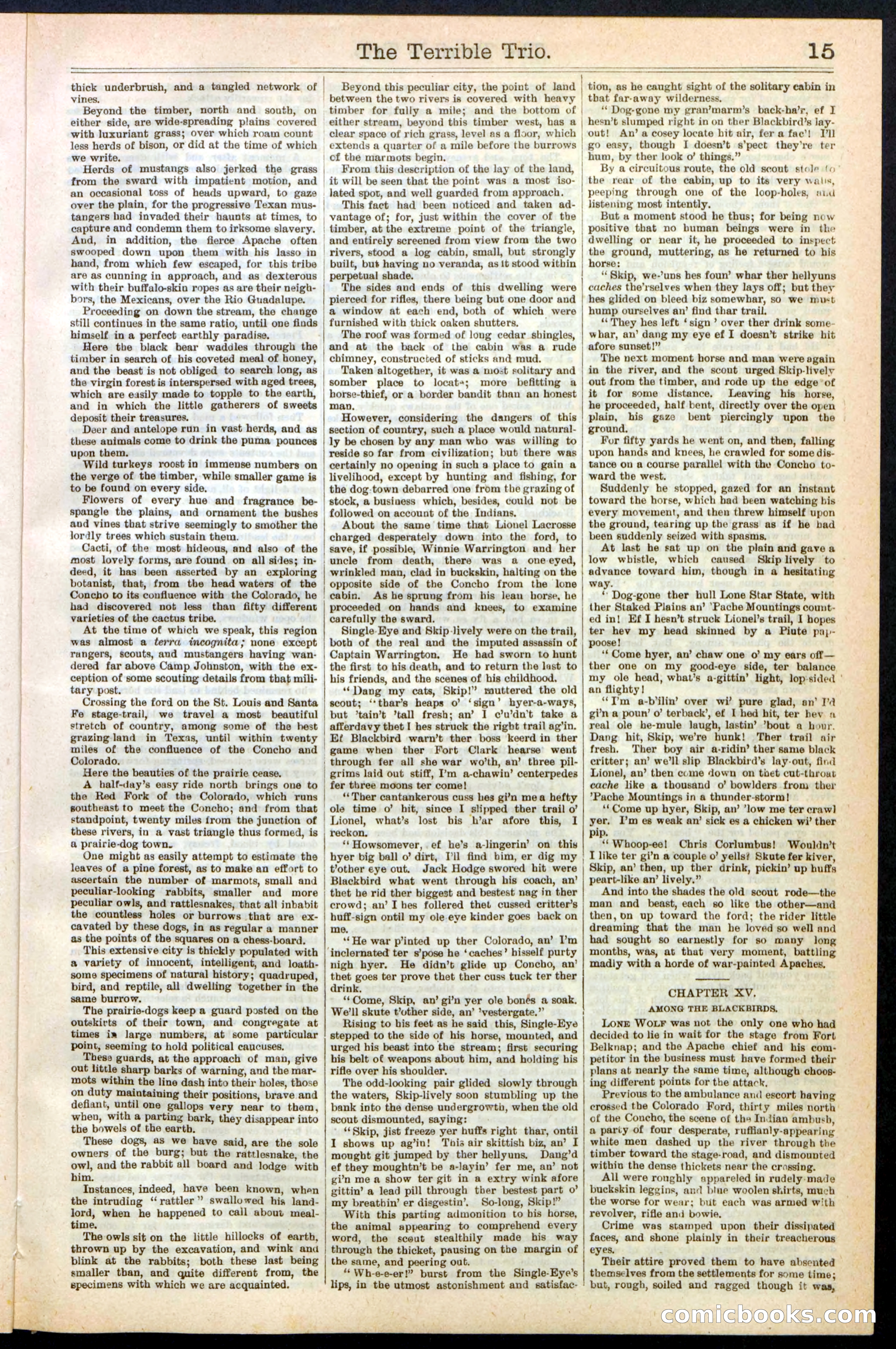
A restored page from Pulp Fiction, 1883. Page through the whole issue in the reader above.
📄 Transcribed text from this page (OCR, searchable)
Machine-transcribed from the original scan — historical spelling and the odd misread are preserved.
— —$——$——— é' i thick underbrush, and a tangled network of | vines. Beyond the timber, north and south, on either side, are wide-spreading plains covered with luxuriant grass; over which roam count less herds of bison, or did at the time of which we write. Herds of mustangs also jerked the grass from the sward with impatient motion, and an occasional toss of heads upward, to gaze over the plain, for the progressive Texan mus- tangers had invaded their haunts at times, to capture and condemn them to irksome slavery. Aud, in addition, the fierce Apache often swooped down upon them with his lasso in hand, from which few escaped, for this tribe are as cunning in approach, and as dexterous with their buffalo-skin ropes as are their neigh- | bors, the Mexicans, over the Rio Guadalupe. Proceeding on down the stream, the change still continues in the same ratio, until one finds himself in a perfect earthly paradise. Here the black bear waddles through the timber in search of bis coveted meal of honey, and the beast is not obliged to search long, as the virgin forest is interspersed with aged trees, which are easily made to topple to the earth, and in which the little gatherers of sweets deposit their treasures. Deer and antelope run in vast herds, and as these animals come to drink the puma pounces upon them. Wild turkeys roost in immense numbers on the verge of the timber, while smaller game is to be found on every side. Flowers of every hue and fragrance be- spangle the plains, and ornament the bushes aod vines that strive seemingly to smother the lordly trees which sustain them. Cacti, of the most hideous, and also of the most lovely forms, are found on all sides; in- deed, it has been asserted by an exploring botanist, that, from tbe head waters of the Concho to its confluence with the Colorado, he had discovered not less than fifty different varieties of the cactus tribe. At the time of which we speak, this region was almost a terra incognita; none except rangers, scouts, and mustangers having wan- dered far above Camp Johnston, with the ex- ception of some scouting details from that mili- tary post. Crossing the ford on the St. Louis and Santa Fe stage-trail, we travel a most beautiful stretch of country, among some of the hest grazing land in Texas, until within twenty miles of the confluence of the Concho and Colorado. Here the beauties of the prairie cease, A half-day’s easy ride north brings one to the Red Fork of the Colorado, which runs southeast to meet the Concho; and from that standpoint, twenty miles from the junction of these rivers, in a vast triangle thus formed, is a prairie-dog town. One might as easily attempt to estimate the leaves of a pine forest, as to make an effort to ascertain the number of marmots, small and peculiar-looking rabbits, smaller and more peculiar owls, and rattlesnakes, that all inbabit the countless holes or burrows that are ex- cavated by these dogs, in as regular a manner as the points of the squares on a chess-board. This extensive city is thickly populated with a variety of innocent, intelligent, and loath- some specimens of natural history; quadruped, bird, and reptile, all dwelling together in the same burrow. The prairie-dogs keep a guard posted on the outskirts of their town, and congregate at times im large numbers, at some particular point, seeming to hold political caucuses. These guards, at the approach of man, give out little sharp barks of warning, and the mar- mots within the line dash into their holes, those on duty maintaining their positions, brave and defiant, until one gallops very near to them, when, with a parting bark, they disappear into the bowels of the eartb. These dogs, as we have said, are the sole owners of the burg; but the rattlesnake, the owl, and the rabbit all board and lodge witb him. Instances, indeed, have been known, when the intruding “rattler” swallowed his land- lord, when he happened to call about meal- time. The owls sit on the little hillocks of earth, thrown up by the excavation, and wink and blink at the rabbits; both these last being smaller than, and quite different from, the specimens with which we are acquainted. | The ‘Terrible Trio. Beyond this peculiar city, the point of land 15 ee ees ee tion, as he caught sight of the solitary eabin in between the two rivers is covered with heavy timber for fully a mile; and the bottom of | either stream, beyond this timber west, has a clear space of rich grass, level as a floor, which | extends a quarter of a mile before the burrows of the marmots begin. From this description of the lay of the land, | it will be seen that the point was a most iso- lated spot, and well guarded from approach. | This fact had been noticed and taken ad- vantage of; for, just within the cover of the | | timber, at the extreme point of the triangle, and entirely screened from view from the two rivers, stood a log cabin, small, but strongly | built, but having no veranda, as it stood witbin | perpetual shade. The sides and ends of this dwelling were pierced for rifles, there being but one door and a window at each end, both of which were furnished with thick oaken shutters. The roof was formed of long cedar shingles, and at the back of the cabin was a rude _ chimney, constructed of sticks and mud. Taken altogether, it was a most solitary and somber place to locats; more befitting a horse-thief, or a border bandit than an honest man. However, considering the dangers of this section of country, such a place would natural- ly be chosen by any man who was willing to reside so far from civilization; but there was certainly no opening in such a place to gain a livelihood, except by hunting and fishing, for the dog-town debarred one from tbe grazing of stock, a business which, besides, could not be followed on account of the Indians, About the same time that Lionel Lacrosse charged desperately down into the ford, to save, if possible, Winnie Warrington and her uncle from death, there was a one eyed, wrinkled man, clad in buckskin, halting on the opposite side of the Concho from the lone cabin. As he sprung from his lean horse, be proceeded on hands and knees, to examine carefully the sward. Single-Eye and Skip-lively were on the trail, both of the real and the imputed assassin of | Captain Warrington, He had sworn to hunt | the first to his death, and to return the last to his friends, and the scenes of his childhood, ‘‘Dang my cats, Skip!” muttered the old scout; ‘‘thar’s heaps o’ ‘sign’ hyer-a-ways, but ’tain’t ’tall fresh; an’ I c’u’dn’t take a | afferdavy thet I hes struck the right trail ag’in. | Et Blackbird warn’t ther boss keerd in ther game when ther Fort Clark hearse went | through fer all she war wo’th, an’ three pil- | grims laid out stiff, ’m a-chawin’ centerpedes fer three moons ter come! | Ther cantankerous cuss hes gi’n mea hefty ole time o’ hit, since I slipped ther trail o’ Lionel, what’s lost bis b’ar afore this, I , reckon, ‘‘ Howsomever, ef he’s a-lingerin’ on this _ hyer big ball o’ dirt, Til find bim, er dig my _t’other eye out. Jack Hodge swored hit were | Blackbird what went through his coach, an’ | thet be rid ther biggest and bestest nag in ther crowd; an’ I hes follered thet cussed critter’s | huff-sign ontil my ole eye kinder goes back on me. ‘He war p’inted up ther Colorado, an’ I’m inclernated ter s’pose he ‘caches’ hisself purty nigh hyer. He didn’t glide up Concho, an’ thet goes ter prove thet ther cuss tuck ter ther drink. ‘‘Come, Skip, an’ gi’n yer ole bonés a soak. We'll skute t’uther side, an’ ’vestergate.”’ Rising to bis feet as he said this, Single-Eye stepped to the side of his horse, mounted, and urged his beast into the stream; first securing his belt o€ weapons about him, and holding bis rifle over his shoulder. The odd-looking pair glided slowly through the waters, Skip-lively soon stumbling up the bank into the dense undergrowth, when the old scout dismounted, saying: ‘Skip, jist freeze yer buffs right thar, ontil I shows up ag’in! This air skittish biz, an’ I mought git jumped by ther hellyuns, Dang’d ef they moughtn’t be a-layin’ fer me, an’ not gin me a show ter git in a extry wink afore gittin’ a lead pill through ther bestest part o’ my breathin’ er disgestin’. So-long, Skip!” With this parting admonition to bis horse, the animal appearing to comprehend every word, the sceut stealthily made his way through the thicket, pausing on the margin of the same, and peering out. ‘‘ Wh-e-e-er!” burst from the Single-Eye’s lips, in the utmost astonishment and satisfac- a rer. — | | ——— eee ee aa CHAPTER Xv, that far-away wilderness. ‘* Dog-gone my gran’marm’s back-ha’r, ef I _ hesn’t slumped right in on ther Blackbird’s lay- out! An’ a cosey locate bit air, fer a fac’! Vl go easy, though I doesn’t s’pect they’re ter hum, by ther look o’ things.” By a circuitous route, the old scout stole ‘o | the rear of the cabin, up to its very walis, peeping through one of the loop-holes, sid _ listening most intently. But a moment stood he thus; for being now positive that no buman beings were in the | dwelling or near it, he proceeded to inspect the ground, muttering, as he returned to his | horse: “Skip, we-’uns hes foun’ whar ther hellyuns caches the’rselves when they lays off; but they hes glided on bleed biz somewhar, so we must hump ourselves an’ find thar trail. ‘‘They hes left ‘sign’ over ther drink some- whar, an’ dang my eye ef I doesn’t strike hit afore sunset!” The next moment horse and man were again in the river, and the scout urged Skip-lively out from the timber, and rode up the edge ‘of it for some distance. Leaving his horse, he proceeded, half bent, directly over the open plain, his gaze ground, For fifty yards he went on, and then, falling upon hands and knees, he crawled for some dis- tance on a course parallel with the Concho to- ward the west. Suddenly he stopped, gazed for an instant toward the horse, which bad been watching his every movement, and then threw himself upon the ground, tearing up the grass as if he bad been suddenly seized with spasms, At last he sat up on the plain and gave a low whistle, advance toward him, though in a hesitating way. * Dog-gone ther hull Lone Star State, with ther Staked Plains an’ ‘Pache Mountings count- ed in! Ef I hesn’t struck Lionel’s trail, I hopes ter hev my head skinned by a Piute pa) - poose! ‘* Come hyer, an’ chaw one o’ my ears off— ther one on my good-eye side, ter balance my ole head, what’s a-gittin’ light, lop-sided ' an flighty! “Tm a-b'ilin’ over wi’? pure glad, an’ I’a gi’n a poun’ o’ terback’, ef I hed hit, ter hev a real ole he-mule laugh, lastin’ *bout a hour. Dang hit, Skip, we’re hunk! Ther trail air fresh. ‘Ther boy air a-ridin’ ther same black eritter; an’ we'll slip Blackbird’s lay-out, find Lionel, an’ then come down on tbet cut-throat cache like a thousand o’ bowlders from ther ’Pache Mountings in a thunder-storm! ‘Come up hyer, Skip, an’ "low me ter craw] yen I’m es weak an’ sick es a chicken wi’ ther pip. *‘Whoop-ee! Chris Corlumbus! Wouldn’t I like ter gi’n a couple o’ yells? Skute fer kiver, Skip, an’ then, up ther drink, pickin’ up buffs peart-like an’ lively.” And into the shades the old scout rode—the man and beast, each so like the other—and then, on up toward the ford; the rider little dreaming that the man he loved so well and had sought so earnestly for so many long months, was, at that very moment, battling madiy with a horde of war-painted Apaches, AMONG THE BLACKBIRDS, LONE WOLF was not the only one who had decided to lie in wait for the stage from Fort Belknap; and the Apache chief and his com- petitor in the business must have formed their plans at nearly the same time, although choos- ing different points for the attack, Previous to the ambulance and escort having crossed the Colorado Ford, thirty miles north of the Concho, the scene of the Indian ambush, a party of four desperate, ruffianly-appearing white men dashed up the river through the timber toward the stage-road, and dismounted withio the dense thickets near the crossing. All were roughly appareled in rudely:made buckskin leggins, and blue woolen shirts, much the worse for wear; but each was armed with revolver, rifle and bowie, Crime was stamped upon their dissipated faces, and shone plainly in their treacherous eyes. themselves from the settlements for some time; but, rough, soiled and ragged though it was, J bent piercingly upon the | which caused Skip lively to — Their attire proved them to have absented <S (eo) |omicboo