
Pulp Fiction, 1883 · page 14 of 32
Beadle's New York Dime Library, No. 239 — page 14: what you’re looking at
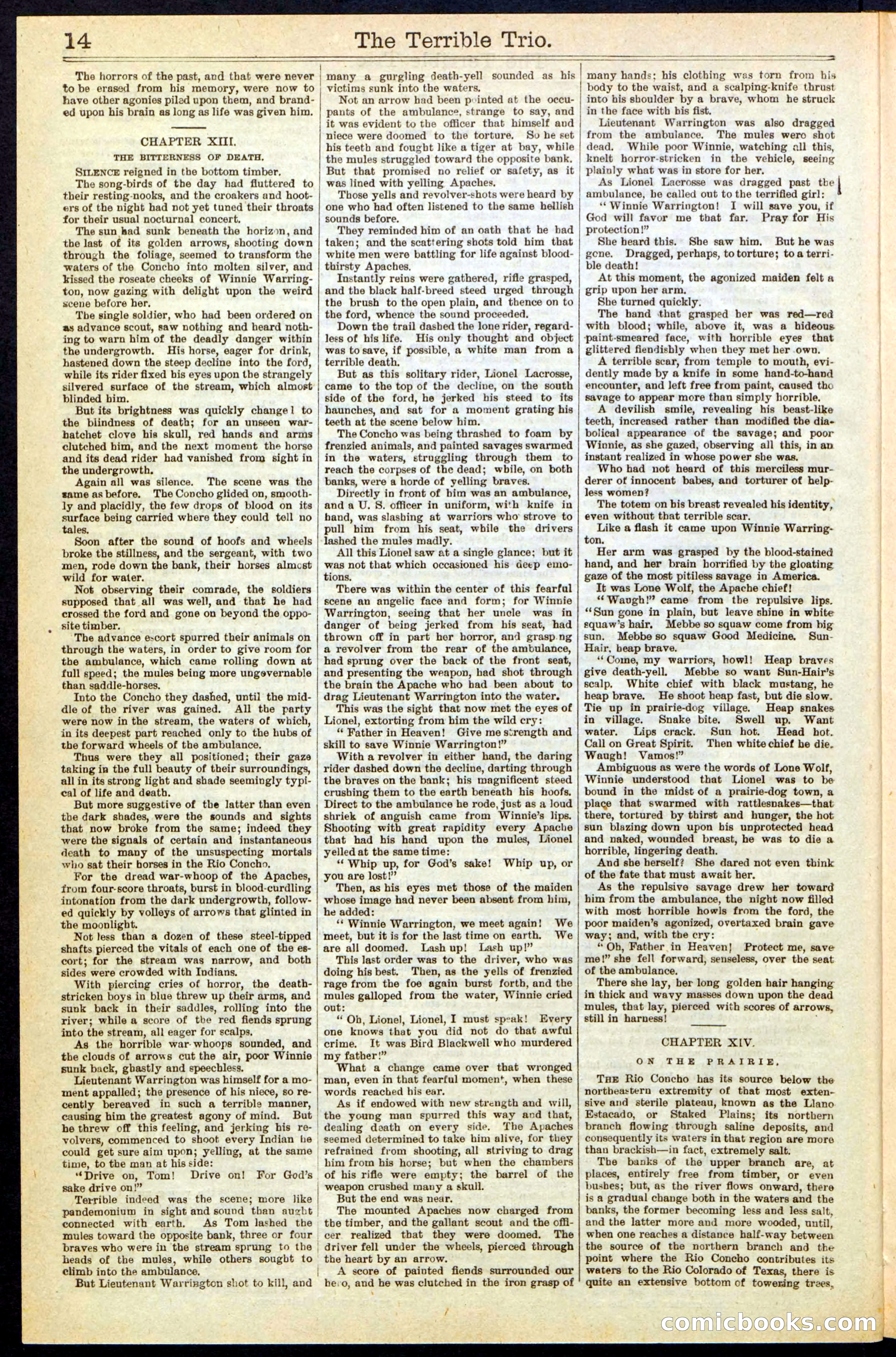
A restored page from Pulp Fiction, 1883. Page through the whole issue in the reader above.
📄 Transcribed text from this page (OCR, searchable)
Machine-transcribed from the original scan — historical spelling and the odd misread are preserved.
14 The horrors of the past, and that were never to be erased from his memory, were now to have other agonies piled upon them, and brand- ed upon his brain as long as life was given him. ee eee CHAPTER XIII. THE BITTERNESS OF DEATH. SILENCE reigned in the bottom timber. The song-birds of the day had fluttered to their resting-nooks, and the croakers and hoot- ers of the night had not yet tuned their throats for their usual nocturnal concert. The sun bad sunk beneath the horizon, and the last of its golden arrows, shooting down through the foliage, seemed to transform the waters of the Concho into molten silver, and kissed the roseate cheeks of Winnie Warring- ton, now gazing with delight upon the weird scene before her, The single soldier, who had been ordered on as advance scout, saw nothing and heard noth- ing to warn him of the deadly danger within the undergrowth. His horse, eager for drink, hastened down the steep decline into the ford, while its rider fixed his eyes upon the strangely silvered surface of the stream, which almost blinded bim. But its brightness was quickly changel to the blindness of death; for an unseen war- hatchet clove his skull, red hands and arms clutched him, and the next moment the horse and its dead rider had vanished from sight in the undergrowth. Again all was silence. The scene was the same as before. The Concho glided on, smooth- ly and placidly, the few drops of blood on its surface being carried where they could tell no tales, Soon after the sound of hoofs and wheels broke the stillness, and the sergeant, with two men, rode down the bank, their horses almost wild for water. Not observing their comrade, the soldiers supposed that all was well, and that he had crossed the ford and gone on beyond the oppo- site timber. ‘The advance escort spurred their animals on through the waters, in order to give room for the ambulance, which came rolling down at full speed; the mules being more ungevernable than saddle-horses, Into the Concho they dashed, until the mid- dle of the river was gained. All the party were now in the stream, the waters of which, in its deepest part reached only to the hubs of the forward wheels of the ambulance, Thus were they all positioned; their gaze taking in the full beauty of their surroundings, all in its strong light and shade seemingly typi- cal of life and death. But more suggestive of the latter than even the dark shades, were the sounds and sights that now broke from the same; indeed they were the signals of certain and instantaneous death to many of the unsuspecting mortals who sat their borses in the Rio Concho, For the dread war-whoop of the Apaches, from four-score throats, burst in blood-curdling intonation from the dark undergrowth, follow- ed quickly by volleys of arrows that glinted in the moonlight. Not less than a dozen of these steel-tipped shafts pierced the vitals of each one of the es- cort; for the stream was narrow, and both sides were crowded with Indians. With piercing cries of horror, the death- stricken boys in blue threw up their arms, and sunk back in their saddles, rolling into the river; while a score of the red fiends sprung into the stream, all eager for scalps, As the horrible war- whoops sounded, and the clouds of arrows cut the air, poor Winnie sunk back, ghastly and speechless. Lieutenant Warrington was himself for a mo- ment appalled; the presence of his niece, so re- cently bereaved in such a terrible manner, causing him the greatest agony of mind. But he threw off this feeling, and jerking his re- ee ee SSS a - a ——— — - 7 EEE volvers, commenced to shoot every Indian he > could get sure aim upon; yelling, at the same time, to the man at his side: “Drive on, Tom! Drive on! For God’s sake drive on!” Terrible indeed was the scene; more like The Terrible Trio. many a gurgling death-yell sounded as his victims sunk into the waters, Not an arrow had been pointed at the occu- pants of the ambulance, strange to say, and it was evident to the officer that himself and niece were doomed to the torture, So he set his teeth and fought like a tiger at bay, while the mules struggled toward the opposite bank. But that promised no relief or safety, as it was lined with yelling Apaches, Those yells and revolver-shots were heard by one who had often listened to the same hellish sounds before. They reminded him of an oath that he bad taken; and the scattering shots told him that white men were battling for life against blood- thirsty Apaches. Instantly reins were gathered, rifle grasped, and the black half-breed steed urged through the brush to the open plain, and thence on to the ford, whence the sound proceeded, Down the trail dashed the lone rider, regard- less of his life. His only thought and object was tosave, if possible, a white man from a terrible death, But as this solitary rider, Lionel Lacrosse, came to the top of the decline, on the south side of the ford, he jerked his steed to its haunches, and sat for a moment grating his teeth at the scene below him. The Concho was being thrashed to foam by frenzied animals, and painted savages swarmed in the waters, struggling through them to reach the corpses of the dead; while, on both banks, were a horde of yelling braves. Directly in front of him was an ambulance, and a U. 8. officer in uniform, with knife in band, was slashing at warriors who strove to pull him from his seat, while the drivers lashed the mules madly. All this Lionel saw at a single glance; but it was not that which occasioned his deep emo- tions. There was within the center of this fearful scene an angelic face and form; for Winnie Warrington, seeing that her uncle was in danger of being jerked from his seat, had thrown off in part her horror, and grasp.ng a revolver from tbo rear of the ambulance, had sprung over the back of the front seat, and presenting the weapon, had shot through the brain the Apache who had been about to drag Lieutenant Warrington into the water. This was the sight that now met the eyes of Lionel, extorting from him the wild cry: ‘‘ Father in Heaven! Give me strength and skill to save Winnie Warrington!” With a revolver in either hand, the daring rider dashed down the decline, darting through the braves on the bank; his magnificent steed crushing them to the earth beneath his hoofs. Direct to the ambulance he rode, just as a loud shriek of anguish came from Winnie’s lips. Shooting with great rapidity every Apache that had his hand upon the mules, Lionel yelled at the same time: ‘‘ Whip up, for God’s sake! you are lost!” Then, as his eyes met those of the maiden whose image had never been absent from him, he added: ‘* Winnie Warrington, we meet again! We meet, but it is for the last time on earth, We are all doomed. Lash up! Lash up!” This last order was to the driver, who was doing his best. Then, as the yells of frenzied rage from the foe again burst forth, and the mules galloped from the water, Winnie cried out: “ Ob, Lionel, Lionel, I must speak! Every one knows that you did not do that awful crime. It was Bird Blackwell who murdered my father!” What a change came over that wronged man, even in that fearful moment, when these words reached his ear. As if endowed with new strength and will, the young man spurred this way and that, dealing death on eyery side. The Apaches seemed determined to take him alive, for they refrained from shooting, all striving to drag him from his horse; but when the chambers of his rifle were empty; the barrel of the Whip up, or | weapon crushed many a skull. pandemonium in sight and sound than aught) connected with earth. As Tom lashed the mules toward the opposite bank, three or four. braves who were in the stream sprung to the heads of the mules, while others sougbt to climb into the ambulance, But Lieutenant Warrington shot to kill, and But the end was near. The mounted Apaches now charged from the timber, and the gallant scout and the offi- cer realized that they were doomed. The driver fell under the wheels, pierced through the heart by an arrow. A score of painted fiends surrounded our he:o, and he was clutched in the iron grasp of / eo ——- ee many hands: his clothing was torn from his body to the waist, and a scalping-knife thrust into his shoulder by a brave, whom he struck _ in the face with bis fist. Lieutenant Warrington was also dragged from the ambulance. The mules wero shot dead. While poor Winnie, watching all this, knelt horror-stricken in the vehicle, seeing plainly what was in store for her. As Lionel Lacrosse was dragged past the ambulance, be called out to the terrified girl: ‘*Winnie Warrington! I will save you, if God will favor me tbat far. Pray for His protection!” She beard this. She saw him. But he was gene. Dragged, perhaps, totorture; toa terri- ble death! At this moment, the agonized maiden felt a grip upon her arm, She turned quickly. The hand that grasped ber was red—red with blood; while, above it, was a hideous ‘paint-smeared face, with horrible eyes that glittered fiendishly when they met her .own. A terrible scar, from temple to mouth, evi- dently made by a knife in some hand-to-hand encounter, and left free from paint, caused tho savage to appear more than simply horrible. A devilish smile, revealing his beast-like teeth, increased rather than modified the dia- bolical appearance of the savage; and poor Winnie, as she gazed, observing all this, in an instant realized in whose power she was. Who had not heard of this merciless mur- derer of innocent babes, and torturer of help- less women? The totem on bis breast revealed his identity, even without that terrible scar. Like a flash it came upon Winnie Warring- ton. Her arm was grasped by the blood-stained hand, and her brain horrified by the gloating gaze of the most pitiless savage in America. It was Lone Wolf, the Apache chief! ‘* Waugh!” came from the repulsive lips. ‘*Sun gone in plain, but leave shine in white squaw’s hair, Mebbe so squaw come from big sun. Mebbe so squaw Good Medicine, Sun- Hair, beap brave. ‘‘Come, my warriors, howl! Heap braves give death-yell. Mebbe so want Sun-Hair’s scalp. White chief with black mustang, he heap brave. He shoot heap fast, but die slow. Tie up in prairie-dog village. Heap snakes in village. Snake bite. Swell up, Want water. Lips crack. Sun hot. Head hot. Call on Great Spirit. Then white chief be die. Waugh! Vamos!” Ambiguous as were the words of Lone Wolf, Winnie understood that Lionel was to be bound in the midst of a prairie-dog town, a place that swarmed with rattlesnakes—that there, tortured by thirst and hunger, the hot sun blazing down upon bis unprotected head and naked, wounded breast, he was to die a horrible, lingering death. And she herself? She dared not even think of the fate that must await her. As the repulsive savage drew her toward him from the ambulance, the night now filled with most horrible howls from the ford, the poor maiden’s agonized, overtaxed brain gave way; and, with the cry: “Oh, Father in Heaven! Protect me, save me!” she fell forward, senseless, over the seat of the ambulance. There she lay, ber long golden hair hanging in thick and wavy masses down upon the dead mules, that lay, pierced with scores of arrows, still in harness! CHAPTER XIV. ON THE PRAIRIE, THE Rio Concho has its source below the northeastern extremity of that most exten- sive and sterile plateau, known as the Llano. Estacado, or Staked Plains; its northern branch flowing through saline deposits, and consequently its waters in that region are more than brackish—in fact, extremely salt. The banks of the upper branch are, at places, entirely free from timber, or even bushes; but, as the river flows onward, there is a gradual change both in the waters and the banks, the former becoming less and less salt, and the latter more and more wooded, until, when one reaches a distance half-way between the source of the northern branch and the point where the Rio Concho contributes its waters to the Rio Colorado of Texas, there is quite an extensive bottom of towering trees, JOO <¢om (E S) Cc