
Pulp Fiction, 1877 · page 4 of 28
Beadle's New York Dime Library, No. 23 — page 4: what you’re looking at
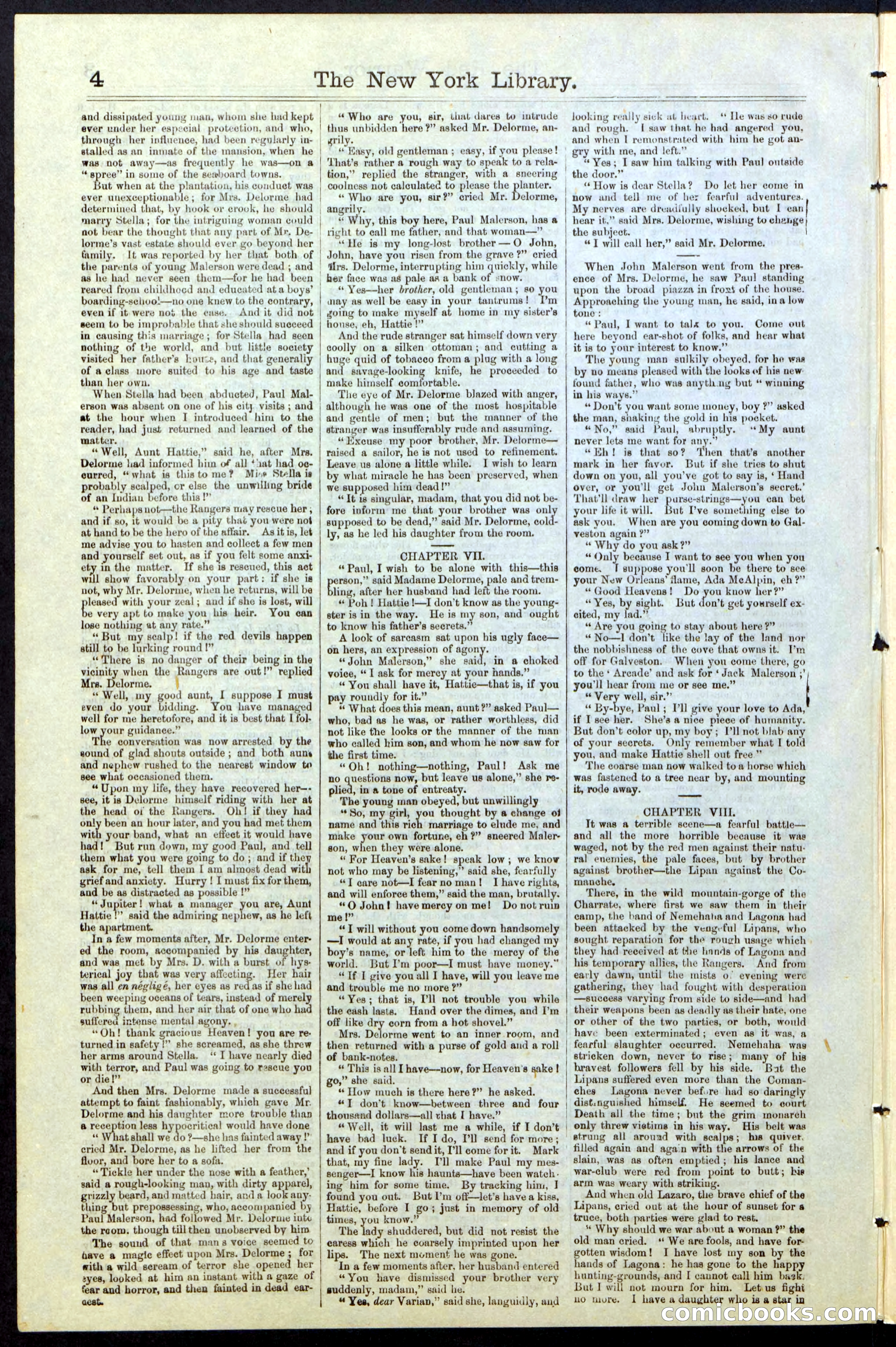
A restored page from Pulp Fiction, 1877. Page through the whole issue in the reader above.
📄 Transcribed text from this page (OCR, searchable)
Machine-transcribed from the original scan — historical spelling and the odd misread are preserved.
4. and dissipated young man, whom she had kept ever under her especial protection, and who, through her influence, had been regularly in- stalled as an inmate of the mansion, when he was not away—as frequently he was—on a “ spree” in some of the sewboard towns. 3ut when at the plantation, his conduet was ever unexceptionable ; for Mrs. Delorme had determined that, by hook or crook, he should marry Stella; for the intriguing woman could | not bear the thought that any part of Mr, De- lorme’s vast estate should ever go beyond her family. It was reported by her that both of the parents of young Malerson were dead ; and as he had never seen them—for he had been reared from childhoed and educated ata boys’ boarding-scliivo!—no one knew to the contrary, even if it were not the cuse. And it did not seem to be improbable that she should sueceed in causing this marriage; for Stella had seen nothing of the world, and buf little society visited her father’s hou:e, and that generaliy of aclass more suited to his age and taste than her own. When Stella had been abducted, Paul Mal- erson was absent on one of his city. visits ; and at the hour when I introduced him to the reader, had just returned and learned of the matter. “ Well, Aunt Hattie,” said he, after Mrs. Delorme }iad informed him of all tat had oe- eurred, “what is thisto me? Mire Stella is probably scalped, or else the unwilling bride of an Indian before this!” * Perhaps not—the Rangers may rescue her , and if so, it would be a pity that you were not at band to be the hero of the affair. As it is, let me advise you to hasten and collect a few men and yourself set out, as if you felt some anxi- ety in the matter. If she is rescued, this act will show favorably on your part: if she is not, why Mr. Delorme, when he returns, will be fae with your zeal; and if she is lost, will e very apt to make you his heir. You can lose nothing at any rate.” “But my scalp! if the red devils happen still to be lurking round !” “There is no danger of their being in the vicinity when the Rangers are out!” replied Mra. Delorme. “ Well, my good aunt, I suppose I must even do your bidding. You have managed well for me heretofore, and it is best that I fol. low your guidance.” The conversation was now arrested by the sound of glad shouts outside ; and both aune and nephew rushed to the nearest window to see what occasioned them. “Upon my life, they have recovered her—- see, it is Delorme himself riding with her at the head oi the Rangers. Oh! if they had only been an hour later, and you had met them with your band, what an effeet it would have had! But run down, my good Paul, and tell them what you were going to do ; and if they ask for me, tell them I am almost dead wit grief and anxiety. Hurry! I must fix for them, and be as distracted as possible !” “Jupiter! what a manager you are, Aunt Hattie !” said the admiring nephew, as he left the apartment. In a few moments after, Mr. Delorme enter- ed the room, accompanied by his daughter, and was met by Mrs. D. with a burst ov hee terical joy that was very affecting. Her hair was all en négligé, her eyes as red as if she had been weeping oceans of tears, instead of merely rubbing them, and her air that of one who had suffered intense mental agony, , “Oh! thank gracious Heaven! you are re- turned in safety !” she screamed, as she threw her arms around Stella. “ I have nearly died with terror, and Paul was going to rescue you or die!” And then Mrs. Delorme made a successful attempt to faint fashionably, which gave Mr. Delorme and his daughter more trouble than a reception less hypocritical would have done “ What shall we Ks ?—she has fainted away !” cried Mr. Delorme, as he lifted her from the fluor, and bore her to a sofa. “Tickle her under the nose with a feather,’ said a rough-looking man, with dirty apparel, grizzly beard, and matted hair, and a look any- thing but prepossessing, who, accompanied by Paul Malerson, had followed Mr. Delorme inte the room. though tillthen unobserved by him The sound of that mans voice seemed to have a magic effect upon Mrs. Delorme ; for with a wild seream of terror she opened her eyes, looked at him an instant with a gaze of fear and horror, and then fainted in dead ear- acat. rT | “Who are you, sir, that dares to imtrude thus unbidden here ?” asked Mr. Delorme, an- grily. * Hasy, old gentleman ; easy, if you please! he New York Library. 'That’s rather a rough way to speak to a rela- | tion,’ replied the stranger, with a sneering coolness not calculated to please the poe “Who are you, sir?” cried Mr. Delorme, angrily. “ Why, this boy here, Paul Malerson, has a right to eall me father, and that woman—” “He is my long-lost brother — O John, John, have you risen from the grave ?” cried flrs. Delorme, interrupting him quickly, while her face was as pale as a bank of snow. “ Yes—her brother, old gentleman; so you may as well be easy in your tantrums! P’m going to tmake myself at home in my sister’s honse, eh, Hattie !” And the rude stranger sat himself down very coolly on a silken ottoman; and eutfing a huge quid of tobacco from a plug with a long and savage-looking knife, he proceeded to make himself comfortable. The eye of Mr. Delorme bjazed with anger, although he was one of the most hospitable and gentle of men; but the manner of the stranger was insufferably rude and assuming. “}xeuse my poor brother, Mr. Delorme— raised a sailor, he is not used to refinement. Leave us alone a little while. I wish to learn by what miracle he has been preserved, when we supposed him dead!” “It is singular, madam, that you did not be- fore inform me that your brother was onl supposed to be dead,” said Mr. Delorme, cold- ly, as he led his daughter from the room. CHAPTER VII. “Paul, I wish to be alone with this—this rson,” said Madame Delorme, pale and trem- ling, after her husband had leit the room. * Poh ! Hattie !—I don’t know as the young- ster is in the way. He is my son, and ought to know his father’s secrets.” A look of sareasm sat upon his ugly face— on hers, an expression of agony. “John Malerson,” she said, in a choked voice, “I ask for merey at your hands,” “ You shall have it, Hattie—that is, if you pay roundly for it.” “ What does this mean, aunt?” asked Paul— who, bad as he was, or rather worthless, did not like the looks or the manner of the man who called him son, and whom he now saw for the first time. “Oh! nothing—nothing, Paul! Ask me no questions now, but leave us alone,” she r- plied, in a tone of entreaty. The young man obeyed, but unwillingly “So, my girl, you thought by a change of name and this rich marriage to elude me, and make your own fortune, eh ?” sneered Maler- son, when they were alone. “ For Heaven’s sake! speak low; we know not who may be listening,” said she, fearfully “T care not—I fear no man! I have rights, and will enforce them,” said the man, brutally. “O John! have mercy on me! Do not ruin me !” “T will without you come down handsomely —I would at any rate, if you had changed my boy’s name, or left him to the merey of the world. But I’m poor—I must have money.” “If I give you all I have, will you leave me and trouble me no more ?” “Yes; that is, Pll not trouble you while the eash lasts. Hand over the dimes, and I’m off like dry corn from a hot shovel.” Mrs. Delorme went to an inner room, and then returned with a purse of gold and a roll of bank-notes. “ This is all I have—now, for Heaven's sake ! go,” she said. “ Tlow much is there here?” he asked. “T don’t know—between three and four thousand dollars—all that I have.” “Well, it will last me a while, if I don’t have bad luck. If I do, I’ll send for more; and if you don’t send it, I'll come for it. Mark that, my fine lady. Ill make Paul my mes- senger—I know his haunts—have been watch. ing him for some time. By tracking him, I found you out. But ’'m off—let’s have a kiss, Hattie, before I go; just in memory of old times, you know.” The dy shuddered, but did not resist the earess which he coarsely imprinted upon her lips. The next moment he was gone. In a few moments after, her husband entered “You have dismissed your brother very suddenly, madam,” said he. “ Yes, dear Varian,” said she, languidly, and looking really sick at heart. [le was so rude and rough. I saw that he had angered you, and when | remonstrated with him he got an- gry with me, and left.” “Yos; I saw him talking with Pau] outside the door.” “ Tow is dear Stella? Do let her come in now and tell me of her fearful adventures. My nerves are dreadlully shocked, but I ean hear it,” said Mrs. Delorme, wishing to chenge the subject. | “ J] will call her,” said Mr. Delorme. When John Malerson went from the prea- ence of Mrs. Delorme, he saw Paul standing upon the broad piazza in froxt of the house. Approaching the young man, he said, ina low tone : “Paul, I want to talx to you. Come out here beyond ear-shot of folks, and hear what it is to your interest to know.” The young man sulkily obeyed, for he waa by no means pleased with the looks of hie new found father, who was anythng but “ winning in his ways.’ * Don’t you want some money, boy ?” asked the man, shaking the gold in his pocket. “No,” said Paul, abruptly. ‘My aunt never lets me want for any.” “Eh! is that so? Then that’s another mark in her favor. But if she tries to shut down on you, all you’ve got to say is, ‘ Hand over, or you'll get John Malerson’s secret.’ That'll draw her purse-strings—you can bet your life it will. But [P’ve something else to ask you. When are you coming down to Gal- veston again ?” “ Why do you ask?” “Only because I want to see you when you come. [| suppose you'll soon be there to see your New Orleans’ flame, Ada MeAlpin, eh ?” “ Good Heavens! Do you know her?” “Yes, by sight. But don't get yourself ex- cited, my lad.” “ Are you going to stay about here ?” “ No—I don’t like the lay of the land nor the nobbishness of the cove that owns it. I’m off for Galveston. When you come there, go to the * Arcade’ and ask for ‘ Jack Malerson ;’ you'll hear from me or see me.” | “ Very well, sir.” “ By-bye, Paul; Vl give your love to Ada, if I see her. She’sa a nice piece of humanity. But don’t color up, my boy; Pll not blab any of your secrets. Only remember what I told you, and make Hattie shell out free” The coarse man now walked to a horse which was fastened to a tree near by, and mounting it, rode away. CHAPTER VIIL. Tt was a terrible scene—a fearful battle— and all the more horrible because it wae waged, not by the red men against their natu- ral enemies, the pale faces, but by brother against brother—the Lipan against the Co- manche, There, in the wild mountain-gorge of the Charrate, where first we saw them in their camp, the band of Nemehahaand Lagona had been attacked by the vengeful Lipans, who sought reparation for the rough usage which they had reeeived at the hands of Lagona and his temporary allies, the Rangers. And from early dawn, until the mists o” evening were gathering, they had fought with desperation —suceess varying from side to side—and had their weapons been as deadly as their hate, one or other of the two parties, or both, would have been exterminated; even as it was, a fearful slaughter occurred. Nemehaha was stricken down, never to rise; many of his hravest followers fell by his side. Bat the Lipans suffered even more than the Coman- ches Lagona never befure had so daringly dist.nguished himself. He seemed to eourt Death all the time; but the grim monarch only threw vietins in his way. His belt was strung all arouad with scalps; hos quiver, filled again and aga‘n with the arrows of the slain, was as often emptied; his lance and war-club were red from point to butt; bie arm was weary with striking. And when old Lazaro, the brave chief of the Lipans, eried out at the hour of sunset for 6 truce, both parties were glad to rest. *“ Why should we war about a woman ?” the old man cried. ‘ We are fools, and have for- —— wisdom! I have lost my son by the nds of Lagona: he has gone to the happy punting amos and I cannot eall him bask. But I will not mourn for him. Let us fight uo more. I have a daughter a Ey a {0 Gomme star 1 OOKS Cc | | |