
Pulp Fiction, 1877 · page 3 of 28
Beadle's New York Dime Library, No. 23 — page 3: what you’re looking at
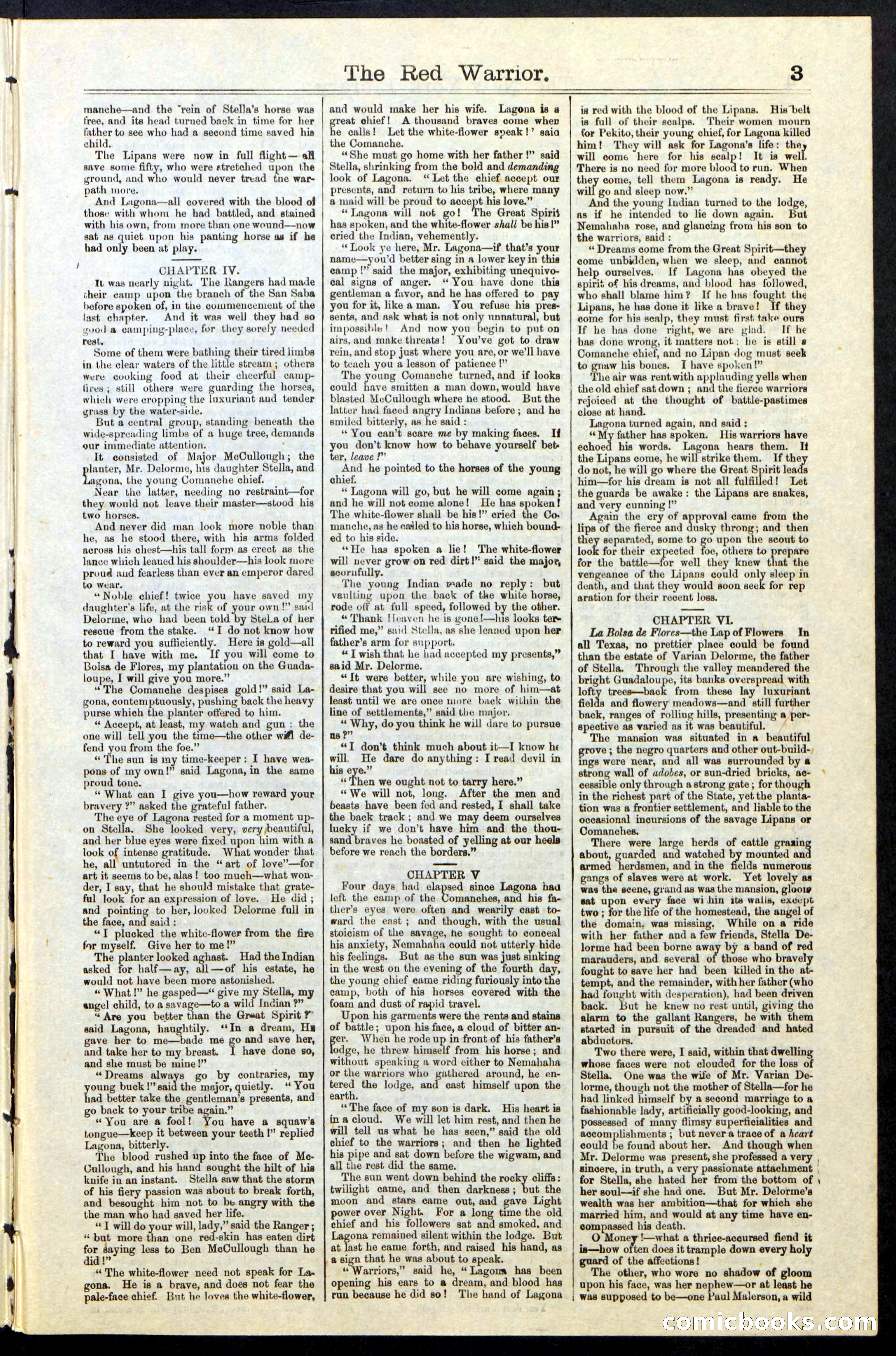
A restored page from Pulp Fiction, 1877. Page through the whole issue in the reader above.
📄 Transcribed text from this page (OCR, searchable)
Machine-transcribed from the original scan — historical spelling and the odd misread are preserved.
oe manche—and the “rein of Stella’s horse was free, and its head turned back in time for her father to see who had a second time saved his ehild. The Lipans were now in full flight ~ af save some fifty, who were stretched upon the ground, and who would never tread the war- path more. And Laugona—all covered with the blood of those with whom he had battled, and stained with his own, from more than one wound—now sat as quiet upon his panting horse as if he had only been at play. CHAPTER IV. Tt was nearly night. The Rangers had made their eamp upon the branch of the San Saba before spoken of, in the commencement of the last chapter. And it was well they had so ood @ camping-place, for they sorely needed rest. Some of them were bathing their tired limbs in the clear waters of the little stream ; others were cooking food at their cheerful camp- fires ; still othera were guarding the horses, which were cropping the luxuriant and tender grass by the water-side. But a central group, standing beneath the wide-spreading limbs of a huge tree, demands our immediate attention. It consisted of Major McCullough; the lanter, Mr. Delorme, his daughter Stella, and (i the young Comanche chief. Near the latter, needing no restraint—for they would not leave their master—stood his two horses. And never did man look more noble than he, as he stood there, with his arms folded across his chest—his tall form as erect as the lance which leaned his shoulder—his look more proud aud fearless than ever an emperor dared to Wear. “Noble chief! twice you have saved my daughter's life, at the risk of your own !” said Delorme, who had been told by SteLa of her rescue from the stake. “I do not know how to reward you sufficiently. Here is gold—all that I have with me. If you will come to Bolsa de Flores, my plantation on the Guada- loupe, I will give you more.” “The Comanche despises gold!” said La- gona, contemptuously, pushing back the heavy purse which the planter offered to him. “ Accept, at least, my watch and gun : the one will tell you the time—the other wil de- fend you from the foe.” “The sun is my time-keeper: I have wea- pons of my own!” said Lagona, in the same proud tone. “What can I give you—how reward your bravery ?” asked the grateful father. The eye of Lagona rested for a moment up- on Stella. She looked very, very beautiful, and her blue eyes were fixed upon him with a look of intense gratitude. What wonder that he, all untutored in the “art of love”—for art it seems to be, alas! too much—what won- der, I say, that he should mistake that grate- ful look for an expression of loye. He did ; and pointing to her, looked Delorme full in the face, and said : “T plucked the white-flower from the fire for myself. Give her to me!” The planter looked aghast. Had the Indian asked for half—ay, all—of his estate, he would not have been more astonished. “ What!” he gasped—“ give my Stella, my angel child, to a savage—to a wild Indian ?” “Are you better than the Great Spirit ?” said Lagona, haughtily. ‘‘In a dream, He gave her to me—bade me go and save her, and take her to my breast. have done 80, and she must be mine!” “Dreams always go by contraries, my oung buck!’ said the major, quietly. “ You had better take the gentleman’s presents, and go back to your tribe again.” “You are a fool! You have a squaw’s tongue—keep it between your teeth !” replied Lagona, bitterly. The blood rushed up into the face of Me- Cullough, and his hand sought the hilt of his knife in an instant. Stella saw that the storm of his fiery passion was about to break forth, and besought him not to be angry with the the man who had saved her life. “T will do your will, lady,” said the Ranger; “ but more than one red-skin has eaten dirt po ying less to Ben McCullough than he di hd “ The white-flower need not speak for La. gona. He is a brave, and does not fear the pale-face chief. But he loves the white-flower, ‘The and would make her his wife. Lagona is a great chief! A thousand braves come wher he calls! Let the white-flower speak!” saia the Comanche. “She must go home with her father !” said Stella, shrinking from the bold and demanding look of Lagona. “ Let the chief accept our presents, and return to his tribe, where many a maid will be proud to aecept his love.” “ Lagona will not go! The Great Spirit has spoken, and the white-flower shall be his!” cried the Indian, vehemently. “ Look ye here, Mr. Lagona—if that’s your name—you'd better sing in a lower key in this eamp !”’ said the major, exhibiting unequivo- cal signs of anger. ‘“ You have done this gentleman a favor, and he has offered to pay you for it, likea man. You refuse his pres- sents, and ask what is not only unnatural, but impossible! And now you Said to put on airs, and make threats! You’ve got to draw rein, and stop just where you are, or we’ll have to teach you a lesson of patience !” The young Comanche turned, and if looks could have smitten a man down, would have blasted McCullough where he stood. But the latter had faced angry Indians before ; and he smiled bitterly, as he said : “You ean’t scare me by making faces. If you don’t know how to behave yourself bet ter, leave !”” And he pointed to the horses of the young chief. “ Lagona will go, but he will come again; and he will not come alone! He has spoken! The white-flower shall be his!” eried the Co. manche, as he ealed to his horse, which bound- ed to his side. “He has spoken a lie! The white-flower will never grow on red dirt!" said the major, scorufully. The young Indian made no reply: but vaulting upon the back of the white horse, rode off at full speed, followed by the other. “Thank Iieaven he is gone!—his looks ter- rified me,” said Stella, as she leaned upon her father’s arm for support. “T wish that he had accepted my presents,” said Mr. Delorme. “It were better, while you are wishing, to desire that you will see no more of him—at least until we are once more back within the line of settlements,” said the major. “ Why, do you think he will dare to pursue ?”? “T don’t think much about it—TI know he will He dare do anything: I read devil in his og “Then we ought not to tarry here.” “We will not, long. After the men and beasts have been fed and rested, I shall take the back track; and we may deem ourselves lucky if we don’t have him and the thou- sand braves he boasted of yelling at our heels before we reach the borders.” CHAPTER V Four days had elapsed since Lagona haa left the camp of the Comanches, and his fa- ther’s eyes were often and wearily cast to- ward the east ; and though, with the usual stoicism of the savage, he sought to conceal his anxiety, Nemahaha could not utterly hide his feelings. But as the sun was just sinking in the west on the evening of the fourth day, the young chief eame riding furiously into the camp, both of his horses covered with the foam and dust of rapid travel. Upon his garments were the rents and stains of battle; upon his face, a cloud of bitter an- er. When he rode up in front of his father’s odge, he threw himself from his horse; and without speaking a word either to Nemahaha or the warriors who gathered around, he en- tered the lodge, and east himself upon the earth. “The face of my son is dark. His heart is inacloud. We will let him rest, and then he will tell us what he has seen,” said the old chief to the warriors; and then he lighted his pipe and sat down before the wigwam, and all the rest did the same. The sun went down behind the saps cliffs : twilight came, and then darkness; but the moon and stars came out, and gave Light power over Night. For a long time the old chief and his followers sat an smoked, and ona remained silent within the lodge. But at last he eame forth, and raised his hand, as a sign that he was about to speak. “Warriors,” said he, “ Lagoms has been opening his ears to a dream, and blood has run because he did so! The hand of Lagona 3 a is red with the blood of the Lipans. His belt is full of their scalps. Their women mourn for Pekito, their young chief, for Lagona killed him! They will ask for Lagona’s life: the will come here for his scalp! It is well, There is no need for more blood to run. When they come, tell them Lagona is ready. He will go and sleep now.” And the young Indian turned to the lodge, as if he intended to lie down again. But Nemahaha rose, and glancing from his son to the warriors, said : “Dreams come from the Great Spirit—they come unbiiden, when we sleep, and cannot help ourselves. If Lagona has obeyed the spirit of his dreams, and blood has followed, who shall blame him? If he has fought the Lipans, he has done it like a brave! ‘if they come for his sealp, they must first take ours If he has done right, we are glad. If he has done wrong, it matters not: he is still a Comanche chief, and no Lipan dog must seek to gnaw his bones. I have spoken!” The air was rent with applauding yells when the old chief sat down ; and the fierce warriors rejoiced at the thought of battle-pastimes close at hand. Lagona turned again, and said ; “ My father has spoken. His warriors have echoed his words. Lagona hears them. It the Lipans come, he will strike them. If the do not, he will go where the Great Spirit leads him—for his dream is not all fulfilled! Let the guards be awake: the Lipans are snakes, and very cunning !” Again the ery of approval came from the lips of the fierce and dusky throng; and then they separated, some to go upon the scout to look for their expected foe, others to prepare for the battle—for well they knew that the vengeance of the Lipans could only sleep in death, and that they would soon seek for rep aration for their recent loss. CHAPTER VI. La Bolsa de Flores—the Lap of Flowers. In all Texas, no prettier place could be found than the estate of Varian Delorme, the father of Stella. Through the valley meandered the bright Guadaloupe, its banks overspread with lofty trees—back from these lay luxuriant fields and flowery meadows—and still further back, ranges of rolling hills, presenting a per- spective as varied as it was beautiful. ~ The mansion was situated in a beautiful ve ; the negro quarters and other out-build-, ings were near, and all was surrounded by a strong wall of adobes, or sun-dried bricks, ac- cessible only through a strong gate ; for though in the richest part of the State, yet the planta- tion was a frontier settlement, and liable to the occasional incursions of the savage Lipans or Comanches. There were large herds of cattle graain about, guarded and watched by mounted an armed Phetdaevied and in the fields numerous gangs of slaves were at work. Yet lovely as was the scene, grand as was the mansion, glooiw sat upon every face wi hin its walis, excupt two ; for the life of the homestead, the angel of the domain, was missing, While on a ride with her father and a few friends, Stella De- lorme had been borne away by a band of red marauders, and several of those who bravel fought to save her had been killed in the a tempt, and the remainder, with her father (who had fought with desperation), had been driven back. But he knew no rest until, giving the alarm to the gallant Rangers, he with them started in pursuit of the dreaded and hated abductors. Two there were, I said, within that dwelling whose faces were not clouded for the loss of Stella. One was the wife of Mr. Varian De- lorme, though not the mother of Stella—for he had linked himself by a second marriage to a fashionable lady, artificially good-looking, and possessed of many flimsy superficialities and accomplishments ; but nevera trace of a heart could be found about her. And though when Mr. Delorme was present, she professed a very sincere, in truth, a very passionate attachment for Stella, she hated her soul—if she had one. But Mr. Delorme’s wealth was her ambition—that for which she married him, and would at any time have en- compassed his death. O Money !—what a thrice-accursed fiend it is—how often does it trample down every holy guard of the affections! : The other, who wore no shadow of gloom upon his face, was her nephew—or at least he was supposed to be—one Paul Malerson, a wild er from the bottom of , Eomichoo Cs) (E(0)