
Pulp Fiction, 1877 · page 26 of 28
Beadle's New York Dime Library, No. 23 — page 26: what you’re looking at
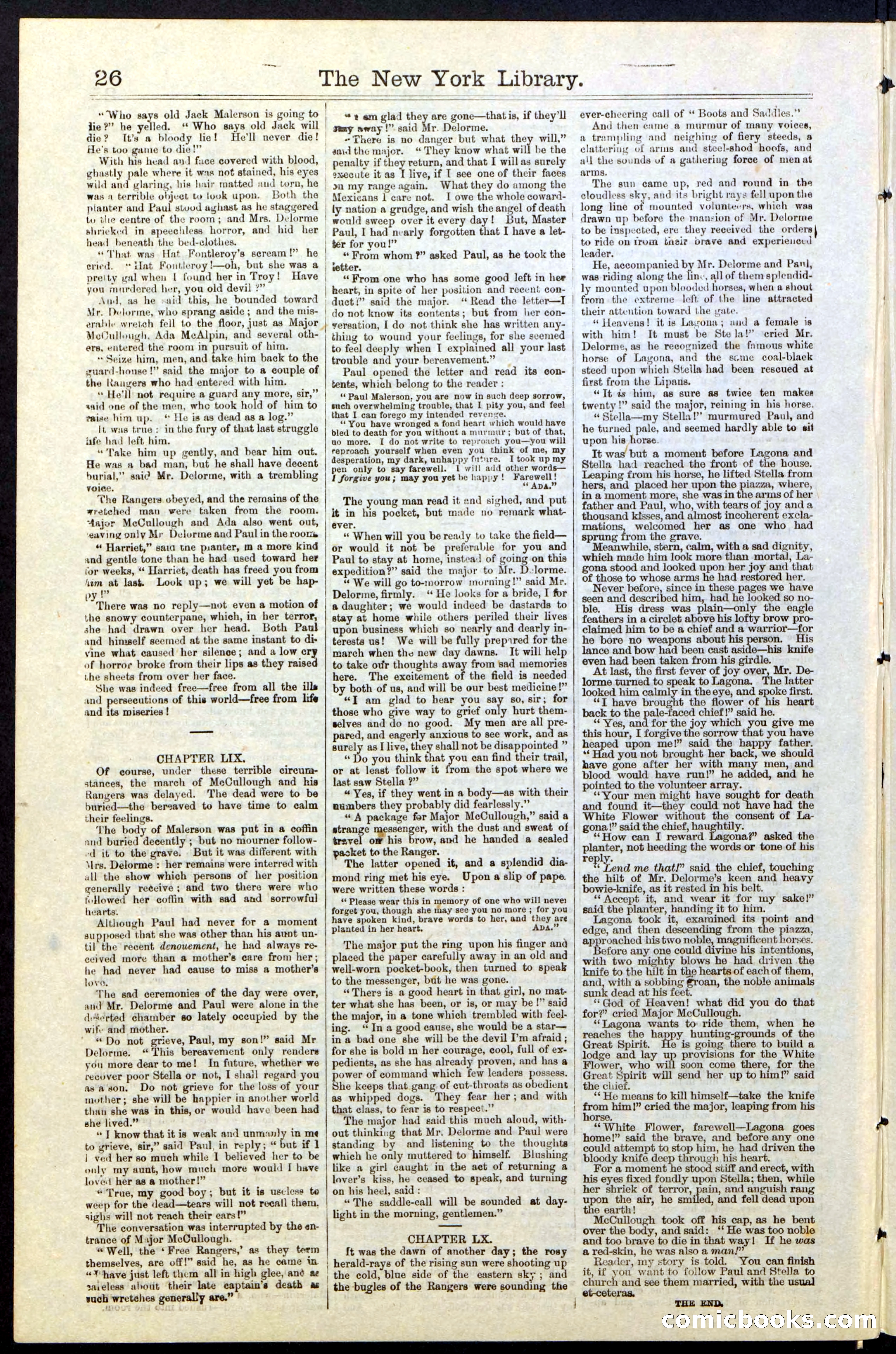
A restored page from Pulp Fiction, 1877. Page through the whole issue in the reader above.
📄 Transcribed text from this page (OCR, searchable)
Machine-transcribed from the original scan — historical spelling and the odd misread are preserved.
The New “Who says old Jack Malerson is going to | lie ?”’ he yelled. die? It’s a bloody lie! He's too game to die!” With his head and fuce covered with blood, ghastly pale where it was not stained, his eyes wild and glaring, his hair matted aud torn, he was a terrible object to look upon. Both the planter and Paul stvod aghast as he staggered to the centre of the room; and Mrs. Delorme shricked in speeeliless horror, and hid her head beneath the bed-clothes. “That was Hat Fontleroy’s seream!” he eried. “iat Foutleroy!—oh, but she was a preity gal when | found her in Troy! Have you murdered her, you old devil ?” Aud, as he said this, he bounded toward Mr. Delorme, who sprang aside ; and the mis- erable wreteh fell to the floor, just as Major MeCullough, Ada McAlpin, and several oth- ers, entered the room in pursuit of him. “Seize him, men, and take him back to the guard-honse !” said the major to a couple of the Raugers who had entered with him. “ He'll not require a guard any more, sir,” anid one of the men, who took hold eaise him up. “ He is as dead as a log.” i. was true: in the fury of that last struggle iufe had left him. “'Take him up gently, and bear him out. He was a bad man, but he shall have decent burial,’ sai@ Mr. Delorme, with a trembling voice. The Rangers obeyed, and the remains of the wretched man were taken from the room. Aajor McCullough and Ada also went out, eaving only Mr Delorme and Paul in the roons “ Harriet,” saia tne psanter, m a more kind and gentle tone than he had used toward her ‘or weeks, “ Harriet, death has freed you from him at last. Look up; we will yet be hap- ) 1"? There was no reply—not even a motion of the snowy counterpane, which, in ber terror, she had drawn over her head. Both Paul and himself seemed at the same instant to di- vine what caused her silence; and a low cry of horroe broke from their lips as they raised the sheets from over her face. She was indeed free—free from all the ills and persecutions of this world—free from life and its miseries ! He'll never die! CHAPTER LIX. Of course, under these terrible circum- stances, the march of McCullough and his Rangers was delayed. The dead were to be buried—the bereaved to have time to calm their feelings. ‘The body of Malerson was put in a coffin and buried decently ; but no mourner follow- od it to the grave. But it was different with Mrs. Delorme : her remains were interred with all the show which persons of her position generally re¢eive ; and two there were who followed her coffin with sad and sorrowful hearts. Although Paul had never for a moment supposed that she was other than his aunt un- til the recent denouement, he had always re- ceived more than a mother’s care from her; he had never had cause to miss a mother’s love, The sad ceremonies of the day were over, and Mr. Delorme and Paul were alone in the deerted chamber so lately occupied by the wife and mother. ' “Do not grieve, Paul, my son!” said Mr Delorme. “This bereavement only renders you more dear to me! In future, whether we recover poor Stella or not, I shail regard you asaxson. Do not grieve for the loss of your mother; she will be happier in another world than she was in this, or would have been had she lived.” “ | know that it is weak and a, in me to grieve, sir,” said Paul, in reply; “ but if 1 | ved her so much while 1 believed her to be only my aunt, how much more would I have loved her as a mother!” “True, my good boy; but it is useless te weep for the dead—tears will not recall them. sighs will not reach their ears!” The conversation was interrupted by the en- trance of Major McCullough. “Well, the ‘Free Rangers,’ as they term of him to | “ Who says old Jack will | oxecute it as | m my range again. oe “+ em glad ney are gone—that is, if they'll seny away !” said Mr. Delorme. - There is no danger but what they will,” anid the major. “They know what will be the penalty if ey return, and that I will as surely live, if I see one of their faces What they do among the Mexicans 1 care not. I owe the whole coward- ly nation a grudge, and wish the angel of death would sweep over it every day! but, Master | Paul, I had nearly forgotten that I have a let- fer for you!” | | “From whom ?” asked Paul, as he took the setter. York Library. “From one who has some good left in her heart, in spite of her position and reeent con- duct!” said the major. “Read the letter—I do not know its eontents; but from her con- yersation, I do not think she has written any- thing to wound your feelings, for she seemed to feel deeply when I expiained all your last trouble and your bereavement.” Paul opened the letter and read its con- tents, which belong to the reader : ‘‘ Paul Malerson, you are now in such deep sorrow, | such overwhelming trouble, that I pity you, and feel | ' that I can forego my intended revenge. “You have wronged a fond heart which would have bled to death for you without a murmur; but of that, uo more. I do not write to reproach you—you will reproach yourself when even you think of me, my desperation, my dark, unhappy future. I took up my pen only to say farewell. 1 will add other words— I forgive you; may you yet be happy! Farewell! “Apa.” The young man read it end sighed, and put it in his pocket, but made no remark what- ever. “ When will you be ready to take the field— or would it not be preferable for you and Paul to stay at home, instead of going on this expedition?” said the major to Mr. D.lorme. “ We will go to-morrow morning!” said Mr. Delorme, firmly. ‘“ He looks for a bride, I for a daughter; we would indeed be dastards to stay at home while others periled their lives upon business which so nearly and dearly in- terests us! We will be fully prepyred for the march when the new day dawns. It will help to take ovr thoughts away from sad memories here. The excitement of the field is needed by both of us, and will be our best medicine!” “T am glad to bear you say so, sir; for those who give way to gricf only hurt them- selves and do no good. My men are all pre- pared, and eagerly anxious to see work, and as ap as I live, they shall not be disappointed ” “Do you think that you can find their trail, or at least follow it from the spot where we last saw Stella ?” “ Yes, if they went in a body—as with their numbers they probably did fearlessly.” “A package fer Major McCullough,” said a strange messenger, with the dust and sweat of travel ow his brow, and he handed a sealed packet to the Ranger. The latter opened it, and a splendid dia- mond ring met his eye. Upon a slip of pape. were written these words : “ Please wear this in ana of one who will neve forget you, though she may see you no more ; for you have spoken kind, brave words to her, and they are planted in her heart. Apa.” The major put the ring upon his finger ana placed the paper carefully away in an old and well-worn pocket-book, then turned to speak to the messenger, but he was gone. “Thers is a good heart in that girl, no mat- ter what she has been, or is, or may be !” said the major, in a tone which trembled with feel- ing. ‘Ina good cause, she would be a star— in a bad one she will be the devil I’m afraid ; for she is bold in her courage, cool, full of ex- pedients, as she has already proven, and has a ower of command which few leaders possess. She keeps that gang of cut-throats as obedient as whipped dogs. They fear her; and with that class, to fear is to respect.” The major had said this much aloud, with- ee eee ———— —_—_ 8 eeeeeeeeeeeeEeEOee—eeeeEeEeEeEeEeEeEeEeeEeEeEeEEe—eeeE out thinking that Mr. Delorme and Paul were | standing by and listening to the thoughts which he only muttered to himself. Blushing like a girl caught in the aet of returning a lever’s kiss, he ceased to speak, and turning on his heel, said : “The saddle-call will be sounded at day- light in the morning, gentlemen.” CHAPTER LX. {t was the dawn of another day; the rosy themselves, are off!” said he, as he came WM | herald-rays of the rising sun were shooting up “have just left them all in high glee, and ae saieless about their late captain’s death as such wretches generally are.” © | OU i Ooi) ' ota ww we the cold, blue side of the eastern sky; ; and the bugles of the Rangers were sounding the upon the air, he smi | the earth! : ee —l] ever-cheering call of “ Boots and Saddles.” And then enme a murmur of many voices, a trempling and neighing of fiery steeds, a clattering of arms and steel-shod hoofs, and all the sounds of a gathering force of men at arms. The sun came up, red and round in the cloudless sky, and its bright rays fell upon the long line of mounted voluntecrs, which was drawn up before the mansion of Mr. Delorme to be inspected, ere they reeeived the orders to ride on trom taziz brave and experienced leader. He, accompanied by Mr. Delorme and Pani, was riding along the linc, all of them splendid- ly mounted upon blooded horses, when a shout from the extreme left of the line attracted their attention toward the vate. “ }leavens! itis Lavona; and a female is with him! It must be Ste la!’ eried Mr. Delorme, as he recognized the famous white horse of Layona, and the seme coal-blaek steed upon which Stella had been rescued at first from the Lipans. “Tt is him, as sure as twice ten makes twenty!” said the major, reining in his horse. “ Stella—my Stella!’ murmured Paul, and he turned pale, and seemed hardly able to sit upon his horse. It was but a moment before Lagona and Stella had reached the front of the house. Leaping from his horse, he lifted Stella from hers, and placed her upon the piazza, where, in a moment more, she was in the arms of her father and Paul, who, with tears of joy anda thousand kisses, and almost incoherent excla- mations, welcomed her as one who had sprung from the grave. Meanwhile, stern, calm, with a sad dignity, which made him look more than mortal, La- gona stood and looked upon her joy and that of those to whose arms he had restored her. Never before, since in these pages we have seen and described him, had he looked so no- ble. His dress was plain—only the eagle feathers in a circlet above his lofty brow pro- claimed him to be a chief and a warrior—for he bore no weapons about his person. His lance and bow had been cast aside—his knife even had been taken from his girdle. At last, the first fever of joy over, Mr. De- lorme turned to speak to Lagona. The latter looked him Sse ig in the eye, and spoke first. “T have brought the flower of his heart back to the pale-faced chief!” said he. “Yes, and for the joy which you give me this hour, I forgive the sorrow that you have heaped upon me!” said the happy father. “f Had you not brought her back, we should have gone after her with many men, and blood would have run!” he added, and he pointed to the volunteer array. “Your men might have aie oa for death and found a a could not have had the White Flower without the consent of La- gona!” said the chief, haughtily. ‘How can I reward na?” asked the planter, not heeding the words or tone of his reply. k Sond me that!” said the chief, touching the hilt of Mr. Delorme’s keen and heavy bowie-knife, as it rested in his belt, “ Accept it, and wear it for my sake!” said the planter, handing it to him. Lagona took it, examined its point and edge, and then descending from the piazza, approached his two noble, magnificent horses. efore any one could divine his intentions, with two mighty blows he had driven the knife to the hilt in the hearts of each of them, and, with a sobbing @roan, the noble animals sunk dead at his feet. ‘God of Heaven! what did you do that for?’ cried Major McCullough. ‘“‘TLagona wants to ride them, when he reaches the happy, busing aeoends of the Great Spirit. He is going there to build a lodge and lay up provisions for the White Flower, who will soon come there, for the Great oo will send her up to him!” said the chief. ** He means to kill himself—take the knife ~— him!” cried the major, leaping from his orse. “White Flower, farewell—Lagona goes home!” said the brave, and before any one could attempt to stop him, he had driven the bloody knife deep through his heart. For a moment he stood stiff and erect, with his eyes fixed fondly upon Stella; then, while her shriek of terror, pain, and anguish rang and fell dead upon McCullough took off his cap, as he bent over the body, and said: ‘‘ He was too noble ' and too brave to die in that way! If he was a red-skin, he was also a man!” : Reader, my story is told. You can finish it, if you want to follow Paul and Stella to church and see them married, with the usual et-ceteras, a THE END ; ' 4 ' v.00 (C “S (E(@) eom