
Pulp Fiction, 1877 · page 25 of 28
Beadle's New York Dime Library, No. 23 — page 25: what you’re looking at
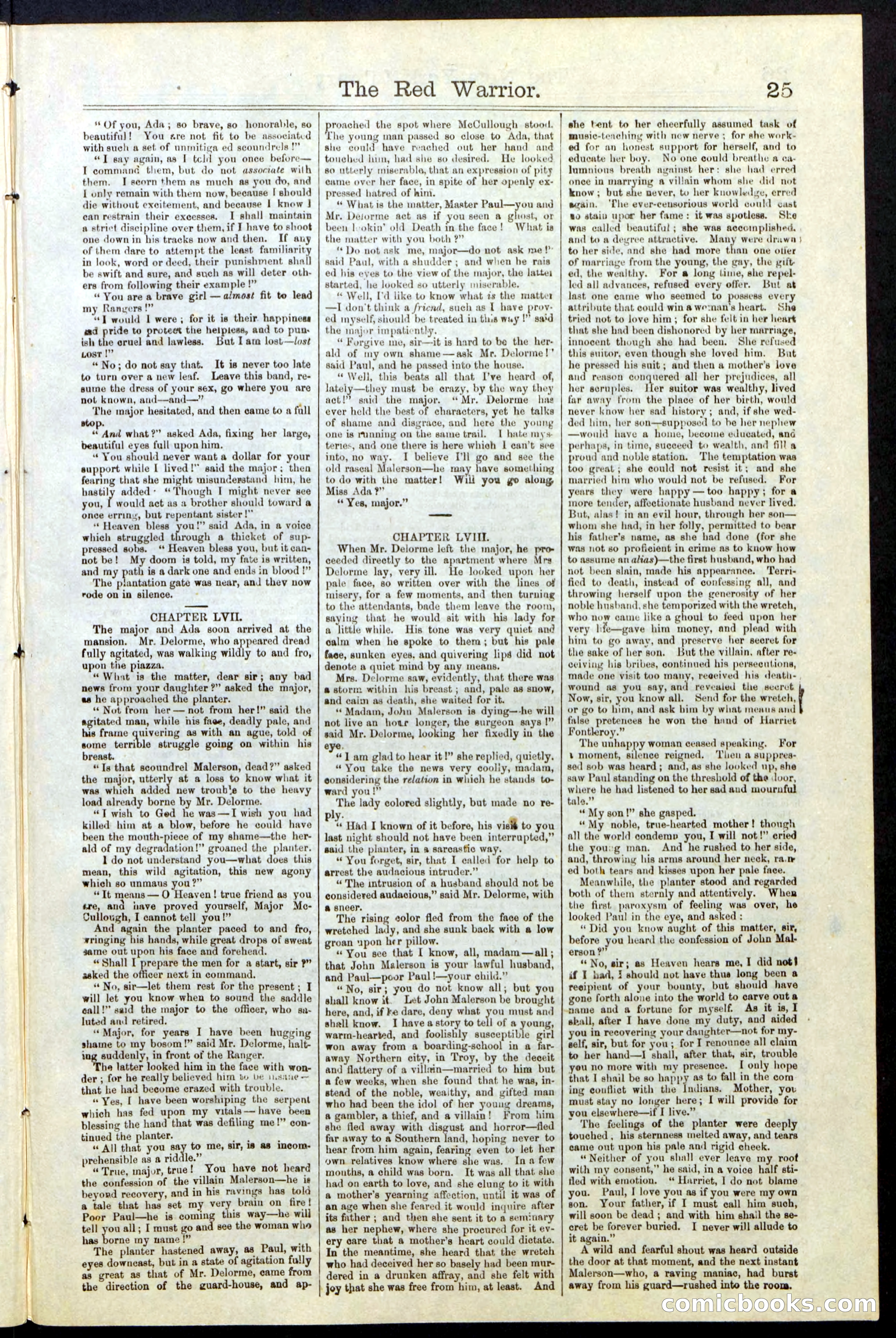
A restored page from Pulp Fiction, 1877. Page through the whole issue in the reader above.
📄 Transcribed text from this page (OCR, searchable)
Machine-transcribed from the original scan — historical spelling and the odd misread are preserved.
— > a a ee ‘Of you, Ada; 8o brave, so honoralle, so beautiful! You sre not fit to be associated with such a set of unmitiga ed scoundrels !” “T gay again, as I teld you onee before— I command them, but do not associate with them. I seorn them as much as you do, and I only remain with them now, because | should die without excitement, and because | know | can restrain their excesses. I shall maintain a strict discipline over them, if I have to shoot one down in his tracks now and then. If any of them dare to attempt the least familiarity in look, word or deed, their punishment shall be swift and sure, and such as will deter oth- ers from following their example !” “ You are a brave girl — almost fit to lead my Ranyers !” ‘J would I were; for it is their happineas wad pride to protect the helpless, and to pun. ish the cruel and lawless. But Lam lost—lost Lost |” “No; do not say that. It is never too late to turn over a new leaf. Leave this band, re- auine the dress of your sex, go where you are not known, and—and—” : The major hesitated, and then came to a full atop. “ And what?” asked Ada, fixing her large, beautiful eyes full upon him. “ You should never want a dollar for your support while I lived!" said the major; then fearing that she might misunderstand him, he hastily added: “Though I might never see you, ft apaln act as a brother should toward a once erriny, but repentant sister!” ‘* Heaven bless you!’ said Ada, in a voice which struggled through a thicket of sup- pressed sobs. “ Heaven bless you, but it can- not be! My doom is told, my fate is written, and my path is a dark one and ends in blovd !” The p:antation gate was near, and thev now rode on in silence. CHAPTER LVIL The major and Ada soon arrived at the mansion. Mr. Delorme, who appeared dread fully agitated, was walking wildly to and fro, upon the piazza. “What is the matter, dear sir; any bad news from your daughter ?” asked the major, as he approached the planter. “ Not from her — not from her!” said the agitated man, while nis fase, deadly pale, and his frame quivering as with an ague, told of some terrible struggle going on within his breast. “Is that scoundrel Malerson, dead?” asked the major, et at a loss to know whiat it was which added new troub'e to the heavy load already borne by Mr. Delorme. “T wish to Ged he was—I wish you had killed him at a blow, before he could have been the mouth-piece of my shame—the her- ald of my degradation!” groaned the planter. 1 do not understand you—what does this mean, this wild agitation, this new agony which so unmaus you?” “Tt means — O Heaven! true friend as you sre, and wave proved yourself, Major Me- Cullough, I cannot tell you!” And again the planter paced to and fro, wringing his hands, while great drops of sweat game out upon his face and forehead. “Shall [ prepare the men for a start, sir ?” asked the officer next in command. “No, sir—let them rest for the present ; I will let you know when to sound the saddle call!” said the major to the officer, who sa- luted and retired. “Major, for years I have been hugging shame to my bosom!” said Mr. Delorme, halt- ing suddenly, in front of the Ranger. The latter looked him in the face with won- der ; for he really believed him bo be iisane that ke had become erazed with trouble. «“ Yes, [ have been worshiping the serpent which has fed upon my vitals—have been blessing the hand that was defiling me!” con- tinued the planter. te : « All that you say to me, Sir, 18 @8 Incom- prehensible as a riddle.” “True, major, true! You have not heard the confession of the villain Malerson—he is beyond recovery, and in his ravings has told a tale that has set my very brain on fire! Poor Paul—he is coming this way—he will tell you all; I must go and see the woman who has borne my mame !” ; The planter hastened away, as Paul, with eyes downcast, but in a state of agitation fully as great as that of Mr. Delorme, came from the direction of the guard-house, and ap- — ee The Red ; Warrior. 25 proached the spot where McCullough stood, | she tent to her cheerfully assumed task of The young man passed so close to Ada, that she could have reached out her hand and touched lim, had she so desired. He looked 80 utterly miserable, that an expression of pity came over her face, in spite of her openly ex- pressed hatred of him. “ What is the matter, Master Paul—you and Mr. Deiorme act as if you seen a ghost, or been lookin’ old Death in the face! What ia the matter with you both ?” '*Do not ask me, major—do not ask me! said Paul, with a shudder; and when he rais ed his eves to the view of the major, the latte started, he looked so utterly miserable. “ Well, Ud like to know what ts the matter —I don't think a friend, such as [ have prov- ed inyself, should be treated in this way !” sad the major impatienthy, “ Forgive me, sir—it is hard to be the her- ald of my own shame—ask Mr. Delorme!' said Paul, and he passed into the house. “ Well, this beats all that I’ve heard of, lately—they must be erazy, by the way they act!” said the major. “Mr. Delorme has ever held the best of characters, yet he talka of shame and disgrace, and here the young one is running on the same trail. I hate mys teries, and one there is here which | can’t see into, no way. I believe ['ll go and see the old raseal Malerson—he may have something to do with the matter! Will you go along, Miss Ada?” * Yes, major.” CHAPTER LVIIL When Mr. Delorme left the major, he pro ceeded directly to the apartment where Mrs Delorme lay, very ill. He looked upon her pale face, so written over with the lines of misery, for a few moments, and then turning to the attendants, bade them leave the room, saying that he would sit with his lady for a little while. His tone was very quiet and calm when he spoke to them; but his pale face, sunken eyes, and quivering lips did not denote a quiet mind by any means, Mrs. Delorme saw, evidently, that there was a storm within his breast ; and, pale as snow, and caim as death, she waited for it. * Madam, John Malerson is dying—-he will not live an hour longer, the surgeon says !” said Mr. Delorme, looking her fixedly in the eye. “] am glad to hear it!” she replied, quietly. “You take the news very cooliy, madam, considering the relation in which he stands to- ward you !” The lady colored slightly, but made no re- ly. a Had I known of it before, his visié to you last night should not have been interrupted,” said the planter, in a sarcasfic way. “ You forget, sir, that I ealled for help to arrest the audacious intruder.” “ The intrusion of a husband should not be considered audacious,” said Mr. Delorme, with a@ sneer. The rising ¢olor fled from the face of the wretched lady, and she sunk back with a low groan upon her pillow. “ You see that I know, all, madam—all; that John Malerson is your lawful husband, and Paul—poor Paul !—your ehild.” “No, sir; you do not know all; but you shall know it. Let John Malerson be brought here, and, if ke dare, deny what zon must and shell know. I have astory to tell of a young, warm-hearted, and foolishly susceptible girl won away from a boarding-school in a far- away Northern city, in Troy, by the deceit and flattery of a villein—married to him but a few weeks, when she found that he was, in- stead of the noble, wealthy, and gifted man who had been the idol of her young dreams, a gambler, a thief, and a villain! From him she fled away with disgust and horror—fled far away to a Southern land, hoping never to hear from him again, fearing even to let her gwn. relatives know where she was. Ina few mouths, a child was born. It was all that she had on earth to love, and she clung to it with a mother’s yearning affection, until it was of an age when she feared it would inquire after its father ; and then she sent it to a seminary as her nephew, where she procured for it ev- ery care that a mother’s heart could dictate. In the meantime, she heard that the wretch who had deceived her so basely had been mur- dered in a drunken affray, and she felt with joy that she was free from him, at least. And music-teraching with new nerve ; for she work- ed for an lionest support for herself, and to educate her boy. No one could breathe a ca- lumnions breath against her: she had erred onee in marrying a villain whom she did not know ; but she never, to her knowledye, erred wrain. ‘Lhe ever-censorious world could cast wo staiv upor her fame: it was spotless. Ske was called beautiful; she was accomplished. and to a devree attractive. Many were drawa to her side, and she had more than one otier of marriaye from the young, the gay, the gilt ed, the wealthy. For a long line, she repel- led all advances, refused every offer. But at last one came who seemed to possess every attribute that could win a wemnan’s heart. She tried not to love him; for she felt in her heart that she had been dishonored by her marriage, innocent though she had been. She refused this suitor, even though she loved him. But he pressed his suit; and then a mother’s love aud reason conquered all her prejudices, all her seruples. Iler suitor was wealthy, lived far away from the place of her birth, would never know her sad history; and, if she wed- ded him, her son—supposed to be her nephew —would have a home, become educated, and perhaps, in time, sueceed to wealth, and fill a proud and noble station. The temptation was too great; she could not resist it; and she married him who would not be refused. For years they were happy —too happy; for a more tender, affectionate husband never lived. But, alas! in an evil hour, through her son— whom she had, in her folly, permitted to bear his father’s name, as she had done (for she was not so proficient in crime as to know how to assume an alias)—the first husband, who had not been slain, made his appearance. Terri- fied to death, instead of confessing all, and throwing herself upon the generosity of her noble husband, she temporized with the wretch, who now came like a ghoul to feed upon her very life—gave him money, and plead with him to go away, and preserve her seeret for the sake of her son. But the villain, after re- ceiving his bribes, continued his persecutions, made one visit too many, reeeived his death- wound as you say, and revealed the seerct Now, sir, you know all. Send for the wretch, or go to him, and ask bim by what meaus and false pretences he won the hand of Harriet Fontleroy.” The unhappy woman ceased apeaking. For +t moment, silence reigned. ‘Then a suppres- sed sob was heard; and, as she looked up, she saw Paul standing on the threshold of the \lvor, where he had listened to her sad aud mournful tale.” “ My son!” she gasped. “My noble, true-hearted mother! though all the world condemp you, I will not!” cried the yourg man. And he rushed to her side, and, throwing his arms around her neck, rar ed both tears and kisses upon her pale face. Meanwhile, the planter stood and regarded both of them sternly and attentively. Wher the first paroxysm of feeling was over, he looked Paul in the eye, and asked : “Did you know aught of this matter, sir, before you heard the confession of John Mal- erson ?” ‘No, sir; as Heaven hears me, I did not} if I had, I should not have thua long been a recipient of your bounty, but should have gone forth alone into the world to carve outa name and a fortune for myself. As it is, I shall, after I have done my duty, and aided you in recovering your danghter—not for my- self, sir, but for you; for I renounce all claim to her hand—I shall, after that, sir, trouble you no more with my presence. I[ only hope that I shail be so happy as to fall in the com ing couflict with the Indians. Mother, you must stay no longer here; I will provide for vou elsewhere—if I live.” The feelings of the planter were deeply touched , his sternness melted away, and tears came out upon his pale and rigid cheek. “Neither of you shall ever leave my root wilh my consent,” he said, in a voice half sti- fled with emotion. “ Harriet, 1 do not blame you. Paul, I love you as if you were my own son. Your father, if I must call him such, will soon be dead ; and with him shail the se- cret be forever buried. I never will allude to it again.” A wild and fearful shout was heard outside the door at that moment, and the next instant Malerson—who, a raving maniac, had burst away from his guard—rushed inte the room. ) MIiGDOO (E(0) <S <€oim