
Pulp Fiction, 1882 · page 9 of 32
Beadle's Dime Library No. 211 — page 9: what you’re looking at
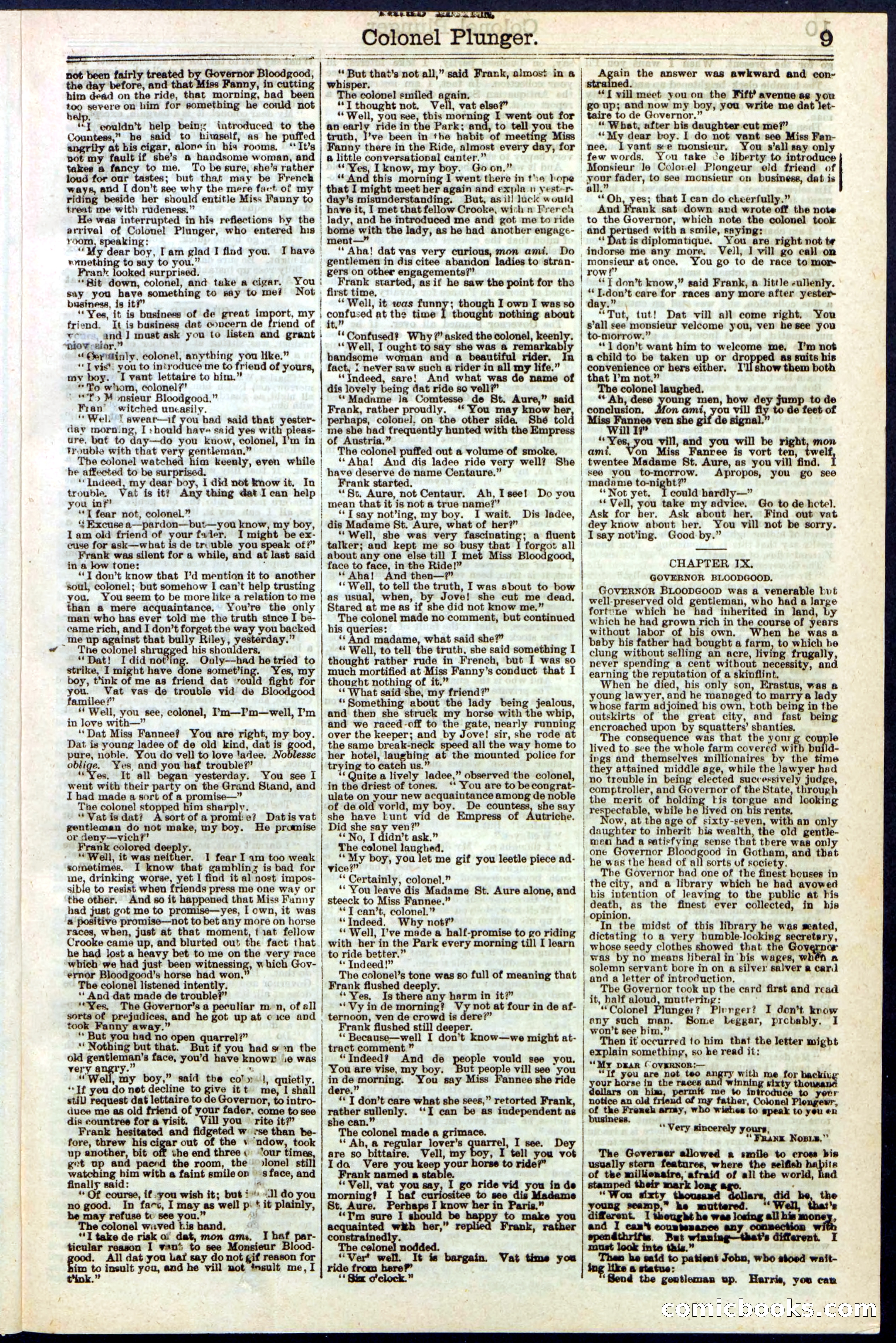
A restored page from Pulp Fiction, 1882. Page through the whole issue in the reader above.
📄 Transcribed text from this page (OCR, searchable)
Machine-transcribed from the original scan — historical spelling and the odd misread are preserved.
aes A CO Te NTN not been fairly treated by Governor Bloodgood, the day before, and that Miss Fanny, in cutting him dead on the ride, that morning, had been too severe on him for something he conld not help. “y eouldn’t help bein introduced to the Countess," he said to himself, as he puffed at his cigar, alone in bis rooms. ‘It’s pot my fault if she’s a handsome woman, and takes a fancy to me. To be sure, she’s rather loud for our tastes; but that may be French ways, and [ don’t see why the mere fact of my riding beside her should entitle Miss Fanny to treat me with rudeness.” He was interrupted in his reflections by the | arrival of Colonel Plunger, who entered his room, speaking: “My dear boy, Tam glad I flad you. I have vamething to say to you.” Prank looked surprised. “Rit down, colonel, and take a cigar. say you have something to say to mef business, is it?” You ‘Yes, it is business of de great im ve and J] must ask you to listen and grant “niov -sior.” “ Gerainly, colonel, anything Pe like.” ‘* T vis'| you to introduce me to fr my boy. I vant lettaire to him.” “To whom, colonel?’ | "Po M msieur Bloodgood.” Fran’ witched uncasily. Wel. | swear—if eal had said that yester- day morning, I :hould have said yes with pleas- ure, bat to day—do you know, colonel, I’m in trouble with that very gentleman.” The colonel watch him keenly, even while he affected to be surprised. trouble. Wat is itt Any thing dat I can help you inf’ “T fear not, colonel.” ‘“{ Excuse a— I am old friend of your failer. I mig euse for ask—what is de tr.uble you Frank was silent for a while, and at last said in a low tone: ‘ “I don’t know that I’d mention it to another soul, colonel; but somehow I can’t help trusting you, You seem to be more like a relation to me than a mere acquaintance. You're the only man who has ever told me the truth since I be- came rich, and I don’t forget the way you backed me up against that bully Riley, * Pause 2 The colonel shrug ed his shoulders, “Dat! I did not ng. Only—had he tried to strike, I might have done someting. Yes, my boy, tink of me as friend dat ould fight for you. Vat vas de trouble vid de Bloodgood familee?’ ‘Well, you see, colonel, ’m—P’m—well, ’m in Jove with—” ‘*Dat Miss Fannee? You are right, my boy. Dat is young ladee of de old kind, dat is good, pure, noble. You do vell to love 'adee. No obi ge. Yes, and you haf trouble?’ ‘Yes. It all began yesterday. You see I went with their party on the Grand Stand, and I had made a sort of a promise—” The colonel sem him sharply. “Vatis dat? A-sortofapromi:e? Datis vat gentleman do not make, my boy. He prumise or deny—vich?” Frank colored deeply. “Well, it was neither. I fear I am too weak sometimes. I know that gamblinz is bad for me, drinking worse, yet I find it al nost impos- sible to resist when friends press me one way or the other. And so it happened that Miss Fanny had just got me to promise—yes, [ own, it was a positive promise—not to bet any more on horse races, when, just at that moment, t rat fellow Crooke came up, and blurted out the fact that he had lost a heavy bet to me on the very race which we had just been witnessing, which Gov- ernor Bloodgood’s horse bad won. The colonel listened intently. ‘‘ And dat made de trouble?” ‘“Yes, The Governor’s a peculiar mn, of all sorts of prejudices, and he got up at c ice and took Fanny away.” ‘* But you had no open quarrel?” ‘Nothing but that. But if you had 2 the old gentleman's face, you’d have knowr 1¢ was very ongty on “Well, my boy,” said the co’» 1, quietly. “If yeu do net decline to give itt me, | shall stil’ request dat lettaire to de Governor, to intro- duee me as old friend of your fader, come to see dis countree for a visit. Vill you rite it?” Frank hesitated and fidgeted w: rse than be- fore, threw his cigar out of the + ndow, took up another, bit the end three« ‘our times, get up and paced the room, the lone! still watching him with a faint smileon sface, and finally said: “Of course, if.yvou wish it; but ' —1l do you no good. In facc, I may as well p\ * it plainly, he may refuse tv see you.” wu me tink.” ex- All dat you Lat say do not insult you, and he vill not ‘nsult me, I ; Not : first time. ort, my | confused at the time friend. It is business dat @ouocern de friend of | it,” ' ‘ . eo iio ball Colonel Plunger. * But that’s not all,” said Frank, almost in a whisper. The colonel smiled again. “TI thought not. Vell, vat else?” “Well, you see, this morning I went out for an early ride in the Park; and, to tell you the truth, ]’ve been in the habit of meeting Miss Fanny there in the Ride, almost every day, for a little conversational canter.” “Yes, [know, my boy. Goon.” “ And this morning 1 went there in the hope that I might meet her again and expla n yeste-r- day’s misunderstanding. But, asi!) luck would | have it, I met that fellow Crooke, wich a Prerch lady, and he introduced me and got me to ride home with the lady, as he had another engage- ment—” ‘Aha! dat vas very curious, mon ami. Do gentlemen in dis citee abandon ladies to stran- gers on other engagements?” Frank started, as if he saw the point for tho “Well, it was funny; though I own I was so thought nothing about “Confused? Why?’ asked the colonel, keenly. ‘“Well, I ought to say she was a remarkably handsome woman and a beautiful rider. In eed, sare! And what was de name of dis lovely being dat ride so vell?” **Madame la Comtesse de St. Aure,” said Frank, rather proudly. ‘‘ You may know her perhaps, colonel, on the other side. Shé told me she had frequently hunted with the Empress of Austria.” The colonel puffed out a volume of smoke. ‘“‘Aha! And dis ladee ride very well? She iend of yours, aaa i never saw such a rider in all my life.” “a n _ have deserve de name Centaure.” ‘Indeed, my dear boy, I did not know it, In | | Frank started. “Sc. Aure, not Centaur. ; mean that it is not a true name?” rdon—but—you ena bag Ba | dis Madame St. Aure, what of her?” speak off’ | talker; and kept me so b | ’ a TL a ‘I say not’ing, my boy. I wait. Dis ladee, ‘Well, she was very rreates ome that I forgot all about any one else till I met Miss Bloodgood, face to face, in the Ride!” ** Aha! And then—?” ‘Well, to tell the truth, I was about to bow as usual, when, by Jove! she cut me dead. Stared at me as if she did not know me.” The colonel made no comment, but continued his queries: “And madame, what said she?” “‘ Well, to tell the truth, she said something I thought ratber rude in French, but I was so much mortified at Miss Fanny’s conduct that I thought nothing of it.” ‘* What said she, my friend?” ‘Something about the lady being jealous, and then she struck my horse with the whip, and we raced-off to the gate, nearly running over the keeper; and by Jove! sir, she rode at the same break-n speed all the way home to her hotel, laughing at the mounted police for trying to catch us.” ‘‘ Quite a lively ladee,” observed the colonel, in the driest of tones. ‘* You are to be congrat- ulate on your new acquaintance among de noble of de old vorid, my boy. De countess, she say she have Lunt vid de Empress of Did she say ven?” ‘* No, I didn’t ask.” The colonel laughed. **My boy, you let me gif you leetie piece ad- vice?” ‘* Certainly, colonel.” ‘You leave dis Madame St. Aure alone, and steeck to Miss Fannee.” “*T can’t, colonel.” ‘“Indeed. Why not?” ** Well, I’ve made a half-promise to go riding with her in the Park every morning till I learn to ride better.” ‘** Indeed!” The colonel’s tone was 80 full of meaning that Frank flushed deeply. ‘Yes. Is there any harm in it?” ‘Vy in de morning? Vy not at four in de af- ternoon, ven de crowd is dere?” Frank flushed still deeper. ** Because—well I don’t know—we might at- tract comment.” “Indeed? And de You are vise, my boy. But eng a see you in de morning. You say Miss nee she ride re. ‘* T don’t care what she sees,” retorted Frank, rather sullenly. ‘‘I can be as independent as she can.” The colonel made a grimace. ‘‘ Ah, a regular lover’s quarrel, I see. Dey are so bittaire. Vell, my boy, I tell you vot Ida Vere you keep your to ride?” Frank named a stable. ‘Vell, vat you say, I ride vid you in de morning? 1 bat curlosites ito 00 dis Madame “I'm sure I should be to make ted with her,” Frank, con f ives well. Tt te bargain, Vat tins , w oa ride from here?’ 4 “" Bier o'clock.” ple vould see you. Ah, I see! Do vou | Autriche. | : and i ee = the answer was awkward and con- “{ vill meet you on the Fift? avenne as you go up; and now my boy, you write me dat let- taire to de Governor.” “ What, after bis daughter cut me?’ ‘‘My dear boy. I do not vant see Miss Fan- nee. Ivant se monsieur. You s’all say only few words. You take Je liberty to introduce Monsieur le Colonel Plongeur eld friend of — fader, to see monsieur on business, dat is a ““Oh, yes; that I can do cheerfully.” And Frank sat down and wrote off the note to the Governor, which note the colonel took rused with a smile, saying: t is diplomatique. You are right not te indorse me any more. Vell, 1 vill go call on monsieur at once, You go to de race to mom ‘“*{ don’t know,” said Frank, a little eullenty. ‘ I-don’t care for races any more after yester- ay.” “Tut, tut! Dat vill all come right; You s’all see monsieur velcome you, ven he see you to-niorrow.” **] don’t want him to welcome me, I’m not a child to be taken up or dropped as suits his convenience or hers either. Ill show them both that I’m not.” The colonel laughed. ‘““Ah, dese young men, how dey jump to de vill fly to de feet of al. * ou vill, and will be right, mon ami. on Miss Santer is vort tet, teed twentee Madame St. Aure, as you vill find, I see you to-morrow. Apropos, you go see | madame to-night?’ ’ a fluent | I say not’ing. Good by.” | | | | could rene 3 Set ‘* Vell, you take my advice. Go to de hetel. Ask for ber. Ask about her. Find out vat dey know about ber. You vill not be sorry. “Not yet. CHAPTER IX, GOVERNOR BLOODGOOD. GOVERNOR BLOODGOOD was a venerable but well-preserved old gentleman, who had a large fortrne which he had iuherited in land, by which he had grown rich in the course of years without labor of his own. When he was a baby his father had bought a farm, to which he clung without selling an acre, living frugally never spending a cent without necessity, and earning the reputation of a skinflint. When he died, bis only son, Erastus, was a young lawyer, and he managed to marry a lady whose farm adjoined his own, both being in the outskirts of the great city, and fast being encroached upon by squatters’ shanties. The consequence was that the yonrg couple lived to see the whole farm covered with build- ings and themselves millionaires by the time they attained middle age, while the Jawyer had no trouble in being elected successively judge, comptroller, and Governor of the State, through the merit of holding tis tongue and looking respectable, while he lived on his rents, ow, at the age of sixty-seven, with an only daughter to inherit his wealth, the old gentle- men had a satisfying sense that there was only one Governor io in Gotham, and that he was the head of all sorts of society. The Governor bad one of the finest houses in the city, and a library which he had ayowed his intention of leaving to the public at his death, as the finest ever collected, in his opinion, In the midst of this library be was seated, dictating to a very bumble-looking etery, whose seedy clothes showed that the or was by no means liberal in bis wages, when a solemn servant bore in on a silver salver a card and a letter of introduction. Tbe Governor took up the card first and read it, half aloud, muttering: “Colonel Plunger ? Pivrger? I don’t know eny such man. Some Leggar, probably. I won’t see him,” Then it occurred to him that the letter might explain something, so ke read it; 5 . DEAR ¢ ORCS er téy ‘ “If you are no esp, tlh me for hy our horse in the races win ollars permit me to ip rity towwas er, Colonel 2 to speak to yeu en ‘Very sincerely yours, | The Goverser allowed a smile to cross bis eye the features, where the selfish ite ‘afraid of all the world, their mark long sixt did seer a peraecfin ms rifts. Bat wins any : to patient Jobn, who stood wait- ing like a statue: . gentieman up. Harrie, you can notice an ald my of army, who TAKE! OY) (E(0) SHal6@ m 77>