
Pulp Fiction, 1882 · page 10 of 32
Beadle's Dime Library No. 211 — page 10: what you’re looking at
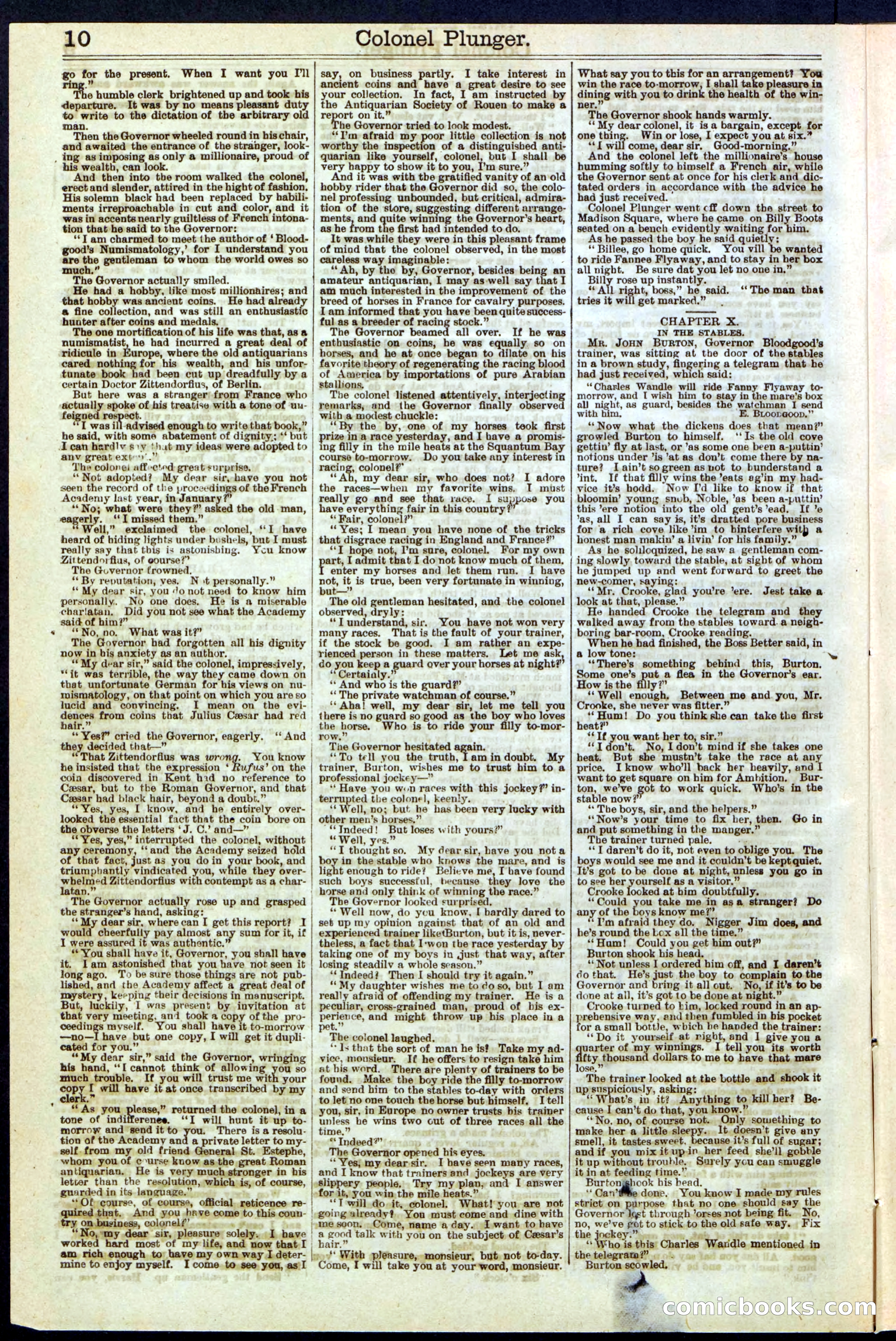
A restored page from Pulp Fiction, 1882. Page through the whole issue in the reader above.
📄 Transcribed text from this page (OCR, searchable)
Machine-transcribed from the original scan — historical spelling and the odd misread are preserved.
10 Colonel Plunger. go for the present. When I want you I'll 16 humble clerk brightened up and took his departure. It was by no means pleasant duty to write to the dictation of the arbitrary old man. Then the Governor wheeled round in his chair, and awaited the entrance of the stranger, look- _ ing as imposing as only a millionaire, proud of e they decided that—” his wealth, can look. And then into tbe room walked the colonel, erect and slender, attired in the hight of fashion, His solemn black had been replaced by habili- ments irreproachable in cut and color, and it was in accents nearly guiltless of French intona- tion that he said to the Governor: ‘*T am charmed to meet the author of ‘ Blood- good’s Numismatology,’ for I understand you are the gentleman to whom the world owes so much,” The Governor actually smiled. He had a hobby, like most millionaires; and that hobby was ancient coins. He had alread @ fine collection, and was still an enthusiastic hunter after coins and medals, The one mortification of his life was that, as a numismatist, he had incurred a t deal of ridicule in Europe, where the old antiquarians cared nothing for his wealth, and his unfor- tunate book had been cut up dreadfully by a certain Doctor Zittendorfius, of Berlin. But here was a stranger) from France who | spoke of his treatise with a tone of un- actuall feigned rexpect. I was ill-advised enough to write that book,” | he said, with some abatement of dignity,; * but I can herd!lv s)v that my ideas were adopted to anv great ext)’ .” The colonei aff-e'rd great surprise, ‘“Not adopted? My dear sir, have you not seen the record of the proceedings of the French Academy last year, in Januar ‘*No; what were they?’ asked the old man, eager! . I missed them,” ell,” exclaimed the colonel, *‘I have heard of hiding lights under bushels, but I must really say that this is astonishing. Ycu know Zittendorfius, of eourse?” The Guvernor frowned. ** By reputation, ves. N +t personally.” ** My dear sir, you ’o not need to know him personally. No one does. He is a miserable cbarlatan, Did you not see what the Academy said of him?” ‘No, no. What was it?” The Governor had forgotten all his dignity now in bis anxiety as an author. “* My dear sir,” said the colonel, impressively, “it was terrible, the way they came down on that unfortunate German for his views on nu- logy, on that point on which you areso lucid and convincing. I mean on the evi- Pay py from coins that Julius Cesar had red air.’ ** Yes?” cried the Governor, eagerly. ‘‘ And “That Zittendorfilus was wrong. he insisted that the expression ‘ Rufus’ on the coia discovered in Kent had no reference to Cesar, but to the Roman Governor, and that Cesar had black hair, beyond a doubt.” Yes, yes, I know, and he entirely over- looked the essential fact that the coin bore on the obverse the letters ‘J. C.’ and—” ‘Yes, yes,” interrupted the colonel, without any ceremony, ‘‘and the Academy seized hold of that fact, just as you doin your book, and triumphantly vindicated you, while they over- res Zittendorfius with contempt as a char- D The Governor actually rose up and grasped | the stranger’s hand, asking: Hh dear sir, where can [ get this report? I would cheerfully pay almost any sum for it, if I were assured it was authentic.’ “You shall have it, Governor, you shall have it. Iam astonished that you have not seen it long ago. To be sure those things are not pub- lished, and the Academy affect a great deal of mystery, keeping their decisions in manuscript. But, hickily, I was present by invitation at that very meeting, and took a copy ofthe pro- ceedings myself. You shall have it to-morrow —no—I have but one copy, cated for you.” You know | I will get it dupli- | Cn i | } say, on business partly. I take interest in ancient coins and have a great desire to see your collection. In fact, I am instructed by the Antiquarian Society of Rouen to make a report on it.” he Governor tried to look modest. **T’m afraid my poor little collection is not worthy the inspection of a distinguished anti- quarian like yourself, colonel, but I shall be very happy to show it to you, I’m sure.” And it was with the gratified vanity of an old hobby rider that the Governor did so, the colo- nel professing unbounded, but critical, admira- tion of the store, suggesting different arrange- ments, and quite winning the Governor’s heart, as he from the first had intended to do. It was while they were in this pleasant frame of mind that the colonel observed, in the most careless way imaginable: : “Ah, by the by, Governor, besides being an amateur antiquarian, I may as-well say that I am much interested in the improvement of the breed of horses in France for cavalry purposes. I am informed that you have been quite success- ful as a breeder of racing stock.” The Governor beamed all over. If he was enthusiastic on coins, he was lly. so on horses, and he at once began to dilate on his favorite theory of regenerating the racing blood of America by importations of pure Arabian stallions, The colonel listened attentively, interjectin remarks, and the Governor finally observe with a modest chuckle: ‘‘By the by, one of my horses teok first prize in a race yesterday, and I have a promis- ing filly in the mile heats at the Squantum Bay course to-morrow. Do you take any interest in racing, colonel?” ‘*Ah, my dear sir, who does not? I adore the races—when my favorite wins, I must really go and see that race. I suppose you have everything fair in this country? * Fair, colonel?” “Yes; I mean you have none of the tricks that disgrace racing in England and France?” *‘T hope not, I’m sure, colonel. For my own art, I auimit that I do not know much of them, enter my horses and let them run. I have BOs, it is true, been very fortunate in winning, ut— The old gentleman hesitated, and the colonel observed, dryly: hae understand, sir. You have not won very many races. That is the fault of your trainer, if the stock be good. I am rather an expe- rienced person in these matters. Let me ask, do you keep a d over your horses at night? ‘* Certaialy.’ ** And who is the guard?” “The private watchman of course.” ‘* Aha! well, my dear sir, let me tell you there is no guard so good as the boy who loves the horse. Who is to ride your filly to-mor- row,” The Governor hesitated ‘‘To tell you the truth, lamindoubt. My trainer, Burton, wishes me to trust him to a professional jockey—” ‘Have you win races with this jockey?’ in- terrupted the colonel, keenly. : ‘* Well, no; but be has been very lucky with other men’s horses,” **Indeed! But loses with yours?” “Well, yes.” “T thought so. My dear sir, have you nota boy in the stable who knows the mare, and is light enough to ride? Believe me, I bave found such boys successful, because they love the | horse and only think of winning the race.” ' “My dear sir,” said the Governor, wringing | his hand, “I cannot think of allowing much le. If you will trust me with your co have it. at once transcribed by my As you ” returned the colone}, in a tone of indifferenee. “I will hunt it up to- morrow and send it to Spe There is a resolu- tion of the Academy and a private letter to my- self. from my old friend General. St. Estephe, whom you of curse know asthe great Roman antiquarian. is very much stronger in his letter than the reeglution whieh-is,.of course, guarded in its language.” : ed that. —" - have come to this coun- . 4 DUs CS: aaa RAs « =“Fueco | : I des pleasure solely. I have | work most of ie oes § e ou so | | ; ; | | hair.” lo of With The Governor looked surprised, ** Well now, do you know, [ bardly dared to seb up my opinion against that of an old and experienced trainer liketBurton, but it is, never- theless, a fact that I-won the race yesterday by taking one of my boys in ,just that way, after losing steadilv a whole season.” **Indeed? Then I should try it again.” “My cor! a9) wishes me to doso, but I am really afraid of offending my trainer. He is a peculiar, cross-grained man, proud of bis ex- ies and might throw up his place in a The colonel laughed. “* Is that the sort of man he is? Take my ad- vice, mousieur. If he offers to resign take him at his word. There are plenty of trainers to be found. Make the boy ride the filly to-morrow and send him to the stables to-day with orders to let no one touch the horse but himself, I tell you, sir, in Europe no owner trusts bis trainer unless he wins two cut of three races all the time.” | * Indeed?” » D The Governor opened his eyes. “Yes; my dearsir. I have seen many races, and I know that trainers and jockeys are very slippery people, Try my plan, and I answer aan dnid ont win the mile heats.” will do-it, colonel, What! you are not L | going already? Yon must come and dine with ne soon, Come, n e aday. Iwant to have a good talk with you on the subject. of Ceesar’s pleasure, monsieur, but not to-day. epecenh to have my own way I deter- mine to enjoy myself. I come. to,see, you, as'\I_ Come, I will take you at your’word, monsieur. What say you to this for an arrangement? You win the race to-morrow, I shall take pleasure in dining with you to drink the health of the win- ner. The Governor shook hands warmly. **My dear colonel, it is a bargain, except for one thing. Win or lose, I expect you at six.” ‘**[ will come, dear sir. Good-morning.” And the colonel left the millionaire’s house humming softly to himself a French air, while the Governor sent at once for his clerk and dic- tated orders in accordance with the advice he had just received. Colonel Plunger went cff down the street to Madison Square, where he came on Billy Boots seated on a bench evidently waiting for him. As he passed the boy he said quietlys ** Billee, go home quick. You vill be wanted to ride Fannee Flyaway, and to stay in her box all night. Be sure dat you let no one in,” Billy rose up instantly. , All right, boss,” he said. ‘‘ The man that tries it will get marked.” CHAPTER X. IN THE STABLES. Mr. JoHN Burton, Governor Bloodgood’s trainer, was sitting at the door of the stables in a brown study, fingering a telegram that he had just received, which said: “Charles Wandle will ride Fanny Flyaway to- morrow, and I wish him to stay in the mare’s box all nigh, as guard, besides the watchman I send with him, E. BLoongoop.” “Now what the dickens does that mean?” growled Burton to himself. ‘' Is the old cove gettin’ fly at last, or ’as some one been a-puttin’ notions under ’is ’at as don’t come there by na- ture? Lain’t sogreen as not to bunderstand a ‘int. If that filly wins the ’eats ag’in my had- vice it’s hodd. Now Id like to know if that bloomin’ young snub, Noble, ’as been a-puttin’ this ’ere notion into the old gent’s’ead. If ’e ‘as, all I can say is, it’s dratted pore business for a rich cove like’im to hinterfere with a honest man makin’ a livin’ for his family.” As he soliloquized, he saw a gentleman com- ing slowly. toward the stable, at sigbt of whom he jumped up and went forward to greet the new-comer, keying: ad you're ’ere. Jest take a ‘*Mr. Crooke, g look at that, please.” He handed Crooke the telegram and they walked away from the stables toward. a neigh- boring bar-room, Crooke reading. When he had finished, the Boss Better said, in a low tone: ‘‘There’s something bebind this, Burton, Some one’s a flea in the Governor’s ear. How is the filly?” ‘Well enough, Between me and. you, Mr. Crooke, she never was fitter.” ‘Hum! Do you think she can take the first heat?” **Tf you want her to, sir.” ‘‘T don’t. No, Idon’t mind if she takes one heat. But she mustn’t take the race at any price. I know who'll back her heavily, and want to get square on him for Ambition, Bur- ton, we’ve got to work quick. Who's in the stable now? “The boys, sir, and the helpers.” ‘‘Now’s your time to fix her, then. Go in and put something in the manger.” The trainer turned pale. - ‘*T daren’t do it, not even to oblige you. The boys would see me and it couldn’t be kept quiet. It’s got to be done at night, unless you go in to see her yourself as a visitor.” Crooke looked at bim doubtfully. . ‘‘Could you take me in asa stranger? Do any of the boys know me?” ; “I'm afraid they do. Nigger Jim does, and he’s round the Lox all the time.” ‘‘Ham! Could you get him out?” Burton shook his h ‘‘ Not unless I ordered him off, and I daren’t do that. He’s just the boy to complain to the Governor and bring it all out. No, if it’s to be done at all, it’s got to be done at night.” . Crooke turned to him, locked round in an ap- prebensive way, and then fumbled in bis pocket for a small bottle, which be handed the trainer: ‘Do it yourself at right, and I give you a uarter of m viene. I tell you its worth ty, thousand dollars to me to have that mare The trainer looked at the bottle and shook it up suspiciously, asking: . ..», ur “What's in it? Anything to kill her? Be- cause I can’t do that, you know.” ‘**No, no, of course not. Only sowething to make her a little sleepy. It. doesn’t give any smell, it tastes. sweet, because it’s full of s ; and if you mix it upin_her feed she'll gobble it up without trouble. Surely you can smuggle it in at feeding time.” a cane Burtonjghook his head. ae? “ Can done. You know I made my rules strict on purpose that no one. should say the Governor Igt through ’orses not being, fit... No, no, we’ve prot to stick to the old safe way. Fix the jockey.” we ele Yo Sah - ” ; Who is this” Charles Waridle mentioned in e 78.0 Var tal gor hoo Burton scowled, » 5 AMGLeeve) G S (E(©)