
Pulp Fiction, 1882 · page 20 of 32
Beadle's Dime Library No. 211 — page 20: what you’re looking at
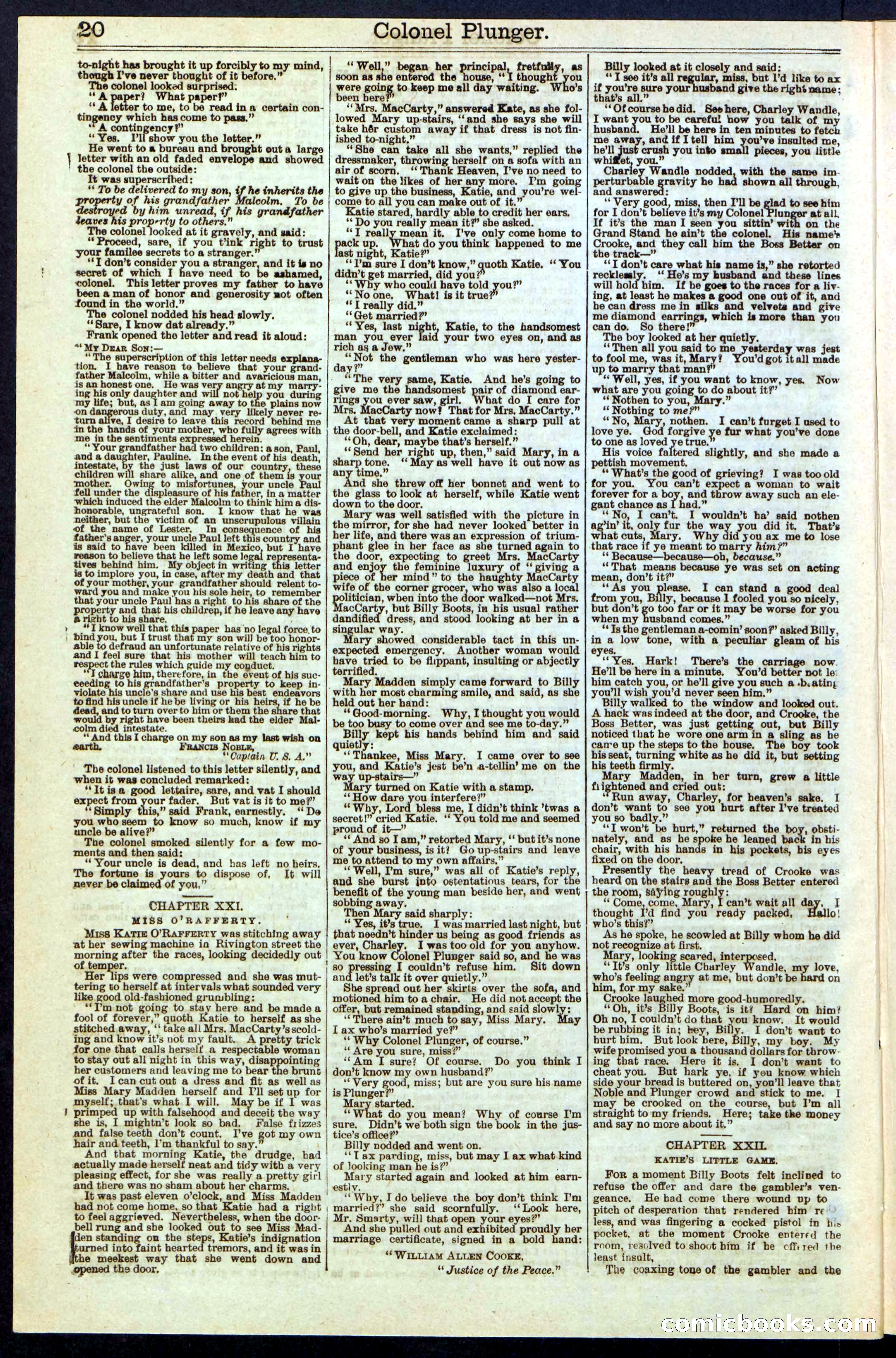
A restored page from Pulp Fiction, 1882. Page through the whole issue in the reader above.
📄 Transcribed text from this page (OCR, searchable)
Machine-transcribed from the original scan — historical spelling and the odd misread are preserved.
? i | The colonel listened to this letter silently, and Colonel Plunger. to-night has brought it up forcibly to my mind, | though I’ve never thought of it before.” The colonel looked surprised. el r? What paper?” “A RB fe. to be read in 6 certain con- tingency which has come to pass. PA eg gee = “Yes. I'll show you the letter.” He went to a bureau and brought outa large letter with an old faded envelope and showed the colonel the outside: It was superscribed: ** To be delivered to my son, if he inherits the aroperty of his grandfather Malcolm. To be ‘d by him unread, if his grandfather deaves his proprrty to others,” The colonel looked at it gravely, and said: % eed, sare, if you t’ink right to trust your familee secrets to a stranger. “*T don’t consider you a stranger, and it is no secret of which I have need be ashamed, colonel. This letter proves my father to have been a man of honor and generosity mot often found in the world.” The colonel nodded his head slowly. “‘Sare, I know dat already.” Frank opened the letter and read it aloud: “IIe pep eneecty lion Cea ‘lett explana “The supe ption of this letter needs - tion, I have reason te believe that your grand- father Malcolm, while a bitter and avaricious man, isan honest one. He was very angry atmy marry- ing his only daughter and will not help you during my life; b am going away to the plains now on rous duty, and may very likely never re- turn alive, I desire to leave this record behind me in the hands of your mother, who fully agrees with me in the sentiments expressed herein. ** Your grandfather two children: a son, Paul, and a daughter, Pauline. Inthe event of his death, intestate, the just laws of our country, these children will share alike, and one of them our mother. Owing to misfortunes, your uncle Paul fell under the pleasure of his f er, in a matter which induced the elder Malcolm to think him a dis- honorable, ungrateful son. I know that he was neither, but the victim of an unscrupulous villain of the name of Lester. In consequence of his father's anger, your uncle Paul left this country and is said to have been killed in Mexico, but I have reason to believe that he left some legal representa- tives behind him. My object in writing this letter is toimplore you, in case, after my death and that of your mother, your grandfather should relent to- ward you and make you his sole heir, to remember Dcoperty and that bis chiltiren, ithe leave aay hare roperty an i , if he leave a ve “TI know well that this paper has no legal force. to bind you. but I trust that my son wil] be too honor- able to defraud an unfortunate relative of his rights and I feel sure that his mother will teach him to ie the rules which guide my cogduct. “TI charge him, therefore, in the évent of his suc- ceeding to his dfather’s property to keep in- violate his uncle's share and use his best endeavors to find his uncle if he be living or his heirs, if he be dead, and to turn over to him or them the share that would by right have been theirs had the elder Mal- colm died intestate. “* And this I charge on my son as my last wish on earth. Francis N OBLE, “Oaplain U. 8. A.” when it was concluded remarked: “It isa good lettaire, sare, and vat I should expect from your fader. But vat is it to me?’ **Simply this,” said Frank, earnestly. ‘ De you who seem to know so much, know if my uncle be alive?” The colonel smoked silently for a few mo- ments and then said: “Your uncle is dead, and has left no heirs, The fortune is ery to dispose of, It will never be claimed of you,” CHAPTER XXI. MISS O’RAFFERTY. Miss Katie O’RaFFerty was stitching away at her sewing machine io Rivington street the morning after the races, looking decidedly out of temper. Her lips were compressed and she was mut- tering to herself at intervals what sounded very like good old-fashioned grumbling: **T’m not going to stay here and be made a fool of forever,” quoth Katie to herself as she stitched away, ‘‘ take all Mrs. MacCarty’s scold- ing and know it’s not my fault. A pretty trick for one that calls herself a respectable woman to stay out all night in this way, disappointing her customers and leaving me to bear the brunt of it. Ican cutout a dress and fit as well as Miss Mary Madden herself and I'll set up for myself; that’s what I will. May be if 1 was ped up with falsehood and deceit the way she is, I mightn’t look so bad. False frizzes and false teeth don’t count. I’ve got my own hair and teeth, I’m thankful to say. And that morning Katie, the drudge, had actually made herself neat and tidy with a very pleasing effect, for she was really a pretty girl and there was no sbam about her charms. It was past eleven o’clock, and Miss Madden ' bad not come home, so that Katie had a right , to feel aggrieved. Nevertheless, when the door- Ben Steitting om the tape Malis tedignation ns on the steps, e’s indignation urned into faint ueavied ttimiers, and it was in e meekest way that she went down and pened the door, “* Well,” an her principal, fretfully, as soon as she entered the ouse, “ft thought you were going to keep me all day waiting. Who's been here?” ‘Mrs. MacCarty,” answered Kate, as she fol- lowed Mary up-stairs, ‘‘and she says she will take hér custom away if that dress is not fin- ished to-night,” “She can take all she wants,” replied the dressmaker, throwing herself on a sofa with an air of scorn. ‘‘ Thank Heaven, I’ve no need to wait on the likes of herany more. I’m goin to give up the business, Katie, and you’re wel- come to all you can make out of it.” Katie stared, hardly able to credit her ears, **Do you really mean it?’ she asked. “TI really mean it. I’ve only come home to ck up. hat do you think happened to me ast night, Katie?” *’m sure I don’t know,” quoth Katie. ‘ You didn’t get married, did you? ‘Why who could have told your “Noone, What! is it true?” “‘T really did.” ‘*Get married?” “Yes, last ry man you ever id rich ag a Jew,” : ore the gentleman who was here yester- ay “The very same, Katie. And he’s going to give me the handsomest pair of diamond ear- rings P habe ever saw, girl. hat do I care for Mrs. MacCarty now? That for Mrs. MacCarty.” At that very moment came a sharp pull at the door-bell, and Katie exclaimed: **Oh, dear, maybe that’s herself.” “Send her right up, then,” said Mary, in a sharp tone. ‘‘ May as well have it out now as any time.” nd she threw off her bonnet and went to the glass to look at herself, while Katie went down to the door. Mary was well satisfied with the picture in the mirror, for she had never looked better in her life, and there was an expression of trium- phant glee in her face as she turned again to the door, expecting to greet Mrs. MacCarty and enjoy the feminine luxury of “ giving a piece of her mind” to the haughty MacCarty wife of the corner grocer, who was also a local litician, when into the door walked—not Mrs. acCarty, but Billy Boots, im his usual rather dandified dress, and stood looking at ber in a gue way. ary showed considerable tact in this un- expected emergency. Another woman would have tried to be flippant, insulting or abjectly terrified. Mary Madden simply came forward to Billy with her most charming smile, and said, as she held out her hand: “Good-morning. Why, I thought you would be too busy to come over and see me to-day.” ae kept his hands behind him and said uietly: i ‘‘Thankee, Miss Mary. I came over to see you, and Katie’s jest be’n a-tellin? me on the wey up-stairs—” y turned on Katie with a stamp. Katie, to the handsomest your two eyes on, and as ‘* How dare you interfere?” “Why, Lord bless me, I didn’t think ’twas a secret!” cried Katie. “‘ You told me and seemed proud of it—” ** And so Iam,” retorted Mary, ‘‘ but it’s none of your business, is it? Go up-stairs and leave me to attend to my own affairs,” ‘Well, I’m sure,” was all of Katie’s reply, and she burst into ostentatious tears, for the benefit of the young man beside her, and went sobbing away. Then Mary said sharply: es, I was married last night, but that needn’t hinder us being as good friends as ever, Charley, I was too old for you anyhow. You know Colonel Plunger said so, and he was 80 prate I couldn’t refuse him. Sit down and let’s talk it over quietly.” She spread out her skirts over the sofa, and motioned him toa chair. He did not accept the offer, but remained standing, and said slowly: ‘There ain’t much to say, Miss Mary. ay I ax who’s married ye?” ‘* Why Colonel Plunger, of course.” ‘“‘ Are you sure, miss?” ‘‘Am I sure? Of course. Do you think I don’t know my own husband?’ ‘Very , miss; but are you sure his name is Plunger?” Mary started. “What do you mean? Why of course ’m sure. Didn’t we both sign the book in the jus- tice’s office?” Billy nodded and went on. . ‘*T ax parding, miss, but may I ax what kind of looking om, is?” Mary started again and looked at him earn- estiy. ‘*Why, I do believe the boy don’t think I’m married?” she said scornfully. ‘‘ Look here, Mr. Smarty, will that open your eyes?” And she pulled out and exhibited proudly her marriage certificate, signed in a bold hand: ‘WILLIAM ALLEN COOKE, ** Justice of the Peace.” a Billy looked at it closely and said: “*T see it’s all lar, miss, but I’d like to ax if you're sure your Seabed give the right name; that’s all.” ‘Ofcourse hedid. Seehere, Charley Wandle, I want Pha to be careful how you talk of my husband. He’ll be here in ten minutes to fetch me ona and if I tell him you've insulted me, hee crush you into saiall pieces, you little whiffet, you.” Charley Wandle nodded, with the same im- perturba ra RERNAEY he had shown all through, and answered: “Very good miss, then I'll be glad to see him for I don’t believe it’s my Colonel Plunger at all. If it’s the man I seen you sittin’ with on the Grand 8tand he ain’t the colonel. His name's Crooke, and they call him the Boss Better on the track—” “*T don’t care what his name is,” she retorted recklessly. ‘‘ He’s my husband and these lines will hold him. If be goes to the races for a liv- ing, at least he makes a good one out of it, and he can dress mein silks and velvete and give me diamond earrings, which is more than you can do. So there! The boy looked at her quietly. “Then all you said to me poor was jest to fool me, was it, Mary? You’dgot itall made up to marry that man?” “Well, yes, if you want to know, yes. Now what are you going to do about it?’ ‘“* Notben to you, a ** Nothing to me?” “No, Mary, nothen. I can’t furget I used to love ye. God forgive ye fur what you’ve done to one as loved ye true.” His voice faltered slightly, and she made a pettish movement, ‘* What’s the good of grieving? I was tooold for you. You can’t expect a woman to wait forever for a boy, and throw away such an ele- gant chance as | had.” ‘* No, I can’t. I wouldn’t ha’ said nothen ag’in’ i only fur the wer P bt did it. That’s what cuts, Mary. Why did you ax me to lose that race if ye meant to marry him?” ‘* Because—because—oh, because.” “That means because ye was set on acting mean, don’t it?” ‘*As you please. I can stand a good deal from you, Billy, because 1 fooled you so nicely, but don’t go too far or it may be worse for you when my husband comes.” ** Ts the gentleman a-comin’ soon?” asked Billy, in a low tone, with a peculiar gleam of his eyes, ‘‘'Yes, Hark! There’s the carriage now. He’ll be here in a minute. You’d better not le: him catch you, or he'll give you such a -b.ating you'll wish you’d never seen him.” Billy walked to the window and looked out. A hack was indeed at the door, and Crooke, the Boss Better, was just getting out, but Billy noticed that he wore one arm in a sling as he came up the steps to the house. The boy took his seat, turning white as he did it, but setting his teeth firmly. me ee ary Madden, in her turn, grew a fiightened and cried out: “Run away, Charley, for heaven's sake. I don’t want to see you hurt after l’ve treated you so badly.” “‘T won’t be hurt,” returned the boy, obsti- nately, and as he spoke he leaned back in bis chair, with his hands in his pockets, bis eyes fixed on the door. Presently the heavy tread of Crooke was heard on the stairs and the Boss Better entered the room, saying roe y be ore See ** Come, come, Mary, thought I’d find you ready packed, lo! who’s this?” As he spoke, he scowled at Billy whom he did not recognize at first. Mary, tg | scared, interposed. “It’s only little Churley Wandle, m who’s feeling angry at me, but don’t be him, for my sake.’ Crooke peg more good-humoredly, “Oh, it’s Billy Boots, is it¢ Hard on him? Oh no, I couldn’t do that be rubbing it in; hey, Bi i I don’t want to burt him. But look bere, Billy, my boy. My wife promised you a thousand dollars for throw- ing that race. Here it is. I don’t want to cheat you. But hark ye, if you know which side your bread is buttered on, you'll leave that Noble and Plunger crowd and stick to me. | may be crooked on the course, but I’m all straight to my friends. Here; take the money and say no more about it,” love, on ou know. It would CHAPTER XXIL KATIE’S LITTLE GAME. For a moment Billy Boots felt inclined to refuse the offer and dare the gambler’s ven- geance. He had come there wound vp to pitch of desperation that rendered him re less, and was fingering a cocked pistol in his pocket, at the moment Crooke entered the room, resolved to shoot him if he cffired the least insalt, The coaxing tone of the gambler and the MIEOOOLKS (E(©) (Eo) EE Oe